

EU politics: what is the point?
Monday 28 January 2013
By any measure, he is not exactly an impartial commentator on the EEA, especially as he is on the record as an active advocate of Norwegian membership of the EU, and author of "Ten Theses on the EU and Norway", in late 2003, containing arguments for Norwegian membership as soon as possible. Asking him, therefore, for his views on the utility of Britain leaving the European Union and adopting the Norway Option of EEA membership is about as productive as would have been interviewing Adolf Hitler in 1936 about the positive contribution of Jews to German civil society. What then is the point of the moronic Dermot Murnaghan of Sky News interviewing the man? What possible value to the debate does he offer, especially when the man is lying through his teeth, declaring, "We don't have any influence on the rules that affect us"? COMMENT THREAD Richard North 28/01/2013 |
EU politics: the irrelevance of the EU
Monday 28 January 2013

A little while ago, I wrote that we have to confront the prospect that there is an alarming number of people who lack the basic understanding of how the global and regional regulatory system works.
We can add to that number Wolfgang Münchau, the doyen's doyen who, today in the Financial Times, adds to the sum of human ignorance by declaring that, "If you are outside the EU, but inside the EEA, you have no vote on single-market policies. Norway and Iceland have to accept whatever the EU decides". That, of course, is not true, not least because of the "veto" or "right of reservation" – set out in Article 102 of the EEA Agreement – to say nothing of being misleading, as both countries have considerable upstream influence that enable them to shape standards before they get to the EU voting stage. Notwithstanding these little gripes, though, Münchau is beginning to ask the right questions, asserting that the benefits of the single market are "vastly exaggerated". They will in the longer term be subsumed by free trade agreements and, in particular, a transatlantic free-trade area incorporating the EU and the United States. This has been something of a hobby-horse of the Financial Times and they are perhaps being more than a little over-optimistic if they believe that the agricultural systems each side of the Atlantic can be harmonised sufficiently to create a level playing field which would permit free trade. With massive understatement, therefore, Münchau casually asserts that "hammering out" a treaty "would not be easy" but he is confident that even if Britain were outside the EU, it would without a doubt be a member of such a zone. Thus, in his book, "there can be no question of it being cut off from trade". There, Münchau goes a little bit wobbly, as he asserts that, outside he EU, "the UK would still be a member of the European Economic Area". That is not strictly true. It could not happen without the UK joining EFTA and with amendments to the EEA Agreement. Further, he has not caught up with the reality of the relationship of EEA countries with the EU, but there is hope yet. While asserting that there would a "perceived loss of political power", which would be "unacceptable to the UK", he then says: "the argument misjudges the extent to which the UK can negotiate the terms of exit". Article 50, declares Münchau, "makes it possible for countries to depart, but leaves the details to the negotiating parties". Then we get to the "killer point". Faced with the combined development of a eurozone economic union (which we cannot join) and a transatlantic free-trade zone, the added benefit of EU membership loses appeal if most of that benefit can be had outside". Thus we are told: "If one is absolutely certain that one will never join the eurozone, there really is not much of a point to being a member of the EU". Münchau is not quite there yet, but with or without a transatlantic free trade area, we are seeing the convergence of global rules, with – as Booker points out - supra-regional standard-setting which makes the EU increasingly irrelevant. That the doyen of all doyens is nevertheless asking about the relevance of the EU to Britain is good news. Once that question is asked, the politicians will find it increasingly difficult to give an honest answer, and we will be on our way out. Article 50 beckons. COMMENT THREAD Richard North 28/01/2013 |
EU politics: a picture of ignorance
Monday 28 January 2013
 Notwithstanding the fact that we are net contributors to the EU budget, and could afford to take up the EU-funded programme and still save money, the man is talking out of his posterior. It is not necessary to be in the EU to take part in EU research programmes. The evidence for this is our old friend Norway, which takes a very active part in the programme, without being a member of the EU. Thus, through the Research Council of Norway, it participates in the Seventh Framework Programme. So far, it has been involved in 1,139 projects, contrasting with Ireland with about the same population, which has roughly the same input. Despite being an EU member, it participates in only 1,079 projects. Furthermore, we are told that: Norway has long traditions in participating in EU RTD actions. It first started in 1987 on a programme level. The EEA agreement (from 1.1.1994) gives Norway full rights and obligations in the framework programmes. Norway's participation in EU Framework Programmes has resulted in a research community that is far more engaged than before, both in European research collaboration and as a participant taking responsibility for structuring and internationalising Norwegian research.Additionally, Norway is also part of the European Research Area, and of COST (European Cooperation in the Field of Scientific and Technical Research), and of the European Science Foundation (ESF). A very detailed evaluation of the participation is here, from which we learn that there is a payment made for participation, amounting in 2010 to £142 million, accounting for nearly 80 percent of Norway's £179 million contribution to the EU budget. However, it certainly gets value for money. Norway is also actively involved in policy co-ordination activities outside the framework programme (FP). It has participated as observer in European Research Area Committee (ERAC) meetings, dealing with financial co-ordination outside of the FP and the development of better framework conditions for research in Europe (mobility, careers, intellectual property and so on). ERAC will likely be the platform where the European Commission will discuss its plans for ERA-type regulations and directives and seek sufficient support from the Member States before launching anything. Norway participates in ERA-policy committees such as the Strategic Forum for International Science and Technology Co-operation (SFIC), the High Level Group on Joint Programming (GPC), the European Strategy Forum on Research Infrastructures (ESFRI), the Steering Group on Human Resources and Mobility, the Working Group on Knowledge Transfer and the European Rail Research Advisory Council (ERRAC). In the past five years Norway was also invited to participate in the Informal Ministerial Competitiveness Council. Thus although not an EU Member State Norway has actively taken part in policy co-ordination activities. Given the stability of the EEA agreement its role does not have to be renegotiated with each new Framework Programme. So, it would appear that Sir Paul Nurse, the man who thinks that human activity contributes seven times more CO2 to the atmosphere than derives from natural sources such as the oceans, knows as little about the workings of the EU as he does about climate science – unaware that Norway has been in the EU research programme for over 25 years. But that does not stop the legacy media giving him free access to spread his misinformation and propaganda. In that, at least, we are not surprised. It was ever going to be thus. COMMENT THREAD Richard North 28/01/2013 |
Fisheries policy: Mackerel Wars – part II
Monday 28 January 2013
 What is marginally helpful, though, is the headline: "How climate change spells disaster for UK fish industry". Forget the bit about the UK fish industry for the moment, and concentrate on "climate change". Referring again to this briefing note, we find that it is a matter of undisputed record that the mackerel biomass has been moving north, a phenomenon attributed to "climate change", triggered by higher water temperatures which have shifted the food supply, with the fish following the food. Prior to 2008, the bulk of the catch was taken from EU Member States water, from Norway and, to a limited extent by the Faroe Islands, with a small amount also taken by the Russian Federation. Things then changed in 2009 when the mackerel started moving is large numbers into Icelandic waters, and the catches there started to become significant. This gave Iceland status as a "Coastal State" within the NEAFC and a seat at the table when it came to negotiating annual quotas. Here, it starts getting seriously complicated for, within the framework of NEAFC, guided by the UNCLOS and FAO agreements, the body of record for setting upper quota limits is ICES, which in turn is reliant on its scientific research with input from member states. At that time, ICES set the mackerel quota, specified in terms of the "recommended total catch" at 572,000 metric tons. This was not enough to sustain the existing fleets in Norwegian and EU Member State waters. Invoking the NEAFC rules, Norway and the EU thus argued that "track record" should determine the apportionment of the quota and since neither Iceland nor the Faroes had a qualifying record, they were not entitled to any quota. The pair then promptly awarded between themselves a quota that amounted to ten percent more than the total catch recommended by ICES. Faced with this, Iceland and the Faroes felt they had no alternative but to award themselves unilateral quotas, allocating themselves 85,000 and 13,000 metric tons respectively, thus triggering the conflict which remains unresolved to this date. At the heart of this, though – and especially as far as the Faroes were concerned, there was a great deal more at stake than just Mackerel catches – a stock which the Faroese were not equipped to exploit. There were two other issues which were to driving the dispute. Firstly, the much more important issue to the Faroes was their traditional herring fishery, and the blue whiting, these valuable fish inhabiting the waters into which the mackerel had moved. And what Faroese scientists were able to show was an alarming situation. Not only did the two species compete for the same food – largely the zooplankton Calanus finmarchicus - but the biomass of fish in their waters has been close to record high, while the zooplankton has been on a declining trend to a record low, and the blue whiting was declining rapidly. This ties in with the second point where there is a major conflict in fisheries management philosophy between the Faroese and ICES in determining allowable fishing effort. ICES work on the basis of calculating the "Spawning stock biomass" and, by a series of species-specific formulae, then calculating a safe level of human predation – which becomes the recommended catch. On the other hand, the Faroese fisheries management system relies on a far more sophisticated range of measures, rather than using quotas as the control instrument. They aim to balance fishing effort in relation to the ecosystem in which it takes place and, in particular, to keep the fish population in balance with the food supply, a philosophy which has gained powerful scientific support. Thus, where there is a deficiency in food supply for a fish stock, be it because of industrial fishing or natural phenomena, the correct way to deal with it is, counter-intuitively, to increase fishing efforts. And, with their increased mackerel quotas, that is precisely what the Faroese – and the Icelanders in their wake – are doing. The response of the EU has been severe. Reports in Augist 2010 were talking of a "mackerel war" and, as the dispute escalated, on 14 December 2011, the European Commission published a proposal permitting "the use of trade and other types of measures as a means to induce a reduction in the intensity of fishing by third countries allowing non-sustainable fishing". Citing UNCLOS and the UN Fish Stocks Agreement, which they claimed had been breached, the Commission proposed to bypass the EFTA/EEA agreement with Iceland, and with sanctions also applying to the Faroes, prohibit the import of fish and fish products from these territories. The final regulations 1026/2012 were published on 14 November 2012, leading to strident calls fromScottish Fishermen for sanctions to be imposed. For 2012, the dispute had escalated out of all proportion, with the Icelanders having set themselves a mackerel quota of 145,000 tons, and the Faroe Islands setting a massive unilateral quota of 148,375 tons – even though they do not have the facilities to process the fish. As the war of words hotted, Scots mackerel fishermen found their own quotas cut and promptly accused Icelanders of "mugging" them of their catches, "plundering" the stocks and putting their £164-million industry at risk. Scottish fishing minister Richard Lochhead said that "the irresponsible overfishing by Iceland and the Faroes" was putting the viability of the Scottish fleet at risk. And this is where the Observer piece comes in. Since Iceland's banking collapse of 2008 and its subsequent attempts to fish its way out of a crisis, Grimsby has boomed on the back of the surge of fresh white fish from Iceland. If sanctions were to be applied, 70 percent of the UK's fish processing industry, along with Europe's biggest concentration of cold storage facilities, would be at risk, alongside 4,000 jobs. The latest development seems to be a statement from Danish fisheries minister Mette Gjerskov, who has said that it is "quite unlikely" that the European fisheries and maritime affairs commission will approve sanctions against Faroes and Iceland. The fact that Norway and the EU have decided to allocate themselves 90 percent of the total recommended mackerel catch for 2013 means there will probably be little legal ground for sanctions to be approved, Gjerskov said. Ironically, aside from the Faroes and Iceland, the biggest potential loser from this ongoing dispute is the United kingdom, with two dogs in the fight. On the one hand, Scottish fishermen are being affected and, on the other, our fishing processors stand to lose a massive part of their income. Yet, the one nation which is not allowed directly into the talks with the parties involved in the United Kingdom. Outside the EU, we could but, in order to preserve that precious "influence" about which Mr Cameron is so keen, we must allow a Greek politician to make the running from Brussels. And that is yet another benefit of our membership of the EU. COMMENT THREAD Richard North 28/01/2013 |
Fisheries policy: Mackerel Wars – part I
Sunday 27 January 2013

An illustration of just how complicated international relations can become is emerging in real time, as a long-standing dispute over North-east Atlantic mackerel (NEAM) stocks comes to a head, with British ministers meeting fisheries Commissioner Maria Damanaki tomorrow, prior to the Fisheries Council meeting, which will attempt to resolve the dispute.
On the face of it, this is a simple quota dispute between the four main players nations which exploit the stocks, the EU, Norway, the Faroe Islands and Iceland. Historically, the bulk of the quota has been taken by the EU and Norway, but since 2009, Iceland and the Faroes have been demanding a share. As tensions have risen, relations between the parties have broken down with the Faroese being accused of acting like "pirates", Iceland of "greed" and the EU of bullying tactics, while there is talk of a new fish war and trade sanctions. The situation is not helped by the removal of NEAM from the Marine Stewardship Council certification scheme, as no longer qualifying as "sustainable stock", and by the Guardian tendency which has Hugh Fearnley-Whittingstall indulging in the most remarkable piece of wishful thinking, when he grandly declares: … if the countries involved could only agree sensible catch limits this could still be a certified sustainable fishery. The issue could be resolved at a stroke, and we could all go back to eating mackerel again with a clear conscience.While Fearnley-Whittingstall wants to put the problems down to "politics and greed", which "are getting in the way of common sense", we have here a fiercely complex issue, on four different levels – politics, commerce, science and the environment itself – all of which are intermixed. If the magic wand of "common sense" could be waved, that would have been done years ago. As it is, the grown-ups are having to sort it out, not least our very own Defra Secretary Owen Paterson – fortunately, a man with some some experience in fisheries policy. On the political level alone, the situation is extraordinarily complicated, as we are dealing with an amalgam of national interests, the regional bodies of the EU and EFTA/EEA, and a skein of international treaties and agreements and in this first part, we will look at the political structures which create the framework in which discussions are being undertaken. At the very top of the heap is not the EU's Common Fisheries Policy (CFP), which some think is the driving force, but the UN Convention on the Law of the Sea (UNCLOS). But, because NEAM are a migratory and "straddling stock" – the biomass spread over the territorial waters of different states – there is an extensive web of additional agreements. The key treaty here is the Convention on the Law of the Sea of 10 December 1982 relating to theConservation and Management of Straddling Fish Stocks and Highly Migratory Fish Stocks, and the 1995 implementing agreement known as the United Nations Fish Stocks Agreement (UNFSA). But this is also augmented by the Food and Agriculture Organisation (FAO) Code of Conduct for Responsible Fisheries, adopted in October 1995. This is a voluntary agreement, although certain parts are based on UNCLOS provisions and some parts have been given binding effect by means of other obligatory legal instruments, such as the Agreement to Promote Compliance with International Conservation and Management Measures by Fishing Vessels on the High Seas, 1993. There is also the FAO International Plan of Action for the Management of Fishing Capacity, which came into force progressively, to be fully effective by 2005. Scientific issues relating to human activities affecting, and affected by, marine ecosystems, and in particular fish stocks, are handled by the International Council for the Exploration of the Sea (ICES). As regards the European Union, the EU ratified the UNLOS agreement in 1998, and subscribes to the FAO codes, the combination being part of the external dimension of the Common Fisheries Policy, set out in detail here. Although the CFP is not part of the internal market acquis and is not part of the EEA Agreement, trade in fish and fish products is covered, and to some extent is affected by these international treaties and agreements. Norway, of course, represents herself on the relevant bodies, but EU Member States are represented by the European Commission and the EEAS, which also deals withUNCLOS issues. This is then further complicated by the fact that the EU has concluded or is party to multiple bilateral and multilateral treaties with neighbouring fishing states. For instance, it lists eleven with Norway, of which three are bilateral, eight with Iceland, and one with the Faroes. Now, because we are dealing with straddling and highly migratory fish stocks fish, the United Nations Fish Stocks Agreement (UNFSA) kicks in and, as this briefing note helpfully explains, the stocks have to be managed by a Regional Fisheries Management Organisation (RFMO), which consists of Coastal States and relevant Distant Water Fishing Nations (other nations with a real interest in the fishery). In this instance, the relevant RFMO is the North East Atlantic Fisheries Commission (NEAFC), to which the Russian Federation, Norway, Iceland, Denmark (in respect of the Faroe Islands and Greenland) and the European Union are parties. The UK was originally a member but in 2006 the founding Convention was modified and EU Member States as individual members were withdrawn. They are now represented exclusively by the European Commission. Thus far, and we have only set the scene. We have four nominal parties to this dispute, Norway, Iceland, the Faroe Islands (formally represented by Denmark, an EU member), and the EU representing the UK and others which have a major interest in the issue. Crucially, in the UK, it is mainly the Scottish pelagic fleet that has the key interest here, but the UK does not have a seat at the NEAFC table, and cannot deal with the parties direct. And that is why ministers are going to Brussels instead of Oslo, talking to EU Fisheries Commissioner, Maria Damanaki, a Greek leftie politicians, born in Crete, and hugely unpopular even in her own PASOK party. This is not a place where "common sense" will find a comfortable home, and to dismiss the issue as "greed" doesn't even get near. Part II here. COMMENT THREAD Richard North 27/01/2013 |
Booker: in Europe and "ruled" by Geneva
Sunday 27 January 2013
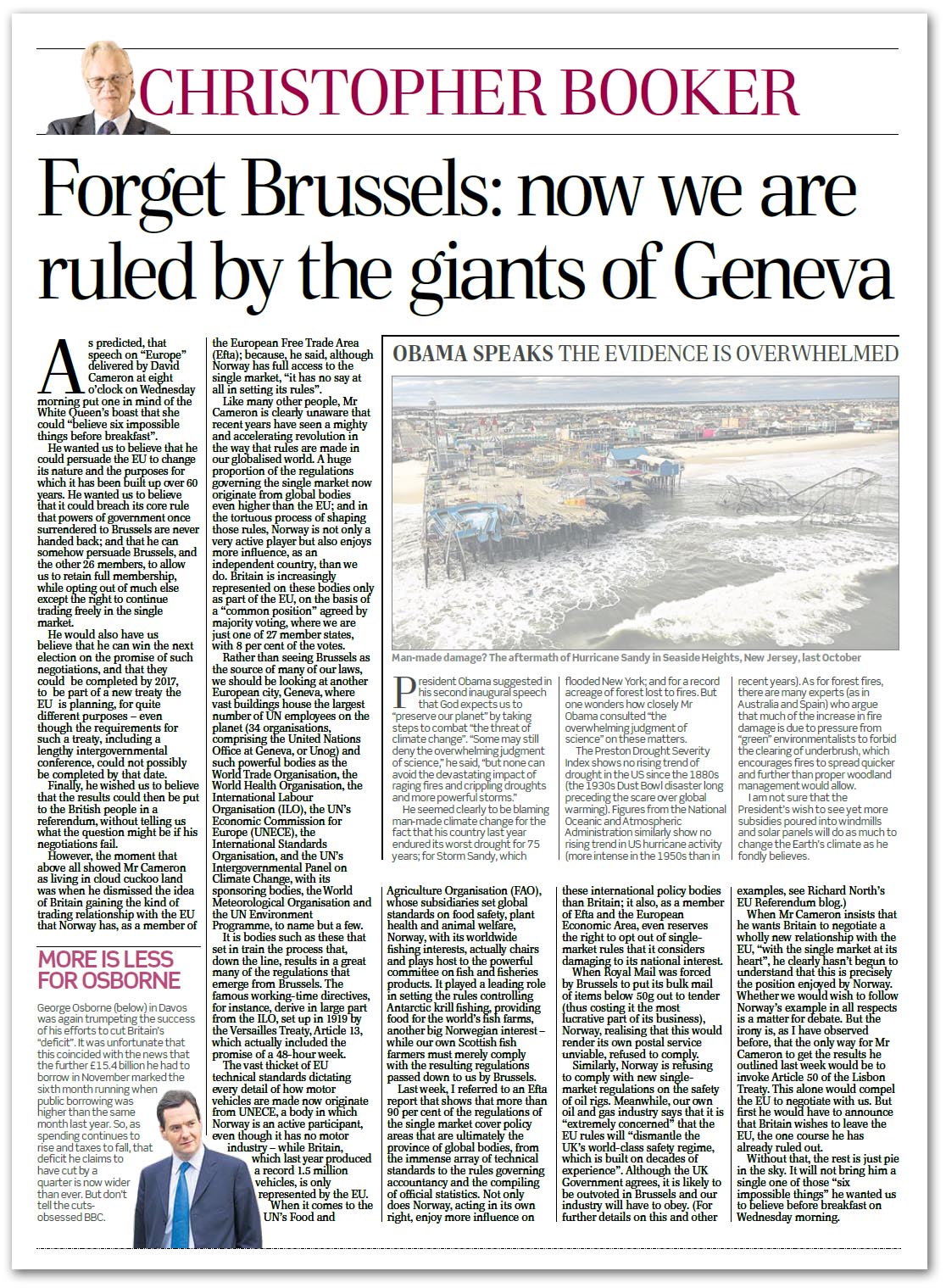 However insidious "global governance" might be, it is largely undertaken on an intergovernmental level which means that, unlike the supranational EU, we can chose to accept or reject agreements "done at Geneva" and other global venues – for the moment, at any rate. What makes the column particularly relevant, of course, is the coincidence of David Cameron's speech (the theme would have been broached this week, even if Cameron had not spoken). Delivered at eight o'clock on Wednesday morning, that speech, says Booker, put one in mind of the White Queen's boast that she could "believe six impossible things before breakfast". Cameron wanted us to believe that he could persuade the EU to change its nature and the purposes for which it has been built up over 60 years. He wanted us to believe that it could breach its core rule that powers of government once surrendered to Brussels are never handed back; and that he can somehow persuade Brussels, and the other 26 members, to allow us to retain full membership, while opting out of much else except the right to continue trading freely in the single market. He would also have us believe that he can win the next election on the promise of such negotiations, and that they could be completed by 2017, to be part of a new treaty the EU is planning, for quite different purposes – even though the requirements for such a treaty, including a lengthy intergovernmental conference (and convention), could not possibly be completed by that date. Finally, he wished us to believe that the results could then be put to the British people in a referendum, without telling us what the question might be if his negotiations fail. However, the moment that above all showed Mr Cameron as living in cloud cuckoo land was when he dismissed the idea of Britain gaining the kind of trading relationship with the EU that Norway has, as a member of the European Free Trade Area (EFTA); because, he said, although Norway has full access to the single market, "it has no say at all in setting its rules". Like many other people, Mr Cameron is clearly unaware that recent years have seen a mighty and accelerating revolution in the way that rules are made in our globalised world. A huge proportion of the regulations governing the single market now originate from global bodies even higher than the EU; and in the tortuous process of shaping those rules, Norway is not only a very active player but also enjoys more influence, as an independent country, than we do. Britain is increasingly represented on these bodies only as part of the EU, on the basis of a "common position" agreed by majority voting, where we are just one of 27 member states, with eight percent of the votes. Rather than seeing Brussels as the source of many of our laws, we should be looking at another European city, Geneva, where vast buildings house the largest number of UN employees on the planet (34 organisations, comprising the United Nations Office at Geneva, or UNOG) and such powerful bodies as the World Trade Organisation, the World Health Organisation, the International Labour Organisation (ILO), the UN's Economic Commission for Europe (UNECE), the International Standards Organisation, and the UN's Intergovernmental Panel on Climate Change, with its sponsoring bodies, the World Meteorological Organisation and the UN Environment Programme, to name but a few. As I have been reporting, for more than five years, it is bodies such as these that set in train the process that, down the line, results in a great many of the regulations that emerge from Brussels. The famous working-time directives, for instance, derive in large part from the ILO, set up in 1919 by the Versailles Treaty, which actually included the promise of a 48-hour week. The vast thicket of EU technical standards dictating every detail of how motor vehicles are made now originate from UNECE, a body in which Norway is an active participant, even though it has no motor industry – while Britain, which last year produced a record 1.5 million vehicles, is only represented by the EU. When it comes to the UN's Food and Agriculture Organisation (FAO), whose subsidiaries set global standards on food safety, plant health and animal welfare, Norway, with its worldwide fishing interests, actually chairs and plays host to the powerful committee on fish and fisheries products. It played a leading role in setting the rules controlling Antarctic krill fishing, providing food for the world's fish farms, another big Norwegian interest – while our own Scottish fish farmers must merely comply with the resulting regulations passed down to us by Brussels. Last week, Booker referred to an EFTA report that shows that more than 90 percent of the regulations of the single market cover policy areas that are ultimately the province of global bodies, from the immense array of technical standards to the rules governing accountancy and the compiling of official statistics. Not only does Norway, acting in its own right, enjoy more influence on these international policy bodies than Britain; it also, as a member of EFTA and the European Economic Area, even reserves the right to opt out of single-market rules that it considers damaging to its national interest. When Royal Mail was forced by Brussels to put its bulk mail of items below 50g out to tender (thus costing it the most lucrative part of its business), Norway, realising that this would render its own postal service unviable, refused to comply. Similarly, Norway is refusing to comply with new single-market regulations on the safety of oil rigs. Meanwhile, our own oil and gas industry says that it is "extremely concerned" that the EU rules will "dismantle the UK's world-class safety regime, which is built on decades of experience". Although the UK Government agrees, it is likely to be outvoted in Brussels and our industry will have to obey. When Mr Cameron insists that he wants Britain to negotiate a wholly new relationship with the EU, "with the single market at its heart", he clearly hasn't begun to understand that this is precisely the position enjoyed by Norway. Whether we would wish to follow Norway's example in all respects is a matter for debate. But the irony is, as we have observed before, that the only way for Mr Cameron to get the results he outlined last week would be to invoke Article 50 of the Lisbon Treaty. This alone would compel the EU to negotiate with us. But first he would have to announce that Britain wishes to leave the EU, the one course he has already ruled out. Without that, the rest is just pie in the sky. It will not bring him a single one of those "six impossible things" he wanted us to believe before breakfast on Wednesday morning. COMMENT THREAD Richard North 27/01/2013 |


 Posts
Posts

