

Booker: Owen Paterson gets a grip
Sunday 17 February 2013
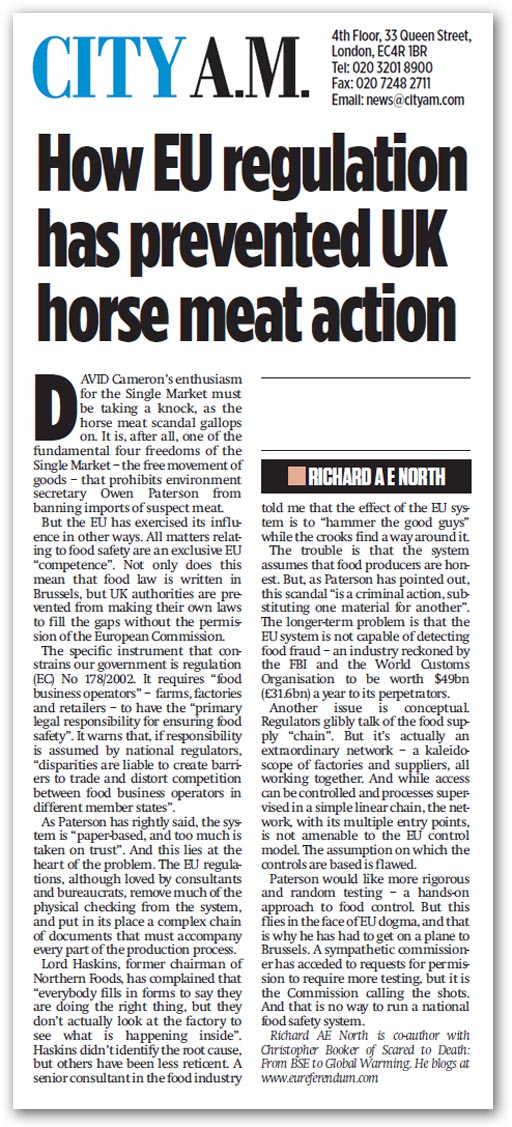
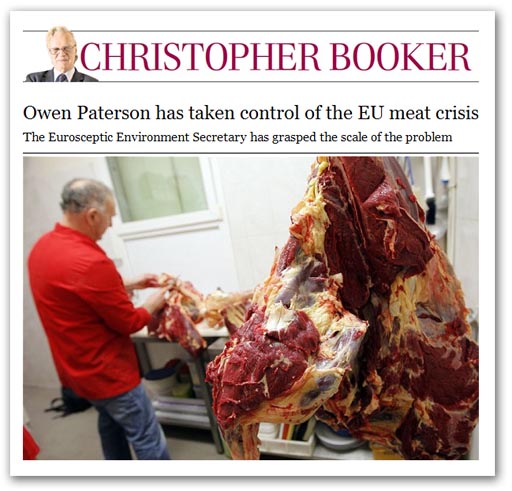 Mr Paterson, he says, is the only politician to have emerged well from what is, in essence, a bogus political storm. His handling of this issue has been sensible and unflappable, offering all the right reassurances while refusing to panic. Thus writes Booker in this week's column, the real drama behind the ongoing story which for the past two weeks has been leading the news across Europe has been almost wholly missed. From the moment when, 10 days ago, Findus told the Food Standards Agency that it had found horse meat in beef lasagne packaged in Luxembourg, from meat processed in France after being bought from an abattoir in Romania, Owen Paterson, our Environment Secretary, has played a blinder. While everyone else floundered about, chasing every little new bit of the scandal as it came to light from one end of the EU to another, Mr Paterson was the one politician who immediately grasped the nature and scale of the problem. He saw what needed to be done and he marshalled all the key players, right up to the time when he instigated a top-level emergency meeting in Brussels on Wednesday evening, for himself and six European food ministers, to agree with the relevant EU Commissioner a Europe-wide plan of action that he was proposing to address the crisis. What Mr Paterson recognised from the start, unlike any other politician in Britain, was that the root of the problem lay in what had followed when, a decade ago, the EU took over all "competence" to make food law from national governments. It promptly introduced a new set of rules across Europe, to replace the old dependence on regular inspection and testing of foodstuffs with a radical new system. The EU's version of what is known as HACCP (Hazard Analysis and Critical Control Points) is based on a trail of paper, whereby any food product, as it passes along the chain from one firm to another, must be accompanied by a piece of paper certifying its nature and contents. This system, set up under EU regulation 178/2002, was to be administered by a new European Food Safety Authority, represented in each country by "independent"national food safety agencies, such as that created in Britain in 2002. But the regulation also laid down that ultimate responsibility for the reliability of food sold to the public was placed on the "food operators" at every step along the chain, culminating in those retailers who sell food to the public. Mr Paterson became aware years ago, when he was on the relevant Commons committee, that this new system was wide open to fraud. Everyone along the chain was expected under the rules to trust the paperwork passed on to them. But it only needed one firm to insert false information into the paper trail and the reliability of the system would collapse (as we have seen when horse meat correctly labelled on leaving a Romanian slaughterhouse was mis-labelled as beef after being exported to western Europe). There has long been evidence to show that this fundamentally flawed system was being fraudulently exploited on a massive scale. In 2008, for instance, it was reported that huge quantities of Chinese rabbit meat imported to Bulgaria were being repackaged using falsified Argentinean health certificates, earning the criminals a profit of £18 million. The latest beef-for-horse switch is estimated to have netted a profit of half a million pounds, and the yearly cost of this and similar frauds at many billions. In 2011 Europol and Interpol collaborated in an investigation known as Operation Opson which led, in just one week, to the seizure of 13,000 sub-standard bottles of olive oil, 12,000 bottles of sub-standard wine, 30 tons of fake tomato sauce, 77 tons of counterfeit cheese, five tons of sub-standard fish and 30,000 counterfeit candy bars. All this, resulting from the wholesale abandonment of routine inspections and testing, was noted by the European Commission at the time, but it failed to take any serious steps to remedy such criminality because the potential for fraud was implicit in the very nature of the system that the EU had set up to regulate trading in food across the Single Market. Now, at last, however, the horse meat scandal has exposed the central flaw in the EU system. And, as soon as it emerged, Mr Paterson began liaising with his opposite numbers in Ireland, France, Romania and other countries, and with the EU's new Maltese health commissioner, Tonio Borg, in Brussels. Only three days after Findus reported its lasagne problem to the Food Standards Agency, he met those senior representatives of Britain's food industry whom he had summoned to his office on a Saturday morning. He reminded the food operators present that, as EU law dictates, they had ultimate responsibility for the labelling and contents of their products, instructing them to carry out tests on all their stock and to report back within six days. The results would be published on Friday. Last Tuesday Mr Paterson reported to the Commons all he had done, only to be beset on all sides by MPs demonstrating their ignorance of the fact that food law is now a full "EU competence". Two of the most lamentable contributions came from two MPs who had worked for the EU in Brussels. The Labour spokesman Mary Creagh, her face screwed up with self-righteous rage, was so determined to blame Mr Paterson for what she imagined was his failure to respond to the crisis that she merely demonstrated that she hadn't got a clue what she was talking about. Anne McIntosh, chairman of the Commons' food committee, despite having been a Tory MEP for ten years, had already been calling on Mr Paterson to impose a ban on imports, unaware that such a ban can only be imposed by Brussels on food safety grounds. Much of our media, alas, seem to understand the workings of our EU system of government no better than the politicians. When Mr Paterson explained to Andrew Neil on television that food law is now "an EU competence", it was reported by The Observer that he had attacked "EU incompetence". This misquotation was repeated by other newspapers, including The Times. On Wednesday, leaving Ms Creagh and other MPs still yapping at his heels in another debate, Mr Paterson travelled to Brussels to join his counterparts from six countries, including Ireland, France, Romania and Luxembourg, in a friendly "summit" with Commissioner Borg, which agreed to all the steps Mr Paterson was proposing. These ranged from regular EU-wide testing of food products, of the type which the flawed system had eliminated, to bringing in Europol, which Britain had already, on Mr Paterson's initiative, been the first country to contact. On Thursday morning, having driven up to The Hague, Mr Paterson had an equally helpful meeting with Europol's senior officials, who were delighted to be involved in fighting a fraud scandal which Europol and Interpol had done their best to flag up 15 months previously. So we have the irony that it has been the most strongly Eurosceptic member of the British Cabinet – also a speaker of several European languages – who is now leading the EU out of a catastrophic mess it has brought upon itself, by creating a system so ill-conceived that for years it has been a disaster waiting to happen. Yet, at the same time, this dismal episode has again shown just how ignorant of how our EU system of government works are the very people who most pride themselves on being good "Europeans". The finest irony of all is the way politicians such as Ms Creagh and papers such as The Observer are so blinded by their infatuation with a vague and make-believe idea of "Europe" that, in reality, they are no more than hopelessly blinkered "Little Englanders". COMMENT THREAD Richard North 17/02/2013 |
EU politics: the silence of the media
Saturday 16 February 2013
 That, of course, is true of the majority of people who rely on the legacy media for their information, but readers of this blog were told about it last Sunday, with a reminder through the week. The regulation, writes Moore for the benefit of his less-informed readers, "discloses the key fact about this scandal. Supported by Tony Blair's government, Regulation 178 transferred responsibility for food safety from each member state to the EU. It set up the European Food Safety Agency. So the British Government is no longer responsible for the safety of the food that Britons eat". This brings on confession time for Charles Moore, who admits that: "We in the media do not really want to focus on this fact, because it is more fun to hunt down and blame a British minister". We have seen this throughout that last week, and indeed in Parliament where Labour MPs – from the same party which in government approved Regulation 178/2002 – have been desperately seeking to pin the blame for the scandal on Owen Peterson and his team. As for the media, they are still at it in the very paper for which Mr Moore writes. Its editorial todayseeks to draw lessons from the scandal, but not once mentions the role of the EU. Similarly, Geoffrey Lean, in his column seeks to analyse the cause of the scandal, without once mentioning that food control is an exclusive EU competence. And the europhile Guardian hasJonanna Blythman pontificate about improving food controls, without even once mentioning the EU. In like mould, the Daily Mail offers: "The unpalatable truth: The horsemeat scandal is a brutal warning that Britain MUST change its ways". This is the paper that turned down the offer of an exclusive interview with Owen Paterson, only to have Dominic Sandbrook write two thousand words on the scandal, also without mentioning the EU. With not the trace of a blush, Sandbrook tells us that the horsemeat scandal is one of those appalling stories from which nobody emerges well: "Certainly not the suppliers, some of whom will surely face criminal charges. Not the Food Standards Agency, which has proved embarrassingly passive. Not the supermarkets, whose obsession with profit margins has seen them drive prices and standards into the gutter". His main target, though, is the "Great British public, whose love affair with cheap meat means we have effectively colluded in our own deception". Thus, with the EU not even on the horizon, Sandbrook could not begin to address the failure of the EU's regulatory model. He keeps his newspaper narrowly focused on its "little England" agenda, it having learned absolutely nothing from the events of last week. Strangely, UKIP – which one might have thought would be shouting from the rooftops that food control is an exclusive EU competence, but all we seem ot have is one press release on the subject, that does not even seem to be on the UKIP website. Back with Charles Moore, having launched his bombshell, he goes on to discuss the role of Downing Street in this affair and generally. "Horse meat provides only the latest example of the problem about how we are governed just now", he writes. "Everything seems very hard to do. No one really backs up anyone else. Authority does not lie where people think it lies". For the sentiment expressed in that last sentence, the media bears a great deal of responsibility. And in a week of tumultuous publicity about an issue that lies within the exclusive competence of the EU, the general media not only seems to have learned nothing, it evidently wants to know nothing of how we are governed. Still less is it prepared to tell the British people anything of such matters. COMMENT THREAD Richard North 16/02/2013 |
Horsemeat scandal: winding down
Saturday 16 February 2013
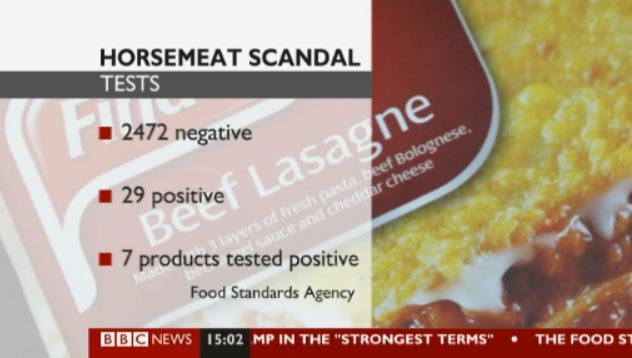 The horsemeat scandal has some of the characteristics of an epidemic – I've heard such media fevers called "psychic epidemics", representing a disease of the mind, rather than a corporeal ailment. One can certainly see this in the Daily Mail yesterday which chose to feature a perfectly ordinary picture of the inside of a Somerset abattoir, where a slaughterman was preparing to shoot a pony (below). It is a scene familiar to anyone who has frequented abattoirs – as one does. The rifle in this case is being used because an equine skull is too thick for a captive bolt. But the muzzle of the rifle is correctly positioned, at the intersection of imaginary lines drawn between eye and opposing ear. The pony is calm and, as regulations require, tethered. A single shot will despatch it, cleanly and without pain. This is humane slaughter, an event which happens up and down the country thousands of times a year. Yet, forgoing any sense of proportion, the paper presents this as a "grisly scene", followed by the graphic detail of the animal flailing on the ground before being winched up "where her throat is cut with a razor sharp knife, severing the carotoid artery". These details, with the sequence wrongly described and key events missing, suggest that the author, Sean Poulter, was not present at the scene. He is fabricating a narrative with deliberate intent to shock rather than inform and educate. This is journalism at its worst – the writer as prostitute, a hack offering his favours for money. 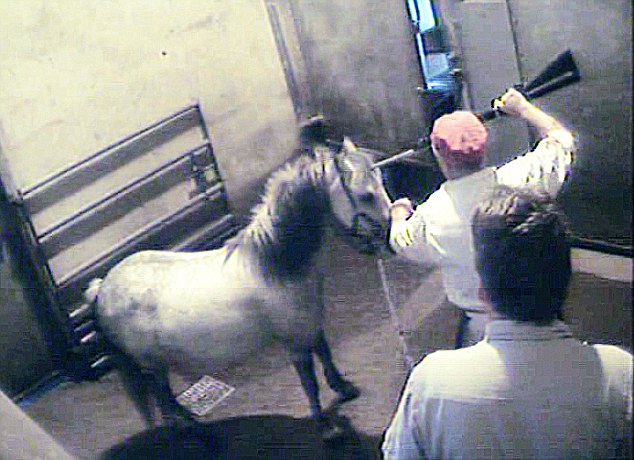 In a certain sense, though, there is encouragement to be taken from this low antic. If the Mail has to sink to such depths to achieve its effect, this signals that attempts at generating a full-blown health scare are failing. The shock quotient of the story is fading. With the first major tranche of much heralded test reports in – after Owen Paterson called for a major test exercise earlier in the week - there is definitely a feeling that the scare has run its course. There have been 2,472 test made, only 29 are positive for horsemeat at low levels, found in seven products lines – all of which have already been withdrawn. For sure, some horse meat has been found in school meals in Lancashire, in burgers from an Ulster hospital supplier, and the "pub giant" Whitbread has found horsemeat in its burgers and lasagnes. Those and sundry other items, such as the finding of trace horsemeat in an Asda chilled bolognese sauce, are keeping journalists busy. Then, on the back of arrests in Todmorden and Wales, there have been three more raids, one on Hull and two in Tottenham. Flexi Foods Ltd in Hull have been targeted, after claims that it sold a large shipment to an Irish business McAdam Foods. Although it was labelled as beef, it was found to contain up to 80 percent horsemeat. One of the Tottenham sites under investigation is Dinos & Sons Continental Foods Ltd. It has been asked to clarify its position in respect of the transportation and storage of frozen beef that was imported by, and belonged to, a third party that the FSA is investigating. All the same, some of the heat and drama seems to have melted away. The papers are covering the story but without the same zest. Some are trying too hard, but they can't sustain it. By Sunday, unless something drastic happens to stoke the flames, the "scare" will be dead on its feet. Next week, the issue could be struggling to find media space, unless the hacks can find something dramatic to ramp it up a notch. Perversely, this makes for the most dangerous period. As media interest gradually fades, the regulators will take over. Already, the Commission has proposed an ambitious "Product Safety and Market Surveillance Package" for 2013. This is intended to "improve the safety of consumer products circulating in the Single Market and to step-up market surveillance concerning all non-food products, including those imported from third countries". It is only a matter of time before the diligent eurocrats come up with a matching package for food products, calling in aid the horsemeat crisis. By then, of course, the little Englanders of the legacy media will have lost interest. They can handle scares, they can create and magnify alarums, but they don't "do" Europe. If nothing else, this current episode has demonstrated that.
But, with Owen Paterson at the helm, their education has started. The "elephant" had an outing this week. It is not going to be so easy to put it back in the closet.
COMMENT: "HORSEMEAT" THREAD Richard North 16/02/2013 |
EU politics: gay marriage not an EU competence
Friday 15 February 2013
 This contrasts with the analysis offered by Booker and myself, on the role of the Council of Europe, which UKIP chooses to ignore. It is thus interesting to see last year's official EU statement on the the issue, where it states: The EU strongly supports the Council of Europe's action aiming at combating all forms of discrimination against lesbians, gays, bisexuals and transgender persons. The EU is ready to strengthen cooperation with the Council of Europe in this field - as it is mentioned in the EU Strategic Framework and Action Plan on Human Rights and Democracy – on the basis of complementarity. In particular the EU is prepared to develop a strategy on how to cooperate with third countries, including within the Council of Europe.We also see the EU state that it "also looks forward to the review of implementation of the Council of Europe’s Recommendation CM/Rec(2010)5 on measures to combat discrimination on grounds of sexual orientation or gender identity, an important reference document for member states of the Council of Europe and also for the EU". Then there is Your Freedom and Ours which retails Peter Tatchell noting that, after he applied to the European Court of Human Rights to strike down the bans on restrictions on gay marriage, and then lobbied the Conservative Party: ... things started to happen. Astonishingly, within three months of our application to the European Court, the Government announced that it was going to consult on legalising gay marriage. They knew that there was no argument they could use in Strasbourg that would be anything other than bigoted and intolerant. I think they realised the game was up, and decided it was better to lead on the issue and get the kudos of enacting liberal reform than be dragged through the courts. It may have been a pure coincidence, but it does strike me as very closely mirroring the pattern of events that I set in place.These points very much confirm the pivotal role of this recommendation and the Council of Europe, in concert with the ECHR, the dynamics of which we identified.
As regards UKIP's claims, we now have the results of Lord Pearson in the Lords questioning HM Government about EU involvement .
He asks "whether there are any European Union proposals to legislate on gay marriage; and, if so, whether they have influenced Government policy". To this Baroness Stowell of Beeston responds: "There are no European Union proposals to legislate on same-sex marriage. Nor does the EU have competence to legislate in the area of substantive family law". All this, essentially, shoots the UKIP fox. Maybe now the party will remove its error-strewn claims from its website, recognising that it got its narrative hopelessly wrong. COMMENT: "GAY MARRIAGE" THREAD Richard North 15/02/2013 |
Horsemeat scandal: extruded verbal material
Friday 15 February 2013
 How typical it is of the British media (and this paper in particular) that the moment we get something of a food "crisis", up goes the cry for "more regulation", along with condemnation – as we see here – of "light-touch regulation". This comes from FT journalist Hannah Kuchler, who may not have been around at the time of the Edwina Currie's "Salmonella in eggs", the Listeria scare, Mad Cow Disease and all the other scares of the late '80s and '90s, which spawned the current crop of regulation. In this example of what the FT calls "high quality global journalism", we get critics likening the failure of Britain's food inspection system to that of light-touch bank regulation before the financial crisis. Industry experts, we are told, blame "a perfect storm of austerity-driven budget cuts, a laisser-faire attitude and fragmented monitoring network for the spread of horsemeat into the food chain". Before going any further, let us revisit what we know of the causation of the horsemeat "crisis" and we can venture that, had the French food processor Comigel carried out pre-production tests of its frozen meat supply, then the horse meat most likely would have been detected and intercepted. The problems we are experiencing would not have occurred. That assumes, of course – as the French government seems to think – that Comigel is innocent of fraud, and guilty of no more than "negligence". Thus, a simple in-house testing regime would have sufficed. On this basis, the problem cannot in any way be attributed to a "light touch" regime. We are looking at a very specific system failure which, in our view was induced by the regulatory system itself. This is not too little regulation, but the wrong type of regulation. Sadly, though, journalists – and indeed legislators and regulators – seem incapable of stepping past a childishly simple assessment, thinking of "too much or too little regulation". Their brains seem incapable of asking whether the right type of regulation has been adopted, and/or whether the model we have has been properly implemented. Devoid of any such sophistication, we thus see Hannah Kuchler tell us that while DNA tests have been used to detect contamination since the crisis erupted, the technique has not previously been standard practice for inspectors. She then relies on a "recently retired [meat] inspector" to tell us that "it could have been possible to discover horsemeat with the naked eye". "Horsemeat does look different – it is darker, the fat is yellower and oilier", the inspector says. At the user end, however, where the likes of trading standards and environmental health officers roam, we are dealing with a processed product. There, DNA testing is the most reliable technique to detect cross-species adulteration.
In the Comigel processing plant, though, we have already learned that the horsemeat meat was used frozen, in which case, visual appearance is of little relevance. One block of frozen meat looks very much like another. A simple "boiling test" would nevertheless have been adequate.
But this "recently retired inspector" is talking about abattoirs and cutting plants. Reductions in the number of inspections at cutting plants – after a change in EU law in 2004 – and pressure to work at speed in abattoirs, could have made horse meat harder to spot, he tells us. "Before we had two inspectors to work a body of beef and they'd do half each – now one does the lot. The volumes of work people have to do working as fast as the production line means you miss more things", he complains. Budget cuts to the Food Standards Agency have contributed to a halving of the number of meat inspectors since the 1990s, though the number of meat plants has also fallen, we are then told. In the past three years local authority regulatory services have been slashed by 32 percent per person in real terms. Yet the failures which are currently gripping the nation took place in a processing plant in another country, out of sight of inspectors - and out of reach of our own. The failures are a result of regulations mandated by the EU and enforced by the French authorities, under the supervision of EU officials. How could a drop in the number of meat inspectors or speeding up the work rate in UK plants be a contributory factor? This, though, it what passes for an intelligent contribution to the debate, made all the more predictable and leaden by resurrecting the old war horse, professor Tim Lang, supposedly an "expert in food policy", but in fact a lefty campaigner. Using Lang is a bit like Godwin's Law. Whomsoever quotes him has automatically lost the debate. That, however, does not stop Kuchler, who then goes on to Liz Moran, president of the association of public analysts. She is allowed a few paragraphs of special pleading, then followed by Andy Foster from the Trading Standards Institute, who says some local authority sampling budgets have been cut by 50-70 percent. This, it appears, is the best that the Financial Times can offer, a piece of work for which the phrase "extruded verbal material" (EVM) was invented. The legacy media, as always, is writing itself out of the debate. It has nothing sensible to offer. COMMENT: "HORSEMEAT" THREAD Richard North 15/02/2013 |
Horsemeat scandal: a modest piece
Friday 15 February 2013
 COMMENT: "HORSEMEAT" THREAD Richard North 15/02/2013 |


 Posts
Posts

