

EU politics: gay marriage not an EU competence
Friday 15 February 2013
 This is despite the analysis offered by Booker and myself, on the role of the Council of Europe, which UKIP chooses to ignore. It is thus interesting to see last year's official EU statement on the the issue, where it states: The EU strongly supports the Council of Europe's action aiming at combating all forms of discrimination against lesbians, gays, bisexuals and transgender persons. The EU is ready to strengthen cooperation with the Council of Europe in this field - as it is mentioned in the EU Strategic Framework and Action Plan on Human Rights and Democracy – on the basis of complementarity. In particular the EU is prepared to develop a strategy on how to cooperate with third countries, including within the Council of Europe.We also see the EU state that it "also looks forward to the review of implementation of the Council of Europe’s Recommendation CM/Rec(2010)5 on measures to combat discrimination on grounds of sexual orientation or gender identity, an important reference document for member states of the Council of Europe and also for the EU". Then there is Your Freedom and Ours which retails Peter Tatchell noting that, after he applied to the European Court of Human Rights to strike down the bans on restrictions on gay marriage, and then lobbied the Conservative Party: ... things started to happen. Astonishingly, within three months of our application to the European Court, the Government announced that it was going to consult on legalising gay marriage. They knew that there was no argument they could use in Strasbourg that would be anything other than bigoted and intolerant. I think they realised the game was up, and decided it was better to lead on the issue and get the kudos of enacting liberal reform than be dragged through the courts. It may have been a pure coincidence, but it does strike me as very closely mirroring the pattern of events that I set in place.These points very much confirm the pivotal role of this recommendation and the Council of Europe, in concert with the ECHR, the dynamics of which we identified.
As regards UKIP's claims, we now have the results of Lord Pearson in the Lords questioning HM Government about EU involvement .
He asks "whether there are any European Union proposals to legislate on gay marriage; and, if so, whether they have influenced Government policy". To this Baroness Stowell of Beeston responds: "There are no European Union proposals to legislate on same-sex marriage. Nor does the EU have competence to legislate in the area of substantive family law". All this, essentially, shoots the UKIP fox. Maybe now the party will remove its error-strewn claims from its website, recognising that it got its narrative hopelessly wrong. COMMENT: "GAY MARRIAGE" THREAD Richard North 15/02/2013 |
Horsemeat scandal: extruded verbal material
Friday 15 February 2013
 How typical it is of the British media (and this paper in particular) that the moment we get something of a food "crisis", up goes the cry for "more regulation", along with condemnation – as we see here – of "light-touch regulation". This comes from FT journalist Hannah Kuchler, who may not have been around at the time of the Edwina Currie's "Salmonella in eggs", the Listeria scare, Mad Cow Disease and all the other scares of the late '80s and '90s, which spawned the current crop of regulation. In this example of what the FT calls "high quality global journalism", we get critics likening the failure of Britain's food inspection system to that of light-touch bank regulation before the financial crisis. Industry experts, we are told, blame "a perfect storm of austerity-driven budget cuts, a laisser-faire attitude and fragmented monitoring network for the spread of horsemeat into the food chain". Before going any further, let us revisit what we know of the causation of the horsemeat "crisis" and we can venture that, had the French food processor Comigel carried out pre-production tests of its frozen meat supply, then the horse meat most likely would have been detected and intercepted. The problems we are experiencing would not have occurred. That assumes, of course – as the French government seems to think – that Comigel is innocent of fraud, and guilty of no more than "negligence". Thus, a simple in-house testing regime would have sufficed. On this basis, the problem cannot in any way be attributed to a "light touch" regime. We are looking at a very specific system failure which, in our view was induced by the regulatory system itself. This is not too little regulation, but the wrong type of regulation. Sadly, though, journalists – and indeed legislators and regulators – seem incapable of stepping past a childishly simple assessment, thinking of "too much or too little regulation". Their brains seem incapable of asking whether the right type of regulation has been adopted, and/or whether the model we have has been properly implemented. Devoid of any such sophistication, we thus see Hannah Kuchler tell us that while DNA tests have been used to detect contamination since the crisis erupted, the technique has not previously been standard practice for inspectors. She then relies on a "recently retired [meat] inspector" to tell us that "it could have been possible to discover horsemeat with the naked eye". "Horsemeat does look different – it is darker, the fat is yellower and oilier", the inspector says. At the user end, however, where the likes of trading standards and environmental health officers roam, we are dealing with a processed product. There, DNA testing is the most reliable technique to detect cross-species adulteration.
In the Comigel processing plant, though, we have already learned that the horsemeat meat was used frozen, in which case, visual appearance is of little relevance. One block of frozen meat looks very much like another. A simple "boiling test" would nevertheless have been adequate.
But this "recently retired inspector" is talking about abattoirs and cutting plants. Reductions in the number of inspections at cutting plants – after a change in EU law in 2004 – and pressure to work at speed in abattoirs, could have made horse meat harder to spot, he tells us. "Before we had two inspectors to work a body of beef and they'd do half each – now one does the lot. The volumes of work people have to do working as fast as the production line means you miss more things", he complains. Budget cuts to the Food Standards Agency have contributed to a halving of the number of meat inspectors since the 1990s, though the number of meat plants has also fallen, we are then told. In the past three years local authority regulatory services have been slashed by 32 percent per person in real terms. Yet the failures which are currently gripping the nation took place in a processing plant in another country, out of sight of inspectors - and out of reach of our own. The failures are a result of regulations mandated by the EU and enforced by the French authorities, under the supervision of EU officials. How could a drop in the number of meat inspectors or speeding up the work rate in UK plants be a contributory factor? This, though, it what passes for an intelligent contribution to the debate, made all the more predictable and leaden by resurrecting the old war horse, professor Tim Lang, supposedly an "expert in food policy", but in fact a lefty campaigner. Using Lang is a bit like Godwin's Law. Whomsoever quotes him has automatically lost the debate. That, however, does not stop Kuchler, who then goes on to Liz Moran, president of the association of public analysts. She is allowed a few paragraphs of special pleading, then followed by Andy Foster from the Trading Standards Institute, who says some local authority sampling budgets have been cut by 50-70 percent. This, it appears, is the best that the Financial Times can offer, a piece of work for which the phrase "extruded verbal material" (EVM) was invented. The legacy media, as always, is writing itself out of the debate. It has nothing sensible to offer. COMMENT: "HORSEMEAT" THREAD Richard North 15/02/2013 |
Horsemeat scandal: a modest piece
Friday 15 February 2013
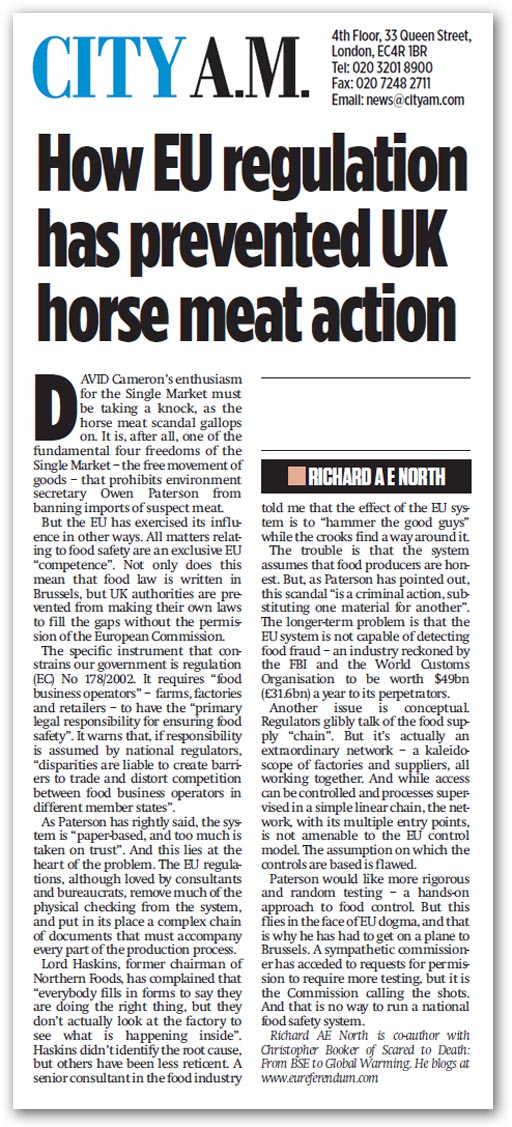 COMMENT: "HORSEMEAT" THREAD Richard North 15/02/2013 |
Horsemeat scandal: a crashing EU failure
Friday 15 February 2013
 Not untypical of such occasions, the firm has denied the allegations, saying it only ever dealt in meat it believed to be beef. However, French consumer affairs minister Benoit Hamon said the meat left Romania clearly and correctly labelled as horse. It was afterwards that it was relabelled as beef. "From the investigation, it would seem that the first agent or actor in this network who stamped 'beef' on horsemeat from Romania was Spanghero", Hamon says. There was "no reason to doubt the good faith" of the Romanian abattoir that originally provided the meat, Hamon adds. The French government believes that the fraud went on for six months and involved around 750 tons of meat. Spanghero would have made a profit of €550,000 euros over the period. In total, 4.5 million items made with horse meat in them have been despatched to supermarkets and other retail outlets. At least 13 countries and 28 companies have been recipients. But, says the government, some blame may rest with Comigel, which made the ready meals sold throughout Europe. Staff there, Hamon avers, should have noticed anomalies in the paperwork. They should also have realised from the smell and look of the meat once it was defrosted that it was not beef. Hamon, however, hasn't fully grasped how processing works, with frozen blocks being used, without defrosting, in order to keep mixes cool. Operators on the production floor, many of them on minimum wage, have next to no chance of detecting substitution. This is confirmed by L'Express which has Comigel saying that product was "cooked without thawing", making it impossible "to detect deception" by its colour or smell. But, to have detected the fraud would have been simple. Pre-production, core samples from a representative number of packs could have been taken, and tested. No special analytical technology would have been is necessary. In my day, a glass beaker, water and a bunsen burner was all that was needed, for what is called the " boiling test ". Apart from detecting taint and rancidity, horsemeat can easily be distinguished from beef by this means. The point, however, is that such direct testing – part of what is known as "organoleptic evaluation" – has been dropped from the control regime in favour of a paperwork audit. And there is no way the EU can evade responsibility for this, even though it is trying. 
To characterise this problem as one of "wrongly labelled products", though, is completely to misidentify the problem. On the one hand, this is a structured, long-term fraud and, on the other, there has been a massive failure to detect it. And the primary responsibility for picking up this sort of thing, according to the very rules which Commissioner Borg is responsible, is the "food operator".
But the EU goes further than simply setting out responsibilities. It also specifies in very great detail the means by which safety and food standards generally shall be maintained, requiring the use of a system known as Hazard Analysis and Critical Control Points (HACCP). The so-called HACCP principles are written into the DNA of EU regulation, required by Article 5 of Regulation (EC) No 852/2004.
HACCP, says the EU, "is a tool to assess hazards and establish control systems that focus on prevention rather than relying mainly on end-product testing". It goes on to say, "efficient and accurate record keeping is essential to the application of a HACCP system … HACCP procedures should be documented". Throughout the industry, Europe-wide, with the active encouragement of regulators, ranks of consultants, and the entire food safety establishment, common-sense controls have been ditched in favour of chasing paper records to an almost absurd degree. But the system is not a matter choice - food operators must implement it, on pain of criminal penalties. Strictly speaking, a properly designed HACCP regime might take account of supplier fraud, and introduce physical checks, but the regulatory fashion was to rely on paper. In this context, it would have been entirely normal for Comigel to have relied on paper records to attest to the provenance of its supplies. Furthermore, any such reliance would have been approved by national regulatory officials, and endorsed by Commission inspectors from the EU's Food and Veterinary Office (FVO). A decade ago, I remember a stormy, ill-tempered meeting in the offices of a major multi-national food processor in Ghent, arguing against full adoption of the HACCP system, calling for the retention of routine checks, and inspection-based systems. My only ally was a deliciously angry French manager who argued that the firm should go into the paper business and stop making meat products if HACCP was to reign supreme (Ironically, it later pulled out of meat processing). During a factory "walk through", I was able to prove my point when I spotted a major contamination hazard that had not been detected – and not noticed by any of the group I was with - even though the process have been fully approved and certified. The Dutch managing director agreed my point, expressing real regret that he could do nothing about it. He was under instructions from the corporate head office to adopt the system. Furthermore, within EU law and the Single Market, it is not possible to stand aside from the crowd – everyone must compete on a "level playing field". This also applies to the regulators. If they demand something different or extra, they are exposed to accusations of creating barriers to trade and distorting competition between food business operators in different Member States. Here again, Mr Borg cannot walk away and suggest that enforcement of the system is the responsibility of national authorities. He has the FVO, and it exerts its malign effect on the system of national control.
The Commission's very own private food police sally forth to inspect national control systems, ensuring that national regulators properly implement the HACCP mantras, and conform with EU regulations. It they depart from the orthodoxy, they are quickly brought into line. Thus, the Commission itself is largely responsible for the way the law is enforced, as well as for the law itself.
And once the EU's version of the HACCP "virus" got embedded in the system, and regimes were approved by FVO inspectors, we then spawned a generation of "auditors" to replace hands-on inspectors. No longer, as Lord Haskins recently complained, do they check the factories. They spend their time checking that form-filling systems are in place, and that the right ticks fill the right boxes.
Since then, such skills which were in any event in short supply have been largely lost. The modern hygiene "auditor" spends so much time with keyboards and flow charts that observational skills have atrophied and inspection techniques have been lost.
Thus, consumer affairs minister Benoit Hamon, now at the very epicentre of the crisis, needs to wake up to the reality of what the EU has brought to his domain. This crisis is the child of the EU, the inevitable consequence of years of policy implementation that has seen the progressive dismantling of tried and tested systems, and their replacement with "Single Market compliant" regimes that have opened the way for a single market in crime. The irony is that there are now so few people around with knowledge and understanding of how systems used to work and should work, that the crashing failure of the EU regime is scarcely recognised for what it is - not least by the regulators themselves, and especially the media.
But, unrecognised or not, there is no disguising the failure. It is there, daily, in the headlines. The system failures are there to see, even if people don't have the first idea of where the real blame lies.
Richard North 15/02/2013 |
Horsemeat scandal: ramping up the scare
Thursday 14 February 2013

The one thing you can guarantee about the food "scare" is that the moment the issue hits the headlines, a legion of agenda-pushers will come crawling out of the woodwork, all trying to ramp up the tension for their own purposes.
Some of this is clearly mischief-making, as we see in The Daily Telegraph today, its front-page lead going for the scary headline, while the content is incredibly thin. The report is flagging up the EFRA Committee report now available, with Anne McIntosh and her committee airing their lack of grasp of the issues. I've been without internet most of the morning, so I've been playing catch-up, having to read the report on the fly. From it, one sees that it is an interim report, and the inference is very clear, that this is a cheap attempt to grab some headline from an issue of topical concern. Watching Miss McIntosh in Parliament does not inspire confidence in her grasp of the subject (any subject) and her manifest inadequacies certainly show in her work. She and her committee have almost nothing to contribute to the understanding of the issues, illustrated by an extract from the conclusion of her current report, which grandly declares: While this is primarily a food labelling issue, the suggestion of fraud on a massive scale, suggests that measures must be put in place now to prevent any further contaminated meat entering the food chain. The Government will need to consider its role in achieving the correct balance between affordable food prices and regulations that ensure transparency and quality.The report then goes on to say: We are concerned that the consumer will be caught in a Catch 22 between paying the costs of higher traceability, labelling and testing standards or having to accept that they will not be provided with comprehensive information about the provenance and composition of the food that they eat. The strong indications that people have intentionally substituted horsemeat for beef leads us to conclude that British consumers have been cynically and systematically duped in pursuit of profit by elements within the food industry.What the MPs have not seemed fully to register is the criminal nature of the problems we are confronting. This is primarily an issue of food fraud. All the labels, traceabilty and systems come to nothing when criminals systematically target the weaknesses and exploit them. Here, McIntosh and her crew need to lift their sights. As food fraud, this current example has involved adulteration of beef with horsemeat. But, it could just as easily have been substitution of any food (or ingredient) by any other – and it very often is. Thus, a narrow focus on one particular commodity, or one tiny section of the food industry, is going to miss the point. As soon as procedures are tightened up in this sector, the criminals will move on to another product, and another weakness - and even to a completely different, i.e., non-food sector. Thus, this should not be looked at primarily as a food safety issue, nor even a food standards issue,per se. We are looking at criminal enterprise, involving billions annually. It has suddenly come to prominence with this product, but that simply reflects the current criminal target. Sorting the narrow issues will not solve the bigger problem. COMMENT: "HORSEMEAT" THREAD Richard North 14/02/2013 |
Horsemeat scandal: the dead hand of the EU
Thursday 14 February 2013
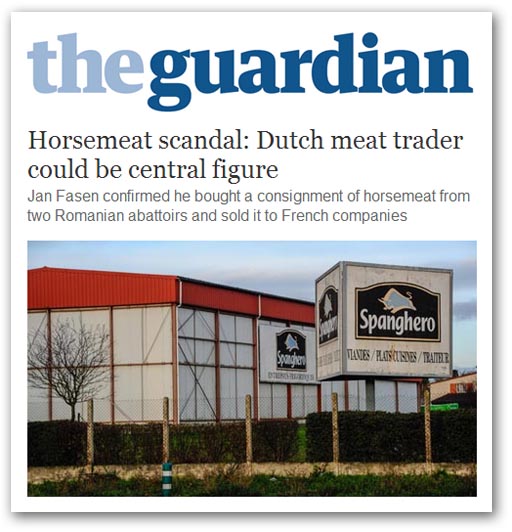 As the Environment Secretary last night was hurtling down the motorway between Brussels and the Hague, ready to meet Europol this morning, the Guardian is one amongst several newspapers highlighting the role of the shady figure of Jan Fasen, director of Draap Trading Ltd, in the sale of horsemeat to the French processor at the centre of this crisis. Fasen, is emerging as a key suspect in the meat adulteration, having confirmed that he bought a consignment of horsemeat from two Romanian abattoirs and sold it to French companies. But while he insists that the meat was clearly labelled as horsemeat, the Dutch broadcaster NOS has reported that Fasen has form. In January 2012, he received a one-year jail term for deliberately marketing South American horsemeat as halal-slaughtered Dutch beef and falsifying documents. A second Dutch meat trader, from the town of Oosterhoutse, was given community service. Draap Trading Ltd is a Cypriot-registered company, run from the Antwerp area of Belgium, and owned by an offshore vehicle based in the British Virgin Islands. Draap spelled backwards is the Dutch word for horse. It delivered meat to the French company Spanghero, which in turn supplied another French company, Comigel. The Findus lasagne products found in Britain containing horsemeat came from a Comigel factory in Luxembourg. Spanghero, on the other hand, insists that the meat delivered to its Castelnaudary plant in southern France had arrived labelled "Beef - originating in EU". The company said: "The meat received was beef meat. This was the order that had been placed. Spanghero did not treat or do anything to the meat". This adds a further level of confusion and uncertainty, further elaborated on by the Mirror, in what is already so murky that the Organised Crime and Corruption Reporting Project is looking in detail at Draap Trading Ltd. It appears that the company was registered in 2008 in Limassol, Cyprus. Its sole shareholder is Hermes Guardian Ltd, an offshore company in the British Virgin Islands. A Draap representative, Andreas Mercruri has refused to disclose the beneficial ownership of the company. This is the sort of thing that the EU has lamentably failed to address, with authorities in Romania suggesting that international criminal networks may be involved in the opaque meat trading business. Sorin Minea, head of Romalimenta, the Romanian food industry federation, warns of "an international mafia ring behind this problem". Addressing these criminal elements of meat adulteration will require a huge effort of will on an international scale, and yesterday Owen Paterson got agreement in principle for a huge programme of testing throughout Europe, to identify the scale of the problem. The significance of this has hardly been appreciated, as it breaks away from the EU-mandated paper-based system, and puts physical testing back in the frame. That there has been no resistance from EU Health Commissioner Tonio Borg is a tacit admission that the EU regime has failed. The BBC has it that the EU is "responding" to the scandal, urging members to conduct random tests to tackle a widening scandal. But this is hardly an adequate description. The British-led initiative has the support of the Irish, French, Romanians and the Dutch, dragging a lethargic Commission into the arena, where it has allowed criminal enterprises to flourish through its inadequate system of controls. Irish Farm Minister Simon Coveney says, "This is a Europe-wide issue that needs a Europe-wide solution". And while that much is true, it is far from being an EU solution. The member states have recognised the problems, they are making the running, and they are putting in the resources to deal with the consequences of a system failure that has gone on far too long. When the dust has settled on this issue, there is going to have to be some serious re-thinking about how we manage our affairs. The dead hand of he EU is creating the problems. It is going to be the power of the nation states that solve them. COMMENT: "HORSEMEAT" THREAD Richard North 14/02/2013 |
Horsemeat scandal: German Greens in disarray
Wednesday 13 February 2013
 This comes after supply lists from the EU have been obtained, from which it is clear that large amounts of frozen products have been delivered to the Federal Republic, which could contain mislabelled meat products. Thus, we have Spiegel, amongst others, reporting that the spokesman for the Consumer Ministry in North Rhine-Westphalia has said businesses in its region are implicated. Deliveries of suspect product took place between November 2012 and January 2013. A company in Luxembourg and a company from France could have delivered falsely declared meat. The suspect frozen foods, lasagna, among other things, may not only have reached North Rhine-Westphalia but also other regions of the country. They have been delivered not only to supermarket chains and discount stores, but also to other food businesses that deal with frozen products. The Environmental Agency is now checking the affected premises. Whether the affected frozen foods actually contain horsemeat only a DNA test can confirm. The results were expected in three to five days. Interestingly, Die Zeit has the EU-loving Greens weeping and gnashing their teeth over the "international production chains". Aimed at cutting prices, they are a conduit for fraud and deceit, says the consumer policy spokesthing of the parliamentary party, Nicole Maisch. Forcing animals in "excruciating transports" to travel through several European countries in order to save a few cents, must belong to the past, says Maisch. Transport should be limited to four hours at home and eight hours abroad. Also clear labelling is needed. she adds. It strikes me that the Greens haven't quite got a handle on this. The crisis is about shipping meat around the continent, not animals. But then, the Greens have never been known to let a good crisis go to waste, so we can expect the usual mantras to surface. The irony is, of course, that their doctrine is the antithesis of the EU's own doctrine of free movement of goods and services within the internal market, which puts them at odds with the organisation they love so much. Being a Green, though, means not having to be intellectually consistent. Not making sense should never be allowed to spoil a Green campaign. Otherwise, they would have to remain silent forever. COMMENT: "HORSEMEAT" THREAD Richard North 13/02/2013 |
Horsemeat scandal: they've noticed – at last!
Wednesday 13 February 2013
 The most worrying part of the whole [horsemeat] furore, it laments, "is what it reveals about the powerlessness of those to whom we grant a mandate to run the country". "We are unable to hold our elected representatives to account for the horsemeat scandal because they have passed responsibility over to officials at the European Commission", it wails. "There is no point in urging Environment Secretary Owen Paterson to 'get a grip' because he is not the person in charge". But if this newspaper has finally got the message, not so opposition MPs. Yesterday in theCommons debate, we had the ghastly Mary Creagh complaining that the Secretary of State "laid the responsibility for food safety squarely on other people’s shoulders". Thus, it was for Owen Paterson to say once again: I shall repeat myself, because it is important that Opposition Members understand this: overall, food safety is a European competence. Council regulation 178/2002 confirms that food operators have primary responsibility for food safety and quality. In the UK, under the system this Government inherited, the independent Food Standards Agency is the lead enforcement authority for food safety and authenticity.The "independent" Food Standards Agency is, of course, a creature of Brussels, the UK branch office of the European Food Safety Authority, its task mainly to implement EU regulations. Pity the corpulent Diane Abbott, suffering no food shortage herself, asserting that "this horsemeat scandal has clear public health implications - possible implications, but implications none the less. There is a public health dimension, so responsibility falls fairly and squarely on Government". "For Ministers to say that the ultimate responsibility lies somewhere else is not something that the British public accept or believe for a second", she wailed. "The Government should not be hiding behind civil servants or quangos. They must accept their moral responsibility for the quality of the food that our people purchase in the shops, and for any possible threat to public health". Kerry McCarthy similarly had trouble accepting the reality. "All food should be of a decent quality, and all consumers should know what is in their food", she declared, then proclaiming: That is the Government’s responsibility, and I was shocked by the Secretary of State’s complacency when he answered questions earlier. He is being very slow to act, but very quick to abdicate all responsibility and say that this is a matter for the Food Standards Agency. That is just not good enough. It is the Government’s responsibility to ensure that people have trust in the food that they eat.Barry Gardiner then asserts that "responsibility for food labelling policy lies with DEFRA", not realising that food labelling policy also lies with Brussels, and has done for many years. And what of Tom Harris (Glasgow South) (Lab)? It is too easy for the Secretary of State "to dismiss his responsibilities by saying repeatedly that retailers have ultimate responsibility for the content of food", he complains. Unless he wants the "F" removed from DEFRA, it is incumbent on him to carry out the responsibilities he already has. The poor dears. They have given away their powers and, unlike the Express cannot cope with the awful truth of what they have done. The collective demands action, while today Owen Paterson, with a broad smile, jets off to Brussels to discuss the situation with our masters. Labour MPs are in favour of EU membership, he says. This is what they wanted. This is what they get. COMMENT: "HORSEMEAT" THREAD Richard North 13/02/2013 |


 Posts
Posts

