
Fisheries policy: amateurs' corner
Sunday 3 February 2013
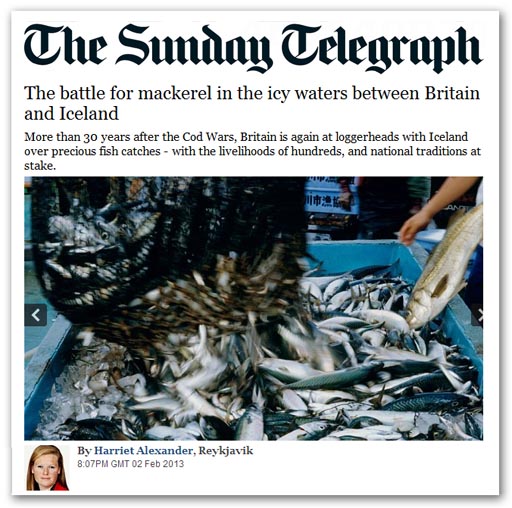
Make sure she is badly-briefed and then send her off to Reykjavik to cover an issue about which she clearly knows nothing, put the result in front of an ignorant editorial desk and the result is a badly-framed mish-mash, of which any reputable newspaper would be ashamed.
The lack of coherence, however, is not confined to the Sunday Telegraph girlie. The Sunday Expressdoes just as badly, also inventing a biff-bam Iceland vs Britain story on the lines of the Cod War. Thus to frame the story is completely to misunderstand (and misrepresent) what is going on. This is a four-way fight which has the EU and Norway on one side, and the Faroe Islands and Iceland on the other. The fault lies almost entirely with the EU and Norwegians, both having behaved in a disgusting fashion. They have demanded 90 percent of the North Atlantic mackerel quota based on historic rights (track record), even though the fish have moved north into Faroese and Icelandic waters. What we have, therefore, is a situation where the EU/Norwegian licensed fleet is continuing to fish its traditional grounds within established national boundaries. They are not in any way encroaching on Icelandic waters (or Faroese for that matter), which was the basis of the Icelandic Cod War.
The dispute arises from the EU and Norway effectively seeking to prohibit these two countries from fishing in their own waters, after the mackerel have moved into their territorial zones - even though not to fish them may harm indigenous stocks of herring and blue whiting, and deplete food supplies.
From our perspective, though, the really interesting thing about the whole dispute, is what the ignorant hacks have completely missed. The UK – although having two dogs in the fight (holding 60 percent of the EU mackerel quota, while also processing fish from the Iceland and the Faroes) – has no seat at the table. Negotiations are being carried out between parties to the North East Atlantic Fisheries Commission, of which we are no longer members. Our seat has been taken up by the EU which negotiates in our place. Thus, while girlie Harriet and her counterpart on the Express can go trotting off to Reykjavik to discuss matters with Iceland's chief negotiator Sigurgeir Thorgeirsson, that is the one thing that British ministers are not allowed to do. Negotiating rights are reserved to the Fisheries Commissioner, Maria Damanaki, a Greek leftie politician, who seems more concerned withpropagandising than ending the problem. All the Brits can do is seek to "influence" the Commission is a so far vain attempt to resolve the dispute. Despite this, the Espress consistently seeks to give the impression that British ministers are directly involved in negotiations, which they are not. Even the girlie is woefully behind the times. There is pressure, she chirps, "for the European Union to impose sanctions on Iceland – threatening to block imports of other fish – unless it dramatically scales back its catch of mackerel, in a variation of the infamous Cod Wars in which navies were summoned and fishing boats rammed". Yet, as we saw from the Council meeting last week, the prospect of sanctions being imposed isremote. As we reported at the time: One of the conditions required is the obligation under WTO Rules for both parties to demonstrate that they are open to negotiation and their willingness to engage in "sustainable fishing". By claiming 90 percent of the stock (even if it is in the framework of an overall quota reduction), the EU does not really seem to be demonstrating a willingness to negotiate, and is on a perilously weak footing.Despite this also, the Express - which bases its whole story on the prospect of sanctions -writes that "the mood among many fishermen is for tough sanctions now". The paper does not even beginning to explain why they are not going to happen. If it was just the girlie getting it wrong, we might suggest she goes back to the Hello Magazine where she clearly belongs. But that would be unfair if it also left James Murray of the Express in place. Neither are use nor ornament, which just about sums up the legacy media which employs them. I don't know how often we have to restate this, but here lies yet another example of the old adage: you may be uniformed if you don't read a newspaper (or a blog), but if you rely on a newspaper, you will end up misinformed. COMMENT THREAD Richard North 03/02/2013 |
EU regulation: "uncertainty in the regulatory environment"
Sunday 3 February 2013
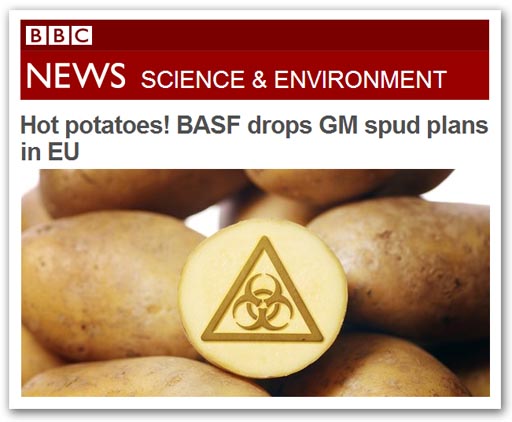 And had such correspondents been active, and those self-same newspapers still took any interest at all in agriculture, more than just the Guardian might have reported on the Oxford Farming Conference back in early January, a political highlight of the farming year which used to be widely reported in the popular media. With the two events in the public domain, one or other of the correspondents – having the time and background knowledge to explore such things – might have linked the two reports and noticed a startling incongruity which has profound implications for the current (albeit lacklustre) debate on the European Union. Crucial to this is that the star speaker at the Oxford Conference was Defra Secretary of State Owen Paterson, his first address at the Conference in his elevated role. And the link which screams out when you put the Guardian report side-by-side with the BASF news is that, on the one hand, you have Mr Paterson actively promoting the use of GM while, almost exactly a month later, we get a major player pulling out a key developmental sector. "The British public should be persuaded of the benefits of genetically modified food", the Guardianreport had Mr Paterson saying, making his statement, "a key signal of the government's intent to expand agricultural biotechnology and [to] make the case for GM food in Europe". Ostensibly, therefore, we have a classic example of the impotence of a British minister in the face of a multinational company reluctant to pursue the technology he favours. And the reason in this instance is, according to the lamentably inaccurate BBC, that: "The genetically modified potato project gained approval at EU level but was a commercial failure". This BBC report (by environment correspondent Matt McGrath) does not even begin to do justice to the issue. It presents a grossly distorted account of the situation, having omitted the all-important sentence in the original BASF press release (dated 29 January). This reads: The company will also discontinue the pursuit of regulatory approvals for the Fortuna, Amadea, and Modena potato projects in Europe because continued investment cannot be justified due to uncertainty in the regulatory environment and threats of field destructions (my emphasis).Field destructions have certainly been a factor in the ongoing struggle to gain wider use of GM crops, but there can be no doubt where the emphasis lies in the BASF press release. The main reason for them pulling out is, quite simply: "uncertainty in the regulatory environment". Regular readers of this blog – who are far better informed on such issues than those who rely on the pap dished out by the legacy media – will be aware that approval of GM crops is an exclusive EU competence. Therefore "uncertainty in the regulatory environment" relates exclusively to implementation of EU law. Furthermore, readers will also be aware that, applications for marketing approval of GM foods, if contested by Member States, go through the comitology process and that one of the BASF potato products suffered from this process in 2006 before it was finally approved in March 2010, after a delay of 13 years. But, since BASF seems to have mastered the approvals process, and has achieved some success in have one of only two products (the other being GM maize) gain market authorisation, one might ask why the company has thrown in the towel after so much time and expense. Part of the reason is undoubtedly due to the European Commission failing to enforce its own legislation. A weak Commission has allowed Member States to conduct what amounts to a low-level guerrilla war against GM, in a bid to prevent such crops being sown in their territories. Austria, Bulgaria, France, Germany, Greece, Hungary, Luxembourg and Poland have all used loopholes in the law to block its exploitation. The key, though, is in the comitology process itself, and in particular the amendments brought in with the Lisbon Treaty. In an attempt to "democratise" the process, Articles 290 and 291 gave powers to the European Parliament to block, under certain circumstances, comitology decisions. As a general rule, the European Parliament tends to be hostile to GM crops and the additional hurdle of gaining approval from this institution has clearly proved to be the last straw for BASF, as the chances of gaining approval for any new product under the amended regime is next to nil. Thus, BASF cannot justify the investment in new products if there is no certainty that, at the end of the long and expensive approval process, there is no reasonable expectation of being given a market authorisation. It is thus pulling out of the European market for these products altogether, and concentrating on the US – an ironic situation for a company founded – and still headquartered – in Germany. The greater irony though is the president of the European Parliament, Martin Schultz telling us that the "EU needs to prove its own importance", arguing that the EU has to become "more democratic" , which "implies strengthening the European Parliament". Under the original, "less democratic" comitology system, it was already virtually impossible for individual member states to influence the process, but under the new "democratic" system administered by an already strengthened European Parliament, it is beyond the reach of individual Member States – and reason. Thus, we find that Owen Paterson, member of the British government, is powerless to intervene and promote the use of GM crops in the UK, even if that was the democratic will of the Westminster parliament and the entire nation. Still less is he able "to make the case for GM food in Europe". The Lisbon Treaty has put paid to that. Piling irony on irony, however, latterly we have besieged by europhile scaremongering about the supposedly crippling "uncertainty" arising from Mr Cameron's referendum announcement, and its effect on the Single Market. Yet the GM approval system is part of the Single Market, and it is the "uncertainty" in this regulatory environment that is causing a major player to desert Europe and concentrate on the United States. As so often, claimed effects and reality are opposites, not that you will ever learn this from the BBC. COMMENT THREAD Richard North 03/02/2013 |
Booker: MPs plumb new depths
Sunday 3 February 2013
 It is not surprising therefore, that Booker – in and amongst a nightmare week that had BT scrambling his telephone lines – should find space in his column to remark on the vacuity of our MPs. His piece starts, however, with the Ken Clarke show on Radio 4's Today programme, a more vacuous item it is hard to recall. This was the 12-minute interview last Thursday in which that battered old Euromaniac was excitably egged on by John Humphrys to explain why it would be "a fatal mistake" for Britain to leave the EU. Constantly talking over Clarke, Humphrys himself even went so far in betraying his bias as to compare those calling for a referendum to the "hangers and floggers" of yesteryear. The most dismal consequence of David Cameron's promise that we might one day have an in-out referendum has been the eruption on all sides of Europhiles suggesting not just that it would be disastrous for Britain to leave the EU, but that even to talk of a referendum is creating such a miasma of fear and uncertainty that it is already imperilling the future of Britain's economy. But the most dismal spectacle was the week in the House of Commons, writes Booker. This began on Monday with Speaker Bercow's support for the idea that MPs should get a 30 percent pay rise, just as the rest of us are facing years of austerity. On Tuesday, we saw Nick Clegg's Lib Dems vengefully refusing to support those promised boundary changes that might give their Tory Coalition allies 20 more seats at the next election. This prompted that admirable parliamentary commentator Quentin Letts to a wonderfully contemptuous threnody on the depths to which, in the past 20 years, he has seen Parliament sink. This was followed on Wednesday by a six-hour debate on "Europe" in which, without exception, MPs regurgitated to an often largely empty House nothing but equally empty cliches, most so ancient that they were already familiar decades ago. Not a single MP, Europhile or Eurosceptic, seemed to have the slightest grasp of how the EU actually works or the rules it lives by. Not one knew enough to spell out why Mr Cameron’s proposals are no more than wishful thinking. Not one, for instance, was aware that for Cameron to get his "re-negotiation" would, under the Lisbon Treaty, require a new treaty, involving procedures so lengthy that they would last way past his 2017 deadline. The only way he could get the negotiations he says he wants would be to invoke Article 50 of the treaty, which not a single MP seemed aware of – and which Mr Cameron has already ruled out, because it would require him first to declare Britain’s intention to leave the EU. Concludes Booker, one of the heaviest prices we have paid for handing over the running of our country to this system centred in Brussels is that our MPs have lost all ability to think for themselves, or to do enough homework to allow them to relate to the real world. All these sad people can think about is how they should be given a pay rise, for serving us more lamentably than any MPs in history. COMMENT THREAD Richard North 03/02/2013 |
Sunday, 3 February 2013


 Posts
Posts

