

Horsemeat fraud: criminality and confusion
Monday 25 February 2013
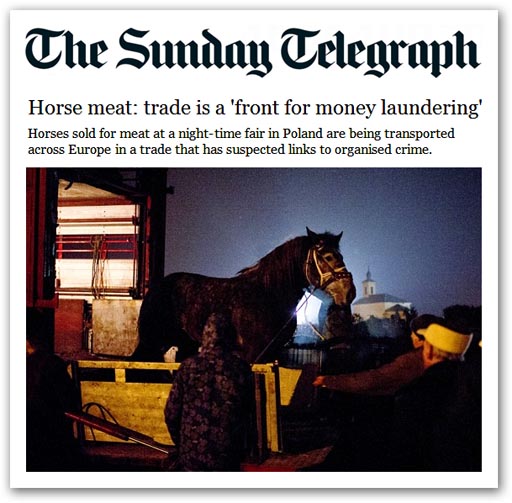 The only useful information could have been covered in an article a fraction of the length, pointing to what appear to be over-generous prices paid for horses on the hoof. An old mare, it was claimed, had been sold through the Skaryszew market for 7,000 zloty, equating to about £1,400 or €1,700. We were further told that the farmer selling the animal expected 5,000 zloty. Journalist Claire Duffin thus asserted that the farmer was paid almost £3.40/kg for his horse – close to €4/kg. Yet, she wrote, the most expensive horse meat, from foals, fetched only £2.40/kg (€2.75/kg) in Italy, where the animals are mostly slaughtered. By contrast, in the UK, unwanted horses which end up in the food supply, can – according to one horse charity - be sold for £100 or less, making slaughter a lucrative proposition in the UK. On this basis – and with the help of the World Horse Welfare charity – Duffin concluded that "a more sinister set of suspicions hang over the whole horse trade in Poland: that it is a front for crime". The charity, and the Polish authorities, suspect that the horses are being used in a form of money laundering. Horse selling is a trade that has been going on a long time. In February 2000, the BBC reported on it, using Compassion in World Farming (CIWF) to claim that about 100,000 horses a year were exported by road to Italy, mainly from Poland and Lithuania, and about 7,000 donkeys, most of them from Romania. The movement of horses, Duffin tells us, creates a convenient paper trail for gangs to "clean up" dirty money. By exaggerating the value and number of horses moved, they can explain the existence of large amounts of cash gained from less legitimate enterprises. Paying farmers "slightly over the odds" for their animals is, then, a small price compared with the potential profits. It would have helped here if we actually had the comparator, in order to understand what we are dealing with.. Duffin's data seems thin, and she could be getting her information from something likethis site, which offers an untypically low figure for meat, from France in 2004. We don't really get an idea of what is involved. Currently, it seems, trade prices for Romanian carcase meat can be €3.50/kg. Frozen Polish (boneless trimmings) can be bought for €4/kg, but there have been reports of sales at as little as €2/kg. Doing our own calculations, meat yield from a horse may be less than 40 percent of live weight. Thus, to cover a price on the hoof of €4/kg, boneless meat would have to average at least €10/kg - to which must be added transport and processing costs. Duffin and her sources are thus right to be suspicious of the prices paid in Skaryszew market, especially if meat is being sold at €2/kg. There is another oddity about the Polish market though, which Duffin does not discuss – the fact that almost its entire legitimate horsemeat export volume was sold to Italy. According to Eurostat, of the 13,016 tonnes exported by Poland in 2010, valued at €34,625,817, 12,988 tonnes went to Italy. In 2011, the Polish exported 12,598 tonnes, valued at €35,299,856. Of that all but ten tonnes ended up in Italy. What is not explained is why so much is trade is done with Poland. The next largest trading partner is Spain, from which Italy takes 3.8kt. Belgium supplies 3.7kt, while France sends 2.6kt. Romania sends a mere 1.7kt. As to the statistics for Italy as a whole, home meat production (2011) was recorded (by Eurostat) as 24.5 kilotonnnes (kt), with imports of 27kt. A negligible 1.7kt of exports are recorded, making total home consumption in the order of 51kt, over 60 percent of total EU consumption. What goes into Italy seems to stay in Italy, in a market that worth about €100 million at wholesale prices. However, both the Observer and the Daily Mail assert that Polish and Italian "mafia gangs" are involved in the trade. If this is the case, it may well be through unrecorded trade, a situation which is compounded by the poor state of official statistics. Not only do there seem to be significant differences between Eurostat and FAO databases, which ostensibly measure some of the same things, there also seems to be a mismatch (in Italy at least) between datasets on domestic meat production and number of horses slaughtered. Italian data, for instance, has 67,000 horses slaughtered in 2010, producing 17.9kt of meat (carcase weight – 178,827 metric quintals), as opposed to the figure of nearly 25kt meat, offered by Eurostat (equivalent to 34kt carcase weight - nearly double that recorded). It would be easier (although somewhat dishonest) to pick one set of statistics, and stick to them. You get this with newspapers, having The Daily Telegraph report in 2010 what it claims to be the FAO figure of 213,000 horses being slaughtered for food in Italy "every year". Yet the Italian government recorded for 2009 the number of 84,063 – of which 45,757 were imported. All the indications are, therefore, that there are significant gaps – or discontinuities – in some of the statistics.  Even then, the plot thickens. While the bulk of horsemeat in Europe is processed in Italy, so far, as of yesterday, only one Italian processor has been implicated in the horsemeat fraud. This is the Prima group. From this firm, so far, only about six tons of frozen beef lasagne have been seized. By contrast, there have been two major units in Germany, with another implicated. This latter unit is the German firm Dreistern Konserven, which produced goulash for Aldi, in which horsemeat was found - and which bought its meat via a dealer from Mipol, a Polish-based firm. There have also been – as yet unproven – links with the Irish horsemeat findings and Poland. It cannot thus be said that Poland is in the clear, but it also cannot be said that we yet have anything like a clear picture of the horsemeat trade in Europe, nor even the movement of horses. There may well be Polish/Italian mafia links - but that may not be behind the current horsemeat fraud. However, there is another dagger at the heart of the EU's Single Market. We are told so much about how much trade is facilitated through this construct, but when a light is shone on just one tiny sector, the statistics fall apart, and the mechanisms of trade are unknown in detail. Neither the European Commission, nor anyone involved in it, really knows what is going on. Interestingly, there is an EU Agricultural Council today (Monday), at which our own Mr Paterson will be present. The one thing he could demand, rather than more labelling, which might obscure more than reveal, is for the European Commission to come up with a definitive report, with reliable statistics, on how the horsemeat trade actually works. COMMENT: "HORSEMEAT" THREAD Richard North 25/02/2013 |
Energy: "Only the Tories have a grip on energy"
Sunday 24 February 2013
 An aspect of that failure, we wrote, is the apparent willingness of the party to leave the debate on "fuel poverty" arising from high energy prices to the dysfunctional and increasingly aggressive gaggle of Labour back-benchers and the economically illiterate delegates at the TUC conference, now in full flow – all variously demanding a windfall tax on the energy companies.
Now, on top of comments from Booker, we have the hypocritical Independent on Sunday whingeing about "successive governments playing politics over energy".
It complains that, over the past decade there have been seven energy secretaries – and at least five white papers – all playing different cards with energy strategy. Thus does it declare: "It's a shameful way to behave and the politicians deserve being trumped for their myopic populism", then arguing: Its time to take the politics – if not religion – out of energy policy; whether you prefer wind over coal over nuclear has nothing to do with ideology but everything to do with safety, efficiency, cost, as well as sustainability. What we need is an independent commission – headed by someone like Buchanan and experts from industry – to stake out a thoughtful and long-term strategy and stick to it so that businesses can plan for the future.Meanwhile, the Sunday Express, with its front page lead, finally wakes up to the EU's Large Combustion Plants (LCP) Directive, telling us what we last reminded our readers in November last year, that: "By next March, five of our largest coal-fired plants, capable of supplying a fifth of our average power needs, are to be shut down". In this blog, we've actually referred to the LCP Directive 31 times, starting in August 2005, strangely enough with a piece headed: "When the lights go out …". And then, we were writing in July 2008about a "politically induced crisis", while in April 2009 we were warning that we were: "Six years away from an energy crisis". That was already after declaring in October 2008 that: We are going to get power cuts, unless we do something soon. The problem is already on us with the quota limitations on the coal-fired stations imposed by the EU's Large Combustion Plants Directive. Now, we know this is that nasty European Union and we don't like talking about it. But hiding your head under the covers won't make it go away!But then, after the egregious failure of the Conservatives to address the issues, which we quite deliberately set out for them in August 2008, the Sunday Telegraph is at last on the case. And what does it tell us? Ah! "Only the Tories have a grip on energy", it proclaims, regaling us with the happy thought that, "The voters of Eastleigh have a splendid opportunity to send a message that green fundamentalism is unaffordable". Sometimes I do have a little difficulty trying to work out which planet than paper is actually on. COMMENT THREAD Richard North 24/02/2013 |
Booker: when the lights go out
Sunday 24 February 2013
 With the closure next month of five major coal-fired power stations that between them contribute nearly a sixth of the UK's average electricity needs, over the next few years, Mr Buchanan feared we will be dangerously close to not having enough power in the grid to keep Britain's lights on. Booker, like so many of us, has been trying to explain this for so long that his readers may be weary of it. It was back in 2006 that he first reported on why, within a decade or so, we might see Britain's lights going out. In fact, as he set out in his book, The Real Global Warming Disaster, in 2009, the writing was already on the wall in the government's energy White Paper of 2003. By then, Tony Blair had signed us up to an energy policy centred on building thousands of windmills, fully aware that we would be losing many of our coal-fired power stations due to an EU anti-pollution directive, and that we were unlikely to build any new nuclear power stations to replace those that by now would be nearing the end of their life. This made a nonsense of Mr Buchanan's claim in a vacuous interview with Evan Davis, on Tuesday'sToday programme on Radio 4, that everything was fine with Britain’s "visionary" energy policy until we were hit by that "financial tsunami" in 2008. This prompted Mr Davis to comment, "So we can blame the bankers for it, as we normally do". (Nine months earlier Booker had written a column headed, "When the lights go out, you’ll know who to blame" – it wasn’t the bankers.) The most interesting passage in Mr Buchanan's interview was where he began hinting at what has recently been emerging as a terrifying new element in the Government' s energy policy. It well knows that electricity from the tens of thousands more wind turbines it hopes to see built in the coming years will cost between two and four times as much as that from conventional power stations. Its solution to this is to rig the market with new taxes and other devices so that this will make electricity from wind farms somehow seem competitive. This is the infamous "green paradigm". The aim is not to make wind cheaper but to double the cost of electricity from the gas, coal and nuclear power stations that still provide virtually all the electricity we need to keep our lights on. Around lunchtime last Monday, for instance, National Grid was showing that all our 4,300 wind turbines put together were providing barely a thousandth of the power we were using, 0.1 percent, or a paltry 31MW (as compared with the 2,200MW we can get from a single gas-fired plant). The harsh fact is that successive governments in the past ten years have staked our national future on two utterly suicidal gambles. First, they have fallen for the delusion that we can depend for nearly a third of our future power on those useless and unreliable windmills – which will require a dozen or more new gas-fired power stations just to provide back-up for when the wind is not blowing. Yet, at the same time, by devices such as the increasingly punitive "carbon tax" due to come into force on April 1, they plan to double the cost of the electricity we get from grown-up power stations, which can only have the effect in the coming years of doubling our electricity bills, driving millions more households into fuel poverty.
If our government were not lost in a bubble of complete make-believe, it would keep open those coal-fired power stations the EU is forcing us to close next month (although it may be too late), it would stop subsidising grotesquely expensive wind farms, and it would go flat out to exploit Britain's vast reserves of the shale gas that has more than halved US gas prices in four years.
But we do not have such a government, says Booker. Our lights will go out, our economy will suffer a catastrophe, our bills will double, and tens of thousands more people will die of cold in those freezing winters that our politicians were somehow fooled into believing would never come again. The bizarre thing is that, according to The Daily Telegraph in May 2010, this wasn't going to happen. But, now it is, the politicians have some explaining to do. COMMENT THREAD Richard North 24/02/2013 |


 Posts
Posts

