Saturday, 1 August 2009

 
State Of The Union 2009
Jim Kirwan
8-1-9


The `Union' of the United States is being threatened with dissolution into five areas for purposes of military command and control, over the still reluctant population, that has been the target of its enemies since before this place had a formalized name. One of the most destructive and least known weapons that have been used to accomplish this impending obscenity; has been the use and abuse of regulations and governmental decrees that have been continually used and abused to end this experiment in Freedom, from within.

War and the Emergency Powers”

War & the Emergency Powers [as signified by] The Gold-Fringed Flag


"The illegal we do immediately. The unconstitutional takes a little longer."--Henry Kissinger

Since March 9, 1933, the United States has been in a state of declared national emergency. In fact, there are now in effect four presidentially-proclaimed states of national emergency: In addition to the national emergency declared by President Roosevelt in 1933, there are also the national emergency proclaimed by President Truman on December 16, 1950, during the Korean conflict, and the states of national emergency declared by President Nixon on March 23, 1970, and August 15, 1971.
http://www.rallye-pointe.com/em_powers.htm

Senate Report 93-549
War and Emergency Powers Acts,
Executive Orders and the New World Order
The Introduction to Senate Report 93-549 (93rd Congress, 1st Session, 1973) summarizes the situation that we face today - except it is far worse today than it was in 1973 !!

"A majority of the people of the United States have lived all of their lives under emergency rule. For 40 years [now 66 years], freedoms and governmental procedures guaranteed by the Constitution have, in varying degrees, been abridged by laws brought into force by states of national emergency. The problem of how a constitutional democracy reacts to great crises, however, far antedates the Great Depression. As a philosophical issue, its origins reach back to the Greek city-states and the Roman Republic. And, in the United States, actions taken by the Government in times of great

crises have - from, at least, the Civil War - in important ways, shaped the present phenomenon of a permanent state of national emergency." 
http://www.barefootsworld.net/war_ep.html 

PRESIDENTIAL POWERS IN TIMES OF EMERGENCY:
On September 14, 2001, President Bush declared that a "national emergency exists by reason of the terrorist attacks ... and the continuing and immediate threat of further attacks on the United States." When the emergency will end, no one knows.
http://writ.news.findlaw.com/dean/20020607.html

The Major Premise

(Updated November 13, 2000)

The Introduction to Senate Report 93-549 (93rd Congress, 1st Session, 1973)summarizes the situation as best as possible;

"A majority of the people of the United States have lived all of their lives under emergency rule. . . And, in the United States, actions taken by the Government in times of great crises have-from, at least, the Civil War-in important ways, shaped the present phenomenon of a permanent state of national emergency."
http://www.universalway.org/majorpremise.html  

  • (a) Any authority granted to the President by section 1702 of this title may be exercised to deal with any unusual and extraordinary threat, which has its source in whole or substantial part outside the United States, to the national security, foreign policy, or economy of the United States, if the President declares a national emergency with respect to such threat.

  • (b) The authorities granted to the President by section 1702 of this title may only be exercised to deal with an unusual and extraordinary threat with respect to which a national emergency has been declared for purposes of this chapter and may not be exercised for any other purpose. Any exercise of such authorities to deal with any new threat shall be based on a new declaration of national emergency which must be with respect to such threat.”

A Special Report on the National
Emergency in the United States of America

From Data on The Web and Archives, 
and the work of Dr. Eugene Schroder, et al, 1979 to present.
I have placed it on the web in this edition, that the data may not be lost.


United States Congressional Record March 17, 1993 Vol. #33, page H-1303 Speaker-Representative James Traficant, Jr. (Ohio) addressing the House:

"Mr. Speaker, we are here now in chapter 11. Members of Congress are official trustees presiding over the greatest reorganization of any Bankrupt entity in world history, the U.S. Government. We are setting forth hopefully, a blueprint for our future. There are some who say it is a coroner's report that will lead to our demise."


United States Congressional Record May 4, 1992, page H 2891, Congressman and Chairman of the House of Representatives Committee on Banking, Finance and Urban Affairs (101st through 103rd Congresses), Representative Henry Gonzalez (Texas) speaking on"NATIONAL AND INTERNATIONAL THIEVERY IN HIGH PLACES" (See Record Entry):

"We are bankrupted. We are insolvent on every level of our national life, whether it is corporate, whether it is just plain you and I out there with the life of debt that we have all piled up, private debt, credit cards and what not, or whether it is the government. We are insolvent. How long will it take before that nasty mega-truth is conveyed?"

United States Congressional Record January 19, 1976, page 240, Representative Marjorie S. Holt (Maryland):

"Mr. Speaker, many of us recently received a letter from the World Affairs Council of Philadelphia, inviting members of Congress to participate in a ceremonial signing of "A Declaration of Interdependence" on January 30 in Congress Hall, adjacent to Independence Hall in Philadelphia.

A number of Members of Congress have been invited to sign this document, lending their prestige to its theme, but I want the record to show my strong opposition to this declaration.

It calls for the surrender of our national sovereignty to international organizations. It declares that our economy should be regulated by international authorities. It proposes that we enter a "New World Order" that would redistribute the wealth created by the American people.

Mr. Speaker, this is an obscenity that defiles our Declaration of Independence, signed 200 years ago in Philadelphia. We fought a great Revolution for independence and individual liberty, but now it is proposed that we participate in a world socialist order.

Are we a proud and free people, or are we a carcass to be picked by the jackals of the world, who want to destroy us? When one cuts through the high-flown rhetoric of this "Declaration of Interdependence," one finds key phrases that tell the story. For example, it states that 'The economy of all nations is a seamless web, and that no one nation can any longer effectively maintain its

processes of production and monetary systems without recognizing the necessity for collaborative regulation by international authorities.' How do you like the idea of "international authorities" controlling our production and our monetary system, Mr. Speaker?

How could any American dedicated to our national independence and freedom tolerate such an idea? . . . America should never subject her fate to decisions by such an assembly, unless we long for national suicide. Instead, let us have independence and freedom . . . If we surrender our independence to a "new world order" . . . we will be betraying our historic ideals of freedom and self-government. Freedom and self-government are not outdated. The fathers of our Republic fought a revolution for those ideals, which are as valid today as they ever were. Let us not betray freedom by embracing slave masters; let us not betray self-government with world government; let us celebrate Jefferson and Madison, not Marx and Lenin."

In a nutshell; the above could be considered to be the Foreword for what is happening today. Please remember that George W. Bush's grandfather Prescott Bush was convicted of Trading with the Enemy during World War Two, and that he did not even serve time for that crime (in a time of war) - Why Not? (1)

If we `care' about the state of what was once a voluntary Union of States that we called The United States: then we had better begin to demand real changes from that entity that now sits astride the center of the Spider's Web which has replaced our government with a fascist state, as prelude, to our disappearance into the facelessness but total surrender of ourselves to the New World Order. . .

1) Bush Nazi Link Confirmedhttp://www.geocities.com/bushfamilynazis/

India rejects emissions cuts for a decade


By James Lamont in New Delhi and Fiona Harvey in London

Published: July 31 2009 19:29 | Last updated: July 31 2009 19:29

India will not discuss signing up to legally binding obligations to make absolute cuts in greenhouse gas emissions for at least 10 years, Jairam Ramesh, the country’s environment minister, said on Friday.

“In 2020, it’s conceivable that we might look at a limited target. But in 2009, no way,” said Mr Ramesh.
Fiercely intelligent yet unfathomably daft, hugely loyal yet slyly treacherous...

How Mandelson is our REAL PM


ByEDWARD DOCX
Last updated at 3:57 PM on 01st August 2009

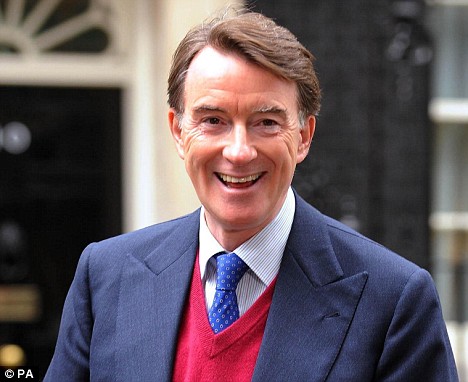
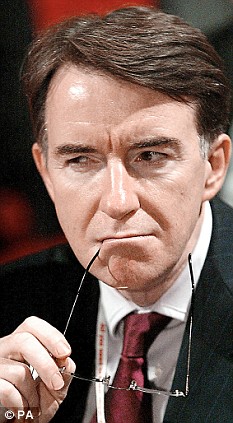
Peter Mandelson

The most powerful man in Britain? Lord Mandelson

This weekend, for the first time in British history, we have three prime ministers presiding over the country at once.

Harriet Harman, the deputy leader of the Labour party, is in Downing Street as acting prime minister.

The official Prime Minister, Gordon Brown, is on holiday in Scotland.

Meanwhile, the real prime minister, Peter Mandelson, is planning for a General Election and running the country. 

For make no mistake: Lord Mandelson is the most powerful man in Britain.

Throughout this week, he has been pronouncing on all matters of policy and presentation.

From public spending cuts to the possibility of a televised debate between the party leaders, he speaks with absolute unquestioned authority.

Indeed, ever since he saved Brown from ignominy in June, Mandelson has performed the role of the official Prime Minister's life-support system. He wields his power daily, but he has consolidated it over the past few weeks.

Like his grandfather Herbert Morrison, he is Lord President of the Council. Like Michael Heseltine, he is First Secretary - ahead of all the other secretaries of state.

And, he continues to rule over the expanding Business, Innovation and Skills department, which has the largest number of ministers in Whitehall.

He is deputy chairman of the Domestic Policy Committee, a member of 80 per cent of the 43 Cabinet committees and sub-committees and he has 11 ministers who report to him on everything from trade to universities and manufacturing.

It was exactly 30 years ago that Mandelson entered political life after being elected as a Labour councillor for Lambeth. In the winter of 1979, the Labour party was just about to forget about the British people in favour of a long and enthusiastic tour of the hinterlands of lunacy and irrelevance.

Mandelson was living in a tiny flat in South London. His bed folded into the living room wall.

The journey from that poky room to the pomp and influence of his present circumstance comprises the most interesting political career of our age.

We have come to know Blair and Brown intimately: their undeniable strengths, obvious weaknesses, psychologies, flawed or otherwise, and the manner in which their private natures are expressed in public.

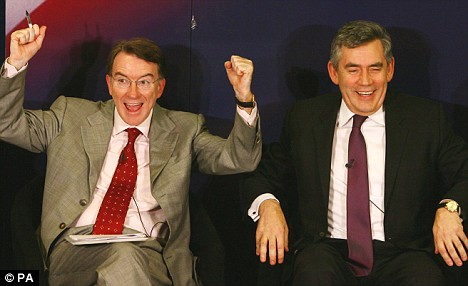
Peter Mandelson Gordon Brown

Mandelson (left) talked with Gordon Brown about re-entering Parliament to which the PM said:  'I'm offering you a different job and in the circumstances, it's a bigger job'

The architecture of their characters is complex, but it is also linear and well drawn. But with Mandelson everything is labyrinthine, shaded and contradictory.

Indeed, if you were to sit down and write the New Labour story as a novel, it is not Blair, Brown, Campbell or Prescott who would be the greatest challenge: it is Mandelson.

For, somehow, you would need to create a man who was fiercely clever and unfathomably daft, formidably direct and slyly oblique.

A man who was the best giver of advice of his generation, but one who was blind to the sometimes disastrous effects of his own behaviour. A man capable of great loyalty and great disloyalty.

A man prepared to sacrifice himself again and again for his leader and his party, but at the same time a sneak, sulker and small-time gossip.

And, most intriguingly of all, a fool and the greatest political seer the post-war Labour party has had.

What on earth made Mandelson the man he is?

Peter Mandelson

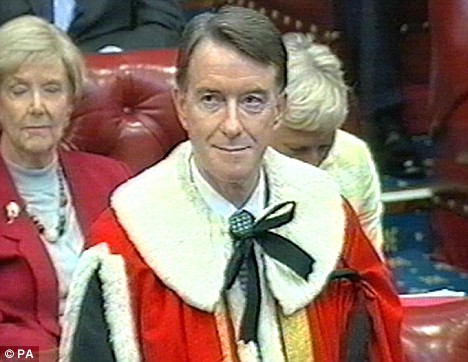
Peer: Being inducted into the House of Lords last year

Peter Benjamin Mandelson was born on October 21, 1953, in Hampstead Garden Suburb, North London, into what might be called Labour party aristocracy.

At that time, Hampstead was choking on Labour party leaders - Gaitskell, Foot and dozens of their acolytes lived there.

Most importantly, the Wilsons lived down the road: a young Peter watched them leave for Downing Street and was invited to visit the prime minister in June 1965, just as his mother, Mary, had been invited to visit by Ramsay MacDonald a generation before.

Peter was the second son of Mary and 'Tony' Mandelson. George was his father's real name, but he changed it and was known to everyone as Tony. He was a flamboyant advertising director on The Jewish Chronicle.

Mary Mandelson was more introspective and seems to have had an emotionally cauterised relationship with her father, Herbert Morrison - a renowned politician who was home secretary, foreign secretary and deputy prime minister.

Indeed, Morrison was an infrequent visitor to the Mandelson family home, especially after he remarried in 1955. The psychological implications of him being Peter's grandfather are, in many ways, more important than any actual relationship between them.

Peter's brother Miles, a clinical psychologist, has said that Peter was closer to their mother than their father, and that mother and son 'were in tune with one another at an emotional level, as well as an intellectual level'.

Peter Mandelson custard

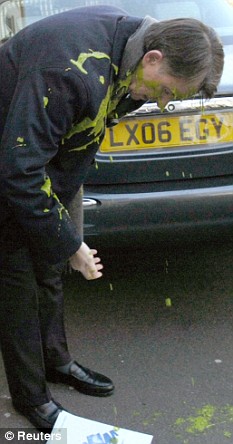
Green protest: Leila Deen was opposed to the expansion of Heathrow airport and showed her fury by throwing custard over Mr Mandelson

And Donald Macintyre, Mandelson's authorised biographer, has documented the terrible rows between father and son, which ended with Peter stomping off to his mother in the kitchen to complain about his father's 'immature' and 'self-indulgent' views.

It seems to have been a combative relationship. Certainly, when Tony died, Peter, then 35, was deeply distressed - not least, Miles speculates, because of a sense of 'unfinished business' between them.

In discussing Mandelson's relationship with his father, an aide who worked with him through the Nineties suggests that 'all through that period, you could see that Peter was unconsciously seeking approval'.

'You see it with lots of men whose relationship with their fathers is in some way difficult. They seek authority figures and curry favour. Peter had it almost as a compulsion.'

And, indeed, there is something of a pattern. Until recently, the default setting on Mandelson's hard drive has been to identify the most powerful person and then work exclusively, almost slavishly, for them - often at the expense of all other relationships.

This predilection for single-minded service to his chosen leader informed Mandelson's relationship with Neil Kinnock, his early relationship with Brown, then with Blair, and now informs, again, his bond with Brown.

It is a strategy most often followed by intelligent people who for real or imagined reasons do not believe they will not be widely liked enough to advance to the top. And it is striking how many of Mandelson's briefing notes - to Kinnock, Brown and Blair - read like those of an independent, but dutiful son.

Dutiful to the leader, perhaps, but not to everyone else - which is why the 'not-being-liked-thing', as Alastair Campbell might put it, comes up a lot. Mandelson's enemies are many and their grievances legion. Though often, one suspects, they can be decoded into a single complaint: he outwitted them.

One thing of which they accuse him time and time again is financial greed. But here it is revealing to note that when Mandelson left TV in 1985 to become Labour's director of communications, he took a big salary cut.

Indeed, on every occasion that he has been given the choice between power and money, he has chosen the former. The truth is that he is not that interested in wealth. Or rather, he ismoreinterested in power.

Mandelson

He's back: Mandelson heads to Number 10 for talks with Gordon Brown on his shock return to Government

This is not to contend that he is unattracted to celebrities and millionaires - but that, in the end, his rich-list love-ins are more a form of curiosity and status affirmation than anything else.

Mandelson's relationship with Reinaldo da Silva, a Brazilian in his late 30s, is a decade long and strictly private - they rarely appear in public together.

Two points are important, though: being homosexual has made a difference to Mandelson's view of himself; and it continues to matter in his day-to-day working life.

One of his former aides told me: 'If you are not at ease socially - if you are from the generation where being gay was a problem, then you set about building an alternative structure for your life in order to be happy and to get some respect and peace.

'Peter spent the first half of his political career trying to find a place that was psychologically comfortable: he wanted to be a gay man in the centre of politics - not just an adviser, but someone taken seriously in his own right.

'Because he is there now, because he is even more the person that he wanted to be, his emails and texts are more playful now. That's why the cruel edge is gone.'

The author Robert Harris, a close friend of Mandelson, expands on the second point: 'Being gay is an advantage to Peter. Or, rather, there are costs and benefits.

'One of the dividends, though, is that his life has assumed a different rhythm. He is freer.

He remains youthful, too. And because he has no family, he is able to be 100 per cent professional.

Blair Mandelson 2001

'Kangaroo court': Mandelson (right), pictured with Tony Blair, was forced to resign after being accused of helping the Hinduja brothers get passports in 2001

'To the people who need him, he is always there. He has no great interests - he is cultured - but he has been able to live for his work.

'His officials say that he has an immense command of detail. That he is clear-eyed and able to take decisions every morning.'

When I asked one Blairite insider what she thought were Mandelson's best and worst moments, she replied that the second Cabinet exit - when he was forced to resign after being accused of helping the Hinduja brothers get passports - was the lowest moment of his professional life.

'It was like a kangaroo court. They had already decided. Peter was just sitting in my office and I had to go and take him down and I was crying and crying. It would have finished most people off.'

She cited his return to the Trade & Industry job ten years later as Business Secretary as the best: 'The whole of the department was gathered on the stairs clapping him in.'

The extraordinaryrapprochementbetween Brown and Mandelson, which paved the way for this return to the Cabinet, was precipitated by a chance conversation a year ago.

In July 2008, Mandelson was lunching with Jeremy Heywood, Brown's principal private secretary.

Mandelson recalls: 'Jeremy arrived late for lunch and said that, on his way out, the Prime Minister had asked where he was going and he said, slightly sheepishly, that he was going to have lunch with me.

'And Gordon said: "Can I come, too?" Jeremy said: "No, you can't." So Gordon said: "Can you ask Peter to come and see me after lunch?'''

Mandelson affirms that they talked all that summer - and, in October, Brown contacted him to discuss the Cabinet reshuffle and make his offer.

'[Mandelson] said: "I've got a job already." (He was then European Commissioner for Trade.) To which Brown said: "I'm offering you a different job and in the circumstances, it's a bigger job." '

Toby Jug

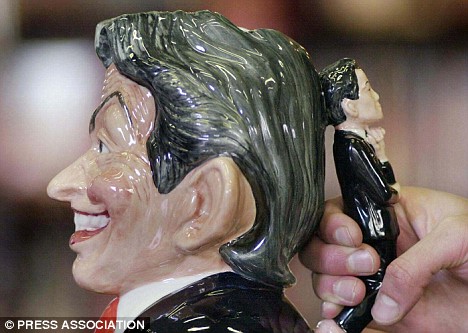
Collectible: A limited edition Toby Jug depicting then Prime Minister, Tony Blair with a Peter Mandelson handle

Naturally, Mandelson went straight to see the other person in the marriage. Blair's response was unequivocal: 'You've got to go back, it's a no-brainer.'

So, after three decades, two dramatic resignations and this surprise recall, Mandelson has emerged from the shadows as his own man - and, crucially, the person who will most influence the next General Election.

Not that Brown seems likely to win, of course, but Mandelson knows there is no nationwide enthusiasm for Cameron and even less for Osborne. This is not 1979 or 1997. The country will puff out its cheeks and vote for an insultingly vapid Conservative Party.

But the margin of the victory is by no means certain and Lord Mandelson will be the single most powerful figure in reducing it.

He will also have calculated that although a General Election defeat seems all but inevitable, a second Conservative term is not.

Able people do not go into politics any more and the field is thin, but Mandelson's ability to transcend the puerile Blair-Brown feud of the past 15 years means he is also the Labour Party's kingmaker.

If he is not the next leader himself - anything is possible - then it will be whoever he believes has the best chance of defeating Cameron next time around.

Because, behind it all, Mandelson sees himself as the guardian-in-chief of the Labour party - its sentinel, protector, the keeper of the flame.

In this sense, Peter Mandelson is as Old Labour as it is possible to be.

EDWARD DOCX'S novel Self Help (Picador) won The Geoffrey Faber Prize. A fuller version of this article appears in Prospect Magazine. www.prospect-magazine.co.uk