 | | The Daily Reckoning | Tuesday, September 28, 2010 | - Owning today what Emerging Markets will need tomorrow,
- When “better than expected” just doesn’t cut it anymore,
- Plus, Bill Bonner on “pre-Clinton” unemployment, Bernanke’s Plan B and plenty more…
.................................................................................................
Offer Closes TOMORROW - Wednesday, Sept 29.
How to Get Every Agora Stock Pick -- For Free -- For Life... It's our best offer of the last 4 years.But it closes forever at 5 PM Wednesday, September 29.
Learn how to get every stock pick for free, for life - right here
.................................................................................................
|  | | | The Problem with Cautious Optimism | | When "Better than Expected" is still "Worse than Desired." | |  | | Eric Fry |
Eric Fry, reporting from Laguna Bach, California…
Better-than-expected is not the same thing as good…
Last Sunday, the offense-challenged Buffalo Bills scored an impressive 30 points against the mighty New England Patriots. Thirty points was double the Bills’ per-game point total from last season, and also double the Patriots’ points-allowed total from last season. So thirty points was definitely much better than expected.
The Bills lost the game – 30 to 38.
Last week, the growth-challenged U.S economy posted a 2% growth in durable goods orders for August and a 7.6% jump in existing home sales. Both reports were better-than-expected. And the stock market welcomed the news with a much better-than-expected response. But the economy is still losing the game.
During the last few weeks, the banter from the financial news play-by-play analysts has upticked from despondent pessimism to cautious optimism. The threat of a double-dip recession is receding, the analysts say, and the economy is slowly recovering.
But is it?
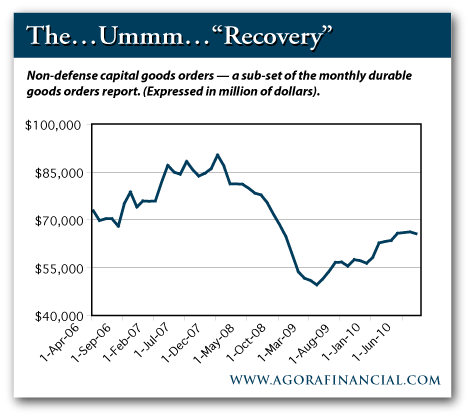
The only problem with cautious optimism is the optimism part. The caution is warranted. The better-than-expected durable goods orders, for example, were still pretty dismal – today’s durable goods orders remain lower than they were five years ago and much lower than they were three years ago.
True enough, say the Wall Street analysts, but you’ve got to look at capital goods orders – the subset of the capital good reports that, in the words of the Associated Press, “is considered a good proxy for business investment planning.”
Okay, so let’s look. What we see is a data series that has bounced off the bottom of very depressed levels, but is stalling well below optimal levels.
Existing homes sales also came in better-then-expected, or “above consensus,” as the Wall Street folks like to say. According to a survey of Wall Street economists, existing homes sales were supposed to increase 7.1% from July’s record-low sales number. Instead, sales jumped a better-than-expected 7.6%...to the second-worst level of the past ten years.
Maybe the economy is improving, but the better-than-expected reports that have been crossing the newswires lately are very far from good. The chart below shows one very clear picture of the difference between better-than-expected and genuinely good.
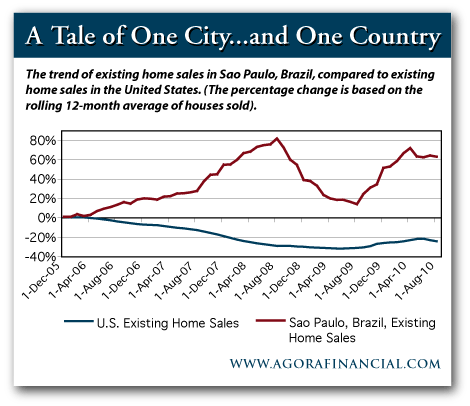
Here in the U.S., existing home sales have rebounded from disastrous to merely awful. Meanwhile, down in the booming Brazilian economy, home sales have progressed from strong to stronger.
These contrasting housing market trends correlate very closely with the contrasting trends of U.S. and Brazilian economic growth. During the last three years, the U.S. economy has produced zero net GDP growth. The Brazilian economy, meanwhile, has grown about 4% per year. This contrast offers just one glimpse into the compelling investment profile of Brazil…and of the Emerging Markets in general.
Last week, your editors here at the Daily Reckoning extolled the virtues of Emerging Market economies and investments. Continuing this theme in today’s edition of the Daily Reckoning, Chris Mayer, editor of Mayer’s Special Situations, provides a few thoughts on Brazil…from Brazil.
| | |
The "Doctor Recommended" Investment...
Across the world, biotech companies are pouring money into curing the biggest killers of mankind — with very little success...
But we've found the exception. There's a little-known biotech that's had astonishing success developing a patented vaccine technology effective against influenza, AIDS — even cancer.
Click here to learn more about this revolutionary technology — and how it could bring early investors up to 10,000% returns.
|
| |
| | The Daily Reckoning Presents | | Flip-Flops-On-The-Ground Research | |  | | Chris Mayer |
"Brazil is blessed with enormous reserves of the metals and minerals essential to modern manufacturing... Coal may be the only substance vital to industrial production that is in short supply."
— Larry Rohter, Brazil on the Rise: The Story of a Country Transformed As I write, I'm in Florianopolis, the capital of the state of Santa Catarina, in southern Brazil. "Floripa," as it is known, is on the landward side of an island, where it can shelter ships from the brunt of the Atlantic Ocean's powers. Our guide tells us that Portuguese colonists settled here in the 17th century, looking for gold.
They didn't find gold, but Floripa has become a favorite spot for wealthy Brazilians. We are staying at a resort on Jurere Beach, which is one of 42 beaches on this 200-square-mile island. Jurere is the best one, apparently, having won a number of awards. Jurere is where the rich stay when they come, and we saw some monster houses that looked like beached cruise ships -- one even had a helipad.
This is the southernmost part of our four-city tour through Brazil. We came to Floripa to look at a new project by a group called Txai (pronounced "chai," like the tea). It is a spectacular piece of property. This project will be open to individuals to buy bungalows, lofts and more.
In the video below, Barb Perriello and I do some boots-on-the-ground investing -- or, in this case, flip-flops on the ground -- as we check out the views on our way to the beach:

But our topic today is fertilizer. In Sao Paulo last week, I gave a short presentation to a group of readers about a few attractive Brazilian investment themes. I talked about the expanding middle class, which is driving the need for new housing. I talked about Brazil's dominant position in the global meat trade. I also talked about the case for hard coking coal (also known as met coal)…and about fertilizer.
Brazil, like most emerging markets, needs much more fertilizer than it produces for itself.
Fertilizer demand is also soaring throughout all the large emerging markets. Companhia Vale Do Rio Doce, “Vale,” (NYSE: RIO) is a large Brazilian company that offers a glimpse into Brazilian demand for both coal and fertilizer.
Last Friday, Vale announced that it planned to sell its fertilizer assets in an IPO in the first half of 2011. (Vale will likely retain a stake in the company, but how much is not clear yet.) Vale Fertilizantes, which is the name of the new fertilizer company, will hold all of Vale's fertilizer assets. Vale is doing this to create value for Vale shareholders by drawing more attention to these things, which are the second biggest revenue generator for Vale, after its more famous iron ore mines.
Vale Fertilizantes has many of Brazil's best fertilizer assets, which is key because Brazil also imports most of its fertilizer needs. Take a look at this chart:

You can see that Brazil depends on the rest of the world for its fertilizer needs, which keep its mighty agricultural production humming. In particular, note the lack of domestic potash, with 93% of Brazil's needs coming from outside of the country.
Vale has some good assets outside of Brazil, too. It has, for example, the Bayovar mine in Peru (a joint venture with Mosaic), which is one of the largest phosphate deposits in South America. It also has potash projects in Saskatchewan and Argentina (though I'm not sure how good its deposit is in Argentina. I have my doubts).
In any event, I'm fascinated by the IPO and will keep you posted. Investors may soon have another choice in potash producers. Vale is looking to boost its production of potash tenfold by 2017, which would put it behind only PotashCorp and Mosaic.
In a bigger-picture sense, both of these commodities fit under a broader theory that you will do well to invest in the commodities that the big emerging markets are short of. China, India and Brazil import both hard coking coal and potash -- and it looks likely they will import a lot more over the next decade.
Regards,
Chris Mayer,
for The Daily Reckoning
Joel’s Note: As all good investors will know, there’s nothing quite like getting your hands dirty – or your flip-flops wet – before making a decision on when and where to invest. An up-close-and-personal look at exactly what you’re investing in - be it stocks, property or otherwise - can provide invaluable information you wouldn’t otherwise get from your lounge chair or from watching the evening news.
Knowing this, Mr. Mayer often leads group research trips to countries and regions in which he is considering investing. You might remember earlier this year he made the long-haul flight to China, to get a ground view of the situation there. Now he’s in Brazil.
In January, Chris will head to Southeast Asia, along with our own Eric Fry and a small group of readers, to get a better handle on the many opportunities this available in this fast-growing region.
If you’d interested in taking part in the excursion – which will include Singapore, Viet Nam, Cambodia and Thailand between January 18-31, 2011, you’re invited to check out the details here.
These groups tend to be pretty small, so don’t dilly-dally. Learn more here:
Southeast Asia Profit Expedition Singapore, Vietnam, Cambodia, Thailand January 18-31, 2011
| | |
The Countdown To September 30...
Here’s a Question: What Will YOU Do When Government Retirement Goes Broke?Starting September 30th, your government “safety net” will officially begin to shrink. But you can protect yourself – and find out how to collect regular income checks from the “other” gov’t-backed retirement program... Simply Click Here (and turn your speakers on) to listen to our full presentation.
|
| | | | Bill Bonner | | Day Care or Default? | |  | | Bill Bonner |
The long-expected decline of an unsustainable economic model.
And now over to Bill Bonner with the rest of today’s reckoning from Baltimore, Maryland...
After so much traveling, we’re happy to stay at home this week and do our reckoning here.
This past weekend, we got back from Florida only to depart immediately to a wedding in New York. The roads are a lot worse in New York than they are in Florida. Maybe it’s the weather. Maybe it’s the tax system. But as you drive up from Maryland, the roads deteriorate as it costs more to drive on them. You run into more and more potholes and shabby tollbooths as you go north.
That’s not likely to change. Local governments are going broke. So are national governments. The politicians will have to make choices. Repair the roads...or keep the libraries open? Day care...or default?
At the wedding was a former Goldman bond trader. “How long do you think it will be before government debt blows up,” we asked him. His reply, “no time soon”...more below...
Not much happened on Wall Street yesterday. The Dow lost 48 points. Gold went nowhere.
And so far, almost everything that we thought ought to happen is happening. More or less. The crisis. The feds’ reaction. The market’s lack of reaction to the feds’ over reaction. Then, the feds’ reaction to the markets failure to react. One dumb thing begets another.
But so far, government debt market hasn’t blown up. But even when things happen that we expect, they don’t necessarily happen the way we think they ought to or when we think they should.
We’ve had the crisis we expected. Then, the feds poured good money in after bad...as expected. They said the economy would ‘recover.’ Of course, the economy would do no such thing. Instead, it has only just begun its “Great Correction” – with high unemployment, falling house prices and treacherous asset markets. And now Obama and Congress are paralyzed by upcoming elections. And Ben Bernanke is thinking about Plan B...and hoping it won’t be necessary.
Unemployment is really far worse than the ‘official’ numbers suggest. The feds take people off the unemployment roles if they go too long without finding another job. In that regard, this slump is the worst ever. People wait longer than ever before to find another job. So more of them slip off the jobless tally before they ever find work. They are disappeared by fed statisticians. We haven’t done the numbers ourselves but John Williams of ShadowStats tells us that if they still did the figures the way they did before Clinton-era “adjustments,” we’d have an unemployment rate between 15% and 17%.
Gradually the financial media and investors are catching on. They’re beginning to realize that this was no ordinary recession...and there won’t be any ordinary recovery either.
The New York Times brought the story to readers this weekend:
“In the old days — before 1990 — American recessions tended to be fairly sharp. But the recoveries, when they came, were also rapid. Laid-off workers were recalled and consumers who had deferred purchases out of fear they might lose their jobs were willing again to buy cars and homes. “The newer version of recessions — in 1990-91 and 2001 — provided shallower downturns. But the aftermath was also slow and painful. They came to be known as jobless recoveries. “The National Bureau of Economic Research determined this week that the recession that began in December 2007 ended in June 2009. That made it the longest downturn since World War II, and data had already shown it was the deepest in terms of decline in gross domestic product. “And now that we know the recovery is more than a year old, it appears that this cycle is combining the worst of both worlds: deep fall followed by slow recovery.” “There are some aspects of this cycle that have no direct precedent. One is the performance of service industries. For most of the years after World War II, the United States economy became more and more oriented toward service jobs, and both employment and spending rose, whatever the state of the rest of the economy. But this time service businesses suffered, and they have been slow to recover. “That is particularly true for the industry that bears the most blame for the recession — financial services. The big banks were bailed out — Lehman Brothers excepted — but employment fell sharply during the recession and has continued to decline. “Another area that is weaker than in previous recoveries is the condition of state and local governments. Working for them was always considered safe, if not particularly rewarding. Neither of the two recessions before the latest one had any significant impact on those jobs. But in this cycle, governments are facing severe budget shortfalls, and layoffs are accelerating.”
What kind of cruel fate is this, dear reader...when even the zombies on the public payroll aren’t safe from layoffs? Have the gods turned against us?
And more thoughts...
The Great Correction is good news, as far as we’re concerned. Finally, the financial gods are kicking the right butts. You can’t really get rich by spending money. And you can’t really create prosperity by building houses for people who can’t afford to pay for them. So to the Bubble Epoque, we say: ‘Goodbye and Good Riddance.”
America needs a correction; it’s getting one. It was wasting too much of its resources on phony, unsustainable ‘growth,’ while actually going deep into debt.
Why was it doing that? Well...blame Alan Greenspan...blame the Fed...blame the US Treasury...blame Richard Nixon...blame Milton Friedman and John Maynard Keynes. They all had a hand in it.
We’re beginning to see more clearly how economists and the feds connived and conspired to rig the system. The dollar-based monetary system they created has a huge bias towards debt and inflation. Almost everyone likes it. And the others don’t know what’s happening anyway... But has any pure paper money ever survived an entire credit cycle – from the boom years through the bust years – intact? Nope. Never.
And now the Great Correction has begun. And the serious question is: how much of this scam is it going to correct?
We don’t know. But there’s a lot to be corrected.
*** “Well, I think the bond market is the most misunderstood market in the world. Everybody is talking about how bonds are the worst place for your money. But I think they are the best place for your money.”
Speaking was one of the best bond traders in the US. At least, that was the judgment of other bond traders and industry experts. We wanted to know more...
“Some of the best investments you can make now are in the bonds of places such as Ireland and Greece. Everyone thinks they’re going broke. But they’re not. The European Central Bank will give them the money to make their payments. They’re not going to default.
“That’s what is great about bonds. We’re entering a difficult period for the world economy. There is simply too much capacity. This correction is going to take a long time. People are worried about defaults on sovereign debt? They can forget about it. Neither Europe nor America will default. The central banks won’t let them. Instead, they will announce a program of long-term deficit reduction. In return for correcting structural budget problems, European nations will get the money they need to meet their obligations. These will be pure cash “awards,” not debt. So their debt won’t increase. Bond investors won’t have anything to worry about.
“I don’t know if they will actually correct their long-term finances or not. It depends on the growth rate. If they can grow their economies fast enough, they may not have a problem. But whatever problem it is, it is far in the future. In the meantime, these sovereign bonds will go up. Because the payers won’t default. And everything else will go down. Want some good advice? Buy bonds.” Regards,
Bill Bonner,
for The Daily Reckoning
................................................................................
Here at The Daily Reckoning, we value your questions and comments. If you would like to send us a few thoughts of your own, please address them to your managing editor atjoel@dailyreckoning.com |
|
|
|

 The Daily Reckoning U.S. Edition


 Posts
Posts

