 | | The Daily Reckoning | Wednesday, December 8, 2010 |
- Rumor frenzy builds around the J.P. Morgan silver short story,
- What "backwardation" could mean for the precious metals,
- Plus, Bill Bonner reckoning on "convicts 'tween the decks" and other goings on...
| | J.P. Morgan and the Great Silver Caper
| How J.P. Morgan is (allegedly) trying to manipulate the silver market
| |  | | Eric Fry |
Reporting from Laguna Beach, California...
There's a lot of rumor, buzz, innuendo, chitchat and scuttlebutt about the precious metals markets these days. Most of the chitchat is about J.P. Morgan and silver. Rumor has it that J.P. Morgan has amassed a whopping short position in silver.
The scuttlebutt, according to SFGate.com, is that "J.P. Morgan holds a giant short position in silver. Furthermore, some observers are accusing the bank of acting as an agent for the Federal Reserve in the market...I.e., a lower silver price helps maintain the relative appeal of the US dollar...
"By selling massive amounts of paper silver in the futures market," SFGate continues, "J.P. Morgan has been able to suppress the price of the precious metal. It is believed that these short positions are naked (i.e. they are not backed by any physical silver)."
If the silver price were falling, Morgan's (alleged) short position would be lauded as a stroke of genius. But since the silver price is soaring, Morgan's (alleged) short position looks much less laudable.
"In recent days," SFGate notes, "rumors have been swirling on the Internet that J.P. Morgan's massive short position is about to blow up in its face in the form of an almighty short squeeze and potential COMEX default, as large traders demand physical delivery of silver that COMEX does not have in its vaults."
Based on some of the latest conjecture, Morgan's short position totals a whopping 3.3 billion ounces. If, therefore, the buzz about J.P. Morgan and silver is even half true, the prestigious investment bank could be cruisin' for bruisin'.
For perspective, 3.3 billion ounces is roughly equal to:
1) One third of all the world's known silver deposits;
2) Two times the world's approximate stockpiles of silver bullion;
3) Four times the annual mined supply of silver;
4) 30 times the inventory of silver at the COMEX. To repeat, short positions - even titanic ones - are no big deal, as long as the price of the underlying asset is falling. But if, inconveniently, it is rising, the spaghetti can hit the fan in spectacular and gruesome fashion.
The silver price is rising...a lot. From less than $10 an ounce two years ago, the silver price has more than tripled. Therefore, if J.P. Morgan does, in fact, hold a 3.3 billion ounce short position, every one-dollar increase in the silver price would produce a loss of $3.3 billion...at least on paper.
Unfortunately, Morgan cannot simply unwind this trade with a couple of mouse-clicks in an E*trade account. The position is too large, both in relation to the world's physical supplies of silver and in relation to the paper "supplies." (Morgan holds almost half of all short positions on the COMEX, which is essentially a "paper market" - participants rarely take delivery of physical silver).
To make matters even more dicey for Morgan, the supplies of physical silver are disappearing rapidly from the marketplace. Increasingly, the kinds of folks who invest in precious metals are also the kinds of folks who distrust intermediaries. These precious metals investors want to know that the shiny stuff is in their personal possession.
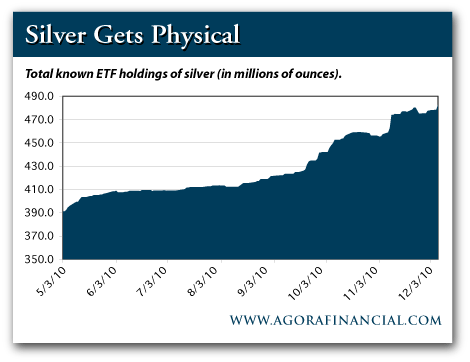
Meanwhile, the ETFs that hold precious metals are soaking up massive quantities of physical metal. Over the last 12 months, the silver ETFs around the globe have increased their holdings by nearly 100 million ounces - or almost as much silver as the entire inventory of the COMEX. The trend in gold is identical.
Therefore, as a result of soaring demand from both individual investors and ETFs, the physical stockpiles of gold and silver are atrophying in relation to the paper claims on both metals. This is not a pleasant picture for a short seller of silver.
Furthermore, the kinds of folks who tend to buy gold and silver are also the kinds of folks who have contempt for Wall Street...and for Wall Street banks like J.P. Morgan. So it should come as no surprise that a grassroots campaign has formed - the sole purpose of which is to punish J.P. Morgan for its attempted manipulation of the silver market.
"A viral campaign (Crash JP Morgue Video) to buy a physical silver and 'crash' the bank is now spreading like wildfire on the Internet," SFGate reports. "Just Google, 'Crash JP Morgan Buy Silver' [to learn more about it]... Those who wish to participate in squeezing the living daylights out of J.P. Morgan, may want to consider buying physical silver, silver futures and SLV."
Maybe this story about J.P Morgan's short position in silver is mere innuendo. Maybe not. But two facts are irrefutable:
1) J.P. Morgan is already under investigation by the CFTC for manipulating the silver market. "The investigation into the bank can be traced back to November 2009," SFGate reports, "when London metals trader and whistleblower Andrew Maguire contacted the CFTC to report market manipulation prior to it actually occurring."
2) Precious metals investors are increasingly keen to get their hands on physical gold and silver, rather than mere paper facsimiles. On this latter point, guest columnist, Frank Holmes, shares some interesting insights...
| The Daily Reckoning Presents
| Investors to Silver: “Let’s Get Physical”
| |  | | Frank Holmes |
The scramble for physical gold and silver is intensifying. People increasingly want to own the real thing, and not some paper substitute, all of which comes with counterparty risk. This conclusion is apparent from the fact that the futures prices for gold and silver have moved into "backwardation."
Allow me to explain...
Because gold is money, gold almost always trades in "contango," meaning that the future prices - i.e., forward prices - are higher than the spot price. The percentage difference between gold's spot and forward price is gold's "interest rate." So in this regard, gold is not different from other moneys, except gold's interest rate is lower than those of national currencies.
But supply and demand dynamics also influence the differential between the spot price and forward prices. And this is where our story gets interesting...
If the forward price is lower than spot - a condition called backwardation - you can sell your metal in the spot market, invest the dollars you receive to earn interest, and then buy your metal back in the future at a lower price and profit the difference. But there is another important factor to consider outside the math of this formula.
If you sell your physical metal in the spot market and at the same time agree with someone to buy it back at a future date, you are now holding someone's paper promise instead of physical metal. In other words, you have counterparty risk, which, of course, is avoided when you hold physical gold or physical silver.
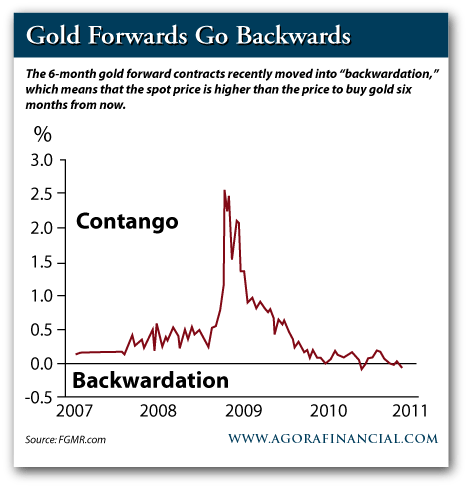
Normally, few people worry about counterparty risk. So bullion dealers and other institutions that deal in the precious metals watch for opportunities to profit from backwardation, with the result that gold rarely trades in backwardation, which explains why the chart below is so extraordinary.
Gold for 1-month and 3-months forward has been mainly in backwardation for more than one year. Even more exceptional is that gold 6-months forward has been in backwardation since November 5th. To show how rare this event is, I checked the LBMA database, which goes back to 1989. There is not one instance of 6-month forward gold being in backwardation, which confirms my own experience. I've been trading the precious metals since the 1970s, and I can't recall any time before this year when 6-months forward gold was in backwardation. The current and continuing backwardation is truly incredible.
12-month forward gold is also approaching backwardation. These downtrends make clear that the demand for physical gold is intensifying.
The picture is even starker in silver. Silver 6-months forward has been continuously in backwardation since June 2nd and mainly in backwardation for more than one year. What does it all mean?
In a word, it is bullish. The only way the increasing demand for physical metal can be met is with higher prices. The higher price will at some level entice people to sell their metal and hold a national currency instead.
Some skeptics may argue that there is no backwardation apparent from COMEX settlement prices. Aside from the fact that COMEX recently changed the method to determine settlement prices from a market-driven basis to instead allow a manual override, which now makes backwardation on the posted COMEX settlement prices virtually impossible, one has to first recognize that COMEX is first and foremost a market for paper- gold and paper-silver.
Therefore, a piece of paper can promise virtually anything, without regard to the underlying reality of how physical metal is actually trading. In other words, COMEX shows March futures in contango, when they should in reality be in backwardation. Thus, if you are buying March silver or April gold futures, you are overpaying. This overpayment is no doubt going into the pockets of those banks that are perennially short and use their size to control the paper market. They can, after all, always conjure up whatever paper they want out of thin air, which of course they cannot do with physical metal.
Any way you look at it, the backwardation in gold and silver is a truly rare event and an exceptionally bullish one too. So be prepared for an upside explosion in the price of both precious metals as the scramble for physical metal intensifies even further, and investors increasingly choose to hold the metals themselves, instead of paper promises.
Regards,
Frank Holmes,
for The Daily Reckoning
Joel's Note: Frank Holmes is chief executive officer and chief investment officer of US Global Investors Inc. He specializes in resource-based industries and money management.
Frank is also a regular favorite at our annual Investment Symposium, which we hold in Vancouver each year. Reckoners who would like to secure an early bird discount to next year's event can find all the information they need right here.
Those readers looking to get their hands on some physical gold may also wish to consider snapping up a few 2003 China tenth-ounce Guanyin 50 Yuan Gold Proofs that our friends at First Federal recently secured.
|
|  | | Bill Bonner
| Emerging Markets and Commodities:
Where Stimulus is REALLY Going
| |  | | Bill Bonner |
Reckoning from Melbourne, Australia...
"It was a debt of honour, so-called, which I had to pay, and I used money which was not my own to do it, in the certainty that I could replace it before there could be any possibility of its being missed. But the most dreadful ill-luck pursued me. The money which I had reckoned upon never came to hand, and a premature examination of accounts exposed my deficits.
"The case might have been dealt leniently with, but the laws were more harshly administered thirty years ago than now, and on my twenty-third birthday I found myself chained as a felon with thirty-seven others convicts in the 'tween decks of the barqueGloria Scott, bound for Australia. "
- Sir Arthur Conan Doyle, The Adventures of Sherlock Holmes
Imagine going from England to Australia on a sailing ship, shackled 'tween the decks. The convicts must have been happy to finally get here.
Imagine getting sent to Australia for failing to pay a debt (even one that was never intended by the creditor)! That would discourage you from spending money that is not your own!
It was a tougher world back in 1855. The "laws were more harshly administered" then.
Now, the laws aren't administered at all. The culprits are in so tight with the feds you'd need some WD40 to get them loose. The banks seem to have taxpayer money on tap. As much as they want. 24/7. On/Off. And the feds spend money that is not their own...and promise to replace it. That replacement money will never come to hand. And an examination of the feds' accounts exposes immense deficits - about 20 times the entire annual output of America's private sector.
And along comes Washington with word of a deal. The bargain was struck yesterday. The rich get to hold onto their money for another two years. And the poor get another 13 months of unemployment benefits.
Win/Win, right?
Are you kidding? The feds' accounts show a deficit of $1.3 trillion. Tax cuts and further spending? Lose, lose, lose...
Well, why not? Give everyone a Christmas present - whether you can afford it or not. Stocks will probably go up today. The papers are reporting that the extension of the Bush tax cuts may be all the economy needs. No further stimulus may be necessary. Because if rich people can look forward to the same tax rates next year...
..what exactly is it they will do? Invest more money? Yes...in India! And China! And commodities! And even gold!
Yes, that's where the stimulus has gone so far.
We don't like the looks of it. This market. This economy. Or this political situation.
We don't like any part of it. It's all based on hype, fraud and hallucination.
So, we've got our "Crash Alert" flag out.
Most likely, of course, it won't be necessary. Things usually muddle forward. And most likely, they'll muddle forward like they did in Japan in the 1990-2010 period...or in Britain from the end of WWII to the Thatcher years. Sluggish economy...high unemployment...falling house prices...and foolish government intervention.
We should see falling stock prices too. Investors have made no money in stocks in a dozen years...but stocks are still pretty pricey. We'd like to see them fall to about half to a third today's level. Then, maybe we could get excited about buying them. As it is, we presume they still face their rendezvous with the bottom. Until it is behind us, it is still ahead of us.
Giving good financial advice is really very easy.
Buy investments that are going up.
"But what if they don't continue to go up?" you ask.
Then don't buy them.
See how easy it is?
And more thoughts...
While stocks have been going nowhere, guess what's been going up. You know. Gold! That's right, gold has been in a bull market for the last 10 years. And this year, gold is up 28%.
That's a trend we like. Because it is long. Solid. And it shows no sign of stopping anytime soon.
Why?
Because the world monetary system has a rendezvous ahead of it too...a rendezvous with destruction. Until that's behind us, it's still ahead of us.
"Wait a minute, Bill... How do you know the monetary system is going to crack up? You admit that you don't get to read tomorrow's headlines before everyone else."
Good point.
Of course, we don't KNOW anything. We're just guessing. But it seems like a good guess. Let's put it this way, it's an extrapolation of current trends in which we have great confidence.
Ben Bernanke admitted this week that he didn't see the problem coming. Which confirms what we knew all along - the people running US monetary policy have no idea what they are doing.
Gold is a bet against Ben Bernanke. It's a bet against the feds. It's a bet against a system that is corrupt and reckless. It's a bet that the managers of a managed currency will sooner or later manage to mess it up.
*** Mr. Bernanke went on to assure the world this week that there was no way inflation would get over 2%. If they headed in that direction, he'd raise rates immediately, he said.
We want to see that! Once consumer price inflation begins to leak into the system, people begin to expect it. They buy and invest - in order to get rid of paper currencies. The velocity of money increases. Prices go up. Raising rates a little doesn't help. You can't follow the rise in inflation. As Paul Volcker found, you have to get ahead of it. You have to raise rates MORE than the current CPI rate in order to squeeze out inflationary expectations. People have to believe you're serious, in other words; you actually have to cause pain and contribute to de- leveraging. It's not enough to talk tough. You have to be tough. Otherwise, they'll continue dumping currency and pushing up prices.
Now let's try to imagine ol' Helicopter Ben raising rates in an economy with 10% unemployment, a 10% budget deficit, total debt equal to 380% of GDP and falling house prices. We can't picture it. We squeeze our eyes...we wrinkle our brow...but as hard as we try...
..we can't imagine it.
*** Here's the Telegraph with a report on one of the big bombs that could explode any day:
The Royal Bank of Scotland has advised clients to take out protection against the risk of a sovereign default by China as one of its top trade trades for 2011. This is a new twist.
It warns that the Communist Party will have to puncture the credit bubble before inflation reaches levels that threaten social stability. This in turn may open a can of worms.
Officially, inflation was 4.4pc in October, and may reach 5pc in November, but it is to hard find anybody in China who believes it is that low. Vegetables have risen 20pc in a month.
The Communist Party learned from Tiananmen in 1989 how surging prices can seed dissent. "Inflation is a redistributive mechanism in favour of the few that can protect living standards, against the large majority who cannot. The political leadership cannot, will not, take risks in that regard," said Mr. [Tim Ash, the bank's emerging markets chief]. Regards,
Bill Bonner,
for The Daily Reckoning
-------------------------------------------------------
Here at The Daily Reckoning, we value your questions and comments. If you would like to send us a few thoughts of your own, please address them to your managing editor atjoel@dailyreckoning.com
|
| |  |  |  | The US Federal Reserve: A Bank that Will Live in Infamy
The Fed hands out money to its powerful cronies. Remember, the Fed is a private bank. It serves what is supposedly a public purpose. But it is neither owned nor controlled by the government. Instead, it’s part of the banking industry. Its official role is to give the US a trustworthy currency...and (more recently) to promote full employment.
Investing in India: Optimism in the New New World
The Pros and Cons of Investing in India | What Happens When Currencies Go Bust?
I was telling the doctor that I distinctly heard a popping sound inside my head when I saw that the foul Federal Reserve had created, last week alone, another $24.2 billion in Fed Credit, which was instantly turned into money when the Fed bought $24.2 billion of US government securities, and all in One Freaking Week (OFW)! It made a kind of “sizzling” sound.
Danger of Deflation Depends on Your Definition of Deflation
The Federal Reserve and Its Secret Set of Books | The Municipal Bond Pitch: “What You’re Giving Me is Pure Bulls**t”
Undaunted by falling municipal bond prices, rising yields, and withdrawal of funds, research reports by large brokerage firms still mollify the majority of clients and fund managers with numbers and assertions: “General obligation bonds do not default.” “The general obligation default rate is 0.01%.” “Most states are required by law to balance their budgets.”
Oil Demand’s Triumphant Return
Fiat Currency Fever: The Causes | |
| | The Daily Reckoning: Now in its 11th year, The Daily Reckoning is the flagship e-letter of Baltimore-based financial research firm and publishing group Agora Financial, a subsidiary of Agora Inc. The Daily Reckoning provides over half a million subscribers with literary economic perspective, global market analysis, and contrarian investment ideas. Published daily in six countries and three languages, each issue delivers a feature-length article by a senior member of our team and a guest essay from one of many leading thinkers and nationally acclaimed columnists. |  |
|
|
|
|
|



 Posts
Posts

