
| |||||||
The following is research published today from MEMRI’s Special Dispatch Series and the Jihad and Terrorism Threat Monitot Project. *Special Dispatch SeriesSpecial Dispatch No. 3570—Muslim Brotherhood/Egypt Egypt Uprising: Google Executive Wael Ghonim in Tearful Interview After His Release from Prison: The Muslim Brotherhood Will Not Hijack This Revolution
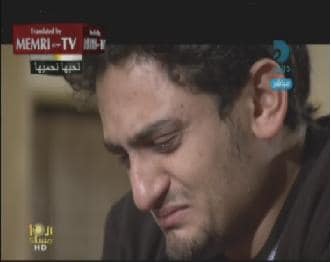
The following is the transcript of an interview with Egyptian Google executive Wael Ghonim after his release from prison in Egypt; in it, he discusses the uprising in Egypt and his prison experiences. The interview aired on Egypt's Dream 2 TV on February 7, 2011. To read the full report, visit http://www.memri.org/report/en/0/0/0/0/0/0/4985.htm.
Special Dispatch No. 3569—Palestinians/Inter-Arab Relations/Egypt PA Supports Mubarak – Along With Egyptian People's Desire For Democracy and ReformThe Palestinian Authority has been cautious in its reaction to the protests in Egypt. Its leaders have kept their comments to a minimum, and its security apparatuses initially tried to suppress demonstrations of support for either the protesters or Mubarak, on the pretext that such demonstrations could be interpreted as interference in Egypt's affairs. Subsequently, however, demonstrations were permitted. Columnists affiliated with the PA expressed support for Mubarak, but also sympathy with the Egyptian people's desire for reforms and democracy. A few days after the outbreak of the protests in Egypt, PA President Mahmoud 'Abbas stressed, in a phone conversation with his Egyptian counterpart Hosni Mubarak, that the Palestinian leadership desired a secure and stable Egypt. A former PA official wondered why the Palestinians didn't emulate the Egyptian uprising in their struggle against Israel. The following are details, and excerpts from some articles on this issue: To read the full report, visit http://www.memri.org/report/en/0/0/0/0/0/0/4984.htm.
Special Dispatch No. 3568—Pakistan/South Asia Studies Project/Egypt Pakistani Dailies Examine Implications of Egyptian Protests for Pakistan; Editorial Warns: 'After Four Decades of Nurturing of Jihadis and Extremists, Any Popular Revolt will Be At Risk of Being Hijacked by Extremist Forces'
On January 31, 2011, Pakistani Prime Minister Yousaf Raza Gilani said that the situation in Pakistan cannot be compared with popular uprisings in Tunisia and Egypt. Speaking in the town of Multan, he claimed that Pakistani "institutions are working and democracy is functional" while the economy in Pakistan is also doing well. Prime Minister Gilani noted that as a dividend of democracy, even government ministers are being questioned by the Federal Investigation Agency (FIA) in various cases, something that would not be possible under a dictatorial regime. He added: "Our foreign exchange reserves are at an unprecedented high level of $17 billion. The stock exchange index that was oscillating between 5,000 to 6,500 points when we took over is now touching 12,500 points. Our exports have reached $11 billion and may double by the end of this fiscal year, and foreign remittances are over $10 billion." The following are two editorials and two analytical reports from Pakistani newspapers, examining the history of people's movements in Pakistan and implications of the mass anti-government uprisings in Tunisia and Egypt for Pakistan. To read the full report, visit http://www.memri.org/report/en/0/0/0/0/0/0/4983.htm.
*From the MEMRI Jihad and Terrorism Threat MonitorISI Message to Egyptians: Wage Jihad In an open letter dated February 9, 2011, the Islamic State of Iraq (ISI) urged Egypt's Muslims to wage jihad and establish Islamic law there. This was the first official reaction to the events in Egypt from any Al-Qaeda affiliate. Interestingly, the letter, titled "From the Islamic State of Iraq to our Muslim People in Beloved Egypt," is signed by the ISI's so-called War Ministry, its operational wing, rather than by its so-called Ministry of Communications, which usually disseminates the organization's publications. Although the letter's title addresses the Muslims in Egypt, its contents indicate that it is directed especially to Salafi-jihadists in that country, as the author repeatedly refers to "the monotheists" [ahl al-tawhid]. The following is a summary of the main points in the letter: 1. Egyptian Muslims are urged to establish Islamic law and avoid non-Islamic frameworks and ideologies, such as secularism, democracy and nationalism. To read the full report, visit http://www.memrijttm.org/content/en/blog_personal.htm?id=4420¶m=GJN To view these reports, you must be a paying member of the Jihad and Terrorism Threat Monitor Project (JTTM). For membership information, send an email to jttmsubs@memri.org with "Membership" in the subject line. The following is the transcript of an interview with Egyptian Google executive Wael Ghonim after his release from prison in Egypt; in it, he discusses the uprising in Egypt and his prison experiences. The interview aired on Egypt's Dream 2 TV on February 7, 2011. To view this clip, visit http://www.memritv.org/clip/en/2800.htm "I Want To Tell All the Mothers and Fathers Whose Children Were Killed That We Pray That God Accepts Your Children As Martyrs" Wael Ghonim: "First of all, I want to tell all the mothers and fathers whose children were killed that we pray that God accepts your children as martyrs, whether they were citizens, officers, or soldiers. Whoever was killed is a martyr. "I Am Not a Hero... The Real Heroes Are the People Who Took to the Streets "In Egypt, we like to invent heroes, but I am not a hero. I slept for 12 days. The real heroes are the people who took to the streets, joined the demonstrations, sacrificed their lives, or were arrested and put their lives in harm's way. I was not a hero. What happened to me made me regret that I was not with the people. I was coming from the UAE to participate in the demonstration. I told people at work that I had an urgent personal matter. I told them that something had happened to my father, and that I needed six days off to go to Egypt. I had vacation time saved up, so they said okay. "We are not traitors, Muna. We love Egypt." "This Is a Revolution Of the Internet Youth, Which Later Became the Revolution Of the Youth Of Egypt" Interviewer Muna: "Wael…" Wael Ghonim: "We are not serving anyone's agenda... Some of us are very rich, living in the best homes, driving the best cars. I don't need anything from anyone. I didn't ask for anything. The things we did put our lives in danger, and we didn't know anything about it. We said we would do it, and that's it. We said that we would fight for our rights, because this is our country. We put our lives in harm's way, and none of us did it for personal gain. "The people who planned this and went to demonstrate do not want for anything. I don't need anything. The thing that tormented me most in jail was that people would know that I am the 'admin.' "I am not a hero. I was using my keyboard to write on the Internet. I was not risking my life. I don't want to mention people by name because they have not been released yet. I don't know where they are, and I don't want to put their lives in danger. Many people, some of whom you have met, like Mustafa Al-Naggar, were really risking their lives, while I was writing on my keyboard. There are no heroes." "The real heroes are the people on the street, each and every one of us. There was no knight on a horse urging people to take action. Be careful that no one tries to con you this way. This is a revolution of the Internet youth, which later became the revolution of the youth of Egypt. "My Kidnapping Was a Crime"; The Police "Are Worried About Egypt and Try to Do One Thing, While I'm Worried About Egypt and Try To Do Another Thing" "Nothing justifies the crime of kidnapping. My kidnapping was a crime. This is what we are fighting. If you want to arrest me, use the law. If you don't know how to use the law, that's too bad. Try changing the law. I'm no legal expert, but they can use the parliament to change the law. "I'm neither a terrorist nor a drug dealer, so, with all due respect, you can't apply the Emergency Law on me. But when I entered [prison] and talked with the officers, I sensed that these people are worried about Egypt. They are worried about Egypt and try to do one thing, while I'm worried about Egypt and try to do another thing. Unfortunately, because of the political regime that was in place, these two things were at odds with one another." The Muslim Brotherhood Were Not Involved In This At All... They Will Not Hijack This Cause "The Muslim Brotherhood were not involved in this at all, and did not know anything about the demonstration. They were just like anyone else joining in. Secondly, until Friday, when they said that they would participate… This is up to them. As a political force, they can participate if they want. But ultimately, they will not hijack this cause, and we don't want any political elements or associations lecturing us. This was done by the Egyptian youth, who are worried about their country." Muna: "The people who were killed are our children and our brothers. They had no ulterior motives. The pictures we showed yesterday are proof of that. I don't know if you saw these pictures or not…" Wael Ghonim: "No, I didn't." Muna: "You can see pictures of young men in the prime of their lives. These are the people who took to the streets… Don't start crying, Wael. Wael, don't cry. These people were not looking to lead political parties. They were not driven by poverty. They were not facing a dead-end. They took to the streets for the sake of their country, Egypt. They said: 'We will do what previous generations could not do. We are not activists. We are not financed by anyone. We just want to say that we love this country.' Wael Ghonim [crying]: " I'd like to say to every mother and father who have lost their son: I'm sorry but this was not our fault. By God, this was not our fault. This is the fault of anyone who was part of the rule. I want to go." [He gets up and walks out, crying.] | |||||||
Wednesday, 9 February 2011




 Posts
Posts

