
 The Daily Reckoning U.S. Edition
Home . Archives . Unsubscribe 
The Daily Reckoning | Thursday, May 19, 2011
-------------------------------------------------------
External Advertisement
"Underground" Video Gets 10 Million Viewers
A really disturbing video has recently become an Internet sensation...
With more than 10 million viewers in the last four months.
If you care at all about our once-great country, I strongly encourage you to check this out, and prepare yourself, before the situation gets any worse.
You can watch the full video, free of charge, here.
A Question of Solvency Lessons to Be Learned from the Greek Debt Crisis
Reporting from Laguna Beach, California...
Eric Fry
The stock market slumped yesterday to a new 14-year low, while bond yields jumped toward modern-era highs. The currency also slumped, as politicians failed to enact deficit-reducing austerity measures.
Otherwise, nothing much of interest happened in Greece yesterday.
Here at home, the stock market rebounded a bit, as did the price of crude oil and most other commodities. Reuters News says the stock market advanced because of "Dell's strong earnings" and that commodities rallied due to an "unexpected drop in US oil supplies."Bloomberg News says the stock market advanced because "the Federal Reserve signaled continued low interest rates" and that commodities rallied due to "signs of increasing demand."
The Daily Reckoning's editors are not smart enough to know which specific event inspired the millions of separate transactions that lifted stock and commodity prices yesterday. We will leave that analysis to our counterparts at Reuters and Bloomberg.
That said, we will not refrain from tackling the tougher analytical tasks, like why investors are fleeing Greek stocks and bonds faster than a chambermaid flees an IMF Director's hotel room.
Based on our exhaustive research, we conclude that investors prefer the securities of solvent entities over those of insolvent entities. But investors cannot always differentiate correctly between solvent and insolvent.
Early in a crisis, hope tends to trump fear. Investors tend to underestimate the underlying distress and overestimate the efficacy of exogenous remedies like government intervention. Early in 2007, for example, the US subprime mortgage market began melting down. By mid- summer, S&P was downgrading more than 600 mortgage-backed securities. And yet, investors bid the Dow Jones Industrial Average to record highs in October of that year.
Three months later, mortgage-lending titan, Countrywide Financial, collapsed into the arms of Bank of America. And two months after that, the Fed gave J.P. Morgan a sweetheart deal to buy the near-bankrupt Bear Stearns. Despite these growing signs of distress, most investors believed a crisis had been averted. But, of course, the crisis was just beginning.
A similar timeline appears to be playing out in the European Union, as we have noted in two previous editions of The Daily Reckoning. (See "The return of the Sovereign Debt Crisis"and "Trade of the Decade: Sell Everything".) As Greece, then Portugal, then Ireland teetered on the brink of a sovereign default, the European Central Bank and the IMF rushed to the scene with a dessert tray of bailout goodies.
In May of last year, the ECB and IMF teamed up to send €110 billion ($137 billion) to the desperate Greeks. Ireland received an €85 billion ($113 billion) handout last November. And just this week, the European Union and the IMF agreed to send €78 billion ($115.5 billion) to Portugal.
Perhaps these rescue efforts will succeed, but we suspect they will merely forestall the inevitable. Greece will default...eventually. And now, finally, investors are beginning to imagine this possibility. As Greece's financial distress becomes increasingly apparent, and her solutions decreasingly viable, investors flee.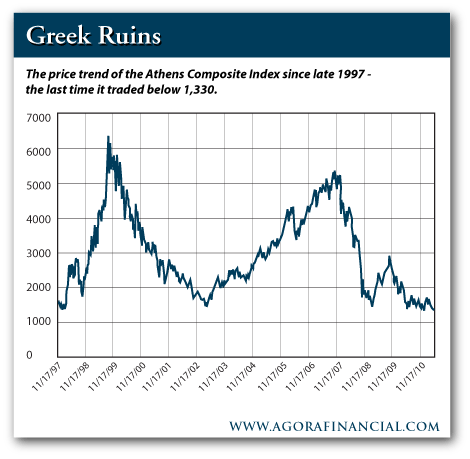
Greek stocks just hit a new 14-year low today, as Greek bond yields remain near all-time highs. The Greek 10-year bond now yields more than 15%. That's a great yield...if you believe you would actually receive it.
Greece's deteriorating sovereign finances are emblematic of the Welfare State's broken "business model." The Greek government ran a deficit last year equal to more than 14% of GDP. A double-digit deficit seems certain again this year. These deficits will expand Greece's total debt-to-GDP from about 125% today to numbers that are even more frightening for a bondholder. But these data points are only the beginning of this sad tale.
60% of Greeks don't pay any income tax. Therefore, according to Eurostat, when you exclude social security contributions, Greece has the lowest tax revenue-to-GDP ratio in the euro zone, at 20.4%. Furthermore, Eurostat observes, "Revenues from personal income taxes...account for a mere 4.7% of GDP, compared with a [European] average of 8.1% of GDP." Stated differently, personal income taxes contribute only 14.4% of Greece's total tax receipts, compared to 43.2% of total tax receipts here in the US.
Bottom line: Even if Greece managed to triple its personal income tax revenue, its government would still operate in the red. Similarly, a doubling of all taxes on personal and corporate income would not close the budget gap. Something is very broken here.
Uncle Sam, are you watching?
Widespread sovereign insolvency, combined with the stench of decaying government finances, may not be immediately bearish for the financial markets, but we doubt they are bullish.The book the US Congress never wanted you to see...
Ron Paul's "Lost" Gold Bible
Buried away in secret since late in the last century, this 200-page guide shows you:
We're spreading the word... Click here to find out more.The Daily Reckoning Presents Storm Warning!
An Interview with Addison Wiggin by Chris MartensonWelcome to Crash Concepts where the economy, energy, and the environment are explored. Up next, fresh ideas and insights into the factors that are driving the world and shaping your future. Presenting information you can't afford to live without, here's Chris Martenson.
Chris Martenson: Welcome to another chrismartenson.com podcast. I am your host, Chris Martenson, and today we have the pleaser of speaking with Addison Wiggin, executive publisher of Agora Financial, LLC, the independent economic forecasting and financial research firm he runs with Bill Bonner. Agora's wide-ranging operations include the influential econo-blog, The Daily Reckoning, bestselling publications such as Financial Reckoning Day Fallout, and The New Empire of Debt, both of which Addison coauthored with Bill.
Addison, you're a man of many talents. I'm delighted to have you here today.
Addison Wiggin: Well thanks for having me, Chris. I'm happy to be here.
Chris Martenson: For many years now you've been prolific in your efforts to wake up the investing public to the risks that lie ahead. Your books, The Demise of the Dollar, Empire of Debt, Financial Reckoning Day, your movie, I.O.U.S.A., all predicted a future that is increasingly now unfolding before our eyes. I'm wondering if you're experiencing some emotional conflict here.
Your predictions have become soundly validated, yet that means sort of the dire outcome you feared is arriving. What's it like for you to be at this time in history?
Addison Wiggin: Well it is kind of an interesting time because we had gotten used to, for well over a decade, being mocked by people in the mainstream press and even people in my own family... There's a whole generation of Americans today that don't understand the very nature of capitalism - the savings and investment that led to the United States being one of the more prosperous countries the world has ever known...
Chris Martenson: Yeah, so what's a big surprise for you in this story so far? What's unfolded maybe a little differently than you thought?
Addison Wiggin: Actually the thing that has been most surprising to me has been the willingness with which politicians in Washington have abandoned the very causes and ideas that led us to be a prosperous society in the first place. I suspected they would do it all along, but just to give you an anecdote in August of 2008 right before the last presidential election, we premiered I.O.U.S.A. This was before stimulus and bailouts, before trillion-dollar deficits. We had spent two-and-a- half years making a movie about the disastrous state of the financial balance sheet in Washington. We were running history deficits of what now seemed like a quaint $450 billion, and we had a mounting pile of unfunded liabilities.
We made the movie and released in August of 2008 for a reason, we wanted it to be part of the national conversations during the presidential campaign season. In August of 2008 we got Warren Buffet together with Pete Peterson, David Walker, the former Comptroller General, we premiered the movie, and we held a national town hall meeting with the intention of making deficit spending and unfunded liabilities a part of the conversation that was going on in Washington prior to electing the new president. We broadcasted on CNBC, we thought we made a big splash. Less than six weeks later, Lehman Brothers declared bankruptcy.
And we were already on sort of the wrong course to fiscal mayhem, and after September 17th, 2008 we jumped course and we got on a faster track and I guess my biggest surprise is how quickly people were willing to engage in the amount of stimulus bailouts and deficit- spending. They just kind of abandoned any kind of fiscal defense to a much greater degree than I thought was even possible.
Chris Martenson: I found that surprising as well... And it was just surprising that money was just thrown everywhere at this problem...
Addison Wiggin: Right, even, even the voices that we followed for a couple of years while filming I.O.U.S.A., David Walker principally amount them. He fully supported the stimulus spending, even though we were documenting his efforts to wake people up to what was happening with the fiscal condition of the United States... It was just surprising to me that for all these people that we've elected to office and for the amount of study and intelligence that they presumably have, they rolled over and threw out all common sense and just went for it.
Chris Martenson: Given what you just saw, and the anecdotes you just shared with us, how do we reverse this, what do we do from this point forward?
Addison Wiggin: Well the prescription for what to do would probably come with a lot of political baggage. It depends on what form you think the government should take. Should the government play the role of providing a safety net for all citizens? Should the government be involved in providing security around the world for national interest companies to do business in places that are otherwise hostile to us? I happen to believe we shouldn't be doing either of those things because we can't afford them, not because politically, I think that they're bad ideas, just that we've never done the hard work of figuring out how to balance those interests with the tax code that we currently run.
Everything is out of whack. We can't be the policeman to the world and provide a safety net for all citizens if we don't have the tax rates or the income to the government that supports all that. It seems like common sense, and it should be common sense, but something happens when you take it from a discussion that you and I might have to the political level, which is often just driven by emotion and public speech. Somehow the desire to continue promising that the government can solve all problems meets with jubilation and most people want to just keep going and they never want to actually accept that at some point unsustainable activities have to end, I mean it's the nature of the word...
I struggle to think that we're even capable of putting together a set of solutions that will work. It might be too late.
Chris Martenson: Well I share that view, and this is not just a US issue. World history, and also current events, recent current events shows that governments will reform, and they will undertake austerity and they will live within their means when the bond mark has forced them too.
Addison Wiggin: Right, absolutely.
Chris Martenson: Greece is in the middle of it, Portugal's in the middle of it, Ireland's right in the middle of it, Spain's gonna get there... So this has been my view for a long time, that the United States will reform when the bond market forces it to. And that day will come. Nobody knows when or how long we can kick the can down the road... But sooner or later, the bond market will revolt... Would you share this view, that there is a day of reckoning here?
Addison Wiggin: Well I would definitely share that view, and I think that it does come when the government has to raise interest rates beyond what it can already afford just to get the money that it needs to continue... It's not unheard of, even in our own history, but when you mention that, when you talk about that, the fact that we might lose control of our ability to fund these massive deficits in this current environment, people think that you're a kook, that you don't understand something that they do understand.
But, in fact, there will be a point where investors will look at their return from the US government, and they'll say, I want more to put my money at risk...
Chris Martenson: Well sure. And think about what would happen to the housing market right now. It's nothing good in terms of upward price mobility. So one of my views is that we're all speculators now... What's your view on QE and is more QE a good idea here, or is Bernanke trapped either way?
Addison Wiggin: Well you mentioned Bill Gross, if you take his point of view, when QE2 dries up, who's going to buy Treasuries then? That was the position that he took when he started unloading Treasuries from Pimco's bond fund. I think the Fed is between a rock and a hard place because they have to continue to be the buyer of last resort in order to keep Treasury [yields] where they are. But the Fed is...at the end- game from what they've been trying to do. They've been trying to play both sides of the trade, keep Treasuries where they are, keep the government funded but at the same time avoid any kind of a fiscal restraint that would make Treasuries viable, or even attractive to the investment crowd.
Chris Martenson: Yeah, well the 10-year at what, 3.5%, 3.4%, somewhere in that zone depending on which day we're talking about. That's a pretty low rate of interest over the next ten years, given everything that I see on the radar screen. And without the Fed stepping in there buying, influencing the prices, manipulating, whatever you want to call it...
It's just a self-referential piece of ridiculousness, so there we are, and we're all speculating now in terms of what the Fed's going to do next. But what does this future mean to investors and what sorts of recommendations are you making to those that are looking to preserve wealth in this interesting period we're in?
Addison Wiggin: Well...we just recommend that people recognize that this is actually happening. Most people tend to think that the government is made up of a bunch of smart people who really know what's going on. Even the readers that write back to us, they say things like, well the Fed wouldn't be doing this kind of thing if there wasn't a very good reason for it.
There's a high degree of trust left in Bernanke's hands, in Timothy Geithner's hands. So even now, part of our goal is just to get people to recognize that there is a possibility that Treasuries might not get funded the way they have in the past. And if you take that piece out of the financial puzzle, then everything else begins to unravel very quickly. And that's why I believe we have gold going to the prices it has that we've seen in recent weeks. Silver, precious metals, many of the commodities, because people are looking for tangible good outside of the financial system, things that seem to make more sense.
So we've been recommending commodities and precious metals, and energy markets.
To be continued...
Regards,
Addison Wiggin,
for The Daily Reckoning
Joel's Note: To that very (golden) end, Addison has lately embarked on a mission to get a copy of "Ron Paul's Lost Gold Bible" in as many hands as possible. Actually, he's giving them away right now, along with a subscription to his big picture research service, Addison Wiggin's Apogee Advisory. If you'd like to add a copy of Dr. Paul's book to your library, and to get yourself on Addison's Apogee email list, you can start here.GRAND THEFT AMERICA!
It's the world's biggest Ponzi scheme, authorized by the U.S. gov't and funded by you... and now you're going to be forced to pay even MORE to keep the scam going.
That's why market analyst Jim Nelson has created a brand new video presentation for you, revealing exactly how this scam works and what you can do to protect yourself from it. But hurry, time is running out and no one is safe from this...
Click here to watch Jim's new video now.Bill Bonner The Propensity for Progress: Investing in Areas With Rapid Growth Potential
Reckoning from Zurich, Switzerland...
Bill Bonner
Dow up 80...oil still below $100...gold still below $1,500....
Oil has a long way to get back to its 2008 high. But it's still 3 times what it was in 2005 and 5 times its price in 2001.
In the battle between inflation and deflation, it's not clear to us who's winning. Prices are rising, but in the context of a general deflationary funk. Try as they might, the feds just can't shake the Great Correction. It leaves them struggling to loosen monetary policy to free-up the economy...and succeeding only in tightening the noose around the consumer's neck. Here's the AP report:NEW YORK (AP) - High gas prices are driving a wider wedge between the wealthy and everybody else.
Of course, this has the obvious nasty feedback loop. The middle and lower classes have less to spend. The economy sinks along with them.
The rich are back to pre-recession splurging: Saks Fifth Avenue and Nordstrom customers are treating themselves to luxury items like $5,000 Hermes handbags and $700 Jimmy Choo shoes, and purchasing at full price.
"The average shopper isn't in the game, except for necessities," said Faith Hope Consolo, chairman of retail leasing and marketing at Prudential Douglas Elliman. At the same time, among the rich, "Luxury products are selling like bread."
J.C. Penney, Wal-Mart and home-improvement retailer Lowe's Cos. all said they're noticing their customers are consolidating shopping trips to save money on gas as the average price hovers at $4 a gallon.
More than a half-dozen corporate earnings reports this week show that for the affluent, rising prices are merely a nuisance. For others, they can mean scrimping to put food on the table.
But we're not going to worry about them. We warned them!
Instead, let's turn to another subject.
Yesterday, The Daily Reckoning set off a bombshell...or at least a stink bomb. We wondered aloud if real growth rates in the developed countries - particularly in England and America - hadn't returned to their pre-Industrial Revolution rates. Is it possible that real growth regresses to the very low levels of the middle ages or before?
Why would that happen?
It's not a matter of Fed policy. Or of tax rates. Or even of debt. It's deeper than that. More basic. More important.
Each time humans make a breakthrough, their rate of growth speeds up. They then take advantage of it. They fill up the economic niche it opens for them...as fully as their new technology allows. And then what? Growth then goes back to 'normal.' But what's normal? Apparently, normal is very low or negligible rates of growth; that's what we had before the Industrial Revolution began.
Which, of course, only gives rise to a whole group of questions.
First, is it true? Is human history a long spell of stagnation or low levels of growth...punctuated by sudden bursts of above-trend growth?
If it is true, is it also true that the developed economies have reached the limit of the 'cheap energy' dividend...which began with the large-scale exploitation of coal in the 18th century, followed by the wide use of oil in the 19th and 20th centuries?
And if that is true, what next? Are there no new sources of cheap energy?
What about nuclear?
Well...a possibility...but recently nuclear power was dealt a huge setback. It's not cheap, not when you add in all the safety features... and the cost of the occasional emergency. Many nations are now re- examining their energy policies to decide whether nuclear has any role to play at all.
What about conservation...energy saving measures...going green?
Well, yes...you can stretch your energy. You can probably even increase your standard of living, by using it more efficiently. But you don't get above-trend economic growth gains by reducing the inputs of energy. You appear to get rapid growth only from big breakthroughs that make new energy available...and put it to work for you.
And more thoughts...
So, what can you expect? The critical component of growth has suddenly become three times as expensive as it was five years ago. The economy can probably continue to 'grow'...but how much? Without a new breakthrough, what can it expect? About the same level of growth as before the new technology came on line - negligible growth, in other words.
And if that is true, how will investors make any money?
Answer: they won't.
Hmmm... This is getting interesting.
'Bill, let me get this straight... You're saying that the kind of growth the US saw in the 18th, 19th and 20th centuries was just an anomaly...right?'
Well, that's the implication.
'You're saying that when the world gets its fill of a new technology - even if it is something as big as oil - that it grows up to the limit that that technology makes available...and then it comes to a halt.'
Yes, that is what this analysis suggests. Let's say you look back at when the bow and arrow was invented. It probably enabled primitive hunters to get more game. They could support more people. So, the human population grew. But once the bow and arrow was widespread, the population probably stopped growing. We had squeezed all the juice we could out of that innovation.
'And you're saying that the investment returns of the past couple hundred years actually may reflect this anomaly...and that investors may never again realize anything like it.'
Well, yes. Not in the advanced, mature economies.
'Then, it sounds like I should just forget about investing all together.'
Nope. First, there are huge parts of the world that are not 'built-out' yet. Where energy use is still very low. These areas can still make rapid progress as they catch up. They're like tribes that hadn't taken up the bow and arrow. When they got it, they could make progress.
You ought to be able to participate in their progress, too, simply by buying companies that are operating in these growth areas. And they're not just foreign companies... US, European and Japanese companies are all taking advantage of growth in the developing world.
Second, there is still the opportunity for making money the old fashioned way...by compounding earnings, not capital gains. We're so used to stocks and real estate going up that is it hard to imagine a world with stagnant prices. But that is what we could be facing. Slow rates of growth should mean very slow or negative price appreciation in America's capital stock. Dividends will become more important. And people who get wealthy will probably do it as they did for centuries before the Industrial Revolution - either by saving and compounding small gains over many years, or by taking it away from someone else.
Regards,
Bill Bonner
for The Daily Reckoning
Friday, 20 May 2011


 Posts
Posts

