

A Safe, Hundreds-of-Percent-Return Trade, Set Up Now…
By Dr. Steve Sjuggerud
Tuesday, July 26, 2011First is the "Hong Kong Can't Help It Rule." That's when the U.S. Fed cuts interest rates below the "market" rate. This means "real" interest rates are below zero. When this happens, buy Hong Kong… It can't help it. It soars.
The second rule is the "20/10 Rule." In short, you want to be a buyer of stocks in Hong Kong when the P/E ratio falls below 10. And you want to be a seller when the ratio rises above 20. Hong Kong stocks often soar by hundreds of percent after they fall below a P/E of 10. And often they lose half their value soon after they rise above a P/E of 20.
Further Reading:
For another interesting Hong Kong play, consider this "live economic experiment." Get the details here: It's "Heads You Win, Tails You Don't Lose" with This Currency.
Email Story 
Print 
A MAJOR STOCK MARKET BREAKOUT IS COMING
The uptrend in crude oil we highlighted last week isn't just good news for producers like Saudi Arabia and Canada… it's good news for oil services as well.
The oil services sector is one of the great "boom and bust" areas of the market. This sector is a mix of companies that sell vital products and services producers need to extract oil & gas. Names here include National Oilwell Varco (drill-rig maker), Ensco (offshore driller), and Schlumberger (everything). These companies enjoy huge increases in profitability when oil prices are high… and suffer when prices fall.
One of the "must watch" names in oil services is industry leader Schlumberger (SLB). SLB is a massive, $128 billion firm that many countries and companies turn to when they need "well work." It's also one of the go-to stocks large money managers use to take a position in oil services. With oil north of $90 per barrel, SLB's customers have hundreds of billions of dollars to invest in future production.
After enjoying a 50% rally in late 2010, SLB has drifted in a sideways trading range for five months. This range, which some traders call a "box," has kept SLB in between $80 and $95 per share. But as you can see below, SLB is working higher and is set to "break out of the box." Like crude oil's uptrend, the uptrend in oil services remains intact.
Tuesday, 26 July 2011
t's one of my favorite trades…
This "set up" has been good for hundreds of percent profits every time I have seen it since I started my career in the investment business in the early 1990s.
It should work again…
This trade works because two governments accidentally force it to work. If it weren't for two different government manipulations, this trade wouldn't exist.
Let me first explain the two manipulations. Then I'll explain how they inevitably cause fantastic booms and busts in one particular market…
You're already familiar with the first government manipulation in this trade…
It's the U.S. Federal Reserve cutting short-term interest rates to essentially zero. This is a manipulated interest rate… It is below normal. The goal is to encourage people and businesses to borrow to get the economy going again.
You're probably not that familiar with the second government manipulation…
The Hong Kong dollar exchange rate is fixed against the U.S. dollar. To maintain the value of its currency versus the U.S. dollar, Hong Kong ends up having interest rates very similar to U.S. short-term rates.
This has kept the currency stable versus the U.S. dollar, which has been a good thing for Hong Kong over history. But Hong Kong often ends up with interest rates that are too low for its own economy. If the economy is already on fire, adding ultra-low interest rates is like adding kerosene.
The kerosene is working. Because of the U.S. Federal Reserve, you can get a mortgage in Hong Kong for less than 2%. With rates so low, Hong Kong's economy expanded at a 7.2% annualized rate in the first quarter of 2011.
I explained the situation in an April 2009 DailyWealth, titled "Hong Kong is About to Skyrocket."
Back then, I wrote, "We have the ultimate recipe for stocks to skyrocket in Hong Kong. Interest rates are next to zero. And Hong Kong stocks are cheap, hitting single-digit P/E ratios a month ago."
Since I wrote that, Hong Kong's stock market is up about 50%. But the situation is I described two years ago is still in place today. Let me explain…
Two years ago, I told you I have two "rules" for making money in Hong Kong:
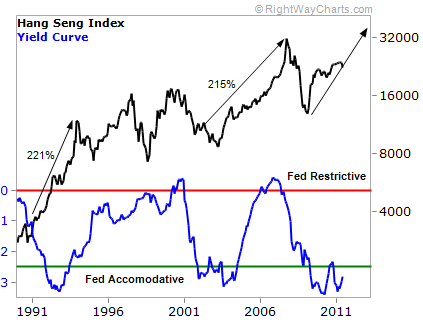
This chart shows the "Hong Kong Can't Help It Rule" in another way. The blue line is the spread between long-term and short-term interest rates. When the spread is wide, it means the U.S. is manipulating rates too much.
When the blue line goes above the red line, when the Fed is "restrictive," Hong Kong stocks fall dramatically. And when the blue line falls below the green line, Hong Kong stocks soar hundreds of percent. Take a look…
Right now, the Fed is still super "accomodative"… which means the Fed is still pouring the kerosene on Hong Kong's fire. The Fed won't stop any time soon. So Hong Kong stocks could soar beyond what anyone can imagine.
Hong Kong stocks haven't soared yet… They're still relatively cheap, which brings me to my second rule for trading Hong Kong:
Hong Kong stocks hit a single-digit P/E in the bottom of the financial crisis. As I write, they're still not that expensive, trading at a P/E ratio of 11.7.
With the Fed holding interest rates near zero, likely for a very long time, there's a good chance Hong Kong stocks (and other assets) could soar to record valuations.
The safest, simplest way for Americans to play it is through shares of EWH – which is the iShares Hong Kong Index Fund.
I expect the Bernanke Asset Bubble will continue for longer than anyone can imagine. And before it's all over, Hong Kong has the potential to develop one of the world's biggest asset bubbles.
You ought to consider putting a few chips on Hong Kong…
Good investing,
Steve


 Posts
Posts

