
 The Daily Reckoning U.S. Edition
Home . Archives . Unsubscribe 
The Daily Reckoning | Thursday, October 20, 2011
-------------------------------------------------------
Patrick Cox’s Breakthrough Technology Alert Presents...
Codename: Panakeia 604 — Is It the Biggest Breakthrough in History?
This breakthrough just hit the market. The story is gaining steam. It could be the biggest breakthrough in history. That means you get an incredible wealth chance...
If you act before midnight Thursday, October 27. Find out why that date is so special by clicking right here.
Kicking Off the “Farewell Euro Tour” A Closer Look at How Europeans Feel About Saving Greece
Reporting from Laguna Beach, California...
Eric Fry
Today’s issue of The Daily Reckoning features the first installment of the “Farewell Euro Tour” — a collection of on-the-street conversations with ordinary folks in Europe about the Greek crisis, and about what this crisis portends for the euro zone. The tour began in the Netherlands, then moved south to Switzerland and then to Italy.
Generally speaking, support for “saving Greece” was tepid at best. Although most folks expressed some vague notion that rescuing Greece was worth trying because it was probably in the public good, most folks also expressed a strong preference for their old national currencies. The Dutch, in particular, preferred their guilder. But the Germans preferred their marks and the French their francs too. Even the Italians preferred their liras.
In other words, as we pointed out a few days ago, “The EU’s bailout schemes seemed to have captured the minds of Europe (like a hostage), but very few hearts. Resignation is the dominant emotion, not resolve.” Take a look...
Watch the video here.
However bleak the prospects for the euro may be, it remains a viable currency for the moment. In fact, one euro will still buy one US dollar and 33 cents, which isn’t that much below its all-time high of $1.49. Furthermore, $1.33 is still very far above the euro’s all- time low of $0.82 — the point being that the euro crisis is not very crisis-like...yet.
But we think a genuine crisis is coming...and there will be no mistaking it when it arrives. The euro may not blow apart completely — although that outcome would not surprise us — but it will stumble noticeably...at least relative to gold.
The dollar may rally against the euro initially, but it, too, is facing a frightening future. The world’s faith-based monetary system is testing the faith of all participants. If that faith should fail, the consequences will not be pretty.
But that’s a problem for another day. So we say, why not spend those euros and dollars while they still buy things of value? Why not buy a little gold, a little silver, a little farmland or maybe a little condo in Uruguay, as today’s guest editors suggest?External Advertisement
This Government Regulation Can Make You Money
Most US Govt. regulations cost business a good deal of money. Yet this one has the potential to help you make a killing. It forces large institutions to dump certain investments before they skyrocket. Our study shows an average gain as high as 213% over the past 9 years. Full report here.The Daily Reckoning Presents Uruguay, Rhymes with “You’re a Buy”
By Ronan McMahon and Margaret SummerfieldLately, the credit rating agencies haven’t been doing much for International Living’shome country of Ireland, other than downgrading it. Moody’s cut Ireland’s credit rating to junk in recent weeks. But some countries are faring much better.
In July, Standard & Poor’s bumped Uruguay’s credit rating up to “investment grade.” Moody’s and Fitch, the other major ratings agencies, boosted Uruguay’s rating as well, although not quite to investment grade.
All three agencies like the country’s “prudent and consistent economic policies.” Fitch, which bumped Uruguay one notch to BB+ on July 14, said that Uruguay’s high GDP per capita income, strong social indicators and solid institutional framework underpinned the country’s creditworthiness. Of course, it helps that Uruguay’s economy is growing strongly, too.
In fact, it grew by 6.8% in the first quarter of 2011. This growth follows on from economic growth of 8.5% in 2010. Manufacturing (pulp paper and dairy), construction, and commerce (car sales and restaurant services) were the most dynamic sectors of the economy. Exports of goods and services expanded 14.7% in the first quarter of 2011, mainly auto parts and tourism. Analysts forecast growth for 2011 to reach 6.3%, up from their prediction of 5.9% in May, based on quarter one’s strong performance. Interestingly, domestic demand in the first quarter rose by 8.3%.
Canada’s Scotiabank wants to target those domestic consumers. The bank justconcluded the purchase of Uruguay’s fourth-largest private bank in terms of loans and deposits, NBC. NBC has 47 branches throughout Uruguay and a three-branch subsidiary in Brazil. The purchase of NBC is not Scotiabank’s first foray into Uruguay. Earlier this year, the Canadian firm bought Pronto!, Uruguay’s third-largest consumer finance company. That gives Scotiabank a strong presence in the Uruguayan market.
Foreign direct investment hit a new high in 2010 according to a report released this week, reaching $2.35 billion. That’s 47.8% higher than in 2009.
The big driver in Uruguay is the “soya dollar.” That is, the agro- wealth that’s been created within Uruguay, as well as in neighboring Brazil and Argentina. Also fueling the fire, Uruguay’s tourism numbers are up an astonishing 40% as of January, 2011, bringing more people to the scene.
Buyers from neighboring countries are here in force...from Brazil because it’s booming...and from Argentina, because inflation is driving prices up, and they’re looking for a safe haven for their money.
Not surprisingly, in Montevideo, the capital, apartment prices rose 22% in 2010. House prices increased by 17%. In Punta del Este, real estate transactions reached $2.25 billion in the 12 months to April 2011.
Around 45% of the properties purchased in Punta were in the town itself. The remaining 55% splits between farms and developments around the town. Chacras, larger lots in private communities, are popular. These large lots, sometimes up to five acres in size, are usually set in a tranquil country landscape of grassland, artificial lakes, and stands of trees. Most offer minimal on-site amenities — a clubhouse and swimming pool, perhaps tennis courts. Pricing ranged from $40-$135 per square meter ($162,000 to over $500,000 per acre) when I checked them out late last year on a scouting trip.
But if you leave Punta del Este behind, and head east to the province of Rocha, you’ll notice two things. First, the beaches are better...wide, unspoiled carpets of white sand, with dunes and white-capped breakers...and empty. Second, real estate prices are much lower.
The province of Rocha stretches east from Punta del Este to the border with Brazil. As development continues to move steadily up the coast from Punta we expect real estate prices will rise in Rocha.
The Rocha market is overlooked and undervalued right now. Buyers tend to focus on Punta del Este if they want a property close to the beach in Uruguay. They simply don’t consider other options. But Punta’s pricing is pushing many buyers out of the Punta market. They’ll start to look elsewhere. Once they do, they’ll realize that not only will their real estate dollars go further in Rocha, but that this area also offers more upside potential.
Now is the time to buy here.
The cheerful and energetic La Paloma is Rocha’s biggest beach town, while the upmarket La Pedrera has a quieter and more genteel ambiance. Tiny Cabo Polonia is famous for its shifting sand dunes, and bohemian residents.
This stretch of coast is in the sights of a handful of international developers. Argentina’s most prominent developer, Eduardo Costantini, is planning a $350 million project here. There have been reports of another planned community by the founder of clothing chains Mango and Etiqueta Negra.
A couple other developments have also attracted our attention. Developer Daniel Oks’ La Serena Golf, for example, is close to one of the best beaches in Rocha. This private community will have a 9- hole golf course, seven lakes, a putting green and tennis courts. More than half the 225 acres will stay as green space. The community is 400 meters from a beautiful beach, a kilometer from a large lake and four kilometers from a nice beach town. Lot sizes in the community range from a half-acre to three-quarters of an acre...and they start at $31,900, which is only a fraction of what a comparable property would cost in Punta.
Rocha is a special place...a great place to visit and spend time. But it’s also a place where real estate investors can profit. We’ve got our eyes on Rocha!
Regards,
Ronan McMahon and Margaret Summerfield,
for The Daily Reckoning
Joel’s Note: Margaret Summerfield is Director at Pathfinder International, which scours the globe to find the most unique and value-oriented real estate opportunities.
Ronan McMahon is Executive Director at Pathfinder International. For more details about Uruguay, go here for Pathfinder’s free report on investing there.
And for those Fellow Reckoners who are interested in international real estate diversification in general, your managing editor will be delivering a speech to Agora Financial Reserve members at Doug Casey’s La Estancia de Cafayate next month. “Doug’s Gulch,” as it’s sometimes known, is an oasis for like-minded freedom seekers tucked away, Rand-style, in the northern reaches of Argentina. You might have seen a few pictures from the place...like this one: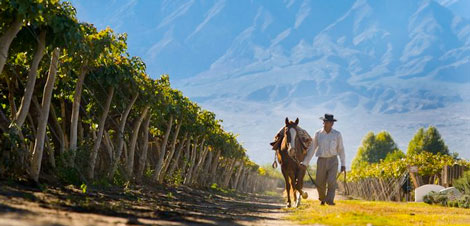
If you’re interested in attending, playing a little golf, drinking some of the local wine and chatting with like-minded individuals, including current owners, here’s where to go for more details. We hope to see you there.Why the warning behind this image could...
“Forever change the way you think about the stock market...
Open your eyes to what you can and can’t expect from the United States government...
And even change the ease at which you’re able to buy and sell things...
Click the image play button to first learn the warning...and some simple ways to prepare for the uncertain times ahead.Bill Bonner The Natural Course of the US Empire
Reckoning from Paris, France...
Bill Bonner
Nothing much from the markets yesterday. The Dow fell 72 points. Gold went down $5.
Meanwhile, the Occupy Wall Street (OWS) movement goes on in America. And 70,000 Greeks “clash with police,” say the news headlines.
People are upset. They know something is wrong. But they don’t know what. The real explanation is too complicated. They won’t sit still for it. So, they look for scapegoats — the rich...the banks...the Chinese.
There’s a joke making its way around the Internet. Goldman Sachs has decided to try to profit from the OWS protests. They’ve set up a “Rage Fund” that will invest in companies that make police batons, pepper spray, bandages, and glass windows.
It’s a joke. But it may turn out to be a good investment strategy.
We’ve made a number of big predictions here in The Daily Reckoning. Some of what we’ve foreseen has actually come to pass — the crash of the tech bubble...the collapse of the housing market...the Great Correction. Some of what we’ve forecast has not yet happened. Some never will.
But here is our most audacious forecast yet: the US is headed for ruin and revolution. The revolution will almost certainly be put down, violently. But the ruin cannot be stopped.
Yes, dear reader, the empire is following its natural course...with the zombies in control and the debt slaves whispering treason. It can’t afford enough bread to keep the popolo minuto (the little people) happy. It will be forced to get tough on them. It is only a matter of time before the secret police round up the ringleaders and disappear them. Heck, the Obama government has already decided that it has the power to kill citizens without any due process of law. What’s to stop it from killing lots of them?
A friend of ours in Argentina explains:
“Everybody is very critical of the generals in Argentina for putting down the radicals in the ’80s. But they had to do it. These guys were kidnapping people. Robbing banks. Murdering people. I was still at school then. I remember that the father of a friend of mine was kidnapped and killed. The police came to school and took the kid away to protect him. They had to do something. The country was sinking into chaos.”
The US will have to do something too. At least, that’s the way most people will see it. It will be “at war” with its malcontents. When you declare a state of war — as demonstrated by the Bush and Obama regimes — you can get away with anything.
The US will continue its program of circuses overseas too. It would make much more sense to bring the troops home and shore up the nation’s finances. But empires don’t back up. And they always manage to find some jackass to lead them where they need to go — to their own destruction. (More below...)
Today, the revolution is a simmering cauldron of greasy misunderstandings and unappetizing conceits. But the fire beneath it is real. It is the heat given off by a system that no longer works.
The New York Times reports that whole cities are now underwater. Millions of Americans are drowning:The United States has a confidence problem: a nation long defined by irrational exuberance has turned gloomy about tomorrow. Consumers are holding back, businesses are suffering and the economy is barely growing.
And more thoughts...
There are good reasons for gloom — incomes have declined, many people cannot find jobs, few trust the government to make things better — but as Federal Reserve chairman, Ben S. Bernanke, noted earlier this year, those problems are not sufficient to explain the depth of the funk.
That has led a growing number of economists to argue that the collapse of housing prices, a defining feature of this downturn, is also a critical and underappreciated impediment to recovery. Americans have lost a vast amount of wealth, and they have lost faith in housing as an investment. They lack money, and they lack the confidence that they will have more money tomorrow.
..The latest data from the survey, released Friday by Thomson Reuters, shows that expectations for economic growth have fallen to the lowest level since May 1980.
In Orlando, a city that trades in upbeat fantasies, the housing crash has been particularly painful. The total value of area homes has fallen below the total mortgage debt on those homes, according to the real estate analytics firm CoreLogic. In the parlance of the real estate world, Orlando is underwater, a distinction matched by Las Vegas.
Meanwhile, the Zombie Metropolis, is doing fine. Here, we turn to Bloomberg:Federal employees whose compensation averages more than $126,000 and the nation’s greatest concentration of lawyers helped Washington edge out San Jose as the wealthiest US metropolitan area, government data show.
*** “God did not create this country to be a nation of followers,” announced Mitt Romney in his speech at the Citadel. “America must lead the world.”
The US capital has swapped top spots with Silicon Valley, according to recent Census Bureau figures, with the typical household in the Washington metro area earning $84,523 last year. The national median income for 2010 was $50,046.
The figures demonstrate how the nation’s political and financial classes are prospering as the economy struggles with unemployment above 9 percent and thousands of Americans protest in the streets against income disparity, said Kevin Zeese, director of Prosperity Agenda, a Baltimore-based advocacy group trying to narrow the divide between rich and poor.
“There’s a gap that’s isolating Washington from the reality of the rest of the country,” Zeese said. “They just get more and more out of touch.”
Total compensation for federal workers, including health care and other benefits, last year averaged $126,369, compared with $122,697 in 2009, according to Bloomberg News calculations of Commerce Department data. There were 170,467 federal employees in the District of Columbia as of June. The Washington area includes the District of Columbia, parts of Northern Virginia, eastern Maryland and eastern West Virginia.
In recent years Washington has attracted more lobbyists and firms with an interest in the health-care overhaul and financial regulations signed into law by President Barack Obama, according to local business leaders.
“Wall Street has moved to K Street,” said Barbara Lang, president and chief executive officer of the DC Chamber of Commerce, referring to the Washington street that’s home to prominent lobbying firms. “Those two industries clearly have grown in our city.”
Last year Washington also had the most lawyers per capita in the US compared with the 50 states, with one for every 12 city residents, according to figures from the American Bar Association and the Census Bureau. In New York State the figure was one out of every 123 residents, while in California the ratio was one in 243.
We can read the old and new testaments. We can consult the priests and soothsayers. We can dissect dead animals and walk the road to Damascus. But damned if we can figure out why God created the USA. We are so fortunate to have Mitt Romney; he seems to have God in his pocket.
Without “clarity of American purpose and resolve, the world becomes a far more dangerous place,” says Romney. What purpose? Resolve to do what? To have “the strongest military in the world.”
Really? Did the God of Abraham, Isaac, Sarah, Jesus of Nazareth, of all the saints, archangels and seraphim really whisper in the ear of the former Wall Street hustler? Did He reveal His plans to this Mormon mouthpiece? Did God — father of the Prince of Peace — really tell Mitt Romney that he should go forth and kick butt all over the planet? It seems unlikely. But who knows? Maybe Romney is right and God is a moron. Or maybe He is just having some fun with Mitt Romney.
“This is America’s moment,” Romney insisted. Anyone who doubts that the US imperial role — though it will bankrupt the nation — is God’s will, should “crawl into an isolationist shell” he said, and “wave the white flag of surrender.”
We don’t know what to think. But God has His ways. His plans. His purposes. It is not for us, at least those of us here at The Daily Reckoning, to know what He has in mind. All we have is questions:
Has God spoken to Mitt Romney? If so, is Romney His candidate? Or his fool?
Regards,
Bill Bonner,
for The Daily Reckoning
Thursday, 20 October 2011


 Posts
Posts

