
11:23AM GMT 22 Dec 2011 10:00PM GMT 22 Dec 2011The coming USE - NuTory Boy seeks to sell us down the river
Note: All the signs are that NuTory Boy wants to sign us up with just a few cosmetic changes to the Treaty. RH
The Sun: Germany has offered UK new EU Treaty deal
The Sun reports that the UK may approve a new version of the EU Treaty change David Cameron vetoed at the 8-9 December EU summit. According to the paper, a new plan proposed by German Foreign Minister Guido Westerwelle, on a visit to see Deputy PM Nick Clegg and Foreign Secretary William Hague on Monday, would contain just a few strict deficit rules for single currency members and include protections against future EU regulation requested by the UK. A senior government source is quoted saying, “If eurozone fiscal union ambitions are strictly limited it will stop France's President Sarkozy 'caucusing' countries to gang up against us. It will give the protections we want and tell the world the EU is united after all.” The paper suggests the new plan is being “championed” by Mr Clegg.
The paper’s leader argues, “If David Cameron can help solve the eurozone crisis and protect British interests, fine…But Mr Cameron must beware. He has just shown steel on Europe. Any sign of weakness will be pounced on, not just in Brussels but by his own backbenchers.”
Sun Sun: Leader Guardian: Garton Ash
France's 'war of words' with Britain is over says French foreign minister Alain Juppé
France's war of words with Britain over Europe is over and differences over the future of the EU will not put the brakes on the two countries defence rapprochement, the country's foreign minister Alain Juppé claimed today.


Wednesday, December 21, 2011
Today saw the Third Reading of Lord Pearson's Bill, which seems to have been something of a non-event [scroll to bottom of page]. As to how it got to this stage so quickly, this is what I wrote but decided not to publish a few days ago:Click here: Your Freedom and Ours: The Bill goes through to the Commons
The Bill goes through to the Commons
The Committee stage debate of Lord Pearson's Bill did not take place as there were no amendments. Lord Pearson moved as the rules say:
There were no objections and the motion was agreed to.
What next? According to the House of Lords Companion to the Standing Orders:
There can be amendments at the Third Reading, which is scheduled for December 21 and the Government and Opposition Front Benches may well decide to defeat the Bill. We shall see. It is entirely possible that nobody wanted this debate now just in case the truth about the non-veto of the phantom treaty might come out.
It seems, there were no amendments [permanent link will be posted tomorrow]. So the Bill is, perhaps unexpectedly, through the House of Lords and goes to the Commons in the new year. The First Reading, not yet scheduled, will be, as ever a formality. But, unlike in the Lords, the Commons divide at Second Reading as well as later on. We shall see what those much-praised, much-vaunted Tory eurosceptics will do. HMG is unhappy with the idea of a establishing "a Committee of Inquiry into the economic implications for the United Kingdom of membership of the European Union". Who will rebel and say that it is, in fact, a very good idea, indeed?
In the meantime, I cannot help being somewhat surprised by the carefully phrased rudeness exhibited by the Lord Strathclyde, Chancellor of the Duchy of Lancaster [just above the Third Reading].
As a number of Orders to do with mayoral referendums in various cities were referred to the Grand Committee,
Lord Pearson asked:
Well, as far as I can see, as readers of this blog know, a referendum of that kind would be a disaster as people, who were easily bamboozled by the Boy-King's phony veto of a non-existent treaty would undoubtedly vote to stay in but reform the unreformable. However, that cannot be HMG's argument. So what did Lord Strathclyde reply, having disposed of another objection:
A period of silence, eh? So we can get on with our business of handing over whatever remains of this country's sovereignty.
Benedict BroganBenedict Brogan is the Daily Telegraph's Deputy Editor. His blog brings you news, gossip, analysis, occasional insight into politics, and more. You can email him at benedict.brogan@telegraph.co. uk. Sign up to Brogan's Briefing, Westminster's must-read morning email, by clickinghere.

William Hague has the 'frites fraternity’ on the run across Whitehall

What are the benefits of staying in the European Union?
The Lords are right to consider a cost-benefit analysis of Britain’s EU membership.

There is not even agreement on this country’s net contribution to EU coffers, something that should be straightforward. The Treasury says the figure is £7.6 billion, up from £4.7 billion in 2009-10. But the sceptics quote figures from the European Commission’s Pink Book, which reveal that we handed over £18.5 billion last year in various forms and received £8 billion in return for regional aid, agricultural support and other projects. So we do get something back; but it is our own money – and it would probably be cheaper to cut out the middleman. Surely by now the costs have reached the point where it is no longer rational to maintain the same relationship with the EU that we have had for 40 years, any more than an aqueduct and a jug of pinot grigio made Roman occupation palatable to the People’s Front of Judea.
http://astore.amazon.co.uk/ civitas-21/detail/1906837325
Time to Say No: Alternatives to EU Membership
List Price: £8.00
By Ian Milne
Price: £7.20 & eligible for FREE Super Saver Delivery. Details
Availability: Usually dispatched within 24 hours
Dispatched from and sold by Amazon.co.uk
4 new or used available from £3.50
Average customer review: ![[]](http://images.amazon.com/images/G/01/associates/network/star40_tpng.png)
( 2 ) Product Description
Evidence is accumulating that membership of the EU imposes a heavy ongoing net cost on the UK economy possibly in excess of ten per cent of GDP, over £140 billion a year at 2009 prices. Long before the 2010 euro crisis a consensus existed (amongst member-state governments, the Commission itself, NGOs, business and academia) that in the decades to come continental EU s prospects, as a market and an economy, are dire. That consensus is strengthening. As much as 60 per cent of UK exports already go outside the EU, using the author s estimates for the effect of distortions on trade statistics. Since 2000 they have been growing almost 40 per cent faster than exports to the EU. Growth in export markets is almost certainly going to occur in the 95 per cent of global population outside EU-26, rather than in the five per cent inside EU-26. That being so, the UK s first priority ought to be to decide how its trading arrangements with the world outside the EU should be configured. That decision would condition the extent to which the UK s relationship with the EU Single Market should be changed. Full withdrawal would be one of the options. The author examines these and other questions in some detail, including the three main alternatives (for the UK) to EU membership. He concludes by sketching out the mechanics, timetable, management and consequences of full UK withdrawal.Europe
Open Europe yesterday published a briefing note arguing that, although the ECB is unlikely to start acting as the eurozone's lender of last resort, it is already heavily intervening in markets. Open Europe estimates that, through its government bond buying and liquidity provision to banks, the ECB’s exposure to weaker eurozone economies has now reached €705bn, up from €444bn in early summer – an increase of over 50% in only six months. The report also notes that the hope that the new long term funding for banks will feed through to increased demand for sovereign debt looks unlikely to happen. Other alternatives such as ‘Quantitative Easing’ also look unlikely to help – under a €500bn programme only €90bn would flow to Italy, while €135bn would hit Germany.
Open Europe press release Open Europe research Times Telegraph: Live Blog Guardian: Live Blog Sky News Blogs: Conway GFS News Novinky.czECB says eurozone leaders created 'cycle of risk'
Protracted indecision among political leaders has created a "cycle of risk" with "systemic crisis proportions not witnessed since the collapse of Lehman Brothers", the European Central Bank (ECB) has warned.


Euroland euphoria on Mario Draghi bank rescue
Southern Europe's battered debt markets are basking in a glorious pre-Christmas rally as hedge funds and investors celebrate a blast of cheap liquidity from the European Central Bank.


This subtle form of 'credit-easing' includes a cut in the reserve requirement to free up €100bn in lending power, and looser rules to allow collateral-starved banks to pawn more of their loan books at the Frankfurt lending window.
Open Europe Europe
Dispute between German government and Bundesbank over loans to IMF deepens
The ECB this morning launched its first three-year lending operation with 523 banks requesting €489bn in loans, well above the expectations of between €250bn and €350bn. The previous largest amount requested was €442bn in one year loans back in June 2009. The aim of the long term lending operation is to provide secure long term financing for banks which can no longer gain funds from the usual avenues, in turn hopefully boosting lending in the wider economy and possibly purchases of sovereign debt. It was widely expected that demand above €400bn would prompt a positive market response. Open Europe’s briefing on the role of the ECB and the potential consequences for its long-term lending featured in the Telegraph, on EUobserver and on Zerohedge. The FT reports that US money market funds, formerly a key source of funding for European banks, have now cut their European exposure to record lows.
Open Europe press release Open Europe research FT WSJ Irish Times Telegraph Telegraph 2 Suddeutsche FT 2 FT 3 WSJ 2 Irish Times Times EUobserverEUobserver 2 Expansión EUobserver 3 Le Figaro Le Figaro: Editorial La Tribune Le Monde Welt Corriere della Sera: Giavazzi FT: Roubini FT: Spiegel WSJ Heard on the Street WSJ Review&Outlook FTD: Zeise Público Les Echos
The Telegraph reports that the Bank of England’s Financial Policy Committee has criticised the EU’s approach to financial regulation, warning, “Maximum harmonisation of regulatory standards restricts the discretion for national authorities to tighten regulatory levers to guard against systemic risk. The main rationale for establishing common minimum standards is to avoid a ‘race to the bottom’ in international regulatory rules. The rationale for maximum standards is not clear.”
Open Europe research Telegraph CityAM Guardian Guardian: Cable
In today’s Die Welt, Editor Michael Stürmer writes, “The loneliness of the British is a bad sign for Europe. The liberal economic forces lose ground vis-à-vis EU-statists. This changes all the equations within the EU, strengthens the development of the Franco-German directorate and weakens the influence of the smaller member states. Germany will become overwhelmed in its role of the irreplaceable yet reluctant hegemon.”
Welt: StürmerGraphic: EU treaty and Eurozone crisis deadlock explained
In the last two weeks David Cameron has vetoed the latest EU treaty and George Osborne has ruled out contributing British money to a €200bn fund to stabilise the Eurozone area. But is Britain really the lone holdout of Europe?
Politiken notes that the prospect of a referendum in Denmark on the EU ‘fiscal compact’ has become “more remote” following an attempt by European Commission President José Manuel Barroso to assure the Danes that the pact would not involve a transfer of sovereignty. Danish Europe Minister Nicolai Wammen said it was “too early to say” whether a referendum would be called, but said it was “unlikely”.
PolitikenTelegraph
Ambrose Evans-Pritchard has covered world politics and economics for 30 years, based in Europe, the US, and Latin America. He joined the Telegraph in 1991, serving as Washington correspondent and later Europe correspondent in Brussels. He is now International Business Editor in London. Subscribe to the City Briefing e-mail.

Britain, the IMF, and the world's richest beggar

Telegraph
Europe: UK refuses to give billions to save the euro
Britain has refused to give billions of pounds to help save the single currency, as the world’s financial watchdog warned that fresh clouds are gathering “over European skies”.

“What we see is stalled growth in advance economies with potential recession in some of the European Union countries, including my own country (France), of course, and channels of contagion, which can be different," she said.
How will the UK judge the role of the ECJ?
1/12/how-will-uk-judge-role- of-ecj.html
The proposed document would see a role for the European Court of Justice in judging whether national governments have transposed a new “balanced budget” obligation and, if this is breached, an automatic “correction mechanism” into national law. The new treaty states:NOTING that compliance with the obligation to transpose the "Balanced Budget Rule" into national legal systems at constitutional or equivalent level should be subject to the jurisdiction of the Court of Justice of the European Union, in accordance with Article 273 of the Treaty on the Functioning of the European Union.
The question is whether this is allowed under EU law, can the ECJ be used for this? (NB, the draft foresees no role for the ECJ in enforcing any sanctions but simply judging whether the new rules have been adequately transposed into national law.)
Article 273 of the EU Treaties, cited by the new treaty, states that:The Court of Justice shall have jurisdiction in any dispute between Member States which relates to the subject matter of the Treaties if the dispute is submitted to it under a special agreement between the parties.
So this EU Treaty article clearly provides the new group with a hook on which to try and hang the new arrangement and get the ECJ involved. Article 273 would allow the ECJ to be used to judge a dispute (in this case whether the “balanced budget” rule has been adequately transposed), as long as the subject of the dispute is “related” to the EU Treaties. The question is whether this 0.5% rule can reasonably be seen as “related” to the Treaties. This is where the legal grey area begins and where it seems that the justification for ECJ involvement is iffy to say the least.
The existing EU Treaties contain obligations for governments to remain within a 3% deficit limit and a 60% debt to GDP limit. But there is no mention of the new 0.5% “structural deficit” limit proposed by the new treaty.
The 0.5% limit is a new obligation. It is therefore a legal stretch to say that this falls under the category of things to which the EU Treaty “relates”. Using the ECJ to judge whether this new obligation has been transposed properly is therefore also a huge legal stretch and one that the UK would be well advised to investigate and possibly challenge. If Cameron does wave the proposal through it will certainly raise political questions about what his veto actually achieved.In Die Welt am Sonntag, columnist Clemens Wegrin argues that, while in his view David Cameron did little to forge coalitions or present an alternative to the Franco-German approach at the latest EU summit, “in essence, the British were right: they have always warned that the euro was a falsely built construction that could not ultimately work…The anger directed at the British is ultimately anger about those who claimed from the outset that the Emperor is naked.”
Welt am Sonntag: Wergin Scott Baker
http://www.thesundaytimes.co. uk/sto/news/uk_news/National/ article844744.ece Whitehall plans euro-evacuation
Marie Woolf and Robin Henry Published: 18 December 2011  Plans aim to protect expats unable to access their money if banks fail (Samuel Aranda)
The Foreign and Commonwealth Office is drawing up plans to evacuate thousands of British expatriates from Spain and Portugal in the event that their banking systems collapse.
It comes as credit rating agencies warn that the deal struck by EU leaders this month may not save the single currency from further turbulence and possible collapse.
Officials from the Foreign Office and the Treasury are preparing contingency plans to help thousands of Britons get home if banks in Spain and Portugal two of the most vulnerable eurozone economies fail and people are unable to get at their money.
Almost 1m Britons live in Spain, many of them pensioners, with large communities in Marbella and Malaga. There are around 50,000 UK nationals living in Portugal.
The Foreign Office is concerned that expats who have invested savings in their adopted countries could be left stranded, unable to withdraw cash and facing losing their homes if the banks call in loans.
Foreign Office sources said it was planning for a “nightmare scenario” with thousands of penniless Britons sleeping at airports with no money and no means of getting home.
Last week Standard & Poor’s, the credit rating agency, downgraded 10 Spanish banks and warned it could lower their credit worthiness scores even further. The banks, including Banco Popular, were put in “credit watch with negative implications”, suggesting their position was shaky.
Fitch, another rating agency, warned this weekend that a solution to the eurozone crisis was probably “beyond reach”.
Among the contingency plans being discussed are sending planes, ships and coaches to evacuate expats. Some could be returned home via Gibraltar.
The Foreign Office is also looking at giving small loans to stranded Britons, while the Treasury would use its influence to ensure that the Spanish and Portuguese governments instruct banks to let Britons access funds so they can pay for groceries and other essentials.
Both Spain and Portugal have a deposit guarantee scheme similar to that in the UK, meaning that depositors are covered for up to €100,000. But in a crisis, many banks limit withdrawals to stop people removing all their money and leaving the country.
The Treasury would also put pressure on banks not to call in mortgage loans from Britons so they do not lose their properties.
Many Britons have retired to the Iberian peninsula on fixed incomes, having sunk their savings into their villas and apartments. Other retired people are living on tiny incomes because their UK state pensions are frozen.
A senior Foreign Office source said the plans were being drawn up to deal with a worst case scenario. It is drawing on experiences of other mass evacuations, such as during the 2006 war between Hezbollah and Israel where the UK sent warships to evacuate expats from Lebanon.
A senior Foreign Office source said: “The nuclear scenario would be having thousands of Brits stranded at the airports in Spain and Portugal with no way to get money from the cash dispenser and no way to get home. Who would be blamed for this? The Foreign Office.
The source added: “We are looking at how we can help evacuate them if the banks in Spain and Portugal collapse, getting people cash, things like that, sending planes. We did similar things in Lebanon in 2006. We are co-ordinating with the Treasury.”
The Treasury confirmed that plans to give emergency aid to Britons if eurozone banks collapse were being prepared but refused to give details.
“Of course we plan for a range of contingencies. We are not going into the specifics of what we are planning for,” it said.
Financial experts said expats could face losing their villas and apartments in popular enclaves such as the Algarve and Marbella.
Simon Smallwood, business development director at International Private Finance, said: “There’s a danger the banks that have lent expatriates money for mortgages and loans could call it in at short notice.”
Jeremy Cook, chief economist at World First, a specialist in foreign currency exchange, said if Spanish or Portuguese banks collapsed expats could face a block or limits on withdrawals to “prevent what little liquidity they have flying off abroad through the back door”.
He said during the Argentinian banking crisis 10 years ago, a daily limit was set on how much money could be withdrawn.
“You would have people taking out as much cash as they could each day because they wouldn’t know what was going to happen with the bank tomorrow,” he said.
He warned that Britons with Spanish or Portuguese accounts could lose savings if the banks collapsed. “Countries have individual safeguards on deposits but for people with large deposits in a bank it would be difficult to say whether all that money would be protected.”
• British fishermen yesterday condemned a European Union deal on fishing that will keep their boats tied up for longer as a “bitter blow”.


UK will fare better in this Anglo-French spat
By Wolfgang Münchau FT December 18,
“...one prefers to be French than British at the moment on the economic level” – François Baroin, French economy minister
“ ... they should start by downgrading Britain which has more deficits, as much debt, more inflation, less growth than us and where credit is slumping” – Christian Noyer, governor, Bank of France
Last week’s series of comparative statements were obviously co-ordinated. What I find intriguing about them is their sheer desperation. The French economic policy elite no longer understand the world. They genuinely believe that they are doing better than the British. The French private sector is in much better shape. The country is committed to the righteous path of fiscal austerity. So why should the rating agencies be downgrading France and not Britain? It is just not fair. Or is it?
There is an obvious gap between the economic narratives. Eurozone leaders believe they have solved the crisis by agreeing a fiscal compact. It was a definitive decision, taken at the European summit of just over a week ago. There will be no fiscal union, no eurobonds, no European Central Bank bail-out. The adjustment will happen through austerity alone – and it will go on and on. A rule to allow a maximum deficit of 0.5 per cent of gross domestic product will in the long run eliminate most public sector debt. The world’s second-largest economy wants to repay all its debts.
The UK government has been conducting a programme of quite extreme pro-cyclical fiscal austerity as well. But there are two differences. The first is a flexible exchange rate – though this offers diminishing marginal returns when everyone pursues the same policy. The second, and most important, is that Britain has its own central bank. The Bank of England has been conducting a much more aggressive monetary policy than the ECB.
Beggar-thy-neighbour type economic policies have a long tradition in Europe. They can work when you are the only one who pursues them – or when the weight of countries not pursuing them exceeds that of those that do. In that case, the adjustment usually goes along with an improvement in the current account position. Given the size of the eurozone, and the policies of the rest of the world, the scope for an increase in the eurozone’s current account position is relatively small. The failure to take into account the effect of co-ordinated austerity has been the main reason the European authorities misjudged the adjustment dynamics in Greece. They are now making the same mistake on a much grander scale.
On my calculations, Italy needs a primary government surplus of almost 5 per cent of GDP simply to maintain the current stock of debt. I am assuming a nominal growth rate of 2 per cent, which is realistic given Italy’s need to improve its competitiveness. I also assume a long-term interest rate of 6 per cent – which is lower than today’s rate. To lower the debt-to-GDP ratio to 60 per cent in 20 years would require an additional 1.5 percentage points in the primary balance. For Italy to achieve debt sustainability thus requires a primary balance of more than 6 per cent. Any shortfall in the nominal growth rate would require a compensation through an even higher primary balance.
The adjustment effort for France is lower. France has higher nominal growth, a lower debt-to-GDP ratio and lower long-term interest rates. It is even less for Germany, but Berlin, too, will need to tighten fiscal policy if it wants to meet its own self-imposed constitutional rule to allow a maximum 0.35 per cent deficit-to-GDP ratio average over the economic cycle. So everybody tightens policy.
In the presence of a joint fiscal retrenchment, in a weak global environment, such policies will almost certainly reinforce the downturn. Italy faces a big recession next year and I see no reason why it should end after one year when the Greek recession has lasted four with no end in sight. As we are going through a period of several years of negative to zero nominal growth, the fiscal effort to meet the target rises proportionately.
The parallels to the Great Depression are obvious: the euro acts as a modern day gold standard; fiscal policies are procyclical; adjustment is delayed through an Irving Fisher-style debt deflation dynamics. Will the euro survive a depression? This is hard to say. If it does, under unchanged policies, we will be measuring the costs of adjustment not in euros but through a death toll.
The real difference between France and the UK is simply that the UK is not trapped. Britain is a sovereign country. France is economically a sub-sovereign zone.That is the simple reason why the eurozone needs a eurobond and a lender of last resort function in the system. With those functions in place, policy errors are less catastrophic.
Mr Baroin is therefore quite wrong. You do not want to be French, German or Italian if you have a choice. A rating downgrade for France and the rest of the eurozone is thus logical and deserved.
In surveys conducted by pollster Maurice de Hond following the December 8-9 summit, 50 per cent of Dutch agreed with the statement: “We never should have joined the euro”, against 47 per cent who disagreed. Fifty-six per cent said they thought European leaders would fail to solve the crisis.Workers of Europe unite, you've only euro chains to lose
Europe's Left has suffered a calamitous six months. Socialist governments have met historic defeats in Portugal and Spain. Greece’s Pasok party was toppled by an EU technocrat Putsch. Ireland’s soft-Left Fianna Foil lost every seat in Dublin.

David Begg, head of the Irish Congress of Trade Unions, said his encounter with the (EU-ECB-IMF) Troika now restructuring Ireland was a sobering experience.
Telegraph
Why the euro turkey is well and truly stuffed
The coming break-up of the single currency makes Britain’s veto seem a mere sideshow, writes Jeff Randall.


Britain started war of words over credit ratings, insists French foreign minister
The French government tried to calm its war of words with Britain yesterday but insisted that London, not Paris, had caused the dispute.
Boris Johnson blames failing eurozone plans on political ego
London mayor says 'hysterical attempts to bubblegum' euro may see weak members leaving the single currency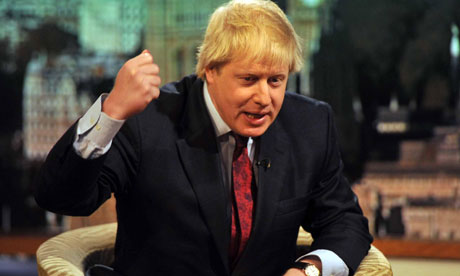
Boris Johnson on the Andrew Marr Show. Photograph: Jeff Overs/BBC/PA
Weak members of the eurozone may leave the single currency in the coming year because "hysterical attempts to bubblegum" the euro keep failing, the London mayor Boris Johnson warned on Sunday.
In some of his most outspoken remarks on the euro, which prompted a rebuke from Nick Clegg, Johnson also appeared to question David Cameron's entire negotiating strategy at the European summit.
The London mayor, whose interventions before the summit prompted Downing Street to toughen its stance, said he expected a realignment of the single currency over the next year.
Speaking on the Andrew Marr Show on BBC1, he said: "I'd be amazed if we were all sitting here next year and the euro had not undergone some sort of change. I think it highly likely that there will be a realignment."
Asked whether that meant some countries would leave the euro, Johnson said: "I think possibly, yes, and we all know who the likely candidates are."
Johnson, who first made his name as the Brussels correspondent of the Daily Telegraph in the 1990s, said European leaders were attempting to keep the euro afloat because so much "political ego" had been invested in European integration.
"There's such phobia about this and such a lot of political ego has been invested in the success of the euro project that people are failing to see that actually that might be the best way forward. We continually go on with these hysterical attempts to bubblegum the whole thing together. We're just going to consign those periphery economies particularly to low growth and we're never going to get confidence back in the eurozone."
Johnson's remarks were echoed by Baroness Neville-Jones, the former security minister. Amid reports that the foreign office is making preparations to evacuate British pensioners from Portugal and Spain, in the event of a banking collapse, Neville-Jones told Sky News: "It is very hard to see at the moment how the eurozone in its present form is going to survive. Spain is clearly a vulnerable area.
"Now if that happens, one of the things that will happen in a crash of that kind, is that the banks would close their doors. You would find that there are people there, including our own citizens and a lot of them, who couldn't get money out to live on.
"So you would have a destitution problem. I think this is a real contingency that they need to plan against – very, very worrying."
Clegg dismissed Johnson's remarks. Speaking shortly after the London mayor's appearance on BBC1, the deputy prime minister told the Murnaghan programme on Sky News: "I read and hear a lot of people breezily predicting almost with a sense of glee that the eurozone is going to fall apart and this country is going to drop out of the euro. I don't know, my crystal ball is no clearer than anybody else – all I do know is that no one should lightly wish for that outcome because there's no such thing in my view as an orderly break up of a currency."
The European Central Bank's president, Mario Draghi, said that politicians had to move fast to make the bailout fund operational, as any delay would push up costs. He told the Financial Times the ECB could not start printing money and that any country leaving the euro would be worse off and would still have to go through the same reforms.
He said there was no long-term trade-off between growth and austerity. (!!!!!!!)
Johnson challenged the PM's negotiating strategy in Brussels. Cameron vetoed a revision of the Lisbon treaty, which would have placed the eurozone's new "fiscal compact" on a legally binding basis after failing to secure a series of concessions to protect Britain's financial services. But the prime minister said he supported greater co-ordination of fiscal policy for the eurozone.
Johnson indicated there was little threat to financial services because Britain has a veto for "most of the important stuff". But he said Cameron had been right to wield the veto because it would be wrong to give Britain's blessing to an "anti-democratic structure of a fiscal union".
Vince Cable, the business secretary, highlighted Lib Dem unease over the veto on the Andrew Marr Show: "I frequently wonder about my position in government because we're all making difficult decisions but, when I reflect on it, – as I do – I realise that what we're committed to is actually making this government work."http://www.telegraph.co.uk/ comment/columnists/ borisjohnson/8964824/EU- crisis-The-Frogs-do-love-us- theyre-just-hopping-mad-with- Germany.html
EU crisis: The Frogs do love us – they’re just hopping mad with GermanyOur entente with the French is still cordiale, but they badly need someone to shout at, writes Boris Johnson.
risis: The Frogs do love us – they’re just hopping mad with Germany
Our entente with the French is still cordiale, but they badly need someone to shout at, writes Boris Johnson.

By Boris Johnson
10:58PM GMT 18 Dec 2011 445 Comments
There is a scene in Monty Python and the Holy Grail that captures the current dialogue between Paris and London. One evening King Arthur arrives with his knights at a darkened castle. He tells the figure on the battlements that he has come to recruit noble knights in his quest for the grail. For some reason the guard turns out to have a heavy French accent.
In fact, the whole castle is occupied by French knights, and they treat the English king with disgraceful rudeness.
First, the guard tells Arthur that he has no interest in obtaining a Holy Grail, since they already have one in the castle. When Arthur says he would like to have a look at this marvel, the French knight refuses, and concludes: “I don’t want to talk to you no more, you empty-headed animal food trough whopper. I fart in your general direction. Your mother was a hamster and your father smelt of elderberries.” The French then cry “fetchez la vache”, and use a trebuchet to bombard the Knights of the Round Table with a dead cow.
If you cut out some of the raspberry blowing and bottom-flashing, that is just about the level of the current diplomatic broadsides from Paris. David Cameron goes to the dark castle in Brussels in his quest for common sense, and ever since they have been peppering us with dead cows. Various French ministers have queued up to say rude things about Britain and the British economy. In an amazing breach of diplomatic convention, the French prime minister has called for Britain’s credit rating to be downgraded and announced that he would much rather be French than these so silly British.
In a bid to calm things down, Nick Clegg has been forced to ring the French up and ask them to stop being so jolly insulting.
“This is quite unacceptable,” the Liberal Democrat leader is supposed to have fumed at the French government.
I don’t know if the French have been chastened by this rebuke, but I think we should urge Nick to relax. Look at the polls. Anyone would think that Nicolas Sarkozy and David Cameron began that summit with a secret meeting, at which they agreed to help boost the other’s domestic ratings. “I’ll bash you if you’ll bash me,” they said. “Our voters will love it!” And hey presto. The Prime Minister takes a principled opposition to plans for a Fiscal Union (FU), and shoots ahead of poor old Ed Miliband in the polls.
Sarkozy bolsters his own election hopes as he launches an ever-popular tirade against les rosbifs and their appalling belief in free markets. It’s win-win. That is the point about the pantomime xenophobia between the French and the British: it is essentially innocent or more innocent than almost any other form of xenophobia; because in our hearts, au fond, neither side really believes it. We have to admit there are times when we enjoy a good old orgy of gratuitous Frog-bashing. There are times when we are all prepared to read how our continental cousins are a bunch of garlic-breathing Strauss-Kahns with a deeply suspect interest in structuralism and gloomy films. In this stereotypical world, their women fail to shave their armpits, they have a weird obsession with suppositories and a fanatical lust to eat our children’s ponies.
As for the French view of the British, I am afraid that there are times when they can be heard to say that we have terrible food, that we prefer hot water bottles to sexual intercourse and that most of the men in our ruling class (this was a tart observation by former prime minister Edith Cresson) were not the marrying kind. This is the kind of cheerful abuse that we have been directing at each other for generations, and ever since the battle of Waterloo it has not been meant very seriously.
Deep down, all reasonable English people know that the French have an extraordinary culture, that their understanding of cheese-making is god-given, that they have high-speed trains of a kind we are still trying to imitate and that it is a shame that we (and our children) are so feeble in our mastery of their beautiful language. You can tell that the British secretly love and admire the French by the sheer numbers who go to France for their holidays, and who make their homes in the Dordogne.
As for the French, they know in their hearts that for all the 20th-century misunderstandings between us Verdun, Mers-el-Kebir, Suez, de Gaulle’s “non” we remain indispensable allies; and all civilised French people understand that we also have our good points: humour, gardens, custard, pubs, democracy, the theatre and everything else that makes this country great. That is why so many hundreds of thousands of French people have moved to England in the past 20 years, and that is why London is now the sixth or seventh biggest French city on Earth. In fact, there are now so many talented French people living in the English capital that a special MP has just been appointed for outre-manche.
Victor Hugo said something about how the French and the English needed each other, because they both did well from the competition and he was right. And the final reason to be cool about the gall of Gaul is, of course, that we are not the real object of French wrath. It isn’t Britain whose dithering is causing the continuing and growing uncertainty over the euro. Downing Street is not responsible for the failure to reassure the markets with a credible plan to guarantee the sovereign debt of the peripheral euro nations.
The French are really disappointed with Germany; and it is a golden rule of European politics that when France is angry with Germany, Britain gets the blame. That is because a rant against Germany is a very different thing, with a much heavier charge. Sixty-seven years after the war, the French are facing up to the reality that the European experiment has failed to contain German economic might, and that the Germans are unwilling and unable to help other countries cope with the agony of the euro.
That is what is really making them angry Telegraph
If the euro is saved then Britain should quit the EU and say good riddance
The season of good cheer may be upon us but in this, my last column of the year, I want to discuss the attractions of good riddance. My subject is Britain’s relations with the EU.


On proximity, admittedly the EU gives us tariff-free access to its market, which may help to boost foreign direct investment into the UK. But the cost is high. It starts with our budget contribution, which amounts to about £7bn net per annum. In addition, there is the cost of the Common Agricultural Policy, which may be only about £3bn net, but is probably much more. Then there is the cost of complying with EU regulations, which some estimates suggest could be about £30bn.
http://www.guardian.co.uk/ politics/2011/dec/19/farage- ukip-tories-pact-referendum
Farage says Ukip could offer Tories electoral pact in return for referendum
Andrew Sparrow speaks to the Ukip leader about electoral pacts, 'nutters', banning the burqa and Europe
Andrew Sparrow, senior political correspondent
guardian.co.uk, Monday 19 December 2011 10.17 GMT
larger | smaller
Nigel Farage says Ukip could form an electoral pact with the Conservatives at the next election if David Cameron were to promise a referendum on membership of the EU. Photograph: Graeme Robertson
"This is the perfect environment if you are Nigel Farage," Nick Clegg told the Guardian at the end of last week. "The people who are trying to exploit the politics of grievance and blame, they believe they have got the wind in their sails."
By coincidence, I was interviewing Farage, the leader of the United Kingdom Independence party (Ukip) on Friday and at that point he didn't seem to have the wind in his sails.
It was a few hours after the announcement of the result in the Feltham and Heston byelection and, despite speculation that Ukip could overtake the Lib Dems, Clegg's party hung on to third place. But, as Farage talked about the broader political picture, he was upbeat about Ukip's chances of tugging Britain out of the EU. Here are the key points from our conversation.
• Farage said Ukip could form an electoral pact with the Conservatives at the next election if David Cameron were to promise a referendum on membership of the European Union. There was "every chance of forcing David Cameron into giving us a referendum", he said. Whether or not to propose an electoral pact with the Conservatives in 2015 would be a "huge decision" for the party, he said. But he had offered the Tories a pact before the 2010 election, he said.
• He renewed his call for 20% of teacheers to be sacked. "There's no doubt there are too many people in the teaching profession who have academic achievements and qualifications [that mean] frankly they shouldn't be in that position," he said.
• He signalled that he was going to ditch Ukip's policy of banning the burqa. At the last election Ukip was in favour of banning the burqa in public buildings and some private buildings. But Farage, who was not party leader at the 2010 election, said this was a policy he had inherited. It was being reviewed, he said. He was "dubious" about using legislation in this area. "I'm not really in favour of banning the burqa," he said.
• He said that he made a mistake when he accussed Herman Van Rompuy, the president of the EU, of having "all the charisma of a damp rag and the appearance of a low-grade bank clerk" in a speech in the European parliament. "Hands up, I got the tone of that wrong," Farage said. (I am astonished by that quote - Nigel happily promotes the sale of dishcloths with Rompuy's image on them, and laughs uproariously with members of the audience about it. Also his repeated attacks on the elite in the EP are bringing him fame and praise from all over. Idris)
• He suggested that Ukip still had a probleem with "nutters" among its members. In the past he has used this term and talked about Ukip having a disproportionate number among its members when it launched as a new party. Asked if this was still a problem, he said: "Less than it was."
• He claimed Ukip was a "very globalist party". He explained: "We are the party saying we've got to stop being so small-minded and thinking that the beginning and end of the economic world is Europe. It jolly well isn't."
Most commentators don't take Ukip particularly seriously because, although they do well in European elections, where they scoop up the anti-European protest vote, they are irrelevant at Westminster because they have never come close to winning a seat in the House of Commons.But earlier this year the Labour magazine Progress speculated about Farage winning enough seats to hold the balance of power after the 2015 election.
Absurd fantasy, or a plausible scenario? In a 30-minute interview at Europe House, the old Conservative party headquarters which is now (ironically) the European parliament and commission's London HQ, we covered this and much else. You can decide for yourself.
Being offensive in the European parliament
Q: On the blog I posted inviting people to suggest questions, there were lots of comments from people who have seen your speeches in the European parliament on YouTube. And they want to know why you're so offensive. For example, this was from gilly606: "I accept that when you speak in the European parliament you are trying to make a point you believe in. But why do you have to be so rude? Why can't you act more like a professional, intelligent, open-minded representative of our country?"
A: Gilly, have you seen what they say about me? No.
Q: Two wrongs don't make a right, as I have to tell my children.
A: Listen, the one speech I've made that was said to be rude was the Rumpy Pumpy speech. [The one in which he told Herman Van Rompuy, the president of the EU, that he had "all the charisma of a damp rag and the appearance of a low-grade bank clerk" – the Guardiaan story about it is here, and the YouTube footage here.]
A lot of this is about parliamentary culture, isn't it?
Q: Are you saying it's part of the European parliament's culture?
A: No, it's not part of their culture. That's the point. [The European parliament] has been designed with this semicircle. The basic assumption when I went there in 1999 was that we would all agree exactly on the direction we were going; the only argument was about how quickly we would get there.
Q: But if you stood up in Westminster and said that David Cameron had all the charisma of a damp rag …
A: Everyone would laugh. What did Vince Cable say about Gordon Brown?
Q: That he was Mr Bean.
A: There you are. What's the difference? In parliaments all over the world you get real confrontation. But the European parliament is not designed for that, because we're not politicians; we're technocrats.
Q: But Vince Cable was using a joke to a make a point. Your comment about Van Rompuy just seemed offensive.
A: Well, if you look at the words I uttered, it's not very offensive. If you look at the tone in which it's delivered, I can understand why people think that. And I've said since then that when you are an unscripted speaker, which I am, sometimes you get the pitch wrong. So, hands up, I got the tone of that wrong. And the reason? This is my defence. When you hear debate in Westminster, there are 200 microphones hanging from the ceiling. So you get a feeling, when you listen or you watch, not just for what the speaker is saying, but for how the house is reacting. In Brussels all you get is the speaker's microphone. So you have absolutely no idea the extent to which on that day I was being
jeered. It was very noisy. There were 300 of them absolutely screaming at me. And I responded to that by lifting the pitch to a level that looked a little bit aggressive. I accept that. Do I think apart from that my speeches have been rude? No I don't.
Q: Another Ukip intervention that offended people even more was Godfrey Bloom calling a German MEP a fascist. Do you think that was acceptable?
A: No. But it was an off-mic comment that somebody heard and there was all the feigned outrage. He would not have stood up and said it. He said it in a half-jokey manner. It wasn't the right thing to have done.
Q: Did you ever apologise to Van Rompuy?
A: I apologised to bank clerks the world over.
Relations with other MEPs
Q: If you ever got elected to the House of Commons, would you try to play the same role in the House of Commons, as a licensed hooligan?
A: I wouldn't be on my own. I wouldn't be surrounded by hundreds of people that hate me, by hundreds of people that don't think I should exist. They actually don't think I should be allowed to be an MEP. This is how undemocratic these people are.
Q: What evidence have you got for that?
A: Very early on, in 2005 or 2006, Hans-Gert Pöttering became president of the European parliament. German MEP, quite senior, been there since 1979. And in my first proper introduction to him he said: "People like you shouldn't be here." I said: "You mean, you don't agree with my point of view." He said: "No, people like you shouldn't be here."
Q: Because you did not support the institution?
A: Yes. They do not think of this as being a democratic chamber. They think of this as being an adjunct to, and to work hand-in-glove with, the European commission.
"Nutters" in Ukip
Q: In your autobiography, Flying Free, you said that in the early days Ukip had a disproportionate number of "nutters" because new parties attract fanatics. [As Farage put it: "Enthusiasm is a prerequisite (in a new party) and enthusiasm is nowhere greater than in the fanatical or the personally ambitious. Nutters and the self-seeking therefore hitch rides."] Do you still think that is a problem for the party?
A: Less than it was. I think the quality of people coming to Ukip has increased markedly. Look at the bloke who stood for us in the [Feltham and Heston] byelection: a successful businessman, somebody with a bit of background, a bit of knowledge of the world. The quality of people has improved markedly. And our selection procedures have improved markedly too.
Political correctness
Q: On the Ukip website there's a page headlined: "What we stand for." It says: "Political correctness is stifling free speech." One of my readers [JonathanCR] wants to hear an example of something that you're not allowed to say because of political correctness but that you would want to say.
A: I think we've been through a very long period of time when to even discuss immigration was considered to be racist. When you look back on it, that Enoch Powell speech was a disaster because it actually stopped national debate because of the language that he used and everything else.
Q: But is there anything now that you want to say that you can't because of the forces of political correctness?
A: I think there are some issues. For example, the current debate on gender balancing. If you say anything against gender balancing, whether it's FTSE boards or whatever, you are perceived to be anti-women. I can make a very intelligent argument that said if you and I were both working in the private sector and we both had commercial customers, and I was a woman and I had three children in the space of the next five years, that I would not be able to do my job as well as you because my client base would not be there. After 20 years in business, that to me says that's one of the reasons why a lot of women do find it more difficult to get to the top of companies. Having debates like that is very, very difficult because there's a perception that you are doing down women. There are lots of examples of that. But I do think the big one has been the whole immigration debate. And I do think we are getting to a much more mature level.
Schools
Q: Another claim on your website is that: "Children are taught to be ashamed of our past." When have your children ever been taught to be ashamed of the past?
A: Oh, yeah, the empire was absolutely awful, and we're beastly people, and the archbishop of Canterbury marches through the streets of Canterbury wearing sackcloth and ashes apologising for slavery, not saying here's the bicentenary of us being the first country to recognise that not only was what we had done morally wrong, but that we were now going to try to free the rest of the world from slavery. That's an example.
Q: But are children really taught that the British empire was a bad thing? My children have never been taught that.
A: I think so, yes.
Q: Have your children been taught that?
A: My children have been taught that we used to have wars and poverty, and terrible things used to happen, but now we've got the European Union and all will be well.
Q: I don't think my children have been taught that either.
A: Aged eight, in primary school. They all get that. [Later he said he was talking about his child's experience in a private school, not a state school.]
Q: You've got strong views on teachers. In your book you say: "A good 20% of teachers should be sacked as useless functionaries." Why do you think that?
A: The real expert on this is Lord Pearson [the former Ukip leader]. Before he got involved with the European question and other things, education was his big thing. There's no doubt there are too many people in the teaching profession who have academic achievements and qualifications [that mean] frankly they shouldn't be in that position. We have suffered a bad lowering of standards.
Q: But how do you get that 20% figure?
A: These are all figures from Malcolm [Pearson]. I'll give you an example. I met a former headmaster of quite a well-known public school at a social event who is now running an academy. He said he was jealous of the guys starting new academies because they could start with a blank sheet of paper. He said he had one in five of his teachers who were having a detrimental effect on the pupils they taught and he could not sack them. That's absolutely from the horse's mouth.
Banning the burqa
Q: You have talked about Ukip being a libertarian party. In your book, writing about when you joined the party, you say: "I was a libertarian to my fingertips and would have welcomed the chance to fight for the nation's cross-dressers, swingers, naturists, prostitutes, adult nappy-wearers, consensual cannibals and the like."
A: That's Ukip, isn't it. We have all sorts of people in our party. We've not no prejudice against any of them. And we want the state to butt out.
Q: Well, why are you in favour of banning the burqa then? [In its manifesto at the last election (pdf), Ukip said it would "tackle extremist Islam by banning the burqa or veiled niqab in public buildings and certain private buildings".]
A: Well, I'm not really in favour of banning the burqa. I'm not.
Q: You're on record as saying …
A: On record as saying that if you can't wear a motorcycle helmet in NatWest or a balaclava on the London Underground, then the law should be applied to everyone equally. But have I ever said we should ban people walking down the streets from wearing religious dress or ceremonial dress? Absolutely not.
Q: But would you legislate on the burqa?
A: This is something that to some extent I've inherited. We are going through a major policy review at the moment. I do think everybody being equal before the law is important. But is it the sort of thing we should be legislating for? I'm dubious about that. When you become the leader of a political party, you inherit an awful lot. You can't change it all at the stroke of a pen or overnight.
Q: But at the time of the last election you were defending that position in interviews.
A: I was defending it in exactly the terms I've given: NatWest bank, the London Underground, but not walking down the street.
Q: But in NatWest bank they don't let people in in a motorcycle helmet because it might be an armed robber. Armed robbers tend to be male.
A: Listen, I'm not looking to pick a fight with any ethnic minority in this country at all. Absolutely not.
Q: So is that a policy that you will be happy to ditch?
A: It's a policy I'm going to look at.
Ukip's strategy before the 2015 general election
Q: After the recent EU summit, you said: "Britain is going to make the great escape. We are going to get out of this union." In practical terms, how do you think that is going to happen?
A: We've conned ourselves for nearly four decades that we have some extraordinary influence within the EU, that we're a big player at the top table. That to me, in the 12 years that I've been there, has never been self-evident, but that's what we've always believed. Last Friday that changed, because there was a realisation that we hadn't got a friend in the room.
Q: But how do you think Britain will get from here to actually leaving the EU? You'll need a government with a majority that calls a referendum.
A: The referendum is by far the most likely route.
Q: So how do you see that happening?
A: It is most likely that it will be the Conservative party, although you never quite know what the Labour party could do on this issue. At the moment it appears to be very, very Europhile, under Ed Miliband, although we do know that Ed Balls and others have slightly different views. I think the pressure within the Conservative party for something radical to happen is very great indeed. Secondly, I think the pressure that Ukip can exert is enormous.
We've spent most of our life being a party with a Labour government. Over the years we've drawn our support from quite a wide spread. Even Guardian research showed a few years ago that 51% of Ukip voters were Tories. The other 49% came from classical liberals, patriotic old Labour and people who otherwise would not vote for anybody. So our effect on the electoral process up until now has been very mixed.
Q: But at the end of the day you need a majority government at Westminster.
A: Well, here's the argument. The Tories are now in. [David] Cameron, I don't think, intends to deliver on these big promises; you know, the referendum, cutting immigration, human rights. I don't think he actually meant any of those things. Now what will happen as Ukip grows, and I believe that it will, is that we will disproportionately start to take more votes away from the Conservatives than from other parties. And you get to a point where, if it's pretty obvious to Cameron that he simply can't win the next election because of that number of people who are not going to vote for him but are going to vote for us, that leads to rebellion in the Tory party.
Q: But what happens then?
A: What happens then is that if he wants to win the next election, he has to call a referendum on the issue.
Q: And if you get to that stage, do you then say: "Great, we've got what we want, we'll tell Ukip supporters to back Conservative candidates"?
A: The difficulty with that is, are we going to believe them? So we would like to see it happen before the general election. If it's a promise in the general election, then there will be very divided opinion within Ukip as to what we should or shouldn't do.
Q: And what's your personal opinion?
A: I don't know what's going to happen. I just feel that it is more than likely, particularly if this electoral timetable works the way that it looks to be working – ie, we go to 2015 – the year after a European electiction in which I think Ukip can do something quite dramatic, I think we've got every chance of forcing [Cameron] into giving us a referendum.
Q: But do you then tell your party: "We want a Conservative majority government, let's form a pact"?
A: I did actually make that offer last time round, if you remember.
Q: So would you do it again?
A: We'd have to see. I don't know. It is some way down the track. My effort and energy and focus is on building up Ukip as an electoral party, Ukip as an operation. That will be a huge decision as and when the time comes.
Q: But wouldn't it make more sense to do that than to actually put up candidates against the Conservatives?
A: That depends on whether we think [Cameron] is telling the truth. If he promises a referendum, is he actually going to deliver that referendum?
Merging with the Conservative party
Q: At some stage in the future can you ever see the Conservative party and Ukip merging?
A: I think it's unlikely. Ukip is a small-government, libertarian political movement. The Conservative party, under its current directorship and governorship, resembles more of a social democratic party. So, at the moment we're such a long way apart. Down at the ground level, of course, there are similarities between many of their activists and many of our activists.
David Cameron
Q: Two months ago in the Evening Standard you said Cameron had shown himself to be "the most pro-EU Conservative prime minister since Edward Heath". Do you still think that in the light of the veto?
A: Well, he had no choice, did he? If we examine the record up until the veto – not that it was a veto, really – his first act was to overturn Michael Howard's "let's take our fishing waters back" policy. He has actively supported the creation of a European foreign policy, which is something that is astonishing to many Conservative voters. He has actively encouraged the eurozone to move towards a full fiscal and political union – again, something that most Conservative voters would find astonishing. He had been a very, very pro-EU prime minister until last Thursday.
Q: And you still think he's the most pro-European Conservative prime minister since Edward Heath?
A: In terms of where he wants us to be, yes.
Chances of becoming a minister
Q: Anthony Painter has written an article for Progress in which he speculates about Ukip winning 25 seats at the next election, the Conservatives having no overall majority, and Cameron having to do a deal with you, implying that you could become deputy prime minister. Can you ever see yourself being in government?
A: I don't make silly predictions for the future.
Q: So the idea of you being in government is a silly prediction?
A: I don't make silly predictions. I don't make any predictions. I travel optimistically. Listen, I see myself as a campaigner. I see Ukip, with me at the helm, as being a force for changing the national debate in this country, which I think we've been quite successful at in one or two areas. There are many other areas in which I would like us to be a catalyst for change. I'm not thinking about post-2015. That's just too far in the distance at the moment.
Ukip and Scottish independence
Q: Ukip supports the right of people not to be governed by distant rules in foreign countries. On the basis of that, one of the people who put a comment on the blog [ArseneKnows] said: "Will you be supporting the SNP in their fight for Scottish independence from a union forced on them by an undemocratic elite, albeit in 1707?"
A: Look, the future of Scotland is absolutely for the people of Scotland to decide. I just wish they were having a more honest debate.
Q: What do you mean by that?
A: Well, there's not very much point in Scotland leaving Westminster and going in under Brussels. [Alex] Salmond has really danced around this question. If he signs an accession treaty for Scotland, he will be committing them to joining the euro. But am I happy to see the United Kingdom become more of a federal model? Yes.
Ukip and English independence
Q: Can you ever see Ukip changing its name and becoming the English Independence party [as Dapper asked on the blog]?
A: Well, we do have representation in Wales. We do have a councillor or two in Northern Ireland. The place where we've really struggled has been Scotland. It has been very difficult for us to get off the ground in Scotland. And that's because the independence debate there takes on an entirely different connotation. So do I see us becoming English only? No. But do I see us being a party that is campaigning for an English parliament and for a fair deal for England and for a new federal structure for the union? Yes.
Changing Ukip's name
Q: What about changing your name to make that more obvious?
A: Rebranding is something that we've discussed many, many times. The big difficulty with rebranding is that it has taken us an awful long time to get Ukip established in people's minds. If you say Ukip, they know what Ukip is. To rebrand, you would need two things; one, a very, very clever replacement and, two, vast amounts of money to reach the same level of market penetration that we've currently got now.
Ukip's future if Britain ever left the EU
Q: If Britain ever left the EU, would Ukip ever wind up and cease to exist?
A: In electoral terms, the USP [unique selling point] that most people know Ukip for will have gone and it will make it much harder for Ukip, much, much harder for Ukip. However, there are so many other things that Ukip is trying to talk about, in terms of sensible, genuine, managed migration policy, in terms of a free enterprise agenda, in terms of Britain's role globally. There are a whole host of things for Ukip to campaign on, post EU. Quite what form that takes, it's difficult to say.
Britain outside the EU
Q: Let's move on to what Britain would be like if we ever did leave the EU. I got several comments on the blog from people [like deadinthewater and Cosmonaut and JonathanCR] who wanted to know what would happen to Britons who wanted to work in the EU. One person who said they would consider voting Ukip [FirmbutFair] said: "What guarantees can you give that, as part of your negotiations, you would keep the rights of UK citizens to move freely around and work in the remaining Union?"
A: Well, we were moving pretty freely around Europe pre-1973.
Q: The world has move on a lot since then.
A: Interestingly, for the first 20 years of our EU membership there were no more foreign British workers in Europe than there had been before we actually joined the thing. The big change, of course, has come since 2004. That was when we admitted poor countries to the union, and that made a huge difference. As far as movement of workers is concerned, there is absolutely no problem in having reciprocal deals. What we object to, and have objected to since 2004, is a total open door to the whole of eastern Europe. That, at a time of youth unemployment at 21%, doesn't make any sense.
Q: Another question came from someone who wanted to know what you would do to protect expats living on the continent.
A: Remember, this is not an equal two-way street. There are four times as many EU workers in Britain as there are British workers abroad. That's the first point to make. Second, the majority of Brits living in Spain or France, or wherever they are, are people living on pensions or people with savings. They are pumping money into those economies. Spain benefits from the Brits being there. Does Britain benefit from there being 1 million Poles here? Well, you could argue that many of them are extremely hard working and very good at what they do. But the net effect of it, at a time of rising unemployment, is, I think, negative for this country.
Q: There is a lot of scepticism about your claim that Britain would be better off outside the EU. [For example, read manasota or Spoonface or RubberBaron]. Have you at any point sat down with politicians from the European commission, or from other EU countries, to sketch out what trade arrangements an independent Britain would have with the EU?
A: This is conversation we've had a lot. It began for me in 2001 with [Neil] Kinnock [then an EU commissioner]. I challenged him live on air, on the Today programme. I said if Britain leaves the EU, what happens in terms of trade relationships? He said he was making no threats, we would carry on doing business just as we do now. All the years I've been there, everybody has said if all you poor Brits want is a free trade deal, then that's very much on offer.
Remember, there is the argument of economic logic. Remarkably, the UK is the biggest export market in the world for both France and Germany. They sell us more than we sell them. We trade at a massive deficit with other EU states. There are 10,000 lorries every day that come from Folkestone and Dover into this country and bomb up the M20. And they're all full of foreign produce being sold in this country. Those lorries are going to keep coming.
Q: Under a Ukip government, what would be Britain's relationship with other international bodies, such as the World Trade Organisation [as Cosmonaut asked on the blog]?
A: Well, this is the exciting thing. One of the things that it has taken British business a long time to understand is that in terms of global trade we are neutered. When the WTO meets in a room like this, we have to leave the room. Tiny little countries are there at the WTO. If you look at the trade that is being negotiated on our behalf by the EU, you find that Switzerland – tiny little Switzerland – has more trade deals with the top 30 global economies than we do as part of the EU.
Q: You'd be happy to submit to WTO jurisdiction, but not EU jurisdiction?
A: Look, when you go to the WTO, or you go to Nato, you sit round the table as a sovereign government and you agree to do something, or you agree not to do something. When you are part of the EU, I, as the member state, give to you, as the unelected commissioner, the power to make that decision. They are fundamentally different things. There's no level on which you can argue that the EU is a co-operative structure. It's not a co-operative structure. It is an assimilative structure that takes power away from member states.
I would argue that we are a very globalist party. In terms of trade, in terms of looking to the future, in terms of what we think the potential for London is, we are the party saying we've got to stop being so small-minded and thinking that the beginning and end of the economic world is Europe. It jolly well isn't
The Sunday Times reported that Conservative MEP Charles Tannock, the party’s Foreign Affairs spokesman in the European Parliament, has failed to register share options he received from an oil and gas “fracking” company. The paper reported he secretly received share options worth up to £500,000 despite claiming to be an unpaid director and noted that Tannock has said that he did not consider share options as remuneration – therefore, he did not consider it necessary to declare them.Telegraph
The BBC makes a meal of the EU dream
Charles Moore reviews Beyond Borders (Radio 4).

In wishing to pool the production of French and German coal and steel, Monnet was not breaking completely new ground. Towards the end of the war, Hitler’s overlord of the wartime economy, Albert Speer, held secret discussions with his counterpart in the collaborationist Vichy government, Jean Bichelonne. Both men wanted a “European Economic Union”, and the best way to get this going was to coordinate production between the French and Germans in Alsace-Lorraine and the Ruhr, with the Germans producing the armaments and the French doing the rest. Needless to say, these talks did not form part of Beyond Borders. Monnet developed comparable ideas in the post-war context. The key to his view of the situation was that national sovereignty should be overridden by what he called “a high authority”, which “must be supranational”. Only then would anything happen.
Telegraph
Staying outside EU risks millions of jobs, warn 20 British businessmen
More than 3m British jobs will be put at risk unless Britain remains at the heart of Europe, a group of leading businessmen warn today.


“The EU’s single market, whilst not complete, is of great importance to the UK. It accounts for over half our trade, but we must deepen and widen it, and push for reform in services, telecoms, the digital arena and energy.”
Bank of England: Brussels is an obstacle to reducing risk
One of the biggest threats to financial stability in the UK is potential interference by the European Union (EU) that would create a "race to the bottom" between regulators, the Bank of England has warned.


"Maximum harmonisation of regulatory standards restricts the discretion for national authorities to tighten regulatory levers to guard against systemic risk. The main rationale for establishing common minimum standards is to avoid a 'race to the bottom' in international regulatory rules. The rationale for maximum standards is not clear."
Council slammed for awarding £4m bin contract to a GERMAN firm... even though British bid was £250,000 cheaper



http://www.yorkshirepost.co. uk/news/at-a-glance/main- section/battery_hen_law _ignored_by_13_eu_countries_1_ 4057035
Battery hen law ignored by 13 EU countries 14 December 2011 06:00
THE Government has criticised countries which are poised to flout strict new rules by continuing to keep hens in battery cages. Farming Minister Jim Paice said that there was “no excuse” for countries to fail to comply with the new rules, which comes into force on January 1.
Despite British farmers spending £400m to comply, 13 European Union countries have said they will not meet the terms of the directive by the start of next month, with 50m hens estimated to still be in battery cages. Yesterday MPs lined up to condemn the actions of EU farmers as Mr Paice sought to reassure them about the impact of a voluntary agreement struck with many food companies and retailers not to use conventional caged
eggs.
Anne McIntosh, MP for Thirsk, Malton and Filey and chairman of the Environment, Food and Rural Affairs select committee, said she was “very disappointed” the Government has not been able to impose a unilateral ban on eggs and egg products which do not comply with the directive unveiled 12 years ago. Mr Paice “strongly resented and resisted” accusations he had done nothing and also rejected the “hysterical comments that have been made by those who allegedly represent the industry”.
“The provision has been in existence for 12 years, since the 1999 directive that bans the keeping of hens in conventional battery cages from 1 January,” he said. “It has been widely welcomed on all sides of the debate, even from those who would prefer it to go further. “I have said in the Agriculture Council and in this country that every country has had 12 years to prepare. Even the newer member states, which were not members at that time, knew what they were signing up to. There is no excuse, in the Government’s view, for any country not to have done everything it could to ensure that its producers comply.”
http://www.express.co.uk/ ourcomments/view/290403/ Patrick-O-Flynn
BRITAIN’S FUTURE LIES OUT OF THE EU AND INTO THE WORLD December 17,2011 - By Patrick O'Flynn
THIS week I heard George Osborne thinking aloud at a lunch hosted by the Conservative Friends of Israel. The Chancellor was asked about dramatic and unexpected changes that occur in the world. He said that the collapse of the Soviet Union had been the most dramatic event at the end of his childhood and “nobody saw it coming”. He was asked about the Arab Spring and whether intervention in Libya had been a hard decision given that the last Labour government had put a lot of effort into getting Colonel Gaddafi to open his wallet to British business. It was at this point that Osborne gave his most intriguing answer: “The establishment are always nervous of change. Change is sometimes disruptive but it can also move you to somewhere better.”
Those words stayed with me long after I left the event. For here was the Government’s chief strategist acknowledging that dramatic, unanticipated change could occur and, despite the natural caution of the political establishment, that it could be worth embracing. Mr Osborne is expecting a dramatic change in his own economic sphere – the falling apart of the eurozone. Such an event will have a far-reaching impact on the whole European political settlement. Could we be about to see an event that is in its way just as dramatic as the collapse of the Soviet Union 20 years ago – namely the collapse of the 60-year project to create a European Union? I am convinced that the
Chancellor is now pondering this possibility. And might such an event move us all to somewhere better? You bet it might. Officially the Government’s position remains that massive political will exists among the key members of the eurozone to save the single currency. But it is becoming increasingly obvious to many ministers that the euro may well be beyond saving.
Nobody has yet explained how its 17 member states and assorted hangers-on will be able to get the requirements of a Fiscal Union past their populations. For southern Europe it means compulsory austerity for many years. For northern Europe it means bailing out the southern cousins to an enormous extent now and a very large extent every year for the foreseeable future in transfer payments as their economies fail to cope with an exchange rate and interest rate set for Germany.
Were countries such as Italy, Greece, Spain and Portugal to fall out of the euro and bring back their own currencies then the whole ideology of ever-closer union would have failed. The question the Brussels bureaucracy really fears would then be on the lips of everyone: what, actually, is the point of the EU? This is the question that my friend Lord Pearson the Ukip peer throws into conversations these days. You can make a compelling case for Nato as the guarantor of peace in Europe and Western liberty (despite its expense and inefficiencies). You can make a case for the United Nations as a tolerated international peacekeeper and organiser of humanitarian relief (despite its lamentable corruption). But what is the point of the EU?
We are passing, however painfully, from a world of regional trading blocks to one of global free trade. The costs of belonging to the single market – with all its attendant regulations – may well already outweigh the gains offered by it. (they do, several times over, as the EU itself admits! Idris) The cost of our vast direct EU subscription certainly outweighs any gains it offers because Britain can guarantee access to the single market through its membership, by a different treaty, of the European Economic Area. The main EU economies are saddled with huge debts, they have over-regulated labour markets that have led to mass unemployment, especially among the young. They cannot afford their welfare states yet lack the will to reform them. As Mr Osborne remarked in his autumn statement, they are pricing themselves out of the world economy. So the growth in trade for Britain must lie beyond Europe, out across the seas. China and India are growing in a single year at a rate the EU will be lucky to achieve in 10 years.
The Anglosphere of Australia, New Zealand, Canada and South Africa is growing strongly too. Other parts of Africa – Commonwealth parts – are getting their act together. The Americas are calling – just as they once did
for Walter Raleigh. All this is beginning to occur to thinkers in the Labour Party too – not the usual old Leftist critics of the EU but among a new generation of Blairites who will one day be charged with making it electable again. One of them, a young man called Luke Bozier, published an essay this week that made it explicit “Access to the European market is a fundamentally important benefit for Britain but everything else is a waste of time. We can take care of our own regulatory, legal and human rights environments and we can take care of our own foreign policy. Britain doesn’t need EU membership and the EU has made clear they don’t need Britain,” he wrote.
The Titanic has sailed in search of Fiscal Union and we are not on it. David Cameron deserves a slap on the back for that. But now, as Mr Osborne realises, another question looms: where do we go from here?
Note: the one scenario they don't test is the Euro collapsing completely and all Eurozone countries re-establishing their old currencies. RH
Price Waterhouse Coopers, you know those boring accountants who wear glasses and throw terrible Christmas parties, did an analysis with modeling on Euro breakup. Its actually pretty good news.
http://www.pwc.pl/pl/ publikacje/What_next_for_ Europe_f.pdf
You know, for all the hand wringing about banks being too big to fail, I worry more about a currency that really is too big!!
from a comment on Conservative Home
http://www.upi.com/Top_News/ Special/2011/12/16/Eurozone- crisis-revives-old-r ivalries-distrust/UPI- 92871324070004/
Eurozone crisis revives old rivalries, distrust. - December 16, 2011
BRUSSELS, Dec. 16 (UPI) -- Before another EU member lines up for a bailout and cries for help, the political organization behind the European Union and its eurozone is betraying signs of stress that recall the
historical baggage of rivalries that kept the union's constituents apart for many years. EU's current bete noir Britain is the prime target of europhiles for failing to stand up for the eurozone at last week's summit, a
conference that produced a two-tier Europe with Britain flung to the bottom rung.
As the eurozone shows little sign of stabilizing and multiple downgrades of banks and then possibly states loom large, Europe is back in form as a group of nations harking back to historical enmities for instant comfort.
European Parliament members last week mocked Britain and briefly boycotted English as a language of communication and the French this week sharpened their words critical of old foe Britain. Several major banks faced the first of crushing downgrades Friday and markets feared sovereign downgrades by credit rating agencies could follow soon. France said it wanted Britain downgraded first, before it could face its own sovereign downgrade -- as if either nation had a choice at the hands of ratings trio Fitch, Moody's and Standard and Poor's.
The entire EU is on Standard and Poor's list of entities on watch for possible downgrade. French Finance Minister Francois Baroin attacked Britain's economy, arguing it was weaker than France's. French Central Bank head Christian Noyer said any sovereign downgrade should begin with Britain "which has more deficits, as much debt, more inflation, less growth than us." Analysts said a sovereign downgrade of either Britain or France from their triple-A ratings could start a series of downgrades across the board in Europe. Several major banks were downgraded this week.
Although British officials said they had a "credible plan" to keep Britain afloat, they faced further recrimination from European counterparts as London prepares to join more EU consultations on saving the eurozone. Last week, the European Parliament heard calls for Britain to be punished for its perceived betrayal and disloyalty to a common cause. The other 26 members of the union remain divided over terms of keeping the eurozone alive, amid fears the collective rescue effort could be unpopular at home and cost them their governments.
Hard-pressed Hungary and cash-shy Czech Republic have already changed their minds about last week's much trumpeted fiscal union plan. Hungarian Prime Minister Viktor Orban said he won't join any deal that moved
toward tax harmonization. Czech Prime Minister Petr Necas said a common tax policy wouldn't be "good for us." Both raised concerns about EU plans for a closer fiscal union, saying that should apply only to eurozone states. The eurozone consists of 17 of the 27 EU countries -- Austria, Belgium, Cyprus, Estonia, Finland, France, Germany, Greece, Ireland, Italy, Luxembourg, Malta, the Netherlands, Portugal, Slovakia, Slovenia and Spain. France and Germany want a deal that requires eurozone countries to have common corporation and financial transaction taxes. At last week's talks, they could secure agreement only on a coordinated economic policy.
British Prime Minister David Cameron made himself unpopular in Brussels last week when he vetoed an attempt by French President Nicolas Sarkozy and German Chancellor Angela Merkel to turn tighter fiscal controls
into a new EU treaty. Sweden said it will leave its Parliament to decide on the deal. Other northern European states are also not too keen on a deal that may demand major fiscal and political sacrifices. European Council President Herman Van Rompuy announced another EU leaders' summit would be called by late January or early February to secure agreement on the text of a new accord.
Read more: http://www.upi.com/Top_News/ Special/2011/12/16/Eurozone- crisis-revives-old-rivalries- distrust/UPI-92871324070004/# ixzz1gmFTLiEF
http://www.newsmax.com/StreetTalk/Europeandebtcrisis-Portugal-PedroNunoSantos-Socialists/2011/12/16/id/421255
Portugal Politician: Debt is our 'Atomic Bomb' - Friday, 16 Dec 2011 - By Forrest Jones
Rich European countries like France and Germany should impose austerity measures on Portugal with a little more care, as Lisbon can unleash the equivalent damage of dropping a nuclear bomb on the economy by defaulting, says Pedro Nuno Santos, vice-president of Portugal's Socialist Party in parliament. "We have an atomic bomb that we can use in the face of the Germans and the French: this atomic bomb is simply that we won't pay," Santos says, according to The Telegraph. "Debt is our only weapon and we must use it to impose better conditions, because recession itself is what is stopping us complying with the (EU-IMF Troika) accord. We should make the legs of the German bankers tremble." Portugal is already locked in recession and sunnier skies don't lie on the horizon thanks to tough austerity measures. The economy should contract by 3 percent in 2011.
The government has lengthened the workweek to 42 hours and has cut wages as part of austerity plans in exchange for a €78 billion loan package from the E.U. and the International Monetary Fund. Many criticize harsh austerity, because while such measures cut spending, they also put more people out of work, which results in less consumer and other demand, less tax revenue and longer economic listlessness. In Santos' view, southern European nations should unite and make policy demands as a block. "It is incomprehensible that the peripheral countries don't do what the French president and the German Chancellor do. They should unite," he says.
Italian Prime Minister Mario Monti has said Europe should remain united in tackling the debt crisis but hinted that Germany and France should be less rigid in enforcing austerity on their southern neighbours. Europe's response to the debt crisis "should be wrapped in a long-term sustainable approach, not just to feed short-term hunger for rigour in some countries," Monti said, according to Reuters. "To help European construction evolve in a way that unites, not divides, we cannot afford that the crisis in the eurozone brings us … the risk of conflicts between the virtuous North and an allegedly vicious South."
http://www.guardian.co.uk/law/ 2011/dec/12/strasbourg-ruling- hearsay-evidence -uk?newsfeed=true
The European court of human rights is considering a challenge by the UK supreme court to its ban on hearsay evidence - Joshua Rozenberg guardian.co.uk, Monday 12 December 2011
On Thursday, the grand chamber of the European court of human rights will deliver a judgment that could mark a turning point in the UK's relationship with the Strasbourg court. On the face of it, the issue looks simple enough. One clue to its importance, though, is that we have had to wait more than 18 months for the court's final appeal chamber to come up with a ruling. Perhaps the judges have found it a difficult decision to reach.
Traditionally, the English courts have not permitted hearsay evidence: a witness was not allowed to give evidence of what he heard someone say to him. That was because it was difficult for the jury to assess the
value of an absent witness's evidence. But English law now permits a number of exceptions in the interests of justice. These are not reflected in the wording of the human rights convention.
What the Strasbourg judges have been asked to decide is whether two defendants in unrelated cases received fair trials in the crown court. They were both convicted even though their lawyers had not been able to
cross-examine witnesses who had given written evidence against them. Imad Al-Khawaja, 55, was a consultant physician working in rehabilitative medicine at Brighton general hospital when he was convicted of
indecently assaulting two female patients under hypnosis. One of the women, who had multiple sclerosis, killed herself before the trial in 2004 and her written statement was read to the jury. Khawaja was sentenced
to 27 months' imprisonment. The other case was brought by Ali Tahery, 36, an Iranian living in London. He was sentenced to nine years' imprisonment for stabbing another man in a fight. The main witness, another Iranian, said he was too frightened to give oral evidence at the trial and his statement was also read to the jury in his absence.
In January 2009, a chamber of the human rights court decided that the written statement had been "the sole or, at least, the decisive basis" for each man's conviction. Both had been denied their right under article
6(3)(d) of the human rights convention to question witnesses who gave evidence against them. They were each awarded compensation of around £5,000. Six months later, the same issue was raised in two other cases heard by the UK's highest court. Michael Horncastle and another man were appealing against their convictions for causing grievous bodily harm to Peter Rice, who was attacked at his flat in Birkenhead in 2005. Rice
died more than a year later from alcoholism. His statement was read at Horncastle's trial, which did not take place until 2007. In the second case, two men were convicted of kidnapping a young woman who
said she was too frightened to give evidence and ran away just before their trial. Again, her statement was read to the jury. In both cases, the appellants' lawyers argued that courts in the UK were required by section 2 of the Human Rights Act to "take into account" the Khawaja ruling. The English courts could no longer rely on hearsay evidence and should allow their appeals.
Giving judgment in December 2009, the supreme court declined to follow the Strasbourg case. Dismissing the appeals, Lord Phillips, the president, said that exceptions to the hearsay rule had been approved by
parliament. "The requirement to 'take into account' the Strasbourg jurisprudence will normally result in this court applying principles that are clearly established by the Strasbourg court," Phillips acknowledged.
"There will, however, be rare occasions where this court has concerns as to whether a decision of the Strasbourg court sufficiently appreciates or accommodates particular aspects of our domestic process. In such circumstances it is open to this court to decline to follow the Strasbourg decision, giving reasons for adopting this course.
"This is likely to give the Strasbourg court the opportunity to reconsider the particular aspect of the decision that is in issue, so that there takes place what may prove to be a valuable dialogue between this court and the Strasbourg court. This is such a case." And that's just what happened. The UK lodged what amounts to an appeal against the Khawaja judgment and the case was heard by the grand chamber in May last year. David Perry QC, for the government, complained that the Strasbourg judges had laid down a "hard-edged, inflexible rule" which contradicted their own previous rulings. He argued the trials of Khawaja and Tahery had been fair and complied with article 6 of the convention. Hearsay evidence was an option of last resort, Perry told the grand chamber. Any potential unfairness to the accused was eliminated but, where a fair trial was impossible, the evidence would not be admitted by the court.
This must be right. The old hearsay rules modified by the Criminal Justice Act 2003 were unfair to victims of crime and weighted too heavily in favour of criminals. We should not be forced by Strasbourg to bring them
back. If that was what the court were to decide on Thursday, there could well be another standoff between Strasbourg and London – as there now is on prisoners' voting. On this occasion, though, the government would have the support of parliament and all the senior judges. So the wiser decision for the human rights judges would be to join the dialogue initiated by Lord Phillips and to modify their previous decision in Khawaja. If they show respect for decisions of the UK courts now, perhaps the UK government will show more respect for their rulings in future.
Bank of England claims EU financial regulation could stop it tackling systemic risk
The Telegraph reports that the Bank of England’s Financial Policy Committee has criticised the EU’s approach to financial regulation, warning, “Maximum harmonisation of regulatory standards restricts the discretion for national authorities to tighten regulatory levers to guard against systemic risk. The main rationale for establishing common minimum standards is to avoid a ‘race to the bottom’ in international regulatory rules. The rationale for maximum standards is not clear.”
Meanwhile, writing in the Guardian, Lib Dem Business Secretary Vince Cable argues, “The scale of British-based banks (with balance sheets valued around 500% of GDP) and the risk they pose to the UK taxpayer has meant that Britain has had to act ahead of other countries” noting that, in some cases, the UK is taking “tougher action than either the EU or the US.”He criticises the European Commission’s proposed Financial Transactions Tax, arguing, “On the EU side, a technically challenging proposal has been wrapped in almost spiritual clothing…But it is in reality a cynical raid on UK financial services – or, more likely, the consumers of them – to fund the EU budget. A perverse Robin Hood tax levied on the people of Nottingham to pay King John.”
http://euobserver.com/22/ 114604
Bulgaria and Romania's Schengen bid, vetoed Poland looks to Schengen deal in September - By Valentina Pop
BRUSSELS - A meeting of interior ministers on Tuesday (13 December) is unlikely to take any decision in the "messy" debate on letting the EU have a say in the temporary re-introduction of border checks to fight
irregular migration. After noting that four EU meetings in the past year have produced conclusions on how to tackle irregular migration, the outgoing Polish EU presidency plans only to report on the state of play and give suggestions to the incoming Danish presidency on how to take the debate further, according to a paper seen by EUobserver. "The challenges posed by the recent migratory situation clearly undermine confidence in the ability of the EU and its member states to manage migration flows across the external borders and across the EU. The internal security concerns are increasing and need to receive an effective response. But it should be emphasized that this response cannot be to the detriment to the movement of people within the Schengen area. Mobility and security must go hand in hand," the document reads.
After debate in the first half of this year on the need to reform the existing rules for re-establishing temporary border checks when faced with influxes of irregular migrants, the European Commission unveiled proposals that are a no-go for most ministers, as it would give the EU executive a right to approve such measures. Late last year, Greece failed to guard its land border with Turkey, the main entry point for migrants trying to get into the EU, prompting the deployment of border guards from other Schengen states. France in spring put up border checks on its Italian border to block Tunisian migrants, while the previous Danish government toyed with the idea of re-establishing border checks to fight migration and crime. According to one EU diplomat, discussions on the changing the rules of the border-free Schengen area are now "a mess". Objections relate mainly to the legal base on which the commission chose to make its proposals, linking evaluation of how states guard common borders to the ability to re-introduce internal border checks.
"There is no unanimity on changing the legal base and no majority to approve the commission's proposal. So we're stuck," the source said. Under its proposal, the commission would need to approve temporary border
checks if they are put in place for more than five days and would have a say in deciding whether a country is not guarding its borders properly - something member states claim only the European Court of Justice is competent to do. "We need a cooling period, for the European Commission to go back and think about it and member states to consider if perhaps the status quo is not so bad after all," the diplomat concluded.
In its recommendations, the Polish presidency proposes speeding up "mobility partnerships" with Tunisia and Morocco and as soon as conditions allow it, with Egypt and Libya. The same goes for the eastern
neighbours and Turkey. "It is important to ensure the commitment of Turkish relevant authorities to the fight against illegal immigration and to strengthening border control. Other ways to achieve progress with Turkey, such as offering clear incentives to the Turkish authorities in the area of visas within the framework of the possibilities offered by the Visa Code, should be directly implemented," the paper reads.
< http://www.thegrocer.co.uk/ articles.aspx?page=articles& ID=224262 >
Bonkers Euro bill to chill our fridges will cost £100m - Ian Quinn, The Grocer - 12 December 2011
The European Commission wants to reduce the temperature of chilled refrigeration units - potentially landing UK supermarkets and suppliers with a £100m energy bill and blowing an ozone-busting hole in industry
efforts to reduce carbon emissions. New rules being lined up in Brussels would require retailers to lower the storage temperature to just 2C for all chilled foods in stores, distribution centres and delivery trucks. The EC started consulting on the proposed expansion to its Food Hygiene Regulations late last month. But retailers and sustainability experts alike warn the idea would not only be hugely costly but have a dire environmental impact.
Most supermarkets in the UK operate with refrigeration equipment set at a maximum of 5C, although M&S operates at a lower maximum of 4C - but many smaller stores operate at up to 7C. All are regarded as completely
safe by leading UK experts and the FSA. The BRC claims the cost of new refrigeration would top £100m and ramp up energy use by 20%, leading to far higher carbon emissions. "This is a prime example of unnecessary business regulation making it harder for retailers to invest and grow," said BRC food director Andrew Opie. "Retailers already follow rules that ensure food is stored and delivered at temperatures that keep it in top condition. New legislation dictating a specific temperature wouldn't do anything to improve safety or quality."
Environmental experts also warned of a disastrous impact on the environment. "We are estimating this could have the effect of adding 120 kilotonnes of carbon a year in to the atmosphere," said Bose Falk, energy
management leader for 2degrees, a consultancy working on global sustainability projects for the likes of Tesco. The FSA told The Grocer it was firmly opposed to the change and that the UK had "made it clear that we see no reason to change the current requirement of retailers" in response to a questionnaire sent to Member States by the Commission. As well as stores, the move would impact on distribution centres and trucks. "This will affect everybody, from butchers, to delivery trucks, to distribution centres," said BRC food policy adviser Kara Thomas.
Simon Miller, director of sustainability consultancy Best Foot Forward, added: "Emissions from refrigeration come both from significant energy usage and refrigerant releases such as HFCs," said "The knock-on effects beyond large stores and distribution centres will be more acute in less efficient appliances such as trucks and coolers." Other famous cases of commission's meddling with uk food and drink industry Fruit & veg, June 2008
Among new rules proposed, one stipulated that Class 1 cucumbers must have a curvature of no more than 10mm per 10cm length. End result: Common sense as 26 fruit and veg standards are tweaked.
Eggs, June 2010 - The Grocer highlighted an oversight by the EU that would have banned retailers from selling eggs by the dozen, or a pack of six bread rolls. End result: Another embarrassing back-track for the bureaucrats.
Milk, August 2010 - In another battle over labelling, one proposal was to ban milk from being labelled 'fresh' if it had a use-by date of over seven days. End result: Dead in the water as the industry successfully argued its case.
Bacon, July 2011 - Proposed new rules stipulate bacon with more than 5% added water (most bacon produced in UK) must be labelled 'bacon with added water' End result: Alive and kicking - set to come into force in 2015.
http://www.monstersandcritics. com/news/europe/news/article_ 1680286.php/Disgr aced-German-re-emerges-as- European-Commission-adviser
Disgraced German re-emerges as European Commission adviser - Dec 12, 2011,
Brussels - Karl-Theodor zu Guttenberg, a disgraced German politician who went into self-imposed exile nine months ago, re-emerged Monday with an honorary post as a European Union adviser. The 40-year-old, once considered the rising star of German conservatism, was forced to resign the defence ministry in March when it emerged that he had copied parts of his 2006 university thesis without credit. Neelie Kroes, the European Commissioner responsible for digital issues, said Guttenberg would advise her on how the EU can support bloggers and cyber-activists suffering repression in authoritarian nations. 'I'm looking for talent, not for saints,' said Kroes in a riposte to German media criticism of the appointment. Guttenberg faces hostility in Germany, from both his old enemies and his former political allies, who fumed last month when he said that centre-right parties were no longer convincing.
'This is not a political comeback,' Guttenberg insisted at a joint Brussels news conference. 'I've moved to the United States and I'm not planning to come back in the next few weeks or months.' The post as independent adviser is unpaid and has no time limit.
Household fuel costs 'could rise by 15%' - By Dave Keating - 12.12.2011
Lower fuel costs will mean a spending cut in the long run. European households will have to spend more on energy and energy-related products in order to meet an EU goal of reducing energy emissions by 85% by 2050, according to a draft roadmap set to be adopted by the European Commission tomorrow (13 December). But lower fuel costs will mean a spending cut in the long run. Household energy expenditure would probably rise by as much as 15% of household income by 2030, according to a draft seen by European Voice. This includes fuel costs as well as the costs of more efficient housing, vehicles and appliances. The transition will also mean higher
expenditure for governments and utilities on projects such as power plants and grids.
The Commission outlines several scenarios for reaching the target between 2020 and 2050. A trajectory for reducing energy consumption by 20% by 2020 has already been set, and the Commission says the EU is on track to meet it. Earlier drafts suggested that targets for 2030 should be set soon to give member states and investors more certainty. But this language has been softened in subsequent drafts. Under existing policies, the EU would not reach even half of its decarbonisation goal by 2050. The roadmap examines five scenarios that could reach the target: high-energy efficiency; diversified supply technologies; high renewable energy; delayed carbon capture and storage (CCS); and building no new nuclear plants. Delayed CCS assumes that the technology, which captures carbon emissions and stores them underground, will not be ready by 2030. All scenarios see electricity prices rising until 2030 and then falling or stabilising thereafter. Nuclear energy does not feature prominently in any of the scenarios. Renewables make up at least half of the energy mix in all of the scenarios.
http://www.express.co.uk/ posts/view/289607/Baroness- Ashton-Boost-Brussels-ar my
Baroness Ashton wants more human rights workers to boost the huge army of Brussels officials - December 13,2011 By Alison Little
EU foreign affairs chief Baroness Ashton wants more human rights workers to boost the huge army of Brussels officials. She says member states should post staff permanently at the EU instead of sending them for a meeting once a month. A leaked document shows she believes that "effective implementation of EU human rights policy requires more frequent meetings and standing capability" of expertise in Brussels. She also said Twitter, YouTube and Facebook had played a big part in the "Arab Spring" and suggested the EU could use social media for "digital diplomacy".
Lady Ashton also wants a ban on selling technology that helps dictators to snoop on their citizens. The document said the EU's "exemplary" record on human rights would help its attempts to promote high standards throughout the world.
http://www.out-law.com/en/ articles/2011/december/female- motorists-face-900m-hike-in- annual-insurance-premiums- government-says/
Women drivers in the UK will pay over £900 million more a year for motor insurance than they currently do as a result of "broadly negative" changes to EU gender laws, the Government has said.12 Dec 2011
The Treasury made the claim in setting out how the Government intends to comply with a ruling by the European Court of Justice (ECJ) which earlier this year determined that using gender to determine insurance risk
when setting the price of premiums was contrary to EU law. The Court said that the practice breached the EU's Gender Directive and that an exception that permitted the activity was "invalid with effect from 21 December 2012".
The Treasury plans to make amendments to the Equality Act in order to comply with the ruling. It has confirmed, however, that insurance contracts concluded before 21 December next year will not have to be altered, even if gender was taken into account in assessing the risk. Industry has been asked for its opinion on the proposed changes. Respondents have until 29 February to make their views known. "We believe the judgment will have unintended and unpredictable consequences beyond simply achieving gender-neutral pricing – including for women and vulnerable groups who can least afford it, such as the elderly," the Treasury said in its consultation (36-page / 503KB PDF).
"We made very clear our concerns about any move to prevent the use of gender as a risk factor in the pricing of individual insurance policies. We believe that the ability of insurers to price on the basis of risk is integral to their need to conduct business efficiently. Due to the nature of the ruling, however, there is no right of appeal against the outcome. The only option available is to implement the ruling, in this case by secondary legislation, which is likely to be made in the spring of 2012," it said. The Treasury said that the ECJ ruling would adversely affect both consumers and insurers. It said that although many male drivers in the motor insurance market stood to benefit from the changes, the "net cost" to motorists would be approximately £300m.
"Gender is one of the most important risk indicators that an insurer can use to price a number of business lines," the Treasury said. "However, if insurers were unable to take gender into account when assessing the risk that they are covering, insurers are likely to have to average prices between high and low-risk individuals in those lines where gender in a risk factor. In such a scenario, a policy at an average price would be more attractive to higher risk individuals, as the policy would not be priced according to their risk."
"Conversely, lower risk individuals would find the product unattractive, as they would effectively be overcharged when compared to their fully risk-priced premium. This is likely to result in adverse selection, whereby the overall risk profile of an insurer’s book becomes more risky as the ‘adverse’ high-risk individuals are incentivised to buy cover and low-risk individuals depart the market," it said. The Treasury said it expects insurers to lose out as a result of the changes because "low-risk" customers will "leave the market" as a result of facing higher premium costs. "The Government believes that nobody should be treated unfairly because of their gender, but that financial services providers should be allowed to make sensible decisions based on sound analysis of relevant risk factors," it said.
http://www.euractiv.com/future-eu/depressed-eu-staff-struggle-fix-image-problem-news-509794
Depressed EU staff struggle to fix 'image problem': 19 December 2011
Civil servants in the EU institutions are struggling to defend their image in the face of growing pressures to cut pay and increase working time. In response, trade unions have made their own proposals for savings as part of the Europe-wide austerity drive. Background: EU institutions, including the Parliament and the Council, employ around 55,000 people. They often generous pay grades and benefits of many staff have become increasingly controversial in recent years. The European Commission employs some 25,000 regular staff, of which half are in the 'administrator' class which has a basic starting salary of €4,350 per month. According to EU figures, some 5,000 staff (over a fifth of regular Commission officials) have pay grades providing for gross salaries of over €10,000 per month. (£100,000 a year)
The Commission says this is comparable to salaries in international organisations such as NATO and the United Nations. In recent years the institutions have come to rely more on temporary staff and now employ some 10,000 'contract agents' whose basic starting salary is €1,600. Speaking to journalists in Brussels on Friday (16 December), EU staff union leaders conceded that European civil servants have difficulties making their case to the public. "We well know that we suffer from an image problem," said Pierre-Philippe Bacri, president of the Federation of European Civil Servants.
To counter this, EU staff unions have published their recommendations for saving €1 billion from the administrative budget through measures such as ending the dispersal of EU agencies across member states and reducing the number of directorates-general, akin to EU 'ministries'. "We are trying to be reasonable in terms of financial expenditures," Bacri said. There has been intense pressure from national governments to reform the European civil service and the issue has also been receivingunfavourable attention in national media in recent months. Belgian public TV station RTBF notably broadcast a documentary on the subject in October entitled Are Eurocrats paid too much?
New Commission proposals
Maroš Šefc(ovic(, the EU commissioner for Administration, published on 13 December his revised proposals to reform EU staff rules. They include a 5% reduction in staff for all institutions in 2013-2017 through turnover, an increase in the minimum working week from 37.5 hours to 40 hours, and an increase of a "special levy" in addition to income tax from 5.5 to 6.%. Perhaps the biggest change will be the creation of a new pay scale for clerical and secretarial staff. Salaries of new secretarial and clerical staff will be cut 18%, bringing down entry-level gross monthly salary to €2,160 with a maximum of €4,350 for the most senior. Union leaders say the measure will unfairly hurt women as they make up the vast majority of secretarial staff. Women make up three-fifths of the Commission's less-paid "assistant" category and are conversely underrepresented among "administrators", who have more executive roles and generous pay, making up two-fifths.
The system for calculating yearly salary increases to compensate for inflation will also be changed, which will now shadow the evolution of purchasing power of civil servants in all 27 member states. EU staff trade unions claim that the reforms as a whole are incompatible with the institutions' greater responsibilities in the wake ofenlargement and the passage of the Lisbon Treaty, and will make it more difficult for the Commission to attract staff in appropriate numbers from each member state.
Šefc(ovic('s office declined to comment on the feasibility of the unions' alternative proposals, saying: "The ball is in the court of the European Parliament and Council now."
No longer proud of working for the EU
In addition to ill-feeling towards the reforms, EU staff have also been increasingly demoralised over the changing role of European institutions. Trade union leader Georges Vlandas said that in previous years there had been "positive projects" such as enlargement and the creation of the euro. "We had been proud to participate in this adventure," he said. Vlandas contrasted this with the current circumstances where the Commission has been asked by the European Council to implement "policies which are hostile to the populations."
"All the austerity that we have seen for the past two years in Greece has only paid the interest [on debt] of the banks," he added.
Friday, 23 December 2011
Alain Juppé, President Nicolas Sarkozy's most senior cabinet figure, insisted that there had been "no strategy" behind a series of extraordinarily belligerent comments from senior French officials over David Cameron's veto of a new EU treaty in the wake of the euro debt crisis.
In the past few days, President Nicolas Sarkozy has been quoted as describing David Cameron's behaviour as that of a "stubborn child", while his Finance Minister François Baroin said he would rather be French than British from an economic point of view. Christian Noyer, the head of France's central bank said that Britain rather than France should lose its triple A credit rating, while Jean-Pierre Jouyet, head of France's financial control body, said Britain had the "stupidest Right in the world".
"The comments (of the past few days) went further than their authors wished," he said, but he said there was "no need for excuses on either side."
"There is not an ounce of doubt that Franco-British relations, that will become excellent once again as we have too much in common to allow them to deteriorate," Mr Juppé told the Daily Telegraph and other British journalists.
"I cannot imagine that we will push Britain out of the European Union," he said.
"We will not undo what we have done. We cannot have a single currency without a move towards budgetary and fiscal harmonisation.
"We will not allow the European Union to unravel. The explosion of the euro would be the end of the EU," he said. "It would spell catastrophe that could end up for the worst."
"These differences are not new, but they have been cemented (by the crisis)."
"Great Britain sees the European Union more as a big market and we – and our certitude has been bolstered by the crisis – think that we must … go much further in creating common economic policies. Not just on budget discipline but on growth and solidarity," he said.
Mr Juppé said he did not think that differences over Europe would "block" defence co-operation between France and the UK. He had a "convergence" of views with William Hague, the Foreign Secretary on tackling the crisis in Libya, Iran and Syria.
France and Britain will host a bilateral defence summit probably "mid-February" in which they will show that the landmark defence accord of Lancaster House last year had "born fruit".
Mr Juppé said co-operation on creating a joint nuclear weapon simulation programme was going ahead in a domain that is "the heart of the heart of national sovereignty", and that the two countries would make announcements on civil nuclear energy. Progress had also been made on a common drone, he said.
Concerning the relationship between France and Germany, he said that historically there had never been "spontaneous convergence" of opinion between the two countries.
He said they had reached agreement with Germany on handling the European Central Bank, which France wants to become a lender of last resort to EU states.
His messages to Chancellor Angela Merkel of Germany was: "Let's respect the independence of the European Central Bank on both sides, the ECB should do what it wants without outside interference. "
Britain, he added should "count itself lucky" it had a central bank able to buy debt.
William Hague is driving European policy (Photo: EPA)
The Foreign Secretary’s harder line on the EU has been a shock to his Europhile mandarins
It is said in Downing Street that shortly before David Cameron set off for his showdown in Brussels, he was offered a spot of strategic advice by William Hague. “If it’s a choice between keeping the euro together or keeping the Conservative Party together,” the Foreign Secretary told him, “it’s in the national interest to keep the Conservative Party together.” Shortly afterwards, the Prime Minister refused to join the Franco-German single currency rescue deal, and Tories everywhere rejoiced.
In the days since Mr Cameron’s unlikely triumph, attention has centred on the outrage of the French, the frustrations of metropolitan Europhiles, and in particular the confusion of Nick Clegg. Westminster has delighted in the Deputy Prime Minister’s vacillation. His weakness accentuates Mr Cameron’s strength. That “No!” to the EU may have been an unintended victory, but it has shifted the advantage the PM’s way. As they go home for Christmas, Tories are cheered and united. They have rediscovered a degree of admiration for their leader.
Central to this change in fortunes has been the Foreign Secretary, who is presiding over a cultural transformation of British diplomacy that has profound implications for how we do business across the Channel. Those of us who a year ago feared Mr Hague had lost the ideological edge that made him such a convincing critic of the European project in Opposition should be heartened to learn that he still has it, and is bringing it to bear. He has turned the dial setting of British EU policy from “emollient” to “sceptical”. Mr Cameron’s “No!” is a precursor of things to come.
You can tell something is up by the reaction of some of our diplomats, who have put on a display of petulant, ill‑disguised horror at this overturning of all their assumptions about how Britain should deal with the EU. The whispered briefings of an enraged ambassador class have appeared in the newspapers. The main target has been Sir Jon Cunliffe, the Treasury’s seasoned chief international negotiator who serves as the Prime Minister’s foreign affairs adviser. He is about to take up the post of the UK representative in the EU, an appointment that has enraged his new colleagues in the Foreign Office, who resent seeing such a plush post go to a bean-counter with no idea how to serve a Ferrero Rocher.
They accuse him of deploying the bully-boy tactics he learned under Gordon Brown when he prepared the negotiations that culminated in Mr Cameron’s veto of the rescue deal. They say he failed to tell his fellow diplomats what the British strategy was, and bounced the French and the Germans into a corner. In reply, some might point out that the more accommodating approach favoured by his critics got us nowhere in the past. Sending him to run the British mission in Brussels – UKREP, to give it its unattractive nickname – was a deliberate attempt by Mr Cameron to shake up the cosy Whitehall euro-consensus.
This spat might look like little more than a cat-fight between jealous rivals, but investigate more closely and it quickly becomes apparent that there is an underlying significance. The complaints from the Foreign Office are a manifestation of a wider sense of rage felt by the EU’s friends in Whitehall, who have just realised that their world has been turned upside down.
Central to this change is the Foreign Secretary himself. When diplomats point the finger at Sir Jon, they are using him as a proxy for Mr Hague, who, along with George Osborne, played a central role in shaping the Prime Minister’s approach to the Brussels negotiations. His point about the unity of the Tory party being in the national interest may have been in jest, but it reminds us that his voice is one of the most influential in Government.
One senior Whitehall figure described it to me like this: “William Hague has done a remarkable job driving European policy, in a way that these Foreign Office morons find so difficult. Blaming Jon Cunliffe disguises the fact that they have lost the argument. Our own Eurocrats have suffered a setback.” A Cabinet colleague says: “William has defied the caricatures. He is determined to reset some of the default assumptions about relations with the EU that the Foreign Office has nurtured for years.” A Downing Street insider rages: “It is lamentable how timid and incompetent our European diplomacy has been.” The complaint from some in No 10 is that all the effort has been invested in the Council of Ministers, the body where final decisions are taken, neglecting the European Commission and Parliament, the other two institutions that under the Lisbon Treaty have huge influence over how EU law is shaped.
Actually, no one has yet come up with a collective term for those mandarins steeped in the ways of the European Union. Arabists are referred to – often derisively – as the “camel corps”, a term that conjures images of gentlemen in pith helmets and puttees, more at ease in the alleys of the souk than the corridors of Whitehall. Their colleagues who have steeped themselves with similar enthusiasm in the labyrinthine complexities of EU politics are equally influential. This “frites fraternity” or “Brussels brotherhood” or whatever we might call it is well entrenched across government. The FCO is its main base, but it is also strong in Vince Cable’s Business department, where an excessive enthusiasm for all things EU is partly blamed by No 10 for the lack of progress in reducing Britain’s regulatory burden. Mr Cameron has let his frustration show in recent months when he has exhorted ministerial colleagues to stand up to officials and lawyers who worry about being taken to the European Court.
This time last year, Mr Hague appeared a weakened figure at Westminster. Colleagues wondered whether he had lost his appetite for the cut and thrust of politics after a particularly bruising episode that exposed his private life to the media glare. Some doubted he would see out the parliament in the role. Others muttered that he had lost his political keenness and become a bit too cosy with the foreign policy establishment, in particular on Europe. His colleagues on the Right were disappointed by what they perceived as his failure to deliver a robustly Eurosceptic programme, conveniently overlooking his role in taking Tory MEPs out of the German-run federalist EPP group in the European Parliament.
All that has changed. His standing has been buoyed by his success in Libya and by the discreet way he has built useful relations with counterparts such as Hillary Clinton in Washington. His landmark speech earlier this autumn, reasserting the Foreign Office’s role as one of our great institutions, undid much of the damage wreaked by Labour on the credibility of our foreign policy. His robust approach to the EU, which prizes bilateral relations over multilateral ones, has forced Labour to adopt a more Euro-questioning pose.
The Brussels “No!” was a startling manifestation of a change that has been quietly under way for some time now. It was a signal to the machine that the old way of doing things, of cosy consensus by Eurostar, is no longer acceptable. It has been done quietly but with great purpose. A principle has been established to which Whitehall’s Euro-elite must adapt
Telegraph
Britain's trawlermen are required under the Common Fisheries Policy to work for just 90 days of the year Photo: Chris Watt

8:01PM GMT 19 Dec 2011
To paraphrase Life of Brian, what has Europe ever done for us? In the Monty Python film, the Judeans could grudgingly cite the aqueduct, roads, wine, irrigation, public baths, sanitation, medicine, education and security to acknowledge that being part of the Roman Empire was not entirely without its advantages. But what exactly do we get from our membership of the EU?
Little, say the Eurosceptics. They tend to answer the question in economic terms, pointing to many years of negative trade imbalances with Europe and a substantial net contribution to the budget to show we have had a bad deal. Plenty, say the pro-Europeans. They emphasise half a century of peace on a continent previously ravaged by war – a point made so eloquently by Germany’s foreign minister Guido Westerwelle on a visit to London yesterday – and the importance of being part of a larger political bloc in a globalised world in which size matters.
Who is right? Is it even possible to answer this question? More to the point, why does no one in government ever try to find out? Perhaps they are frightened of the answer. The fact is that next year marks the 40th anniversary of the passage of the European Communities Act; yet in all that time our membership has never been subject to an official cost-benefit analysis.
Certainly, Eurosceptic groups have produced dozens of reports detailing how we have been disadvantaged by belonging to the EU; but no government has ever sanctioned an inquiry to test the case. The lofty view from Whitehall has always been that the benefits of membership are so self-evident that such an exercise would be a waste of time and money.
Most of us have gone along with this over the years – myself included, I must confess – fearful that becoming semi-detached from Europe would adversely affect our standing in the world. But there must come a point when the economic liabilities outweigh whatever political and diplomatic uplift accrues from membership. That time has surely arrived when we are under pressure to stump up (that is, borrow) £25 billion in the middle of a recession to rescue countries made insolvent because they belong to a currency union that we refused to join. Or when our trawlermen are required under the Common Fisheries Policy to work for just 90 days of the year, as agreed at the weekend – the latest devastating blow to a once-great industry.
It is at this timely juncture that the House of Lords is considering whether to set up an independent committee of inquiry to answer precisely the question: cui bono? It would consist of seven people: two in favour of staying in the EU, two who want to leave and two who have no firm view, with an independent chairman. True, this measure is being sponsored by someone who fits firmly into the “let’s get out” camp – Lord Pearson of Rannoch, a Ukip peer and long-standing critic of Britain’s membership. But what do pro-Europeans have to fear from such an exercise? If the virtues of belonging are so obvious, they will be apparent to any inquiry.
More than that, it might provide definitive proof of the case regularly made by pro-Europeans to justify continued membership. Foremost among their points is the negative impact on the economy if we left. It is often said that since 40 per cent of our exports go to EU clients, three million jobs would be jeopardised by withdrawal, a point made once again by business leaders in a letter on this page. But why does one follow the other? Does the fact that so many jobs are linked to trade with European countries mean they would be lost or would the business simply continue? We don’t trade with the EU as an institution, but with its constituent states.
Another claim is that inward investment from, say, Japanese motor firms would dry up. Is that true? With the eurozone in such a mess, and the regulatory burden of the EU hampering growth, a non-member on the periphery of the EU but no longer subject to its rules might actually be attractive to overseas investors. After all, the City of London has developed into the world’s largest financial centre despite the UK being outside the euro.
Here is another question: how many of member states’ laws are imposed by Europe? No one knows for sure; estimates vary from 10 per cent to 80 per cent, though the true figure is probably closer to 50 per cent. In the NHS, working-time restrictions have severely disadvantaged our hospitals and EU directives have impaired clinical research. Protectionism, lack of competitiveness, over-regulation: all these incur serious costs, but the pro-Europeans would argue that they are a small price to pay for access to the single market and a place at the top table of world trade talks. Is that true? And in any case, why would we be excluded from the European market if we were outside the EU? Perhaps someone without an axe to grind could explain.
New Open Europe Briefing: ECB exposure to struggling eurozone economies has surged by 50% in six months
Open Europe concludes that there may come a day when the ECB has no choice but to intervene on a massive scale. However, if so, that will likely be a stop gap on the path to a new, slimmed-down eurozone, and probably following the default of at least one eurozone member. The report was covered by the Times and the Telegraph, on the Telegraph and Guardian live blogs, Ed Conway’s Sky News blog, GFS News and Business Insider. Open Europe’s Raoul Ruparel is quoted in the Times discussing the ECB’s long term funding operation, stating, “This is one of the final big steps they can take, so if this doesn’t have the desired effect, where can they go?”
Telegraph
ECB President Draghi arrives at the European Parliament economic and monetary affairs committee in Brussels on Monday. Photo: Reuters
By Louise Armitstead, Chief business correspondent
10:00PM GMT 19 Dec 2011
In a hard hitting Financial Stability Review, the ECB said the "risks to euro area financial stability increased considerably in the second half of 2011". It said "positive market responses" to European summit agreements had been "short-lived – indeed, a bumpy ratification process appears to have contributed to additional market uncertainties."
As European leaders – minus the UK – stumbled towards extending €150bn (£125bn) of extra credit lines to the International Monetary Fund (IMF), the report demanded "bold and decisive action both within and outside the euro area." It said that "swift and effective implementation" of the December 9 Brussels agreement was "pivotal... to curtailing the cycle of risk intensification in the euro area that characterised the latter half of 2011."
But the ECB's own role is less pivotal apparently. Mario Draghi stuck to his usual script in a speech to the European Parliament and insisted the bank would not intervene. The European Treaty "forbids monetary union," he said. "Losing credibility for the central bank is not going to do any good to market confidence."
But in Madrid Mariano Rajoy used his inaurgural speech as the country's leader to call for the ECB to act as lender of last resort. He committed Spain to a "thankless task" of austerity but implied the eurozone still needed a backstop.
His views were echoed in Rome where president Giorgio Napolitano called for a "strengthening of the still insufficient firewalls necessary to defend sovereign debt and save the single currency".
Britain was unapologetic about refusing to contribute more to the IMF. "We were clear that we would not be making a contribution," a Treasury source told reporters. Wolfgang Schäuble, the German finance minister, admitted there was "no chance" of the US increasing its contribution to the IMF either.
Instead, Mr Draghi, who said markets should pay less attention to credit rating agencies, backed fiscal union and austerity measures. He also called for banks, now supposedly stronger because of access to cheap dollar funding, to support countries by buying up sovereign debt. But a report by Open Europe argued that "loading up on risky sovereign debt just to keep the eurozone ticking over in the short-term" could amount to a "spectacular own goal" by the ECB.
The think tank said that "contrary to popular opinion, the ECB is already heavily intervening in markets" both through its bond buying programme and liquidity support for banks. "We estimate that the ECB's exposure to weaker eurozone economies has reached €705bn, up from €444bn in early summer – an increase of over 50pc in only six months, raising fresh questions about its credibility, independence and possible losses it may face."
European markets finished almost flat. In Paris, the CAC 40 edged up 0.06pc, in Frankfurt the DAX 30 fell 0.54pc and in London the FTSE 100 slid 0.4pc.
Telegraph
Wednesday 21 December 2011
The buying spree comes as markets wait for the ECB to turn on the monetary spigot. Funds are betting that an offer of unlimited bank credit for three years – long-term repo operations (LTROs) – will transform the underlying dynamic of Europe's debt crisis. Photo: Bloomberg News
9:56PM GMT 20 Dec 2011
Yields on Spain's three-month notes plummeted to 1.74pc on Tuesday from 5.11pc last month, leading euphoric moves across the eurozone periphery. Spanish 10-year yields fell below 5pc for the first time in two months, with credit rallies in Italy, Belgium, and Ireland.
Exuberance lifted Germany's DAX index by 3pc, the French CAC by 2.7pc, and FTSE 100 by 1pc, with ripple effects through commodities and risky assets worldwide.
The buying spree comes as markets wait for the ECB to turn on the monetary spigot. Funds are betting that an offer of unlimited bank credit for three years – long-term repo operations (LTROs) – will transform the underlying dynamic of Europe's debt crisis. Banks will be able to borrow at 1pc to buy Spanish and Italian bonds at 5pc or 6pc. It allows the ECB to prop up sovereign states without violating EU treaty law.
Lenders call it the "Sarko trade" after French leader Nicolas Sarkozy said the liquidity will allow each state to "turn to its banks" for finance. Markets have seized on the idea, hoovering up distressed debt in advance to lock in gains.
The ECB move is part of a string of fresh measures by the bank's new president Mario Draghi to head off a dangerous escalation of the crisis. "We are trying to avoid a credit crunch," he told Euro MPs on Monday, warning that EMU banks and states must together to raise €720bn (£602bn) over the first quarter of 2012.
"Draghi's been smart," said Simon Ward, of Henderson Global Investors. "The spread available to banks is going to prove attractive. He has outmanoeuvred the Bundesbank by drawing it in deeper."
Yet it is unclear whether liquidity alone can stop investor flight from Club Med. European banks have already cut holdings of EMU bonds by €65bn this year, and are slashing loan books to meet the EU's core Tier 1 capital ratio of 9pc. The Basel-based Global Stability Board fears that deleveraging could reach €2.5 trillion over coming months, risking a shock to the system.
"This may help sovereign debt a bit but we don't think it is a game-changer," said Mark Schofield, rates chief at Citigroup, predicting that banks will use the money to plug other holes and cover a dollar funding squeeze. "Most banks already hold too much of their own government's debt. It may take coercion to make them buy more."
Jacques Cailloux from RBS said over-excited markets may latch on to a big headline number at today's tender – perhaps €500bn – but most of this will be recycled money from old support operations. "The new liquidity will be just €100bn or €200bn. This at least prevents a Lehman event in the banking system but it doesn't solve the fundamental problem," he said.
There are nagging concerns over how long the ECB itself can keep shouldering the eurozone burden, given that it has no sovereign entity behind it. The three-year LTRO is like a 'double-up' Martingale bet. It may save the day but it also concentrates risk further for the Bundesbank and other central banks in the eurozone system, as well as private banks.
The ultimate disaster could be even worse if it all goes wrong.
Away from moves driven by the ECB's actions, stockmarkets were also buoyed by an unexpected boost to Germany's economic outlook. Despite a gloomy forecast earlier this month, the respected Ifo Institute said its latest monthy index showed business confidence had increased to 107.2 points from 106.6.
Respondents told Ifo that while the current situation was bleak, they expected the economy to improve over the next six months. Economists had expected confidence to fall. Hans-Werner Sinn, president of Ifo, said: "The German economy seems to be successfully countering the downturn in Western Europe." German consumer confidence was also up, according to GfK data.
There was less optimism across the border. Jean-Pierre Jouyet, head of France's AMF securities regulator, admitted it was unlikely his country would keep its AAA rating. He said: "Keeping it would need a miracle but I want to believe it can happen."
Making it happen will require the bondmarkets to support the €178bn of debt France plans to issue during 2012. The French debt agency said the total issuance, which is needed to fund its €78.7bn budget deficit and €97.9bn of debt, will be lower that €184bn issued this year due to austerity measures.
Fitch, the rating agency that last week warned France had "slightly higher than 50pc" chance of being downgraded, extended its warning to the AAA-rated European Financial Stability Facility (EFSF) saying it would face a downgrade if France lost its rating.
"France is the most exposed of the 'AAA' euro member states to a further intensification of the eurozone sovereign debt crisis. It provides €158.5bn of guarantees plus over-guarantees to the EFSF guarantee pool under the framework agreement," Fitch said in a report.
European leaders will conclude their plans to extend an extra €150bn to the International Monetary Fund (IMF) in "early 2012" – including the UK's possible contribution alongside the G20.
Martin Kotthaus, a spokesman for the German finance ministry said: "The UK said yesterday they want to see within the context of the G20 to what extent they will want to contribute to raising the fire-power of the IMF, and I expect these questions and details could be settled by early 2012."
Separately Dexia, the Belgian-French bank, said it was progressing with its break-up with a sale of its Luxembourg subsidiary to Qatari investors for €730m – less than the expected €1bn.
Huge demand for new ECB long-term bank lending;
Greek Finance Minister Evangelos Venizelos said yesterday that a deal on write downs for private bondholders under the second Greek bailout is close. Negotiations on the €130bn bailout itself will restart on 16 January with the IMF and the EU, although Venizelos stressed Greece must step up the pace of its structural reforms before then. Separately, the latest IMF report on Ireland warned that the eurozone crisis could hamper demand for Irish exports and cut in half its estimates for Irish growth next year. Separately, European Council President Herman Van Rompuy announced that the next EU summit will be held on 30 January.
Die Welt reports that the dispute between the German government and the Bundesbank over Germany’s €45bn bilateral loans to the IMF has deepened, as the Bundesbank has rejected the government’s argument that it is sufficient that the German Parliament’s Budgetary Committee has “taken note” of the measures, with a source claiming that "the Bundesbank continues to expect that the Bundestag bears shared responsibility for expanded contribution to the IMF.”
FT Deutschland’s Financial Editor Lucas Zeise argues that the re-introduction of Germany’s bank bailout fund Soffin and others “indicates that our governments are preparing for a sovereign default and a Greek exit from the currency union – probably already in the first quarter [of 2012].”
The chairman of France’s financial markets watchdog AMF, Jean-Pierre Jouyet, yesterday said that it would take “a miracle” for France to maintain its Triple-A credit rating, although he still considered it possible, reports La Tribune. Le Figaro notes that, according to the French Treasury Agency (AFT), France will have to borrow €178bn next year. According to a new OpinionWay-Fiducial poll published by Les Echos, 68% of French would consider the loss of the Triple-A as a “failure” for French President Nicolas Sarkozy.
Bank of England claims EU financial regulation could stop it tackling systemic risk
Meanwhile, writing in the Guardian, Lib Dem Business Secretary Vince Cable argues, “The scale of British-based banks (with balance sheets valued around 500% of GDP) and the risk they pose to the UK taxpayer has meant that Britain has had to act ahead of other countries” noting that, in some cases, the UK is taking “tougher action than either the EU or the US.”
He criticises the European Commission’s proposed Financial Transactions Tax, arguing, “On the EU side, a technically challenging proposal has been wrapped in almost spiritual clothing…But it is in reality a cynical raid on UK financial services – or, more likely, the consumers of them – to fund the EU budget. A perverse Robin Hood tax levied on the people of Nottingham to pay King John.”
Die Welt Editor: Britain’s loneliness “a bad sign for Europe”
Telegraph
By Conrad Quilty-Harper, John Burn-Murdoch and Dan Palmer
9:00AM GMT 20 Dec 2011
Although Britain is the only country to outright reject the new treaty, other countries (shown on the map above marked "Maybe") like the Netherlands, Ireland and Sweden are either sceptical about the new pact or lack the political clout to push through ratification without further consultation or even referendums.
The Czech Republic and Hungary have both asked for more time to consider the proposals, and Slovakia has a general election early next year with pre-election campaigning expected to be heavily focused on the new treaty.
The core supporters of the treaty and bail-out fund are France and Germany, with Portugal, Italy, Spain and Greece having very little choice but to support the proposals.
Explore the map above by clicking on each country to see background information about their level of support for the treaty and bail-out fund.
'Get on with it and stop begging' (Photo: AP)
Euro rage is reaching new heights over Britain's latest outrage.
Our refusal to pony up a further €31bn we cannot afford, to prop up a monetary union that was created against our wishes and better judgment, and launched with the malevolent purpose of accelerating the great leap forward to a European state that is inherently undemocratic.
It is being presented as treachery, Anglo-Saxon perfidy, and the naked pursuit of national self-interest.
Let me just point out:
1) The UK never agreed to such a commitment in the first place. The line was written into the December 9 summit communiqué in an attempt to bounce Britain into handing over the money.
2) The UK does not consider the rescue machinery to be remotely credible as constructed.
3) The eurozone has the means to tackle its own debt crisis, if it is willing to use them. These include fiscal pooling and the mobilisation of the ECB.
As eurozone politicians never tire of reminding us, their aggregate debt levels are lower than those of the UK, US, or Japan. They are right. So get on with it and stop begging.
Euroland is of course entitled not to deploy eurobonds or the ECB if these mean a) a breach of the German constitution b) violate the ECB's mandate. But that is entirely their choice. Both the Grundgesetz and the ECB mandate can be changed.
It was EMU members who created this dysfunctional currency. They are now trying to shift the consequences of their error onto others rather than taking the minimum steps necessary to fix the problem at root.
If they are unwilling to save EMU by serious action – ie fiscal union – they should organize an orderly break-up.
4) The UK is willing to back more funds for the IMF, but only in line with our IMF quota and proportionate to other members around the world.
5) the UK budget deficit is dangerously high, again as critics never tire of pointing out.
Eurolanders want it both ways. They bask in their fiscal superiority, yet they demand an external rescue.
Excuse us benighted Little Englanders if we cannot quite see things their way.
6) The eurozone rescue does not in any case deal with the cause of the crisis, which is the 30pc intra-EMU currency misalignment between North and South.
It merely perpetuates a deformed system that is draining the lifeblood out of half Europe.
I always feared that Britain would somehow be blamed for the demise of monetary union. My nightmare is coming true.
David Cameron vetoed Britain's entry into the new European treaty Photo: AP
By Rowena Mason and Tim Ross
7:28PM GMT 19 Dec 2011
European leaders have been trying to raise €200 billion (£167.7 billion) to save the single currency from collapse before a deadline of tonight.
They want the money will come from a loan through the International Monetary Fund (IMF), which organises bail-outs for stricken countries.
However, many members of the IMF, including Britain and the US, are refusing to put in extra contributions to save the currency.
Last-minute talks last night suggested only €150 billion would be raised, but details are unlikely to be confirmed until the new year.
Amid growing uncertainy over the future of the euro, Christine Lagarde, managing director of the IMF, yesterday told countries to “beware of the clouds that are accumulating in European skies”.
A second warning came from the United Nations trade and development arm, which predicted a “fully-fledged recession” or even “outright depression” next year, similar to the one in the 1930s.
If recession breaks out across Western nations, more countries could need bail-outs from the IMF, like Greece and Portugal have already required.
Officials last night admitted Britain could still give up to £10 billion to the IMF for a new global bail-out fund, just not one specifically aimed at saving the euro.
Treasury sources told The Daily Telegraph that Chancellor George Osborne was directly asked to contribute on a conference call with European Union finance ministers but he “categorically” declined.
One Treasury source said: “We refused to contribute. The eurozone and some others may still commit to a smaller number.”
The move risks isolating Britain further in Europe, after its decision not to take part in a new treaty ten days ago.
Prime Minister David Cameron did not sign the treaty over fears that a new European Union tax on financial transactions would have harmed the banking sector.
The UK faced a backlash from countries such as France, after the treaty was agreed in principle by all of the 26 other European Union countries.
Germany yesterday tried to make peace by offering a “standing invitation to Great Britain to work together with the rest of us”, as talks on the treaty are due to begin again.
Guido Westerwelle, the German foreign minister, extended the olive branch during a visit to London to “build bridges over troubled water”.
He called on the UK to accept a “shared destiny” with Europe after the deep divisions of the Second World War at a joint appearance with William Hague, the Foreign Secretary.
“We are in this situation now,” he said. “Do we think we can change it or not? I think we can change it and I think we should change it. And with good will on both sides it will be possible and I think it is in our mutual interest.”
He said Germany wanted all of Europe, including Britain, to be united in closer political union.
“For many people out of Germany, the euro and the European union is a single market and a common currency,” he said. “For us, it’s more. For us, it’s the answer to the darkest chapter in our history… Europe is not only our destiny, it’s also a desire. A political union is what we want and it’s not the first time we have to find answers out of
controversy and we will find answers this time. This is our hope and this is our duty.”
He said Britain should not fear greater regulations for the financial services industry, as Germany wants London to have a “positive and prosperous” future.
“There is no hidden agenda against the City of London,” he said. “It is our mutual interest to have a strong centre here in London.
“My main message is for the British people - you can count on us, and we count on you.”
Mr Hague said Britain welcomed taking part in new discussions on the European treaty as an observer.
However, he made clear that safeguards for the City of London “absolutely remain requirements for the UK”.
A draft of the new European treaty proposed by France and Germany has been leaked and attention has immediately turned to the thorny issue of the role of the EU institutions in enforcing or policing the new deal – remember the UK's line is broadly that they can't, a key source of potential leverage in future talks.
British embassies are now taking active steps to prepare for the possibility of the euro collapsing – something that’s no longer as inconceivable as it once was.
The Foreign Office is preparing contingency plans to help expats from the Costa del Sol and the Algarve who could be stranded without cash – or caught up in riots and civil unrest.
As every major developed economy hits Bass’s Keynesian Endgame, the status quo is set to change dramatically. Nowhere is this climax playing out louder than in Europe and the implicit solution of Germany-uber-alles (while seemingly inevitable though nevertheless lengthy in execution) is likely to not sit well with many of the EMU nations. To wit, The Telegraph today reports that Britain’s Foreign Office is advising its overseas embassies to draw up plans to help expats should the collapse of the Euro turn explosive. Almost incredibly, a senior minister has revealed that Britain is now planning on the basis that a euro collapse is matter of time.
Students march with home-made placards during a demonstration in Madrid Thursday Nov. 17, 2011. The students are protesting education cuts after enduring nearly two years of recession prompted in part by the collapse of a real estate bubble. Spain's economy has 21.5 unemployment, posted zero growth in the third quarter and is not expected to improve much next year.It is the periodic focus of fears it will be the next euro zone country to require a bailout, after Greece, Ireland and Portugal. (AP Photo/Paul White)
British embassies in the eurozone have been told to draw up plans to help British expats through the collapse of the single currency, amid new fears for Italy and Spain.
As the Italian government struggled to borrow and Spain considered seeking an international bail-out, British ministers privately warned that the break-up of the euro, once almost unthinkable, is now increasingly plausible.
Diplomats are preparing to help Britons abroad through a banking collapse and even riots arising from the debt crisis.
The Treasury confirmed earlier this month that contingency planning for a collapse is now under way.
A senior minister has now revealed the extent of the Government’s concern, saying that Britain is now planning on the basis that a euro collapse is now just a matter of time.
“It’s in our interests that they keep playing for time because that gives us more time to prepare,” the minister told the Daily Telegraph.
Recent Foreign and Commonwealth Office instructions to embassies and consulates request contingency planning for extreme scenarios including rioting and social unrest.
Greece has seen several outbreaks of civil disorder as its government struggles with its huge debts. British officials think similar scenes cannot be ruled out in other nations if the euro collapses.
Diplomats have also been told to prepare to help tens of thousands of British citizens in eurozone countries with the consequences of a financial collapse that would leave them unable to access bank accounts or even withdraw cash.
A man dressed as a banker lies on a mattress as he is rolled along on top of students during a demonstration march in Madrid Thursday Nov. 17, 2011. The students are protesting education cuts after enduring nearly two years of recession prompted in part by the collapse of a real estate bubble. Spain's economy has 21.5 unemployment, posted zero growth in the third quarter and is not expected to improve much next year.It is the periodic focus of fears it will be the next euro zone country to require a bailout, after Greece, Ireland and Portugal. (AP Photo/Paul White)
While European leaders still say there is no need to draw up a Plan B, some of the world’s biggest banks, and their supervisors, are doing just that.
“We cannot be, and are not, complacent on this front,” Andrew Bailey, a regulator at Britain’s Financial Services Authority, said this week. “We must not ignore the prospect of a disorderly departure of some countries from the euro zone,” he said.
Banks including Merrill Lynch, Barclays Capital and Nomura issued a cascade of reports this week examining the likelihood of a breakup of the euro zone. “The euro zone financial crisis has entered a far more dangerous phase,” analysts at Nomura wrote on Friday. Unless the European Central Bank steps in to help where politicians have failed, “a euro breakup now appears probable rather than possible,” the bank said.
Major British financial institutions, like the Royal Bank of Scotland, are drawing up contingency plans in case the unthinkable veers toward reality, bank supervisors said Thursday. United States regulators have been pushing American banks like Citigroup and others to reduce their exposure to the euro zone. In Asia, authorities in Hong Kong have stepped up their monitoring of the international exposure of foreign and local banks in light of the European crisis.
Riot police officer clash with demostrators following a protest against the government in Madrid Thursday Nov. 17, 2011. The students are protesting education cuts after enduring nearly two years of recession prompted in part by the collapse of a real estate bubble. Spain's economy has 21.5 unemployment, posted zero growth in the third quarter and is not expected to improve much next year.It is the periodic focus of fears it will be the next euro zone country to require a bailout, after Greece, Ireland
Telegraph
The question for today’s Left is whether it is in their interests to keep apologising for an EU monetary regime that has pushed the jobless rate for youth upwards. Photo: Reuters
8:33PM GMT 18 Dec 2011
Almost 97pc of the European Union’s population is now governed by conservative or Right-leaning coalitions, or EU-imposed mandarins. All that is left to social democrats is Austria (8.4m), Denmark (5.5m), and Slovenia (2.1m).
The whole machinery of the European Union (EU) system is under the control of the Right, with variants of Rhenish corporatism in the Council, and pre-modern Hayekians at the European Central Bank (ECB). Whether you regard this Hegelian ascendancy as good or bad, it certainly has profound consequences.
For just as former Prime Minister Margaret Thatcher protested at Bruges that “we have not successfully rolled back the frontiers of the state in Britain, only to see them reimposed at a European level”, the Left might equally protest that they have not fought the long, hard struggle for worker rights in their own democracies to see social welfare rolled back by Brussels and Frankfurt.
In Italy, EU viceroy Mario Monti has more or less been ordered to reform the labour code, to break union power by shifting to “firm-level” wage deals and rewrite Article 18 that protects workers against sacking for economic reasons – the issue that led to the assassination of two labour reformers by the Red Brigades since 1998.
No doubt Italy should confront its trade unions if it hopes to compete in the world, but my point is a different one. Who decides such matters? Why would the Italian Left think it desirable to concentrate further power in EU hands when it will without question be used against them? They might win control of Italy. They have no chance of taking control of policy levers in Europe in the foreseeable future, if ever.
“The man from the IMF was very helpful, but the officials from the EU were neo-liberal ideologues. We had a very fraught meeting, almost a shouting match,” he said. “It would have been better if we had never have joined the euro.”
The consequences of this Rhenish Right ascendancy in EU institutions – not the same as Anglo-Saxon or Burkean “small platoon” conservatism, by the way – was in evidence at the Merkozy summit in Brussels. As the BBC’s Paul Mason put it, the deal has “outlawed expansionary fiscal policy” by enshrining near-zero structural deficits in international law, with constitutional debt brakes, mandatory sanctions and budget commissars for delinquent nations.
The 26 states that went along with this Merkel plan have given up the right to pursue counter-cyclical Keynesian stimulus, and have agreed to do so in perpetuity since it is almost impossible to repeal EU “Acquis”.
Personally, I am not a Keynesian – nor are many Daily Telegraph readers – but this strikes me as a mad commitment to make. For the Left it is surely an unmitigated disaster. They cannot pursue their economic agenda ever again. Fabians feared long ago that such an outcome was built into EMU. They called the euro a “bankers’ ramp”, but somehow their warnings were drowned out in the mass hysteria of monetary union.
Owen Jones at the New Statesman said it is baffling that socialists have been so slow to recognise the threat. “The proposed EU treaty is perhaps the biggest catastrophe to befall the European Left since the Second World War. After this stitch-up, the Left really needs to have a long, hard think about its attitude to the EU as it is currently constructed. There’s still a sense that any criticism of the EU puts you in the same box as swivel-eyed Ukip-ers. It is a travesty that highlighting the EU’s palpable lack of democracy has become a Right wing issue.”
Well, yes, we’re all swivel-eyed now. It should indeed have nothing to do with Right wing or Left wing affiliation. Besides, if you listen closely, angry talk is simmering across Europe, in the ranks of the French socialist party, in Germany‘s Linke, in Italy’s Rifondazione, and Spain’s newly-liberated Socialist Workers Party (PSOE).
Note the outburst last week by Pedro Nuno Santos, socialist vice-president in Portugal’s Assembleia. “We have an atomic bomb that we can use in the face of the Germans and the French: this atomic bomb is simply that we won’t pay. Debt is our only weapon and we must use it to impose better conditions. We should make the legs of the German bankers tremble,” he said.
The sacrosanct 40-hour week is being stretched to 42 hours in Portugal. Manuel Carvalho da Silva, head of the General Confederation of Portuguese Workers, said pay-cuts for public workers under successive austerity packages will amount to 27pc.
This is an “internal devaluation” of epic proportions.
Much has been written in recent weeks of Europe’s swing to the far Right, of the rise of Geert Wilders in Holland, or Marie Le Pen’s Front National in France, or – quite different – the black-shirt Garda Magyar of Hungary’s Jobbik party. The echoes of the 1930s are loud, and will become louder as combined monetary and fiscal contraction entrench depression.
Yet there is another parallel of equal resonance: the election of the Front Populaire in France with Communist support in May 1936, the cathartic rejection of deflation policy. Whether or not Leon Blum privately wanted to leave the Gold Standard – that inter-war replica of Europe’s unemployment union – the logic of his policies forced the outcome. Orthodoxy was overthrown.
The question for today’s Left is whether it is in their interests to keep apologising for an EU monetary regime that has pushed the jobless rate for youth to 49pc in Spain, 45pc in Greece, 30pc in Portugal and Ireland, 29pc in Italy and 24pc in France – yet 8.9pc in undervalued Germany – and that offers no credible way out of the slump for the Southern half.
Comrades across Europe, come over to the eurosceptic side. You have only your euro chains to lose.
The single currency's combustion is on its way
By Jeff Randall
12:04AM GMT 19 Dec 2011
As George Osborne prepares his response to the Vickers report on banking reform (the Chancellor is expected to make a Commons statement this afternoon), there’s a growing sense in the City that while Britain upgrades its sprinkler system, a fireball has already engulfed our neighbours. Much-needed changes to UK financial legislation, recommended by Vickers, will be enacted by the end of the current parliament, with the overhaul completed by 2019. Nothing wrong with long-term planning, except that with the eurozone in disarray and sovereign defaults looking all but certain, even getting to next Christmas without a fresh banking crisis may prove a wish too far for Santa.
Those who had bet on a seasonal gift of salvation from this month’s Brussels summit have already lost their wager. With a gun to the head of monetary union, European ministers, in effect, invited bond markets to pull the trigger. Without a new mechanism for very large and permanent fiscal transfers – from the prudent to the profligate – the euro turkey is stuffed.
The sideshow of David Cameron’s veto will soon be upstaged by the single currency's combustion and the immolation of its weaker members’ economies.
Confounded by the triumph of remorseless debt over political will, EU leaders have succumbed to collective delirium, promising that future government budgets will be “balanced or in surplus” and that annual structural deficits will “not exceed 0.5 per cent of nominal gross domestic product”.
There is not one chance in a million that this can be achieved by more than a handful of EU states. When fantasy masquerades as action, the end is nigh.
One can only marvel at the Micawberism of some in the European press who continue to perform as cheerleaders for a dysfunctional and discredited system. Germany’s Der Spiegel concluded: “The result of [the summit] is a success. A success for the majority of Europeans and for efforts to find a solution to the euro crisis.” Keep taking the tablets, guys.
Nouriel Roubini, professor of economics at New York University, sees it differently: “Papering over solvency problems with financing and liquidity may eventually give way to painful and possibly disorderly restructurings; addressing weak competitiveness and current-account imbalances requires currency adjustments that may eventually lead some members to exit the eurozone.”
The French, in particular, are finding this hard to swallow. In a new book, The End of the Euro, Johan Van Overtveldt, editor-in chief of Trends, Belgium’s leading business weekly, delivers a harsh verdict: “France’s inability to accept gracefully its political and economic decline has produced additional tension. Le grandeur de la France, once an undeniable reality, is now a thing of the past.” Burdened by an inferiority complex over France’s subordinate relationship with Germany, frustrated by the markets’ sceptical view of the French state’s finances, the elite in Paris lashes out at an imaginary conspiracy among Anglo-Saxon bond investors and their perceived henchmen, the ratings agencies.
With Fitch, one of the big three, deciding that “a comprehensive solution to the eurozone crisis is technically and politically beyond reach” and Standard & Poor’s, a rival agency, reported to be preparing a downgrade of France’s triple-A status, a sense of persecution is building inside the Elysée Palace. Quel dommage!
In May 2010, when I wrote a column for this newspaper under the headline “Whatever Germany does, the euro as we know it is dead”, there was a predictable response from the usual suspects, accusing me of economic illiteracy and xenophobia. Today, it seems, I’m in good company. The Economist, not known as a flag-waver for Little Englanders, opines: “As investors and voters lose faith, the task of saving the single currency grows harder. Sooner or later, the euro will be beyond saving.”
It’s a view shared by many whose livelihoods depend on forecasting global events and adjusting their finances accordingly. Few believe that the euro will disappear altogether, but a growing number expect it to be reconstructed, shorn of members who can neither accept the rules nor afford the fees.
Last week, I pre-recorded a Christmas special for Sky News at which Sir Philip Hampton, Royal Bank of Scotland’s chairman, was a guest. Asked if the euro would hold together in 2012, he said: “I think it’s likely that one country, a small country, will drop out. It could be any of them because these things will be driven by political events as much as by economic circumstances.”
Would such an outcome trigger a banking Armageddon? On this, Sir Philip was only slightly more guarded: “Some banks will be under particular strain, but I don’t think the banking system as a whole. The banking system as a whole can deal with Greece.”
Social cohesion, however, is a different matter. As if to bat back France’s recent aspersions on Britain’s creditworthiness, Sir Philip predicted a wave of unrest across the Channel: “France has got an unmatched history of getting on to the streets and making a big noise. I’m amazed the French have been so subdued. I don’t think it will continue: they will be on the streets in 2012.” Cher Sarko, you have been warned.
Jeff Randall’s 'Christmas Dinner’ with RBS’s chairman Sir Philip Hampton, Sainsbury’s chief executive Justin King and Imperial Tobacco’s chief executive Alison Cooper will be broadcast on Sky News at 7.30pm on December 22.
Telegraph
Alain Juppé, the French foreign minister, insisted that there was “no strategy” behind French calls for Britain to lose its AAA credit rating.
But he said the attacks on Britain were understandable and a reaction to questioning of the French economy by George Osborne, the Chancellor.
Mr Juppé’s remarks came as Sir Mervyn King, the Governor of the Bank of England, warned that the eurozone crisis was starting to harm the “real economy” of European businesses.
After David Cameron refused to take part in a new European treaty aimed at resolving the debt crisis at a Brussels summit earlier this month, a string of senior French officials made public attacks on Britain’s economy.
Yesterday, Mr Cameron’s European stance was backed by British business leaders. A poll by the Institute of Directors found that 77 per cent of its members supported the British veto and 63 per cent wanted a looser relationship with the European Union.
François Baroin, the French finance minister, joined in, commenting that he would “rather be French than British” from an economic point of view.
Mr Juppé described the jibes as spontaneous remarks “in the heat of the moment” and not part of a co-ordinated strategy.
“The comments went further than their authors wished,” he said. “Off the cuff reactions in the heat of the moment do not constitute a strategy of antagonism with Britain. That said, one can understand that when France is in a very difficult situation, we want to remind people we are not the only ones.”
Despite his emollient tone, Mr Juppé said the blame for the Anglo-French dispute lay with Mr Osborne, who last month suggested that France could follow countries like Greece into a debt crisis.
“Your Chancellor of the Exchequer made some comments about the eurozone that were not particularly nice.”
When asked whether Mr Osborne should apologise, he replied: “We don’t ask for excuses. But it must not continue.”
Mr Juppé insisted that relations between Britain and France will quickly “return to excellent”, but made clear that fundamental differences remain.
“Britain sees the European Union more as a big market and we think that we must go much further in creating common economic policies. Not just on budget discipline but on growth and solidarity,” he said. “We will not allow the European Union to unravel. The explosion of the euro would be the end of the EU.”
Financial markets rose this week after the European Central Bank lent banks hundreds of billions of euros. But yesterday Sir Mervyn warned that Europe’s growth prospects “have deteriorated” because of fears in the financial markets. “Investors lack confidence to continue to provide normal levels of funding. Dependence on central banks has risen,” he said.
Meanwhile, the Office for National Statistics revised upwards its estimate for UK economic growth between July and September from 0.5 per cent to 0.6 per cent.
The increase was offset by a cut in the growth figures for the second quarter, from 0.1 per cent to zero.
Monday, 19 December, 2011 12:34
http://www.guardian.co.uk/ politics/2011/dec/18/boris- johnson-eurozone-crisis
![[]](http://static.guim.co.uk/static/5a6b7b25f094cbe0536d46935e0a848c0061e2cb/common/images/icon_reddit.gif)
but that is taboo. Much better to chuck a cow at les anglais.
The crisis will play out in one of two ways. One is that the euro collapses and the second is that some sort of fiscal and political union is cobbled together to save the currency union. Photo: Reuters
8:39PM GMT 18 Dec 2011
Why did we join the EU in the first place? We didn’t; we joined the Common Market, which evolved into the EU. But this disguises a more fundamental truth. In the first couple of decades after the Second World War, the UK was in sharp relative decline. Meanwhile, from a state of devastation, the countries of continental Europe advanced rapidly. By contrast, the non–European world, in which we had played out so much of our history, seemed like a backwater. Add in a dose of Britain’s imagined cultural inferiority and a smidgeon of Vorsprung Durch Technik and you have the explanation.
Whatever was true then, the economic reality now is very different. Many of those backwater countries, including several members of the Commonwealth, are booming. Meanwhile, the countries of the EU have been growing relatively slowly – which looks set to continue.
Yet the UK policy establishment is still in the grip of three serious economic delusions which appear to dictate continued membership of the EU: top table syndrome, sizism, and proximity fetishism. The first I have discussed before but the other two need attention.
On size, it is striking that so many of the world’s richest countries are small. The reason, I suspect, is that in a large country the state can be incompetent and yet the country can get by – and still large resources can be available for governments to spend. By contrast, the government of a small country must ensure that the economy remains competitive or its own resources will soon be curtailed.
Singapore is an interesting example. At independence, the view of the British Government was that she should throw in her lot with the much larger Malaysian federation – which she did. Accordingly, when she was expelled in 1965 it must have seemed that her future was bleak. Now look at her. Never mind Malaysia, she has a higher income per head than the UK. Why? The essential answer is good government – by Singapore for Singapore.
Other costs are virtually impossible to quantify – the costs of having our democracy undermined and key national decisions effectively made by the kleptocracy in Brussels.
Admittedly, trade with the EU is very important – about 50pc of our exports go there – but that means that more than 80pc of our GDP does not consist of exports to the EU. Yet this overwhelming part is still governed by the EU’s panoply of ridiculous regulations.
In any case, being outside the EU would not imply being unable to export into it. The tariffs that non-EU goods pay to enter the European market are minor, being governed by world trade agreements. Moreover, there is every prospect of being able to negotiate favoured access, not least because we are their largest export market.
More fundamentally, over centuries this country has made her living (and endured much of her dying) around the world. It is extraordinary that in the age of the internet she should believe that she must do the economic and political equivalent of marrying her next door neighbour. If ever there was a time when matters of language, culture, shared history, law and fellow feeling should trump geography surely this is it.
The European crisis will play out in one of two ways. One is that the euro collapses and the integrationist tendency suffers a huge loss of prestige. In that event, the UK should be ready to advance her vision of a new Europe.
The second is that some sort of fiscal and political union is cobbled together to save the currency union, leaving us marginalised. This union would tax, harmonise and regulate until the (much subsided) cows come home. In that case, we should be prepared to withdraw from the EU. Far from being an economic catastrophe, this could be the making of us. And, most importantly, there would still be us for it to be the making of.
Roger Bootle is managing director of Capital Economics. roger.bootle@capitaleconomics. com
Conservative MEP failed to declare £500,000 of energy share options
Jean Monnet: charming cognac salesman and networker Photo: AFP

8:20AM GMT 19 Dec 2011
As the eurozone totters, the British Broadcasting Corporation has become ever more mindful of its historic duty to defend the European project at all costs. Since David Cameron said “No” in Brussels, the airwaves have been full of frightening words like “isolated”, “on the fringes”, and “lost in the mid-Atlantic”. The studios have been full of septuagenarians, such as Michael Heseltine and Leon Brittan, who represent the last generation of true believers.
These propaganda efforts have not been confined to news programmes. The BBC is making a determined effort to take us back to the early, most sacred years in which the euro-religion developed its creed. Beyond Borders was a gallant and, sad to say, comical attempt to dramatise the Schuman Plan, the invention of the Coal and Steel Community in 1950, from which all else has flowed. The playwright, Mike Walker, attempted to recreate the moment when Jean Monnet’s big idea won through. Monnet, the charming cognac salesman and networker, has as good a claim as any to be the father of the European Union. Timothy West played him.
You could tell very quickly which side you were supposed to be on, because the Monnets, devoted to what Jean calls “the power of ideas as well as the anvil and the forge”, go for a long walk in the Alps and see an eagle (a representation, we are perhaps meant to guess, of Germany). “People shoot eagles,” laments Mme Monnet: “How could they shoot anything so beautiful?” Later, the couple hear shots. “Hunters killing!” exclaims Jean: “It spoils the peace. With peace, everything will be achieved.” Field sports, it seems, are a major obstacle to European unity. Jean and Sylvia love nature and animals and birds and peace. “Perhaps it is time for a new world,” they dream.
They also love food. As the Europhile historian Hugo Young has written: “The story of Britain and Europe is, among other things, a story of many meals.” In the 45 minutes of Beyond Borders, the cast spent a good proportion of their time talking with their mouths full. Mme Monnet produces an uncommonly good soup for the co-conspirators of the Coal and Steel Pact, and this enables them to draft their visionary words. The American Secretary of State, Dean Acheson, gets such a fine meal off Monnet in Paris that, despite his doubts (“That’s a coal and steel cartel, Monnet, and that’s pure poison to any US administration”), he allows Monnet to persuade him by scribbling answers on a napkin.
Acheson is en route to London to discuss these matters. Monnet tells him not to wait for the British — “We waited for them once before, when Hitler entered the Rhineland in 1936.” Acheson points out, no doubt justly, that the food Monnet is giving him is much better than any he will get off Ernie Bevin, the British Foreign Secretary. So he agrees to Monnet’s plan.
In the play, Monnet recognises that the British dislike the whole principle of the high authority, but that is just too bad. They want to see the detail before they agree to anything but, in Monnet’s view, it should be exactly the other way round: they should accept the whole, huge principle, and only then settle down to decide the practice. Nor (young Mr Cameron be warned!) are opt-outs allowed. “There can be no special conditions for one nation,” says Monnet, “whatever their history. Equals are equals.”
As a drama, Beyond Borders was creaky. It was full of the fact-introducing dialogue which never happens in real life (“I became a Russian citizen in order to marry you”) and devices like a ticking clock and drumming fingers to indicate that Monnet and chums are waiting for an important telephone call about whether Schuman, the French minister, has accepted their idea.
Its solemn ending, in which Monnet quotes Rimbaud’s poem: “I have stretched ropes from belfry to belfry… golden chains from star to star [the stars, you see, should be taken to represent the flag of the European Union]. And I am dancing…” made me laugh out loud.
In a way, though, this short play did encapsulate accurately the attitudes that lie behind “ever-closer union”. It identified a key point which British pro-European politicians have generally sought to evade, which is that the entire idea, in its essence and its genesis, does want to create a new pan-European nation, by means that are at best only semi-democratic. It also brought out the fact that, from the beginning, this was about French and Germans agreeing and the rest following. The British were wanted on board if possible, but it was considered unwise to tell them much about the nature of the voyage and its proposed destination. More than 60 years have since passed, and now these birth defects threaten the life of the whole thing.
Cabinet Office minister Francis Maude Photo: PHOTOSHOT
By Christopher Hope, Senior Political Correspondent
10:00PM GMT 19 Dec 2011
In aletter to the Daily Telegraph, 20 businessmen say it is "imperative" that Britain has a place on the negotiating table when major decisions about Europe are taken.
Signatories including Sir Richard Branson, the Virgin tycoon, and Sir Mike Rake, the chairman of British Telecom, argue that the future of Europe is vital to Britain's economic interests.
Their intervention, which comes 10 days after David Cameron vetoed EU treaty reforms, will put pressure on the Prime Minister not to bow to the Conservative right and demand the re-patriation of further powers from Brussels.
The letter, which is also signed by Sir Martin Sorrell, chief executive of advertising group WPP, and Paul Marshall, chairman of hedge fund Marshall Wace, urges the Government to “re-engage in the decision making process in Europe”.
It says: “It is in Britain’s interest that the Euro survives and we therefore should do everything we can to ensure the necessary steps are taken to guarantee its viability.
The letter, which has been co-ordinated by lobby group Business for New Europe, suggests that dis-engaging from the EU could threaten British jobs..
The businessmen argue: “The Government estimates that three million British jobs rely on exports to our European partners.
"The EU’s institutions, from the Commission to the European Court of Justice, exist mainly to safeguard the single market’s level playing field.
“This narrative on the single market has to be the bedrock of our re-engagement with Europe. We are more likely to achieve this by remaining as closely involved as possible in the EU decision making process.”
Other signatories include Roland Rudd, chairman of Business for New Europe, former EU trade commissioner Lord Brittan, Lord Kerr, the deputy chairman of Royal Dutch Shell and Sir Stephen Wall, Tony Blair’s former Europe adviser.
Wednesday 21 December 2011
A pedestrian walks past European Union (EU) flags outside the the European Commission headquarters, in Brussels on Monday. The Bank of England warned that Brussels was proving an obstacle to reducing systemic risk. Photo: Bloomberg
9:13PM GMT 20 Dec 2011
Brussels has demanded that key banking regulations are set centrally, making national supervisors little more than arms-length officials policing the EU code. However, in a discussion paper on the new "toolkit" of powers the Bank is requesting to prevent a rerun of the financial crisis, it warned that Brussels was proving an obstacle to reducing systemic risk.
The Bank also appeared to endorse David Cameron's decision to veto the revised EU treaty after failing to secure additional safeguards for independent UK financial regulation.
The broadside against Brussels came in a consultation document from the Bank's Financial Policy Committee (FPC), which will have the power to instruct lenders to increase capital buffers or demand larger deposits from homebuyers to prevent dangerous bubbles forming in the financial system.
The document proposed 15 "tools" and cited examples of where the powers have been used and with what success to open a broad consultation with banks and users of finance. Responses are due by March next year, when the Bank will decide which "tools" to recommend to the Treasury.
"The key hurdle arising with the national discretion criterion is that the powers may be constrained by EU law," the Bank said. "In particular, the draft Capital Requirements Regulation is a so-called 'maximum harmonising' regulation.
The Bank added: "At its September meeting, the [FPC] judged that the maximum harmonisation approach risked fundamentally impeding its ability to meet its proposed statutory objective. For this reason, it urged HM Treasury to continue its efforts to alter the course of European legislation in this area."
Under the planned Financial Services Bill, the FPC will have the power to instruct specific banking supervisors to enforce any "tool" it deems necessary. Among the 15 currently proposed, banks could be made to increase capital against risky assets, build extra capital or liquidity buffers, or tighten loan-to-value requirements. Not all 15 are expected to be adopted.
Last updated at 10:09 AM on 20th December 2011
A council has been attacked for awarding a £4million wheelie bin contract to a German company - despite a British bid that was £250,000 cheaper.
Durham County Council will buy 225,000 'twin bins' from the overseas supplier, allowing it to reduce collections to fortnightly next year.
The move has infuriated families and workers in the region, which has been one of the worst hit areas in the country during the financial crisis.
Ugly: Families could be greeted by the sight of overflowing bins outside their doors after the council switches to fortnightly collections (file picture)
Cancellations of weekly collections elsewhere in the UK have led to chaotic scenes, with bins overflowing and unsightly rubbish strewn across roads.
Campaigners said taxpayers' money was being squandered instead of vital cash being injected into local businesses.
With the Labour-run council trying to save around £150m, the £250,000 could have been used to improve roads and youth services, or reduce the 1,600 job cuts being made by the authority.
The decision was also called a 'kick in the teeth for British manufacturers' who have lost out on the quarter-of-a-million-pound deal.
But the council insisted price alone was not the deciding issue, and that European rules meant it could not favour a UK supplier.
Emma Boon, campaign director of the TaxPayers' Alliance, said: 'It seems bizarre that the council decided to offer this contract to the German firm, when a UK company was offering a cheaper alternative.
'Clearly there is more to consider than just the cost when signing new contracts, but Durham County Council has to find millions in savings in the coming years, a saving of a quarter of a million pounds of taxpayers' money is not to be sniffed at.
Expense: Durham County Council has chosen a deal with a German firm when British companies have offered deals that were around £250,000 cheaper
'The decision-making process needs to be transparent so that local residents are satisfied that they are getting the best deal.'
Doretta Cocks, of the Campaign for Weekly Waste Collection, said: 'It beggars belief.
'At this time, British companies should be supported rather than European ones.'
She suggested that the German firm may have been able to supply the bins more quickly than a UK firm.
'I am not an expert in moulded plastic,' she added. 'But they cannot be that hard to make.
'It is a real kick in the teeth for the British manufacturers who must be thinking "how did we lose this when we came in cheaper?"'
The decision was made in defiance of the Government, which urged local authorities to stick with weekly services.
It is believed Durham County Council overlooked quotes from several UK companies in favour of ESE, which is expected to make the bins in Germany or France before shipping them to Durham.
A source said: 'At a time when we are trying to save money, keep jobs in the UK and revive the economy, we are sending this overseas at an extra cost of a quarter of a million pounds to the taxpayer.
Imports: Old bins, pictured, will be replaced by 'twins' provided by German firm ESE and probably made in France or Germany, taking jobs away from British workers
'There are a few here still trying to work out how something like this can be justified.'
In 2009, Durham County Council came under fire after buying 15,000 wheelie bins for £254,000 from ESE - then known as Otto Environmental systems.
But bungling councillors were unable to agree on a collection method and the bins were stored on farmland near Crook for six months, at a cost to taxpayers of £1,250 a month.
Darren Knowd, the council's corporate procurement manager, said the authority had followed EU regulations and clearly set out how the contract would be awarded.
He said that bidders were told in advance that the winner would not be chosen on price alone, because it was important the council had confidence that all requirements would be met.
He added: 'Taking into account both the price and the quality requirements of the project, the winning bidder produced the best all-round offer which provided the council with greater assurance that the project would be satisfactorily completed.
The council was 'very committed' to providing opportunities for local companies, he added, and 55 per cent of contracts went to North- East firms. But legally it could not favour UK bidders, he said.
Read more: http://www.dailymail.co.uk/ news/article-2076455/Council- slammed-awarding-4m-bin- contract-GERMAN-firm--British- bid-250-000-cheaper.html# ixzz1h4w9pBhO Want your politics with the cant taken out? Then try my blogs:


 Posts
Posts

