 | | The Daily Reckoning | Friday, December 23, 2011 |
- Agora Financial Reserve Membership...Open for the holidays!
- “Goodnight Greece...Goodnight Bernanke...Goodnight Goldman...”
- Plus, Bill Bonner on how the zombie system works and what the monsters get...
-------------------------------------------------------
Why I’ll “Pay” You $7,403 to Cancel Your Subscription***
I know that sounds funny ’ me “paying” you thousands of dollars to cancel...
But that’s exactly what I want to do today.
Please look here to get to the bottom of this insane situation.
***For-your-eyes-only invitation expires promptly on January 4th, 2012
|  | | | | The Daily Reckoning Best of 2011 Series Continues | |  | | Joel Bowman |
Reporting from Buenos Aires, Argentina...
If you missed yesterday’s edition of The Daily Reckoning, you may well be surprised to find a conspicuous paucity of facts and figures in today’s lead. You will discover no “The Dow fell/rallied x number of points” reportage...no “gold up/down, oil down/up” numerical regurgitations...no chin-stroking “VIX spikes” headlines or mid- paragraph mutterings. Nada of the sort.
After spending the past week on a Nicaraguan coastline, sipping margaritas with Agora Financial Reserve members and discussing — in real time, with real people — the state of the world and the competing theories that influence it, we just can’t bear the thought of spiking our vain to inject the witless tripe that today passes for news. We’re on a mainstream news media hiatus, in other words. No television. No newspapers. No flashing updates. We’ve even asked our friends to spare us from all but the most immediately life- altering current affairs.
For the next week — that is, until the end of the year — this Daily Reckoning editor is going “unplugged.”
A funny thing happens when one disengages from the short-order editorial dispensary that is the mainstream news cycle: we begin to think. We don’t have time to do that when our brains are fielding all manner of rapid-fire intellectual stimulus packages.
The typical news page refreshes every five minutes, or less. Barely have we had time to read all the way through an article (never mind process it!) when another catchy, must-read headline scrolls across the crawler. We dedicate an inordinate amount of brainpower to just “keeping up with the news”...whatever that means. Rarely do we afford ourselves the time to let the dust settle, to step back and take in the larger picture. Forests are so often lost in the trees, as they say, the majesty and grandeur of the universe ignored for a single star.
Instead of dedicating one more column inch to the increasingly granular interplay between the world’s governments and the markets they affect to save and to serve, we are going to take that step back today. We’re going to reward ourselves with a moment to reflect on a few key issues borne of the year past.
In this, the second column in our Daily Reckoning Best of 2011 Series, our longtime friend and Agora Financial’s editorial director, Eric Fry, connects the dots from the monsters under our beds, the ghastly goings on in Europe and what will become of it all before bedtime.
Please enjoy this Daily Reckoning classique, originally published in these pages on June 1 of this year, 2011...
| | | | | A Wealth Chance This Extreme Pops Up Once Every Few Lifetimes |
Only 62 people know exactly why these four companies could change
the world. Starting right now, you’re #63 on the inside. That means you’re on the verge of massive wealth.
Click here for the full story — you can’t afford to miss this epic, one-time wealth chance.
|
| |
| | The Daily Reckoning Presents | | Where the Wildest Things Are | | |  | | Eric Fry |
Today, your California editor will pay homage to the classic picture books of our generation — Where the Wild Things Are, Green Eggs and Ham andGoodnight Moon — with a special “Financial World in Pictures” edition of The Daily Reckoning.
As it turns out, not all of the world’s wild things are in Max’s bedroom. Some of the wildest things of all are in the accounting ledgers of various national governments. Greek finances, for example, aren’t just wild; they’re scary too.
The Greeks are short of cash, plain and simple. But a variety of European leaders and finance officials refuse to see it that way. They want to imagine, like Max, that they can become “king of all wild things” and tame the savage debt crisis that’s prowling around in the euro zone... But we doubt the finance ministers will fare as well as Max. The Greek debt monster will not return to the closet without mauling a few bondholders along the way.
Financial markets around the globe rallied yesterday on the “good news” that the European Union and the IMF would continue bailing out Greece. Never mind that last year’s $157 billion bailout failed to make the insolvent Greeks solvent, the EU pooh-bahs are cobbling together a new $60 billion bailout which, as Joel Bowman pointed out yesterday, “does little more than to give false hope to a doomed scenario.”
“If the medicine isn’t working, increase the dose. That, at least, is the treatment plan being pursued by the saviors of the euro in Brussels,” Germany’s Der Spiegel cynically observes. “Hardly anyone believes anymore that Greece can avoid a restructuring, or a debt haircut. Its mountain of debts has grown to more than 150 percent of gross domestic product this year. Meanwhile, the economy is shrinking, partly because of the austerity measures.
“The country is stuck in a vicious circle,” Der Spiegel continues. “Investors refuse to lend Greece money at affordable interest rates because they are convinced that Greece is over-indebted. This forces the government to accept bailout loans from its partner countries, which further increases debt levels while reducing creditworthiness.”
Greek finances have entered the hopeless stage — a fact that is obvious to the Man on the Street, but opaque to the men and women in the conference rooms of Northern Europe. “A total restructuring of Greek debt is not an option and nobody is planning it,” Luxembourg Prime Minister Jean-Claude Juncker reiterated yesterday. A few days earlier, the French Finance Minister, Christine Lagarde, declared, “A restructuring of Greek debts is absolutely out of the question.” Likewise, German Finance Minister, Wolfgang Schäuble, is on the record saying, “A debt restructuring is not under consideration and is completely speculative.”
These vehement official declarations can mean only one thing: A debt restructuring is absolutely certain and everybody should be planning on it.
“The question is no longer whether Greece will restructure its debt, but when.” says Peer Steinbrück, the predecessor of Germany’s current Finance Minister. Oxford economist, Clemens Fuest, agrees, “Europe’s governments must face reality. [They] cannot keep behaving as if Greece were not insolvent, while constantly imposing new burdens on taxpayers for the bailout.”
Despite these self-evident observations, the EU will continue fighting against the inevitable for a while longer. “We will try to solve the Greek problem by the end of June,” says Juncker. Conveniently, Juncker specified only the month, but not the year.
A solution will certainly arrive, but it will certainly not look anything like the solution EU finance ministers are implementing...and it will certainly not be painless.
“Large segments of the [Greek] population favor a quick fix, like the one Vassilis Sarantopoulos, 50, the head of a small Greek publishing company, recommends,” Der Spiegel relates. “The ‘solution’ to Greece’s debt crisis is obvious, says Sarantopoulos: ‘Withdrawal from the euro zone, return to the drachma, non- recognition of the government debt.’... Sarantopoulos is one of the advocates of a new movement in Greece called ‘I Won’t Pay.’ The name speaks for itself.”
Yes it does. But this “new movement” is as old as the Caveman’s first IOU. “I won’t pay” isn’t painless, but it is an elegantly simple solution...and it always works. It always solves insolvency.
Alas, Greece’s feeble finances are not the only wild things roaming around in the financial markets “roaring their terrible roars, gnashing their terrible teeth” and “showing their terrible claws.”
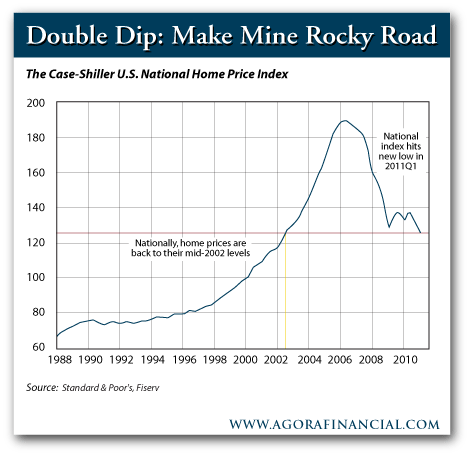
The US housing market is also looking pretty scary. The Case-Shiller 20-City Index of home prices has dropped to its lowest level since mid-2003. After adjusting for inflation, the index has tumbled to 1999 levels. “Prices have now fallen further since the bubble burst than they did during the Great Depression,” the Associate Press reports. “It took 19 years for the housing market to regain its losses after the Depression ended.”
Apparently, no one wants to buy a house. In a recent survey, 92% of all homeowners said they believe it is a bad time to sell a house. Visibly, an even higher percentage of folks — like about 100% — believe it is a bad time to buy house. The pace of new home sales has plunged to the lowest level since JFK was sharing afternoon teas with Marilyn Monroe. Folks are simply too fearful or too credit- strapped to buy a home.
They do not want to buy a house.
They will not buy one with a mouse.
They will not buy one with a spouse.
They do not like home prices that fall. They do not like these things at all.
Home prices seem destined to continue falling for a while. Pending home sales plunged 12% in April, according to the National Association of Realtors. Meanwhile, foreclosed inventory continues flooding into the market. CoreLogic estimates that 1.8 million mortgages are more than 90 days delinquent, in foreclosure or bank- owned. This “shadow inventory” will swell the number of unsold homes by nearly 50%!
The housing mega-bust is no mystery, of course. Folks without jobs or savings tend to buy very few homes. Americans, by and large, are in the retrenchment stage. They are trying to solidify their shaky finances by shopping less and saving more...or saving anything. They are struggling to re-pay debt the old-fashion way — by defaulting and/or curtailing consumption relative to incomes.
The Greek government will get there eventually...and when it does, the repercussions will certainly extend beyond its borders. French and German banks, to name two obvious victims, will suffer blows to their balance sheets. But who knows how far and wide the repercussions might spread?
Perhaps the resulting trauma will cross the Atlantic and wound a few financial institutions on our own shores. Already, Goldman Sachs is exhibiting some uncharacteristic frailty. For the first time in recent history (and probably ever) the cost of insuring Goldman’s debt against default is more expensive than the cost of insuring Citigroup’s debt against default.
In other words, professional investors are saying that Goldman is riskier than Citi. Why? Perhaps it’s because the Justice Department is sniffing around in Goldman’s books and records; perhaps it’s because an ex-Goldman guy is no longer Treasury Secretary; perhaps it’s because Goldman’s profitability remains hyper-vulnerable to financial market distress, like that kind of distress that could result from the simultaneous defaults of two million American homeowners and two or three European governments.
At that point, it would be time to say, “Good night.”
Good night Greek banks.
Good night banks that hold Greek bonds.
Good night US housing market.
Good night banks that hold mortgage-backed securities.
Good night quantitative easing.
Good night Ben Bernanke.
Good night global bond markets.
Good night financial firms that receive federal indictments for lying to clients.
Good night Goldman Sachs.
Regards,
Eric J. Fry
for The Daily Reckoning
Joel’s Note: As mentioned above, Eric Fry is the editorial director for Agora Financial. In this capacity, he also oversees and contributes to many of the investment decisions taken by the editorial team. The culmination of his work, and that of his fellow writers, thinkers and contrarian investors, is perhaps best expressed through the Agora Financial Reserve, membership to which affords readers a lifetime of Agora Financial’s best ideas, finest research and fiercest editorial. For more information on The Reserve,see here.
| | | | | Breaking News: “Are gold prices manipulated?” |
Are governments, banks, and traders secretly pushing gold prices... down?
Controversial new sources say they could be.
They could be using the manipulation to get very rich, at the expense of anybody who owns gold or silver. But our head resource expert says the charade “can’t last much longer.”
Click here now for details.
|
| | | | | Bill Bonner | | The Perfect Heist: Why Government Theft Continues to Go Unnoticed | | |  | | Bill Bonner |
Reckoning from Baltimore, Maryland...
Today, we doff our caps to the folks at the European Central Bank. They’ve pulled off the perfect heist.
The euro-feds have opened the valves...turned on the spigots...and let nearly a half trillion euros worth of liquidity flow directly into the very same banks that have proven they can’t be trusted with a penny.
But that’s how a zombie system works. The living give. The monsters get.
And since, at this stage of the credit cycle, the living don’t have much to give, the feds turn on the printing presses.
Then, from whom does the money come?
Gotta come from someone, no?
That’s right... When you borrow it, it comes from the people who lend it. When you tax it, it comes from the taxpayers. But whom does it come from when you just print it up?
Well, at first it appears to come from no one. Nobody reaches in his pocket and finds fewer dollars. Nobody’s pocket has been picked. But how could that be? Nothing comes from nothing. You add a zero to a zero and you still have a zero.
And yet, the zombie banks now have 489 billion more euros in their vaults. That’s what it said in yesterday’s Financial Times.
“Banks snap up 489 billion euros in ECB loan offer.”
This money certainly seems real. The banks can lend it. Spend it. Toss it out the window or down the drain. They can light cigars with it. They can use it to wrap gold coins before sending them out as Christmas presents.
Let’s see, we saw an ad. Mercedes Benz CL class 2011-2012 autos are selling, in round numbers, for $100,000. With this money, you could buy about 6 million of them. Which is probably more or less what will happen to the money.
But what concerns us today is not where it goes but where it came from. Did it come from space? From another galaxy? No? Then, isn’t all wealth on earth owned by someone? Yes? Then, it must have come from some humans somewhere on Earth.
But who?
Here’s an answer: Each unit of currency represents a claim on resources. Now, there are enough new units to claim 6 million new Mercedes. We infer that people who had claims on them previously have less of a claim now, because there are only so many new Mercedes available. And since those claims arose from the value of the currency they earned and saved, we further infer that the value of the new money must have been stolen out of the value of the old money. What else can you call it but theft? People who had euros previously now have less purchasing power (at least theoretically). They never agreed to let their money be clipped. They never even knew what was happening to them.
But since we’re in a Great Correction...and since Europe is entering a recession...and since recessions and corrections are basically deflationary (prices fall as demand eases)... the old currency holders aren’t likely to notice...or raise a stink about it.
It may be larceny, but it’s grand larceny. Heck, it’s great larceny. The perfect heist. The poor victims don’t even know they are victims. They have as much money in their pockets and bank accounts on Friday as they had on Monday. And if prices rise slightly, not one in a hundred will blame the ECB.
And more thoughts...
Meanwhile, over in the USA, the criminal gangs can’t seem to get organized.
Late yesterday came a report that a deal had been struck to extend the payroll tax by 2 months. But a bigger problem is coming up. Just wait ‘til next year. Here’s Bloombergwith a full report:
Payroll Tax Tiff Times 25 Awaits Congress in ‘Utter Dysfunction’
Dec. 22 (Bloomberg) — The brinksmanship in Congress over a payroll tax-cut extension may end up looking like a quaint disagreement by next December, when lawmakers must grapple with a fiscal policy debate at least 25 times more costly.
Unless Congress acts by the end of 2012, income tax cuts will expire, automatic reductions in defense and domestic spending will start and the alternative minimum tax will ensnare millions more taxpayers. The same Congress that can’t find a way to extend the widely supported payroll tax cut beyond Dec. 31 will be seeking to bridge long-held ideological differences.
“The prospects are bleak,” said Leonard Burman, a former Treasury Department official who teaches public affairs at Syracuse University in New York. “I’ve never seen such a high level of dysfunction in the 25 years or so that I’ve been paying attention to government.”
The year-end 2012 series of deadlines on tax and spending policy stems from Congress’s tendency to push problems into the future with temporary solutions. This year alone, lawmakers have flirted with a federal government shutdown three times, almost defaulted on the US debt for the first time in history and allowed aviation taxes to lapse for two weeks.
Trillions at Stake
The $4 trillion in expiring tax cuts and $1.2 trillion in potential spending cuts dwarf the $200 billion at stake in the current fight over the payroll tax cut and other provisions, including expanded unemployment insurance. Those items, if extended for another year, would expire at the end of 2012. *** A theory should explain something without reference to something else. That is, a metaphor doesn’t work. It’s just a description. If you say that government is a kind of ‘social contract,’ you are merely describing how it seems to you...or what you think it might be comparable to.
Our theory is that government is a natural phenomenon, an expression of power relationships, in which some people seek to dominate others by force. These dominators gather ‘insiders’ together so that they can take money, power and status away from other people, the ‘outsiders.’
Many people think that government provides some service. That is true, but it is incidental. Governments often deliver the mail. But they don’t have to. They would still be governments even if they didn’t control the Post Office. And what if they didn’t have a department of inland fisheries, or a program to teach retarded democrats to count to 20? They would still be in the government business...and still have their helicopters, chauffeurs and expense accounts. But if they lost control of the police or the army it would be an entirely different matter. Force is the essence of government, not a decorative detail. Without armies and police, they would no longer be governments. It is “from the barrel of a gun,” as Mao put it, that political power projects itself.
At the end of the 19th century, people were asked what they thought the new century would bring. Almost universally they predicted that government would grow smaller. Why? Because people were becoming much richer and better educated. The thinkers of the time thought there would be less need for government. People who were rich and well-educated had no use for government, they believed.
It didn’t turn out that way. Because the thinkers misunderstood what government really is. They had the wrong theory. Government is not an organization that provides benefits and services, and therefore shrinks as the need subsides. Governments grew tremendously in the 20th century. Because they are essentially parasitic luxuries. As a society grows richer it can afford more illusions, more waste, more re-distribution of wealth, more regulation, higher taxes, and more unproductive government employees.
The outsiders take more, because there is more to take.
Regards,
Bill Bonner
for The Daily Reckoning |
|
|
|

 The Daily Reckoning U.S. Edition


 Posts
Posts

