

The enemy within Thursday 3 May 2012  "It is two successive winters with very low rainfall which have put all of southern England and the Midlands into official drought status, involving hosepipe bans, and for all April's rain, a third dry winter cannot be ruled out", says the Independent. To expand on the doomsday scenario, the paper enlists a BBC favourite, Adrian McDonald, professor of environmental management at the University of Leeds. "I don't think we've ever worked out the consequences of three dry winters in a row," McDonald says. "But you would be expecting measures to try and conserve water that would be quite dramatic. There would be standpipes in the streets, and people's water supply would be cut off. We don't know the numbers of people who would be involved, but it could be tens of thousands, easily". This is a man funded to study "potable water demand forecasting and household forecasting in the UK", so if there is a management plan to deal; with this eventuality, you would expect McDonald to know about it. Strangely, then, he volunteers the observation that there seems to be "no proper plan" in place to deal with such a possibility. "As far as I'm aware", he says, "there is no strategic national plan to deal with three dry winters in row. I'd like to be proven wrong. I'd like to think we had a plan to deal with it". Of course, we did have a plan, which was devised in 2004. It involved building five new reservoirs and extending three more. And up to 2008, it was still the preferred option with the water companies. You would have thought that such a plan might have got a mention from McDonald, if only to mourn its passing. But he offers not a word about it. Nor does he mention the EU plan – which is to spread alarm and despondency about water shortages, as part of a strategy to force up prices and thereby reduce consumption. But then, when you look at McDonald's sources of funding, and the amount of EU money involved, there is no way he is going to spill the beans on the plan. As far as the EU goes, Leeds University is bought and paid for. And that is part of our problem. When the media want supposedly independent comment, they go to the universities, but these are working for the enemy. They will not give a fair, honest or even balanced appraisal as they are part of the policy-making machine that serves the EU. Thus do we have EU policy taking over and no-one is going to mention it. But all you have to do is follow the money, and the evidence is there: in our universities and halls of academe, we have the enemy within. COMMENT: "ELEPHANTS IN THE WATER" THREAD Richard North 03/05/2012 |
The elephants in the water Thursday 3 May 2012  Although this has the smell of the EU, not wanting to leap in without fully understanding the situation, I've been holding off from identifying an EU link in the current application of UK water policy. However, I have now gathered enough to determine that we are indeed dealing with the EU – and in a big way. The current agenda is coming entirely from the EU, and in particular from Commission Communication COM(2007) 414 final, on: "Addressing the challenge of water scarcity and droughts in the European Union". This is the worst of all combinations, though. It involves the EU and climate change, with the Commission asserting that water scarcity and droughts have now emerged "as a major challenge" – and "climate change is expected to make matters worse". Using that as its base, the EU has effectively taken over water management policy. Interestingly (if that is the right word), we are also seeing a convergence between the attitude to energy and water supply. Having adopted "an Energy and Climate package to guide the EU towards a sustainable, competitive and secure energy policy", the commission tells us that "one of its central themes" is to tackle the energy challenge by "first making an effort to use energy more efficiently before looking at alternatives". This approach, it then says, "is also valid for water scarcity and droughts". And now it all begins to make sense. We've seen a perversity creep into UK policy where, instead of dealing with local water shortages by increasing storage capacity, government is preventing these shortages from being resolved, and is then seeking to reduce consumption. Now we see where this is coming from. "In order to come to grips with water scarcity and droughts", says the commission, "the first priority is to move towards a water efficient and water-saving economy". What the commission decided, the UK government has adopted. Then we see the climate change manta, for the commission goes on to tell us that: "Saving water also means saving energy, as extracting, transporting and treating water comes at a high energy cost". Thus, the commission asserts that: "it is essential to improve water demand management". Having set the baseline, we very quickly get to the core, with the commission deciding that one of the main challenges to be addressed is "ineffective water pricing policies" which generally do not reflect the level of sensitivity of water resources at local level. The "user pays" principle, it complains, "is hardly implemented beyond the sectors of drinking water supply and waste water treatment. Introducing this principle at EU level, it then asserts, "would put an end to needless losses or waste, ensuring that water remains available for essential uses across Europe". In other words, says the commission, "it would encourage efficient water use". From those beginnings, via the Framework Water Directive, we see the emergence of a formal policy, the effects of which are only too evident. This is not a failure of policy, as we have suggested. It is the replacement of UK policy by EU policy. That it is now in the process of being implemented we see via the Daily Wail and the assertion from the Lords Agriculture, Fisheries and Environment EU sub-committee that water bills "should be allowed to rise" to encourage people to save water in the face of scarcer resources. Needless to say, the Wail cannot get its head round the idea that the reason why the Lords European Union Committee is thus declaring is that it is parotting EU policy. The protection of our water environment while the population continues to grow will require the adoption of innovations, such as metering, and real-time information about domestic water consumption, and will require consumers either to pay more or to save more, says the Committee. And then are we told: We believe that the cost of water will have to rise in areas where other measures are not enough to meet the challenges of water scarcity.Basically, price is to be used as the primary tool of water management. No longer is it the function of water companies to provide adequate supplies of clean water at minimum cost. The task is to reduce demand, thereby saving energy and reducing carbon footprints. Of course, if water becomes too plentiful and there is no need for rationing, extreme water-saving measures could not be implemented and consumer resistance to price rises would be difficult to overcome. Therefore, in implementing EU policy, it has become government strategy deliberately to maintain a climate of shortage, and an atmosphere of crisis. The consumer is being given the choice between standpipes and higher prices, which makes paying more seem a better option. But it is an artificial choice, engineered for doctrinal reasons rather than necessity. Once more, we are being taken for a ride. The [EU] elephants are in our water supply, and the British government, as always, is falling into line. COMMENT THREAD Richard North 03/05/2012 |
A failure of policy Wednesday 2 May 2012 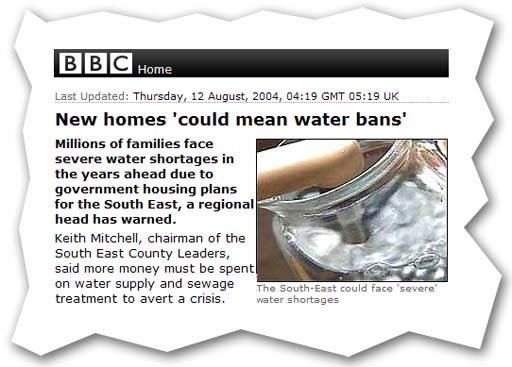 Some 17,395,000,000 litres or nearly four billion gallons of water a day (1,411 billion gallons a year)go in to the UK mains water supply. As back-up, there is a capacity to store about 520 billion gallons in above-ground reservoirs, representing about 36 percent of the annual supply. Currently, that is enough capacity to supply water for four months if there was no rainfall at all, and groundwater and river abstraction was to stop completely for that period. Experience demonstrates that this is not enough. However, no-one but a congenital Tory Boy would raise the issue of "building loads more reservoirs that we will only need once every 100 years". That is not on the cards. On the other hand, it is entirely reasonable to work on the basis of a 25 year cycle, which is the industry standard for assessment – and a legal requirement under the Water Act 2003. And to deal with this, and the increase in population, plus "security of supply in the face of climate change", in 2004 new reservoirs were very much on the agenda. Potential shortages had been well-flagged, and even this was leaving it rather late – the following year, there was a major drought in the southeast, when we were getting exactly the same headlines as we are now. 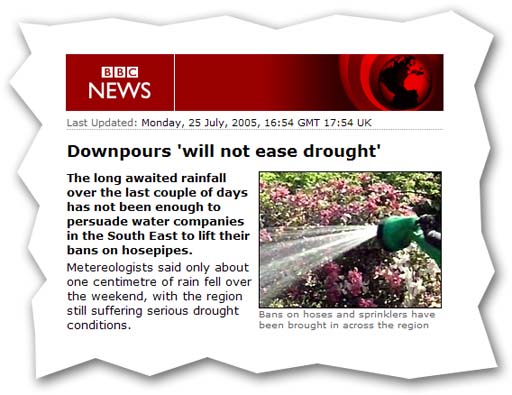 Thus, by July 2007, the trade journal Global water intelligence was reporting that there were 666 reservoirs in the UK "and rising". To overcome the perennial problem of water shortages, five major new reservoir projects had been thought necessary, plus three large extensions to existing reservoirs. This was not an academic project. Outline plans had been set out in the water companies' 25-year water resources plans prepared in 2004. One of those planned was the Abingdon reservoir, and the fate of that has already been recorded. Another had been announced in September 2003 – the Clay Hill reservoir near Canterbury in Kent, to be built at a cost of £100m. And it was to be joined by a huge reservoir at Broad Oak, near Folkestone. Both, however, have been deferred, one to 2020 and the other to 2023. 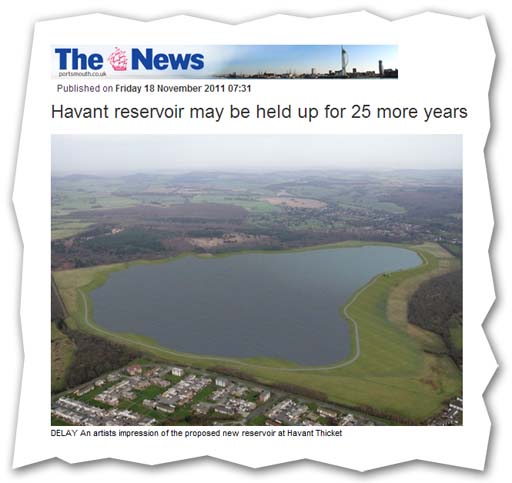 Yet another was Havant Thicket, a £36m project between Havant and Rowlands Castle, near Portsmouth. But, in November 2011, it was announced that this was to be deferred for 25 years, after the government told Portsmouth Water to go back to the drawing board in devising its Water Resources Management Plan. Of the five in the planning stage in 2004, that left the Lower Severn reservoir, in the Severn Trent Water area. And there has been no progress here either: in 2010, this was still under discussion, with no construction plans having been made public. Thus, none of the five reservoirs deemed essential in 2004 – all in the south of England – have seen the light of day. And neither have the three reservoir extensions, although one, the Abberton Reservoir enhancement, in Essex, is due to come on-stream in 2014. That aside, in the twenty yearssince 1992, the only new major public water supply reservoir, owned by a water company, to become operational is Severn Trent Water's Carsington reservoir. There is absolutely no question that the lack of building has been government-inspired. Each time a water company has got its plans to a working stage, they have been rejected by government planning inspectors, with the obvious approval of ministers, right up to and including Caroline Spelman. Despite this, there has been no specific declaration by successive governments, opposing the building of reservoirs. Simply, with just one exception, it has not happened – the climate nannies are pursuing instead a policy of reduced water consumption, in line with its more general climate change mitigation strategy. And now we are reaping the predictable and predicted effects. COMMENT: "WHELK STALL" THREAD Richard North 02/05/2012 |
Not fit to run a whelk stall Wednesday 2 May 2012  The idiot Caroline Spelman - a woman famed for her stupidity - is now telling us that, even after the wettest April for more than 100 years, if the country "endured" another dry winter the desperate measure would be "more likely" next year. In suggesting this, she quietly glosses over the fact that official climate change projections are for "little change in the amount of precipitation" but that "it is likely that more of it will fall in the winter, with drier summers, for much of the UK". The warmists have got their projections completely wrong. The rainfall pattern is the opposite of that predicted.  The water companies, however, have not been entirely wrong in their projections. Hence, in 2006 Thames Water was saying that customer demand was also expected to rocket over the next three decades, on top of a predicted population increase of 800,000 for London. A new reservoir was needed or customers would "face an increased risk in hosepipe bans and water restrictions", it said.  Needless to say, the plan was rejected by the egregious Caroline Spelman who decided that there was "no immediate need" for such a site - largely based on the idea that people would respond to her nagging and reduce per capita water consumption. Thus, her way of dealing with storage shortfalls is simply to instruct us to use less water. What all this conceals – and is intended to conceal – is a massive failure in strategic planning, on a par with the failure to ensure adequate energy supplies. In two recent reports, one on water supplyand the other on infrastructure, there is no recognition whatsoever of the need for more storage capacity. Instead, we see the focus on "water efficiency", with Spelman lecturing us on how our "attittudes" to water must change.  In the infrastructure report, we see the statement that "increases in population will put more pressure on our water supplies", although nothing is said of the population having already increased by eleven percent since privatisation, with no increase in storage capacity. "Britain's infrastructure will be made fit for the 21st century", said the preposterous George Osborne at the time, in signing the report. Instead, as the water infrastructure fails, we are now told to save water. It is all our fault, the government would have us believe, dumping the responsibility for its failures on our lap. Yet, while the media are just beginning to realise what is going on, the bulk of the politico-media establishment is still obsessed with the Murdoch soap opera and sundry irrelevancies. It needs to start focusing on the more important issues, bringing an executive to book for multiple failures that go back decades. As it stands, we are looking at a government which is presiding over the lights going out and the taps running dry. Murdoch may or may not be fit to run a television station but of far more importance is the increasing evidence that government is not fit to run a whelk stall. COMMENT THREAD Richard North 02/05/2012 |
A matter of indifference Wednesday 2 May 2012  The last place one might have expected to see this was in the Failygraph, and I'm not even sure that the Rev Dr Peter Mullen is right – that the Tories will necessarily get a drubbing on Thursday. People are in a funny mood, and while many are sick to the teeth of Cameron and his Tories, they are not ready to rush out and note for Miliband. And nor will they vote in their droves for UKIP or another minority party. What is going to predominate on Thursday, then, is indifference. Typically, we will be seeing turnouts in the thirty percent region, or less, which means that councillors will be getting elected on the votes of ten percent of the electorate. That is already happening in by-elections for MPs, and the trend will be more evident with the locals. This, in turn, makes a nonsense of the earnest analysis that we have seen of late, with clever-clogs think-tanks purporting to tell us something of the political attitudes of today. But, of those who know anything of grass-roots politics, it matters not whether voters are in the north or south, east or west. The predominant attitude is indifference. That is not apathy. People do care, but the majority are indifferent to the messages offered by the established political parties. Like performing seals, if they are called upon to give vent in focus group, people can entertain their questioners with legends of what they might do, if they could be bothered to vote. But the majority – the vast majority – do not vote. Confronted with political parties that are so much hot air, parties which – as Mullen says – have alienated their core supporters (all of them, not just the Tories), they see no point whatsoever in partaking in the voting process. Most feel that their votes will not make the slightest bit of difference. Largely, they are right. The media, of course, is as bad as the politicians. What interests them, such as the Murdoch saga, is also largely a matter of indifference to the majority of people. Like the politicians, the hacks have spiralled off into a planet of their own, leaving their readers stranded. Only the political classes and their media groupies now find anything of interest in the current party political agendas. For the rest of us, politics is not even a spectator sport. One does not watch the TV news any more. One looks at it – in amazement. And the party political broadcasts are no longer even vaguely amusing. Mullen thus asks why anyone should vote for Dave's Tory party. But he is an exception. Most people don't even go that far. They don't bother asking the question. There is no need to ask. Party politics is a tedious game for a diminishing minority. It has nothing to do with real people. COMMENT THREAD Richard North 02/05/2012 |


 Posts
Posts

