
Tuesday 29 May 2012 Monday 28 May 2012 Monday 28 May 2012
Moonbat agrees with EU Ref on climate change

He moans that promises, targets, legal obligations, the act which was supposed to guarantee our carbon cuts: all are to be vaporised in the power station furnaces. This is a government of the old and the dirty, committed to the technologies of a previous century, without a wisp of concern for the future.
Bliss! Sheer bliss! An unhappy Moonbat.
COMMENT THREAD
Richard North 29/05/2012 European history points the way to an exit strategy

This is an appraisal of our current situation, and if it was based on an accurate historical analysis, it would be of significant help in charting our departure from the EU. But it is so bad that I had initially thought of ignoring it.
The Raedwald synthesis, however, invites a discussion about the nature of the European project, and makes it necessary to deal with the Anderson assertion that: "At the heart of Europe's crisis is the abolition of the nation state and the attempt to impose monetary union".
The difficulty here is Anderson's thesis that, in the wake of the Second World War, the [EU] founding fathers made a fatal mistake of seeking to abolish nationalism and the nation state. Civilisation could only survive if Europe moved beyond the era of the nation state, he claims in their name.
This, however, is accepting the framing dictated by the EU commission. And the importance of not doing this is absolute – as pointed out by an American academic. Those who control the framing of a narrative have huge influence on its content.
Here the specific framing is the timescale, with its focus on the post-WWII period. But, if one accepts that the intellectual construct on which the EU is based was devised in the mid-war period by Arthur Salter, published in 1929, the argument takes on a different shape. Crucially, so do the remedies – and the exit plan, as we shall soon see.
Firstly, we are able to assert that the primary objective of the founding fathers was not the abolition of the nation state, per se. It was the abolition of war in Europe. The cause of war they then wrongly diagnosed as nationalism, which as a malign force they attributed to the existence of nation states.
Thus, the reasons for setting up what was to become the EU were far more complex than Anderson portrays, running to three tiers: the nation state caused nationalism; nationalism caused war; to avoid war, the nation state must be controlled (effectively abolished as an independent entity).
Even if the reasoning was correct (which it wasn't), though, it applied not to the post-Second World War period but to the situation after the First World War. Yet, by 1945, the geopolitical situation had changed so markedly that the solution proposed for another era could no longer apply. The rationale for European integration was (and is) fundamentally flawed.
If we are ever going to unpick the EU, before it collapses of its own accord, we need to address that flaw. Demolish the rationale and we are closer to bringing the project down.
However, to explore this, Raedwald calls in aid Laurent Warlouzet to tell us all about the attitude of de Gaulle. But when we look at this writer, we see he is a member of the faculty of the European University Institute, researching the "History of the European Economic Community (EEC), 1970s-1980s".
This, one would not take as reliable – he is working for the enemy. To get a better idea of what was going on, one must read a lot wider. And the wider reading gives a very different interpretation, so much so that one can argue that the Warlouzet scenario is distorted.
Once again, we are back to framing – and a willingness to fit information from partisan sources into a pre-set frame. Broaden it out and one finds that de-Gaulle was in fact highly supportive of the supranational venture he was supposed to be opposing. Rather than fighting it, he was actually seeking to shape it in a manner which would suit France's interests.
In this, de Gaulle was successful. What he got out of the affair was a financial package for the Common Agricultural Policy (CAP) which favoured France. And, in exchange for that, the French premier supported the supranational projects and further political integration.
During the so-called "empty chair" crisis, French officials only boycotted discussions on new policies. The continued to participate in the EEC's work on existing policies, including the CAP. The net effect of the "empty chair", therefore, was to draw the Community together more tightly.
Interestingly, de Gaul, the supposed nationalist, should have been more at ease with the intergovernmental Nato. But, in the same year – 1966 - that he established the so-called "Luxembourg compromise" which protected the CAP and thereby kept France within the supranational EEC, he withdrew from Nato. This simply does not accord with the thesis that France, the nation state, was opposed to the development of a supranational construct.
What one learns from this is that nation state governments are not at all opposed to the idea of a supranational government, if they believe that they can secure some national advantage from participation. But the governments are not the people. The people, ultimately, have to pay the price for any gains.
Bringing this right up to date, we have Martin Feldstein, professor of economics at Harvard University,making the case that the French are still using the EU for their own purposes – and the EU is not delivering.
A European political union, we are told, could make Europe a power comparable to the United States, and thereby give France, with its sophisticated foreign service, an important role in European and world affairs. But now, he says, the European project, "has clearly failed to achieve what French political leaders have wanted from the beginning".
If that were true, then the project would soon be over, if indeed the nation states were still the dominant force. But what Feldstein misses completely is the status of the integrationists as independent players, and their ability to "game" the situation.
Jean Monnet and Robert Schuman Feldstein describes as two leading French politicians" who "proposed the creation of a United States of Europe". But, while Monnet may have been a Frenchman by birth, his interests were not those of a French national. He was the ultimate trans-national, or "tranzie" as we have come to call the breed.
Monnet, thus, was more interested in pursuing the integration agenda, and achieved much of what he wanted by making alliances with the dominant member states. There was not so much a conflict between nationalists and "tranzies" as a manipulated confluence of interest.
Going full circle, we find that Anderson argues that the solution to the current crisis is a return to national currencies for the eurozone members – an option, he says, that will be "neither be easy or (sic) cost-free".
In effect, this is a reassertion of nationalism, which looks attractive but misses the point. We now have a powerful supranational government in place, which is not going to relax its grip on the currency, nor any of its other gains. To retain them, it is going to maintain the same strategy of allying its interests with those of the nation states – a case of hanging together or hanging separately.
Thus, we cannot expect tension between the supranational and national elements of the EU to act as a divisive force. The confluence of interest binds them together. Heads of states and governments sit together with EU officials, as one body. They have become one (pictured above, the European Council in Brussels).
A better and perhaps only answer is to attack the founding myth, which remains to this day the idea that political integration is necessary to prevent war in Europe – or anywhere else for that matter.
Perversely, the main threats of attack now come from outside Europe and, in terms of terrorism, from non-state actors. The European Union is poorly equipped to deal with these, in which context the very thing which the integrationists set out to do they cannot deliver.
Thus, to facilitate our exit, we need to convey that the European Union is surplus to requirements. It is based on a false paradigm and, as such, always was redundant. Acceptance of that simple fact will make its continued existence politically unsustainable.
COMMENT THREAD
Richard North 28/05/2012 Randall talks sense but misses the bigger picture on democracy
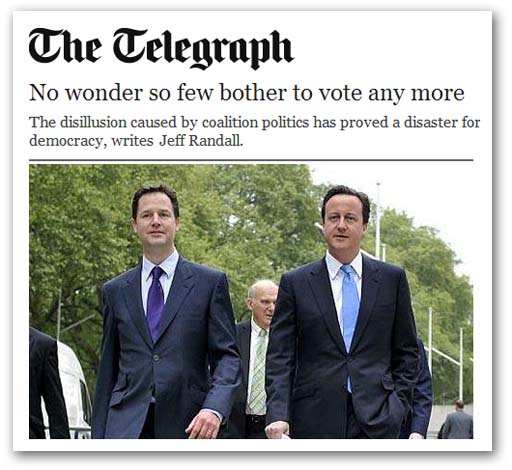
If reader feedback on popular websites, he says, reflects public anger, many people are … at boiling point. Fury is the norm, not just with ministers but the police, other public officials and the media.
Randall then lists a lot of the things that might have given rise to that anger, the latest being the rather unsavoury Baroness Warsi, who adds to a suspicion that cheap-and-nasty corruption is the new British disease.
With so much cause for grievance, now, you might think, would be the right moment for an upsurge in political engagement – but it's not happening, Randall says. A recent study by the Hansard Society shows that, far from embracing mainstream parties, the electorate is more withdrawn than at any time in the past decade.
Now read my previous piece, if you haven't already done so. Tell you what - I'll save you the bother. The key bit is this: "From a lot of different inputs, it is evident that politics – in this country and elsewhere – is going AWOL. People have had enough and they are switching off in droves".
Essentially, we're saying the same things – the differences being that Randall gets paid and I don't, and he has a much bigger audience, even though I've said it earlier and better – with far more analysis. But then, I'm not in the bubble.
You can plough through the Randall piece if you like, but I'm in a good mood this morning – although I don't know why. I'll save you the trouble again. He writes:Coalition politics is proving a disaster for conventional democracy. Disillusioned citizens are simply dropping out, as they conclude, justifiably, that the system is giving them neither what they were promised nor what they would like.
As you will have noticed – probably far ahead of me - he is confusing chicken and egg. We've actually ended up with the coalition because we don't have a democracy in any meaningful sense. Witterings from Witney lists some of the deficiencies, and they've been around a long time. Thus, so many disillusioned citizens dropped out that we ended up with the Cleggerons. They (the Cleggerons) are a symptom, not the cause of the disease.
The crunch issue is that people will take part in politics if they think that their input will make the difference. If they have no means of effecting change, and voting becomes a meaningless ritual, an increasing number of people don't bother and we end up where we are today.
The trouble is in this country is that people don't get angry – but then I suppose that is also our greatest strength. Life is full of contradictions like that. We wouldn't want angry people storming the streets. It makes life even messier and more dangerous.
But we can still address the deficiencies that are causing this problem. And, entertaining though he is, Randall isn't doing it. Anyone who can talk in terms of a "conventional democracy", without realising that we are nowhere near achieving anything close to what might be considered a democracy - "conventional" or otherwise - is missing the bigger picture.
I'll give you a few more pieces to read … like this one, and this short one, and especially this. Read Randall, read these pieces when or if you have time. Then, if I've got it wrong - not that I have, of course - tell me. The forum is still open for new applications for those that want to try - although read this first.
Tuesday, 29 May 2012
The death trains will keep rolling, I wrote on Sunday, noting that reality was at last intruding into energy policy. And now Moonbat takes centre stage, complaining that Britain's climate change policy is going up in smoke.
The integrationists, however, would prefer us to focus on a nation state versus federalists paradigm, arguing that the federalists represent the forces of good, battling against the selfish nationalists.Raedwald, in his piece, picks up an aspect of this "battle", revisiting the "empty chair crisis" of the mid 60s, precipitated by de Gaulle as a supposed example of the nation state interest at play.
Jeff Randall is always an entertaining writer, with the unusual ability to see something of the world outside the bubble he inhabits. He thus talks a very great deal of sense, and especially today.


 Posts
Posts

