
Wednesday 20 June 2012 Wednesday 20 June 2012 Wednesday 20 June 2012 Tuesday 19 June 2012 Tuesday 19 June 2012 Wednesday 20 June 2012 Tuesday 19 June 2012
Greek establishment forms government
Richard North 20/06/2012 Eurocrash: not a party plaything

Over the weekend, he was trying to capitalise on the success of Hollande, calling for a new centre-left alliance "to free Europe from the grip of austerity", pinning the blame for the travails of the euro firmly on Cameron and Merkel. But, far from offering a way out, the main aim was to portray The Boy as "a weak statesman".
However, Miliband is now seeking to dress up this political opportunism in "intellectual" clothing. In the current edition of the Grauniad, he writes of the two economic crises of the 20th century being "the parents of dramatic changes in the political centre of gravity in western economies".
The 1930s, he says, spawned welfare capitalism – a new social contract in which full employment paid for public services and welfare benefits. The 1970s gave birth to the cocktail of monetarism, privatisation and deregulation that dominated the 1980s.
Crass though this may sound - and the slogan really does sound crass - this could be good tactics. Cameron tends to look and sound ideology-lite, so an attempt at injecting some gravitas into the debate is superficially attractive, especially when he utters words such as: "The health of our democracy is not just a matter for politicians".
Nevertheless, he may well find that the country is not in the mood for party games, while events over the Channel mercilessly expose shallow opportunism. And that, at the root of things, seems to be the only thing on the table.
COMMENT THREAD
Richard North 20/06/2012 Debt in perspective

Ambrose thinks the tentative deal to douse the raging fire in Spain and Italy comes in the nick of time, but is fraught with fresh dangers. And while he is undoubtedly right, this is on the vague assumption that the money can be found. But ...Unfortunately, the ESM fund does not yet exist. It has not been ratified by Germany and Italy. When it does come into being, it won't have much money. It has a theoretical limit of €500bn - a nice wish - but its paid up capital will start at just €22bn.
However in all the excitement, the invisible elephant of consumer debt escapes mention. While this news was coming in, we also got a reminder that UK credit card debt had reached £1 trillion before the credit crisis, in 2005. Average credit card debt per UK household then stood at almost £2,300 and was at its highest in London, where average household debts totalled £2,861.
Now, as then, UK consumer debt is at an historical high. It amounts to more than the entire external debt of Africa and South America combined. Nor has the debt mountain stopped growing. Between them, UK consumers have a total of 66.8 million credit cards – five times the European average.
By February 2012, UK households owed an average of £7,900 on personal loans, overdrafts and credit cards. And that was after each household had paid off an average of around £355 of their unsecured debt. UK households remained "among the most indebted in the world" despite three successive years of net repayments.
With the continuing slide in incomes and a lack of domestic demand, our ability to service personal debt will create further vulnerabilities in domestic banks already fatally exposed to the euro crisis to the tune of £100 billion.
If the national systems collapse, there will thus be a double-whammy effect as the consumer credit market collapses in its wake. Debt, which is already treated as a commodity, will suffer a catastrophic write-down, rendering the latest round of stimulation a futile gesture.
While pundits are saying that "Europe" is running out of time to write a new ending, the markets are getting tired of replaying the same day over and over and over again. But, when the music stops, the consequences could be worse than anyone could imagine.
And, as much as anything, we are looking at a failure of imagination. Says Simon Jenkins:It's not working, is it? No matter how many summits there are, no matter how many times the Greeks vote or Barack Obama pleads or David Cameron lectures from on high, nothing happens. The yield on Spanish bonds, that beckoning finger of apocalypse, goes relentlessly upwards.
All we do, he says, "is howl, simper and plead for Germany to do something, even just kick the can down the road. Alongside Europe's tottering mountain of debt lies a pit of intellectual emptiness".
I know it's hackneyed, and even premature, but we are seeing the death of the projet.
COMMENT THREAD
Richard North 20/06/2012 Eurocrash: market mysteries
I'm not quite sure, therefore, what to make of the latest market hyperventilation. Surely, it has been known for some time that the Ton would only be a starter for ten?
But, at least, the Guardian is not rooting for Barroso. Referring to his "not us guv" outburst yesterday, the paper asks: "how much self-deluding error can you pack into a 50-word temper tantrum?" It then asks: "How hard must it have also been to choose a Canadian to pick on for your 'I've completely lost it' outburst?"
Is commission president molestation a criminal offence? If so, the Grauniad has just committed it. Or is this the stuff of his nightmares? A people's movement (the Movimento 5 Stelle) seems to be making waves, while sentiment against the euro is on the increase.
COMMENT: "CONCRETE MOVES" THREAD
Richard North 19/06/2012 Eurocrash: concrete moves needed

Nor can one take any great comfort from their being "alarmed". They share this feature with doors in public buildings, thus equipped to prevent unauthorised exit. The exit in this case, however, is one they should encourage – except that they won't. The euro sails on regardless.
The only thing left, then, is petulance. Asked by a Canadian journalist why North Americans should help pay for Europe's crisis, Barroso broke from his conciliatory tone and effectively blamed US practices for causing the European troubles.
"This crisis was not originated in Europe", said our Maoist friend. "This crisis was originated in North America. Many in our financial sector were contaminated by unorthodox practices from some sectors of the financial market".
Said the Wall Street Journal, few mainstream economists would support the view that US financial practices caused Europe's heavy borrowing or the deep structural problems in its currency union.
But, it added, Barroso's language, briefly tinged with anger, showed how tensions are boiling over as the crisis moves into a more dangerous phase.
Yet, despite that, our leaders "don't expect to make major decisions". But many hope the summit will help European leaders make "concrete moves" at the European Council next week. Methinks Mafia-style "concrete moves" are called for.
COMMENT THREAD
Richard North 19/06/2012 Energy: a red card for the greens
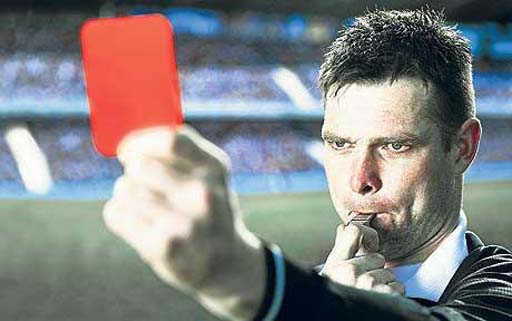
This comes on the back of a story heralding a government intention to cut subsidies by up to 25 percent for onshore installations, the deed to be announced in the forthcoming Energy Bill.
Existing bird choppers – of which there are about 3,000 in the UK – are unlikely to be affected in the short to medium term, as these are already locked into lucrative supply contracts, to which subsidies are attached. But the cut will affect the erection of new turbines, of which a notional 4,000 more are planned.
Given that the offshore programme is not exactly galloping ahead, this makes it almost certain that the government will fail to meet its 2020 renewable energy target, thus falling foul of its own and EU targets.
How appropriate it is then that Geoffrey Lean in the same paper is lamenting the failure of the Earth Summit in Rio to prepare anything other than an "unprecedently weak" set of conclusions. After the brave new world of 1992, this marks another stage in the decline of the high-level green agenda.
The UK, of course, is not alone in clawing back ground from the Greens. In Germany, there are complaints that the "energy revolution", although hardly begun, is already running out of steam. There is, says Spiegel, a lack of political decisiveness and companies are complaining of a dearth of incentives to invest billions in necessary infrastructure.
Consumers, on the other hand, are being swamped with meaningless corporate greenwash, while the flagship EU carbon trading system is collapsing and, to add insult to injury, there is talk of the EUrebranding gas as "low carbon" energy.
As the great climate change fantasy declines in intensity, the greens are at last on the back foot. Even the intervention of the famous Nick Clegg isn't helping them, as Brogan realises there might be votes in cheap electricity.
Switching off subsidies for wind farms puts clear blue water between the Tories and the Lib Dems, says Brogan. And if played right, it could put Mr Cameron on the side of a global energy revolution that promises to keep the lights on, lower the cost to voters, and energise his electoral prospects when he most needs it.
And if the chatterati see it in these terms, the greens have nowhere to go.
COMMENT THREAD
Richard North 20/06/2012 They're all at it

One is entitled to smile, though, at the self-importance of the Failygraph which, five years after webroke the story, and after even the IEA did it only a week ago, the paper "reveals" the story to the waiting world.
What this really reveals, though, is the insularity and the institutional arrogance of the paper. Its scope is limited to a few "approved" sources and outside these, it has very little idea of what is going on. Yet, in its arrogance, it takes the view that if the detail is news to it, then it must be news to everybody else.
Richard North 19/06/2012
Wednesday, 20 June 2012
In what has to be a travesty of the democratic process, two ideologically opposed parties have come together to form a government in Greece. Reuters describes them as the parties "that have dominated Greece's discredited politics since 1974".
They are, of course, the supposedly conservative New Democracy party and Socialist Pasok, joined together in an uneasy alliance, there to support the establishment and see off the upstart Syriza coalition of the radical left.
Putting it in context, political equivalents would be the Democrats and Republicans forging an alliance in Congress, or Labour and Conservatives merging to form a government in the UK. That much the EU has achieved, breaking up the normal left-right divisions and redefining politics. Few will argue that it is for the better.
The leader of the opposition, though, will have to go a long way before he can convince the cynical majority that he has anything on offer other than words. Nevertheless, the rhetoric is interesting. The boy Miliband has been reading daddy's history books.
Giving him his due, Ambrose has been saying for some time that the Spanish "not-a-bailout" fund would exceed €100 billion, and could morph into €450 billion.
An interesting sign of the times comes in the Failygraph op-ed today, as no less than the mighty Benedict Brogan stoops to the level of us lesser mortals to discuss windmills.


 Posts
Posts

