
Monday 4 June 2012 Monday 4 June 2012 Sunday 3 June 2012 Sunday 3 June 2012
The royal road to the new Europe

It starts by reminding us that last June, Jean-Claude Trichet – then still ECB president – was arguing for "giving euro area authorities a much deeper and authoritative say" in the formation of economic policies. He was also suggesting a central finance ministry to fit with the existing single market, single currency and a single central bank.
Then, say Reuters authors Noah Barkin and Daniel Flynn, "the idea seemed fanciful, a distant dream that would take years or even decades to realise, if it ever came to be". And they are not wrong. At the time it seemed yet another ritual call for "more Europe" from an ardent integrationist, for which there seemed little appetite.
But now, one year later, we are told that Germany is pushing its partners for precisely the kind of giant leap forward in fiscal integration that the now-departed European Central Bank president had in mind.
After falling short with her "fiscal compact" on budget discipline Merkel, we are told, is pressing for much more ambitious measures, including a central authority to manage eurozone finances, and major new powers for the European Commission, European Parliament and European Court of Justice.
This is the thrust of the Welt story which we reviewed yesterday and what could be spin is already being locked in, as we see Germany centre stage.
You would expect a Berlin-centric story from a German newspaper, just as you see British papers seek to plant a Union Jack on EU stories, so a note of caution is warranted. The idea of these "more ambitious measures" took shape at the Brussels dining club (aka European Council) last month and are being worked upon by senior EU officials.
This is very much in character for the modern, post-war Germany, which is still diffident about asserting its own power and seeks solutions within a European context. And, within that context, we don't yet know the true position of France, without which nothing can happen.
The Reuters Barkin and Flynn duo are nevertheless playing to the gallery, telling us that until [eurozone] states agree to the steps mooted, and the unprecedented loss of sovereignty they involve, the officials say Berlin will refuse to consider other initiatives like eurobonds or a "banking union" with cross-border deposit guarantees.
It's how you tell 'em that makes the difference, for the same thing could be put slightly differently. Essentially, Berlin cannot agree to the steps mooted and the unprecedented loss of sovereignty they involve, until or unless there is a treaty change, which is what I was saying in May, prior to the informal dinner in Brussels.
"Of much more interest is the dark game being played by the EU Commission", I wrote at the time, observing that we could see the commission going for the main chance – the economic governance that it had always hankered after.
Whatever the media are saying, therefore, it is vital to keep in mind that this is primarily an EU initiative. Brussels, not Berlin, is in the driving seat (even if it is there under license from Berlin) and the proposals are coming for senior EU officials. Germany has ceded the ground to them.
Anyhow, we learn that the goal is for EU leaders to agree to develop a road map to "fiscal union" at the European Council on 28-29 June (which we knew already from Welt). But we also learn that member states will then "put the meat on the bones of the plan in the second half of 2012".
This is new information, with several European sources having told Reuters that this will include a timetable for overhauling EU treaties, "a step Berlin sees as vital for setting closer integration in stone". Reuters cites a government official in Berlin saying: "The fundamental question is relatively simple. Do our partners really want more Europe, or do they just want more German money?"
We now get a classic example of why one should not go to financial commentators for views about the EU, as we get Erik Neilsen, chief economist at Unicredit telling us, "The world is not coming to an end; rather, it feels as if we are on the doorstep to another major European integration move". So far so good, but he then asks: "But why do these initiatives only come when we are on the edge of the cliff where the risk of an accident is so much higher?"
There speaks ignorance writ large. That, Mr Neilsen, is the way the European Union works. That is the doctrine of beneficial crisis, used as a mechanism for facilitating change when the political will is absent, and there is no popular assent. It is only because we are "on the edge of a cliff" that the moves can even be considered.
What we have to be conscious of is that the political geography of the EU is now being re-written under our very noses, with incredible rapidity. From the look of it, the "colleagues" are not going to let Greece go without a fight.
In order to keep the eurozone intact, we may well see a variation on the plan which was emerging in February, with massive financial transfers being made, initially in the form of a new Marshall Plan, in exchange for fiscal sovereignty – effectively creating the Socialist Republic of Europe.
Everything will, of course, depend on France. Hollande is not Jacques Chirac, and he is known to have worries about ceding so much sovereignty. "It's a big challenge for Hollande," says a senior French official. "I think that he is ready for (closer fiscal integration) but I think the rest of the French political class - both on the left and right - is not".
The EU, thus, is on the cusp. The "colleagues" are going for broke, risking everything for one huge lunge towards the final goal. If they succeed, they will get their country called "Europe" – smaller than intended – but a single state nonetheless. If they fail, the likelihood is that the European Union will collapse. Everything is to play for.
And, for all the drama, while the story is on the Welt front page, which is talking in terms of "the royal road to the new Europe", the British media and political establishment – as always – have dropped the ball. The "pop royalty" is getting its outing and the collective brain is on hold.
COMMENT THREAD
Richard North 04/06/2012 Spanish "rescue" may signal end game close

"A bail-out would not be the apocalypse," says José María Beneyto, foreign affairs spokesman in Spain's parliament. "You have to live with it. We have got to escape this or we'll go mad worrying about bonds spreads".
On top of that, Cyprus is edging closer to a bail-out after President Demetris Christofias said his country had been engulfed by large exposure to Greece. "I don't want to absolutely exclude it", he says. The Cypriot banking system is nine times the country's GDP, with assets of €157bn (£127bn). It has been called the "Iceland" of the South.
With Spanish premier Mariano Rajoy calling for an EU "fiscal authority" and use of the European Stability Mechanism (ESM) to recapitalise banks, Ambrose also picks up the "master plan" for the future of the EU.
However, Ambrose is concentrating very much on the immediate crisis, citing Gary Jenkins from Swordfish, who says half-measures are no longer enough. "We may be approaching the endgame where either the eurozone or the ECB takes action to stem the bleeding or the whole thing collapses," he adds.
Soros, apparently, is giving it three months, suggesting Greece might leave the euro in the autumn, which is where we were last February. The "colleagues", it thus seems, are engaged in a deadly race against time – as to whether they keep the euro going long enough for them to be able to have anything left to save when it comes to drafting a new treaty.
Personally, I don't think Ambrose and others have fully taken on board the implications of the EU "master plan". In a separate piece, he writes that "Germany can break the logjam at any time by agreeing to fiscal union, debt-pooling and full mobilization of the ECB, with all that this implies for its democracy".
COMMENT THREAD
Richard North 04/06/2012 European Union: Britain on the way out?
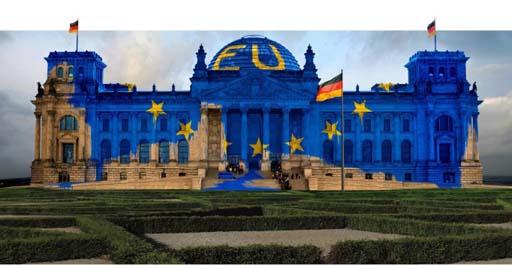
This comes from Welt online, where there is a report that Merkel is trying to break free from the perpetual cycle of short-term crisis management, and "to think about how we move forward over the next five to ten years".
In the offing, is seems, is a secret "master plan" for the future of the EU, which is being hatched up by Van Rompuy, Barroso, Euro Group President Jean-Claude Juncker and the head of the ECB, Mario Draghi.
The quartet was given its instructions at the dining club meeting on 23 May in Brussels and the plan is set to be unveiled at the European Council later this month, of which it is said, this "could be a revolutionary document".
Under conditions of great secrecy, four areas are being looked at, we are told: structural reforms, the banking union, a fiscal union and political union. And, whatever the actual content, all parties are reported to be agreed that another major treaty will be needed.
This is a change in strategy for European integration but, says an anonymous central banker, "this change of strategy has to come". It is the defining element of Europe's monetary union.
The implications of such a development for the UK are, of course, phenomenal. If, as is indicated, the "colleagues" are set on a new treaty – and quite soon from the look of it – Cameron and his merry men are shortly going to be required to make crucial decisions which will formalise an "outer circle" role for the UK.
Given current public sentiment, there would appear to be no alternative, as there is not the slightest possibility that Britain might join EMU and take part in the "inner circle".
Unless we move fast, though, this means that the British relationship with the new grouping will be defined not by us but the "colleagues", necessarily on their terms. The need, therefore, is now to define what we require and even whether we will accept what some might declare is "second-class" status, or strike out in new directions.
As such, the idea of an in/out referendum – always tenuous, at best - is essentially dead in the water. Events, as predicted, are to be decided elsewhere, leaving the British struggling to catch up.
However, there is nothing to say that the new "inner circle" will be at all feasible, or even accepted by all 17 members of the eurozone. The attempt at what amounts to the final step at integration may be the step to far, and presage the break-up of the entire European Union.
Either way, there is a massive opportunity for the UK – our very own "beneficial crisis". This is the opportunity to reverse the tide of integration and set the agenda for the next decade and beyond.
COMMENT THREAD
Richard North 03/06/2012 Booker: the beneficial crisis out of control

On Thursday – while even the EU's economic affairs commissioner was warning of the "disintegration" of the eurozone, and a former Spanish prime minister spoke of "a total emergency, the worst crisis we have ever lived through" – one internet summary of the day's top stories (headed by "Jeremy Hunt") ranked Spain only 20th on the list.
Both Booker and I though have noted how so many commentators, even those who have tried to put this latest crisis into perspective, often reveal how hazily informed many of them are about the history of the EU and what a central role the creation of the euro has played in it.
Thus, almost wearily, Booker tells us about the BBC's Robert Peston who was not the only one to "explain" how the idea of a single currency was concocted by Helmut Kohl and François Mitterrand after the fall of Communism in 1989.
That so many people get it wrong, however, is not just a curiosity. One cannot, as Booker says, grasp the significance of the euro without realising that its history goes much further back than that. So he tells the story one again.
It all goes back, as the man says, to 1957 and Jean Monnet – who was the real organising genius behind the gradual building of "Europe" into a single, unified state.
It was he who suggested that it was only through monetary and economic union that the "political union which is the goal" could be achieved. "There are no premature ideas", he wrote, "only opportunities for which we must learn to wait".
By 1970, Monnet's ideas were being fleshed out by the Werner report, which saw monetary union as the key step towards political union. But in 1978, another report for the European Commission, by Sir Donald McDougall, warned that it would be reckless to create a single currency unless Europe was first given an all-powerful government, with the power to tax, and to make a massive transfer of resources from the richer states to the poorer.
In the 1980s, though, that other great integrator Jacques Delors (second only to Monnet in his influence on the drive to European political union) decided to ignore the advice of McDougall and others and to launch the single currency without the suggested preconditions. To move straight to fiscal union, he knew, was not on the cards. But if the single currency was put in place first, it would create exactly the kind of strains which had been foreseen – making fiscal union the only way out.
Delors was banking on that same principle that Monnet had relied on ever since the "European project" was launched in 1950: the "beneficial crisis" – one which can be used, as so often in the EU's history, to justify giving a whole new tranche of powers to Brussels.
Those responsible for setting up the euro in the 1990s knew that it would eventually bring about the kind of strains between richer and poorer countries that could justify their moving on to the fiscal and political union that was always the real goal.
And there we have the crunch. What they hadn't reckoned with was that the crisis, when it came, would be so immense that it would spiral out of anyone's control.
Thus, amid the present shambles, we hear distracted voices calling for "more Europe" – more powers for Brussels, a new treaty – but the truth is that the chaos has gone way beyond their ability to solve it. They are not going to get their new powers, their "eurobonds", their fiscal union.
As the ultimate "beneficial crisis" that the architects of Europe dreamt of arrives – it is not turning out to be so beneficial after all. As Shakespeare put it, they have been "hoist with their own petard", as "purposes mistook fall on the inventors' heads".
They have been horribly caught out, and the result, as we begin to see, is a catastrophe which could be about to take a great deal more of their "European dream" with it.
For all that, there is nothing we can do about it. Those vainglorious zealots thought they knew better than everybody else. They didn't. And we are going to have to pay the price.
COMMENT THREAD
Richard North 03/06/2012
Monday, 4 June 2012
As the net closes on a bankrupt Spain, Ambrose is assessing the odds of the country having to go for a bail-out.
The answer from Chancellor Angela Merkel over the weekend, says Ambrose, was "under no circumstances", in which case we should prepare for the consequences. But, according to Welt, this is precisely what is being considered by the quartet, the solution being crafted at a European level.
From behind the scenes, there could be ready to emerge a game changer, although not necessarily for the better. The implications for the sovereignty and the democratic status of the participating countries is dire. And if this is the only thing on offer, some may refuse. It may thus signal that the end game is indeed close.
It looks as if the "colleagues" are plotting the exit of the Britain from the European Union as we know it or, to be more precise, as it is about to become.
Crucially, it is also being mooted that there will be a high price for the treaty – a division between the 17 eurozone countries and the remainder. Britain, whether it likes it or not, could be on the way out.


 Posts
Posts

