
Thursday 21 June 2012 Thursday 21 June 2012
United States of Europe: Merek gives her backing

As reported by Handelsblatt, she wants to give "more power and drive" to Europe at the European Council in late June. "We need not only a monetary union, but we also need a so-called fiscal union … And we need above all a political union", she said.
However, SPD leader Sigmar Gabriel called it "a new dramatic turn". After over three years and a "near-hopeless situation", Merkel was recognising that the lack of political union accompanying European Monetary Union constituted "a birth defect". The SPD leader said it was "imperative" to make further steps towards political integration of the EU.
The Greens also demand a clearer commitment. "We now need a political union", they say, "but it must be authentic". This is Green party leader Cem Ozdemir. He complains that Merkel's reluctance in recent years had led to the ever deeper into crisis, with Germany isolated at European and international level.
On the other hand, Left Party leader Gregor Gysi accuses Merkel of splitting Europe into three groups: a core Europe, peripheral Europe, an EU and a non-EU parts of Europe. This is something Cameron will have to confront when he goes to Brussels at the end of the month.
Westerwelle's report is not without its critics, but the indications from Westerwelle himself are that Berlin wants political union in order to compensate for German economic dominance. In other words, the post-war paradigm still holds. Germany is offering new shackles to her European partners, to reassure them that her power is constrained.
"I don't want a German Europe ... I want a European Germany", Westerwelle says. Asked if Germany was becoming too dominant at the moment, he admitted there was occasionally a tendency to boast, which concerned him. And there was also a tendency toward re-nationalisation throughout Europe. He opposed this.
This side of the Channel, though, such issues are not being debated in the media with any intensity. The English papers and broadcast media insist on treating this almost exclusively as an economics issue. Thus, the degree to which the political agenda has advanced is going to come as something of a shock when Cameron goes to Brussels.
Very quickly, it well be realised that "Europe" is venturing into territory where we cannot follow. We are coming to a parting of the ways.
COMMENT THREAD
Richard North 21/06/2012 The United States of Europe: final shape emerges
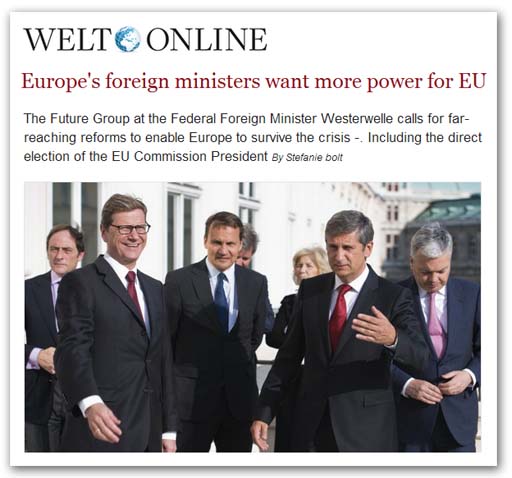
There should be a single, directly elected EU president, and a bicameral parliament similar to the US with its Senate and House of Representatives. The upper house would be a National Council of Ministers, equal in status to the EU Parliament. In the longer term, the parliament would become a true legislature, with the right to initiate legislation (structure illustrated below).
There should also be a common European border guard, European rather than national visas, the expansion of the common foreign and security policy, with decisions taken by qualified majority voting, the creation of an EU army, and more direct control of national budgets.
These are the interim recommendations of the "Future Group" (Zukunftsgruppe) on the European Union, presented to Barroso, Van Rompuy, ECB chief Mario Draghi and euro group chief Jean-Claude Juncker – the so-called "quartet".
On the initiative of German foreign minister Guido Westerwelle, the group was launched on 20 March, with a meeting in Berlin of nine European foreign ministers (from Belgium, the Netherlands, Luxembourg, Austria, Spain, Portugal, Italy and Poland, as well as Germany), later joined by Denmark, making a group of ten.
It was initially set up to take a broader focus of the challenges facing the European Union. The aim was to kick off a "strategic debate", specifically addressing the question: "Where do we need "more Europe?" – not "whether" but "where".
The eight-page report has been widely reviewed by the German-speaking press, including Handesblatt, Die Welt, FAZ and Die Press. So far, though, the only report in the British press seems to have been in the Financial Times, reflecting the lack of attention given to the growing discussions on a new EU treaty and the plans for political union.
And although it is not anticipated that the precise issues rehearsed by the Future Group will be raised at the European Council in 28 June, they are very much in accord with the line being taken both by the "quartet" and Merkel.
Furthermore, the Zukunftsgruppe has not yet finished its deliberations. It is aiming to present a final report in the early autumn, in good time for the expected IGC on a new treaty on fiscal and political union. The next consultations are in Spain in July and then with the new French foreign minister Laurent Fabius.
Should some or all of their proposed changes be adopted, they would undoubtedly trigger referendums in many EU countries, and most certainly in the UK, as they go far beyond just the eurozone, and go to the heart of the power structures in the EU.
But even if they are not adopted, the fact that such changes are being considered indicates the general direction of travel. This should be taken as a warning. The final shape of the United States of Europe is beginning to emerge and, in the nature of things, it can only be a matter of time before the "colleagues" try to turn it into reality.
COMMENT THREAD
Richard North 21/06/2012
Thursday, 21 June 2012
Merkel also pleaded for a two-speed Europe. Already, there are examples, such as the Schengen rules on free movement and travel to the eurozone, she said. Although one must "always allow all to participate" and be open, "we must not stop because one or the other will not go along".
The European Council, therefore, is shaping up to be an epic event, although there are also strains showing. Bavarian first minister Horst Seehofer wants to avoid a discussion on the political unity of Europe. He wants to see current difficulties solved first.
Institutional reforms are needed to the EU "to make the European Union and the euro irreversible". The EU should fewer commissioners but a more powerful commission, which should become a "real European government".


 Posts
Posts

