

Booker: the law is not the law Sunday 29 July 2012 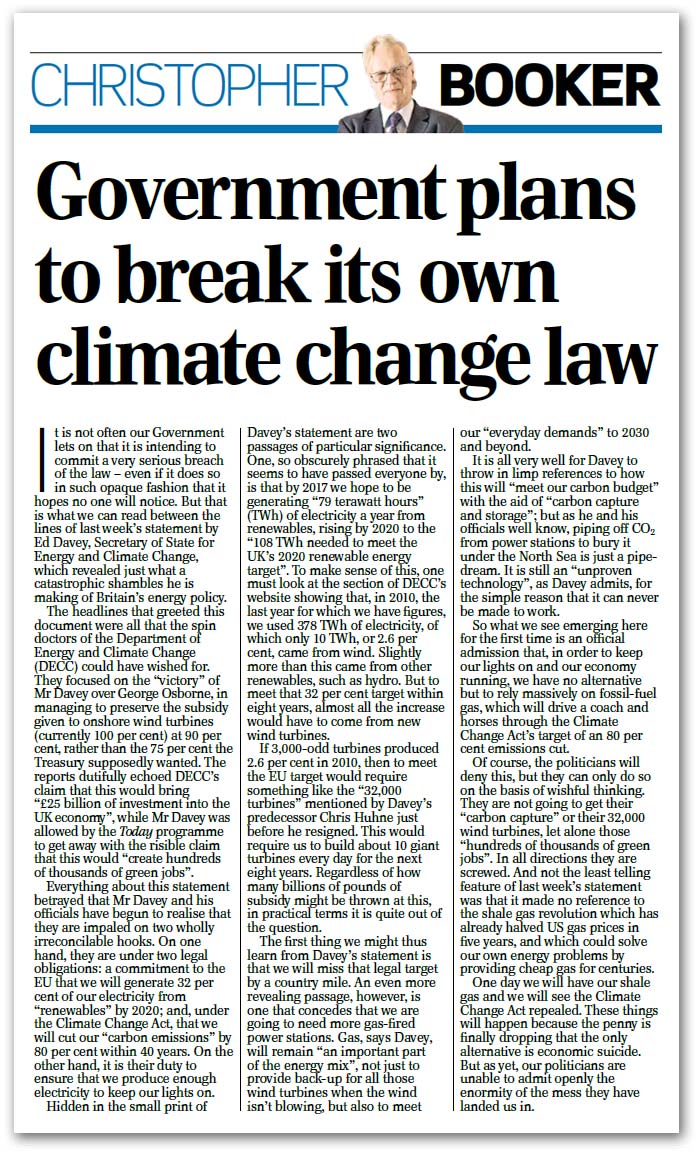 The law we are talking about is the Climate Change Act. Although this sets specific, mandatory targets aimed at reducing emissions, these have now become aspirational, with no realistic prospect of the government achieving them. What Booker has found though is that the government it is intending to commit this very serious breach of the law – it is doing so in such opaque fashion that it hopes no one will notice. The detail is buried in last week's statement by Ed Davey, secretary of state for energy and climate change, which reveals just what a catastrophic shambles he is making of Britain’s energy policy. As always though, the legacy media missed the point. The headlines that greeted this document focused on the "victory" of Mr Davey over George Osborne, in managing to preserve the subsidy given to onshore wind turbines at 90 percent, rather than the 75 percent the Treasury supposedly wanted. The reports dutifully echoed DECC's claim that this would bring "£25 billion of investment into the UK economy", while Davey was allowed by the Today programme to get away with the risible claim that this would "create hundreds of thousands of green jobs". Everything about this statement, Booker writes, betrayed the fact that Davey and his officials have begun to realise that they are impaled on two wholly irreconcilable hooks. On one hand, they are under two legal obligations: a commitment to the EU that we will generate 32 percent of our electricity from "renewables" by 2020; and, under the Climate Change Act, that we will cut our "carbon emissions" by 80 percent within 40 years. On the other hand, it is their duty to ensure that we produce enough electricity to keep our lights on. Hidden in the small print of Davey's statement are two passages of particular significance. One, so obscurely phrased that it seems to have passed everyone by, is that by 2017 we hope to be generating "79 terawatt hours" (TWh) of electricity a year from renewables, rising by 2020 to the "108 TWh needed to meet the UK’s 2020 renewable energy target". To make sense of this, one must look at the section of DECC's website showing that, in 2010, the last year for which we have figures, we used 378 TWh of electricity, of which only 10 TWh, or 2.6 per cent, came from wind. Slightly more than this came from other renewables, such as hydro. But to meet that 32 per cent target within eight years, almost all the increase would have to come from new wind turbines. If 3,000-odd turbines produced 2.6 per cent in 2010, then to meet the EU target would require something like the "32,000 turbines" mentioned by Davey's predecessor Chris Huhne just before he resigned. This would require us to build about 10 giant turbines every day for the next eight years. Regardless of how many billions of pounds of subsidy might be thrown at this, in practical terms it is quite out of the question. The first thing we might thus learn from Davey's statement is that we will miss that legal target by a country mile. An even more revealing passage, however, is one that concedes that we are going to need more gas-fired power stations. Gas, says Davey, will remain "an important part of the energy mix", not just to provide back-up for all those wind turbines when the wind isn't blowing, but also to meet our "everyday demands" to 2030 and beyond. It is all very well for Davey to throw in limp references to how this will “meet our carbon budget” with the aid of "carbon capture and storage"; but as he and his officials well know, piping off CO2 from power stations to bury it under the North Sea is just a pipe-dream. It is still an "unproven technology", as Davey admits, for the simple reason that it can never be made to work. So what we see emerging here for the first time is an official admission that, in order to keep our lights on and our economy running, we have no alternative but to rely massively on fossil-fuel gas, which will drive a coach and horses through the Climate Change Act's target of an 80 per cent emissions cut. Of course, the politicians will deny this, but they can only do so on the basis of wishful thinking. They are not going to get their "carbon capture" or their 32,000 wind turbines, let alone those "hundreds of thousands of green jobs". In all directions they are screwed. And not the least telling feature of last week's statement was that it made no reference to the shale gas revolution which has already halved US gas prices in five years, and which could solve our own energy problems by providing cheap gas for centuries. One day, concludes Booker, we will have our shale gas and we will see the Climate Change Act repealed. These things will happen because the penny is finally dropping that the only alternative is economic suicide. But as yet, our politicians are unable to admit openly the enormity of the mess they have landed us in. COMMENT THREAD Richard North 29/07/2012 |
Eurocrash: last ditch or ready to ditch? Saturday 28 July 2012  There are two ways of looking at this. One option is that the "colleagues" are preparing to ditch Greece – or perhaps something even more traumatic – and are therefore talking up the euro big time to hide their intentions from the market. The other is that they really do have that pretty amazing rabbit ready to be plucked out of a hat, and they are going to astound us all with a brand new, cunning plan in order to mount a last-ditch rescue. The Bundesbank, however, isn't playing ball, opposing any further government bond purchases by the ECB, or giving a banking license to the ESM. Given that Germany has not ratified the ESM treaty, and can't do so until Karlsruhle has handed down its judgement in September, it is difficult to see how the Drahgi "plan" can work. And the idea that there is suddenly a massive new credit line that the ECB can tap into seems a little far-fetched. Predictions in this game though are getting too hard to call. Possibly, the "colleagues" are trying to bluff the markets into supporting the euro. But if that is the game, it is a very dangerous play. Misleading the markets may be easy to do, but they can extract a terrible revenge. COMMENT THREAD Richard North 28/07/2012 |


 Posts
Posts

