 | | The Daily Reckoning | Tuesday, July 10, 2012 |
- Why now is a great time to snap up some gold mining stocks on the cheap...
- An overindulgent feast and Germany gets stuck with the bill...
- Plus, a closer look at the many and varied casualties of war...
-------------------------------------------------------
External Advertisement
Last Train to Paradise...
One hard-working couple from Sacramento watched the recession derail their retirement plans — savings wrecked, jobs lost...
But then they discovered something most folks in their situation never do.
And today they have a condo overlooking the Pacific... and, when it gets hot, a cool-weather retreat up in the mountains they escape to in a hamlet with cute cafes and great farmers markets.
They’re living a retirement even better than the one they’d planned and saved for.
You could be, too. Here’s how...
|  | | | | Quote of the Day... | | | We’re in a major bear market. The bad news is that lots of nasty things will happen to take the market lower, toward an ultimate bottom. The good news is that eventually a real bottom will be reached, and it will be possible to buy great companies unbelievably cheaply. However, there’s more bad news, namely that the bottom is likely quite a while down the road...
In the meantime, the busybodies, losers, and goons who populate the “Swindlers Encouragement Commission” will have a field day. Their counterproductive rules serve only to enrich lawyers and create a false sense of security for naïve investors. It’s all part and parcel of an investment climate — and more importantly a moral climate — in which the public thinks someone should pay them if they gamble and lose.
It’s more writing on the wall: the America that once was has been replaced by the “United State,” inhabited by herds of obedient, reality-TV-educated inmates who take no responsibility for their own actions. Things are going to get worse before they get better.
— Doug Casey
| | | | A brief note from our reckoner-in-chief, Bill Bonner... | | |  | | Bill Bonner |
Your editor is starting work on a new book. It will explain everything that needs explaining...at least about economics and politics.
Stay tuned to learn more about...the little known law that governs almost everything (at least everything we can talk about in a family publication).
Why empires fail... It’s covered...
Why there can be no recovery... That too...
Why you can have too much safety...too much health care...too much education...too much money...too much stuff...
..and too much of too much!
Stay tuned...
Regards,
Bill Bonner
for The Daily Reckoning
| | | | Gold Miners are Cheap, Cheap, Cheap! | | |  | | Chris Mayer |
Gold mining shares deserve their own discussion. I am bullish on gold without qualification. I am also bullish on gold miners...but with one very large qualification: they must produce positive cash flow.
I think the bull market in gold is intact. And I think gold prices will make highs within a year.
However, gold stocks have done poorly. Few have been spared. Like the other mining companies, they suffer from the same affliction: an eager willingness to take whatever cash they generate and dump it right back into the ground.
So even though the four largest listed gold miners — Goldcorp, Barrick, Newmont and Newcrest — generated $47.5 billion in operating cash flows in the last decade, they spent $62.5 billion in new mines, acquisitions and other capital expenditures. The big four have made no money in one of the greatest gold bull markets on record. In fact, they’ve lost money.
How did they make up this deficit? They sold more shares to the ever-gullible public — always a sucker for a good story about buried treasure. The number of shares outstanding rose 117% in the decade.
I’ve railed before about the management of gold miners. And I’ve tried to find gold miners in which the management teams do intelligent things. But it is hard. Even when you think you have found a team that says all the right things and looks as if it can do it, it does stuff that makes you scratch your head.
Aurizon Mines (Symbol: AZK. Price $4.43), for instance, is a wonderful miner. It generates plenty of cash. It has nearly $200 million in cash in the bank and no debt. But where is the payoff for shareholders? There is no dividend, no share buyback. Despite record revenues and cash margins, AZK’s cash balance is actually 7% lower than a year ago — again, because they put it all back in the ground. The share price is down almost 10% year over year. And this has been one of the better-performing mining stocks!
It’s very frustrating...
Still, price-to-cash-flow multiples have fallen to generational lows. During the last two decades, the XAU Index of gold mining stocks traded, on average, for 14 times cash flow. Today, the XAU is selling for less than 7 times cash flow, which is very close to its all-time low. So with smaller miners that produce cash flow, you have the chance of a good bounce to something closer to historical norms. The best case is a buyout by one of those free-spending bigger gold companies.
Regards,
Chris Mayer
for The Daily Reckoning
Editor’s Note: Much like Chris, we’re still bullish on gold. And while mining stocks may be a good way to speculate on the Midas metal, there is still no substitute for the physical stuff — both as a store of wealth and as security against declining paper currencies. Here’s where it gets interesting...
We just discovered the most dynamic and hands-down easiest way to invest in gold (and other precious metals). We realize that’s a bold statement. But we wouldn’t make the claim unless we believed we could back it up. And back it up, we shall.
Unfortunately, we can’t reveal too much right now. But rest assured, in 6 short days you will have all the info you need. Sorry to be so cryptic, but this is a very sensitive (and potentially very lucrative) offer, and we need to tread carefully. Keep watching this space for more details, but in the meantime, plan to be watching your inbox at 9AM on Monday, July 16th.
| | | | | Why “gold $2,000” is a joke... |
On April 24, 2007... one gold expert said “gold is on its way to $2,000 per ounce.” At the time, gold was trading around $688 and the mainstream figured he’d lost his mind.
But anybody who listened had the chance to make up to 175% on the metal alone... and up to three times more on related metal plays, as I write you today.
So what’s this gold expert’s latest prediction? Click here to find out.
|
| |
| | The Daily Reckoning Presents | | Like a Lead Zeppelin | | |  | | Eric Fry |
The German government, a AAA-borrower, is more likely to default than Viacom, a “near junk” borrower. At least, that’s what the credit default swap (CDS) market is saying. The CDS market may be wrong, of course, but it probably isn’t crazy.
The AAA German government is bearing a very heavy burden these days, thanks to its financially challenged Eurozone companions. As a result of this burden — both immediate and prospective — the cost of insuring a 5-year German bond against default is higher than the cost of insuring a 5-year Viacom bond against a default.
How could this be?
The answer is simple: Germany has become the “rich guy” in a group of friends who are dining at an expensive restaurant. Prior to the meal, everyone assumed that each friend would pay his share of the bill. (Each friend, that is, besides Greece. That dude never pays).
But now that the meal is over, almost no one is reaching for his wallet. Greece “stepped out for a smoke,” Spain “went to the restroom,” Italy “excused himself to take an urgent phone call.” Meanwhile, most of the other diners are shuffling nervously through their wallets, mumbling about not finding the credit card they are looking for.
And there, at the head table, sits a forlorn Germany — platinum Amex card in hand — dreading the fate he knows is coming his way. That’s why investors are pricing insurance on Germany’s AAA debt at BBB levels.
AAA borrowers, according to Standard & Poor’s, possess “extremely strong capacity to meet financial commitments,” whereas BBB borrowers like Viacom possess merely “Adequate capacity to meet financial commitments, but [are] more subject to adverse economic conditions.”
Like a textbook AAA borrower, Germany possesses an “extremely strong capacity to meet financial commitments.” Unfortunately, those commitments are going parabolic...which means that Germany’s robust balance sheet is as “subject to adverse economic conditions” as a textbook BBB borrower.
At last count, Germany was on the hook for about €1.5 trillion of direct and contingent liabilities. For starters, as James Grant, editor of Grant’s Interest Rate Observer, explains, “There’s the money that the German government has pledged to defend the euro. Such commitments — promised but yet undrawn — include €22 billion for the first Greek bailout, €211 billion for the European Financial Stability Facility, €190 billion for the European Stability Mechanism, €12 billion for the European Financial Stabilization Mechanism and $40 billion for the Securities Markets Program. They sum up to €475 billion, or 18% of German GDP.”
Next up, the Bundesbank is facing another €698.6 billion of exposure to various peripheral European central banks. That exposure derives from an obscure credit facility known as the Trans-European Automated Real-Time Gross Settlement Express Transfer System — i.e., “Target2.” The Bundesbank’s Target2 balances soared to €698.6 billion in May... from €644.2 billion in April,” Grant observes, “and next to nothing in 2006.”
Meanwhile, over in the private sector, German banks are sitting on about €323 billion of exposure to Greece, Ireland, Portugal, Spain and Italy.
So when you tally up all these acronyms, direct loans, backdoor guarantees and cryptic credit facilities, Germany’s total exposure to its beleaguered Eurozone neighbors soars to €1.5 trillion! That’s a staggering sum of money, equal to more than half of German GDP.
And remember, not a single one of these credit facilities is financing domestic German enterprise; they are simply trust-me lifelines to foreign economies with a long, checkered history of debt-repayment...or more typically, debt-non-repayment.
“Markets are beginning to latch on to the fact that, in effect, Germany is the euro and the euro is Germany,” observes Evan Lorenz, a research analyst at Grant’s Interest Rate Observer.
That’s the reason, Lorenz surmises, why insuring AAA-rated German debt against a default now costs 100 basis points per year, which is higher than the cost of insuring BBB+ rated Viacom (92 basis points) and double the cost of insuring AA+ rated US Treasurys.
Curiously, German government bonds remain the go-to safe haven asset on the European Continent. The 10-year bund yields a skimpy 1.32% — well below the 10-year US Treasury’s 1.52% yield.
Thus, dear investor, we have an anomaly, a conundrum. The folks buying credit insurance consider German bonds twice as risky as US Treasurys. But the folks buying the actual bonds, consider German bonds less risky than Treasurys. Here’s our guess: Someone is right.
Whatever the outcome, risks to Germany’s national balance sheet are clearly on the rise. If these risks continue to rise, Germany’s high-flying bond market may start flying like a lead Zeppelin.
Regards,
Eric Fry
for The Daily Reckoning
| | | | | Only 62 People Know Exactly Why These Four Companies Could Change the World |
Now you’re #63 “on the inside” — and you’re on the verge of raking in lasting wealth.
This could go down in history as the story of our era.
Click here for all the details.
|
| | | | | Now over to Joel Bowman with the rest of today’s reckoning from Paris, France... | | |  | | Joel Bowman |
When Napoleon crossed the Niemen, at the outset of the 1812 French invasion of Russia, he had under his command some 422,000 men. When he approached those same waters the next year, this time from the east, in sluggish, worn down retreat after defeats in Moscow, Borodino, Smolensk...his ranks had been cut to barely 10,000. A few enfeebled diehards were all that remained of the Grande Armée.
[This famous graph, by Charles Joseph Minard, shows the decreasing size of the Grande Armée. The brown line (followed from left to right) shows Napoleon’s march to Russia. The black line (followed from right to left) depicts his retreat. The size of the army is show equal to the width of the lines.]
Of course, military strategists are slow to learn and quick to forget. Napoleon wasn’t the only fool to covet the vast plains of the east. One hundred and thirty years later, Adolf Hitler embarked on Operation Barbarossa, the largest military operation in human history, both in terms of manpower...and casualties. His monstrous panzer divisions rolled east, pounding Napoleon’s tracks past Minsk, Orsha and Smolensk. They thundered north, over the River Dvina to Leningrad, and South, through the Ukraine and onto Stalingrad. Once again it was a remarkable show, equal parts brute strength and determined stupidity. The weather, and the Russians, buried the Germans too, just as they had The Little Corporal’s men. All in, 4.3 million Germans fell during the campaign — a fatality list ten times the size of Napoleon’s entire army. During the whole of WWII, the German army lost a total of 5.5 million soldiers.
Of course, it would be obscene to talk about the “sacrifice” made by Napoleon’s army. Most people recognize them for what they were: an organized band of thugs invading other people’s land. And yet, the Frenchmen laid down their lives by the hundreds of thousands. They were patriotic to the last. Equally, it would be considered a breach of decency to hail the bravery and dedication of the Nazi soldiers. They are recognized as aggressors, as brutal occupiers and ruthless killers. And so they should be. But were they not highly trained and committed to their cause? Did they not “sacrifice” their lives by the millions for their country?
In both cases, the defeated armies’ men were nothing short of model soldiers. They marched. They obeyed orders. They killed on command. And when the blood dried and the dust settled, they were awarded medals for murdering people they’d never met, whose names and stories they’d never know. They were, in other words, just like their opposition...though without the good fortune of having “won” the war.
The ground under a dead German may well be as cold and hard as that under a dead Russian or a dead Frenchman. But history doesn’t remember all soldiers equally. Nor does it tend to separate soldiers — whose job it is to kill — too well from civilians — whose desire it is not to be killed.
It is estimated that between one and three million German civilians were killed during WWII. Who murdered these people? It’s almost considered impolite to ask, lest blame fall on heroes’ shoulders. Over in the Pacific, Japan lost between a half- and one-million civilians. Who killed these people, these men and women and children? Did they receive medals for doing so? Were they honored by their own state, welcomed home with parades and confetti?
Imagine for a second that The Axis Alliance was victorious in WWII. How might history remember President Roosevelt’s Executive Order 9066, ordering the internment of 110,000 Japanese Americans in “War Relocation Camps” across the United States?
Moreover, what might history have to say about the only two nuclear weapons ever to have been deployed during wartime? Little Boy, the atomic bomb dropped on Hiroshima, killed between 90,000-166,000 people. Fat Man, dropped on Nagasaki three days later, killed between 60,000-80,000 people. In both cases, the vast majority of the victims were civilians. They died of flash or flame burns...falling debris...radiation sickness...
Here’s what US President Harry Truman told the public in a radio address after dropping Fat Man:
“We have used it [the Atomic Bomb] in order to shorten the agony of war, in order to save the lives of thousands and thousands of young Americans. We will continue to use it until we completely destroy Japan’s power to make war.” |
Who were these thousands and thousands of “young Americans” Truman was protecting? Surely not the same boys he was sending off to war. The US lost more than 400,000 soldiers on various battlefields in Europe and the Pacific...but “only” 1,700 civilians. Statistically, the best way to protect oneself against war was, as it is now, simply not to go.
Switzerland, which stayed famously neutral (despite their inconvenient geography), lost 100 civilians...and zero soldiers. New Zealand, meanwhile, lost nearly 12,000 troops, many of whom fell in places like Maleme and Galatas, during the Battle of Crete, and in far flung outposts in Italy and in Northern Africa. Again, these poor sods would have done better to stay at home, tending to their personal affairs, taking care of their families and ignoring heartfelt pleas from “society” for “shared sacrifice.” In all of WWII, not a single Kiwi civilian life was lost due to war.
Alas, The State’s message, articulated by Truman and emulated by “enemy leaders” around the world, was then as it is now: “We will make war in order to shorten it. We will make war until the other side cannot.”
Contrary to these bellicose hollerings of The State, the message of peace is not to “share the sacrifice”...but to avoid it altogether.
Regards,
Joel Bowman
for The Daily Reckoning
-------------------------------------------------------
Here at The Daily Reckoning, we value your questions and comments. If you would like to send us a few thoughts of your own, please address them to your managing editor at joel@dailyreckoning.com |
|
|
|

 The Daily Reckoning U.S. Edition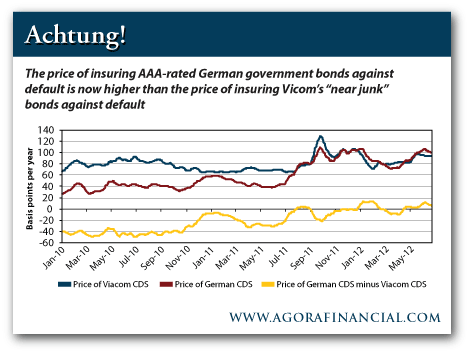


 Posts
Posts

