

EU referendum: just suppose we got one: Part I Wednesday 11 July 2012  Well, according to a poll published in The Sun last Monday, 48 percent of the electorate would rush out to vote to leave the EU – against 31 percent who would want to stay in. For that very reason, our Dave will not be offering a straight "in/out" referendum. He will have been looking at the small print of the YouGov poll and will have seen that, if he could "crack a new deal", people would vote to stay in, by 42 to 34 percent. Furthermore, 63 percent of those polled would be quite happy to have Dave set out a list of the powers "he hopes to bring back from the European Union", against a firm timetable for delivery. Only 24 percent would oppose that proposition, leaving 13 percent who don't know what they think (illustrated above). Then, should Dave go to Brussels in the style of Harold Wilson all those many years ago, and then come back waving his piece of paper, telling us what a wonderful new relationship he had negotiated, a massive 67 percent would be content to have a vote. Only 19 percent would go against such an idea, leaving 14 percent who don't know. What this says is the "renegotiators" are winning. The idea that little Dave can go trotting off to Brussels and bring back a new deal is firmly lodged in the public mind. The vast majority is prepared to allow him a shot at it – suspending judgement until they see the colour of his deal. Such an outcome is hardly surprising. Not only does this reward the propagandists who have been working to this end, it reflects the innate conservatism of the voting public. This is especially apparent in referendums, where the tendency is to vote with the status quo. Taking account of that tendency, the "renegotiators" are offering a safe choice, allowing voters to indulge their "euroscepticism" without having to risk the scary option of kissing goodbye to Mother Europe and leave the EU. This is euroscepticism-lite. Now look at what UKIP and its "hard core" praetorian guard have got to offer. From the desk of the Great Leader Farage himself, we learn that "naturally", UKIP would repeal the European Communities Act (ECA). Only then would negotiation be on the cards. Mr Farage believes we should reject a negotiated settlement under Article 50. The only use he has for that article is to "demonstrate the hypocrisy of Cameron (if any further demonstration were needed) in pretending to wish to 're-negotiate'". In other words, UKIP policy runs totally against the grain of what the public wants. Voters feel safe with the idea of "renegotiation". So UKIP offers the opposite. It wants the public to buy the most extreme of all possible scenarios – cutting loose without talks and without the safety net of a new agreement. This not only ignores the status quo effect. It massacres it, trampling the carcass into the dust and spitting on the remains. This is a policy calculated to fail in the most spectacular way imaginable, and is an absolute gift to the europhiles. It will ensure that Mr Farage keeps his job as an MEP into his seventies and beyond, and us locked in the embrace of Europe for as long as it lasts. Part II to follow. COMMENT THREAD Richard North 11/07/2012 |
Karlsruhe: adding uncertainty and complexity Wednesday 11 July 2012 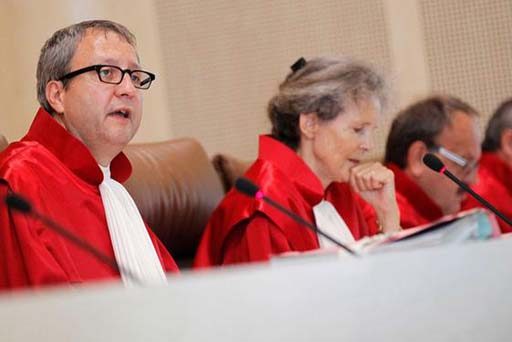 However, on this occasion, I was not that wrong. On 2 July, Spiegel was reporting that the plaintiffs, who opposed Germany transferring more power to European institutions, were trying to obtain a temporary injunction against the two laws to stop them entering into force. This would last until the court had addressed the main complaints against the measures at a later date and ruled whether the laws in question were constitutional. It was highly unusual, said Spiegel, for the court to hold a hearing on requests for a temporary injunction. The fact that it was doing so is regarded as a sign of the importance of the issue. All that now seems to have gone by the board, unless I have missed something. But, it is most certainly the case that the court in Karlruhe had a hearing on the ESM and fiscal pact yesterday. But, as Deutsche Welle now reports, it may be some time before we get a ruling. The judges may delay their decision until the autumn. Originally, the decision as to whether the ESM and the proposed fiscal pact on national budgets were contrary to the German constitution was expected by the end of July, and finance minister Schäuble has been before the court to warn that delay could trigger "massive uncertainty on the markets" and "significant economic distortions". The judges, however, seemed distinctly underwhelmed by this warning, with court president Andreas Voßkuhle sticking to the German constitution, loftily declaring that: "It is the task of constitutional courts to uphold rules even in cases when that is not politically opportune". It is that attitude which has made him so popular with the political classes (not), but the man is obviously not going to be moved from his intention of carrying out a "very thorough examination" of the issues. And, like it or not, we are all going to have to wait until he has finished. So significant is this that we even get a report in the Daily Wail, which gives details of Schäuble's warning. Ambrose, who has been consistently following this issue, also writes in detail, adding further colour to the reports. Where we go from here is anyone's guess, but we have just seen another layer of uncertainty and complexity added to a situation which is already intolerably uncertain and complex. One really does wonder how much more of this the system can take, before it falls apart. COMMENT THREAD |
EU debate: the worst of all possible worlds Tuesday 10 July 2012  We are also told that he will also ask Hollande to uphold an informal deal with his predecessor to leave alone Britain's £2.7bn annual EU rebate. In exchange, we are led to believe that Cameron will not to demand major changes to the Common Agricultural Policy. Inevitably, it is difficult to ascertain how much of this is spin. What is trailed, and what might actually happen, could be different things. But we are advised that Cameron is planning to explain in greater detail "safeguards" to protect its position when eurozone leaders draw up a new treaty. The line being played is that Britain fears that moves towards a fiscal union in the eurozone could undermine the EU's single market. It is also said that Cameron will make clear that Britain would use the discussions to demand a renegotiation of Britain's position in the EU, possibly by demanding the repatriation of social and employment laws. This latter ploy, of attempting to hijack an IGC convened for other purposes, is almost certain to fail, but it is one that is a constant refrain in the Tory litany. It keeps the renegotiation hopes alive, and gives the impression that Cameron is able to achieve something without having to commit to leaving the EU. This strategy, however, is no more or less realistic than the other extreme of waving a magic wand and repealing the European Communities Act - a strategy endorsed by no less than Nigel Farage. Neither is going to happen because neither can happen, leaving the EU debate in a quagmire of fantasy where no realistic options are on the table. Blundering into this quagmire today is the very same Farage with an opinion piece in The Sun. He is beating the drum for an immediate "in/out" referendum, which is no more likely to have the desired effect than any other strategy. With no new EU treaty on the table, and confusion prevailing, a referendum at the moment is not a sensible option. The situation is further complicated today by the publication of the Fresh Start initiative, which is said to be a "shopping list" of powers the Fresh Start Group wants the UK to reclaim from Brussels. Fresh Start is fronted by Andrea Leadsom, George Eustice and Chris Heaton-Harris. These are three MPs who want the UK to remain within the EU but say, "the prospect of closer economic and political integration in the eurozone in response to the debt crisis requires the UK to fundamentally reappraise its status within the EU". "Over the coming years, there will be a series of opportunities for the UK to take back power from Brussels. This is the perfect chance for us to negotiate a radically different relationship with the EU, one which properly serves Britain's interests", they say. Thus does the EU debate slide into a glorious fudge, lacking clarity of purpose and feasibility, none of the factions offering any credible options for extricating ourselves from the unholy mess that is the European Union. This is the worst of all possible worlds. COMMENT THREAD Richard North 10/07/2012 |
Eurosceptics: an absolute determination to fail Monday 9 July 2012  Mostly, they are familiar names, such as Torquil Erikson, a Rome-based English language teacher. He has managed to post a comment on Booker's site which is both patronising and wrong, exhibiting an advanced paranoia which is wondrous to behold. Referring to the two-year allowance for negotiations in Article 50 as a "waiting period that a withdrawing state must wait before it can consider itself sovereign once again", Erikson postulates that in this "enforced waiting period", we would still be in the EU and subject to all their decisions. Warming to his theme, Erikson then tells us that Eurocrats who "do not like us already" would use this power against us. Already many of their decisions have crippled us, destroying our fishing, decimating our agriculture, and now threatening our financial services industry. This process, he says, "would accelerate during the two years. At the end we might well be free, but we would be naked and impoverished". Other readers would have the Eurogendarmerie storming the British Isles to enforce their masters' will, a "paramilitary groups" which is "NOT accountable for their actions". They are, we are informed, "are able to kill people if they deem it necessary and will NOT be charged under law". Such foetid hyperbole is all directed to the one outcome: immediate repeal of the European Communities Act 1972, effectively abrogating the EU treaties and casting us adrift from the malign Europe of the eurosceptic imagination, ready to launch ourselves as a free and independent nation on the global market. Some of the errors behind Erikson's assumptions were immediately pointed out on the Booker comments, but it is not Erikson's style to acknowledge or respond to them. Instead, he circulates his original comment, unaltered, to his groupescule friends, seeking their approval. He is joined by Ashley Mote, who accuses Booker of ignoring the "practical consequences". The fabled two years, Mote asserts. "would be used by the bureaucrats to mount a huge and sustained PR campaign in the UK to warn the people of the UK of the terrible consequences of leaving". Then, echoing the Torquil Erikson scenario: … any and every EU regulation and directive which has been passed into UK law would be nit-picked over and reinforced with threats of fines and prosecution. Any interim activity planned by the British government would be examined microscopically for any apparent unlawful activity, and again policed with threats. It would be a logistical and administrative nightmare for the then UK government.Mote, in between court appearances, has been an MEP, so you would think he would know something about the workings of the EU. But, as we suspected at the time, he has never let such knowledge sully his brain. Even if his fevered imagination was founded in fact, does he not know how long it takes for the Commission to start infringement proceedings, and how long it takes to get a case through the ECJ? By the time the first case reached Luxembourg, we would be long gone. But locked in his haze of ignorance, there is only one way Mote would have us leave: "Repeal the European Communities Act, 1972, which took us in. We are immediately free. No further discussion, except perhaps about practicalities". The thing about these people is that they do not change. Through the twenty years of the contemporary movement, no facts, arguments or information have ever been known to affect them. Their arguments are locked in as solid as fossils in the stones found on Dorset beaches, the same now as when they were first thought of. Never mind the fact that, the day after we abrogate the treaties, trade stops - and much more besides. Looking at the consequences, any sensible person will readily accept that, for an orderly departure from the EU, negotiations are necessary. And if the EU has set down a procedure for these (which we agreed), then it would be absurd for us not to pursue it – bearing in mind that, if the negotiations collapse, we leave anyway and the provisions of the Vienna Convention still apply. Further, the only way we are going to bring a majority with us, to support our exit from the EU, is to convince people that leaving the EU can be achieved without major disruption and cost, and that existing trading agreements can continue – for the time being at least. The Article 50 route is the logical path. In rejecting the negotiation route, and advocating the "sudden death" scenario, the particular group of eurosceptics represented by Erickson and Mote is not only being unrealistic. It seems almost as if they are determined to fail, intent on frightening off the middle ground that we need to win an "in/out" referendum. They not only want to leave, but do it in the most damaging way possible, thereby doing their best to ensure that withdrawal from the EU is never actually achieved. In their own way, these people are more dangerous than the europhiles. At least with them, we know which side they are on. UPDATE: Your Freedom and Ours has linked to this post, arguing that self-styled hard core members of the eurosceptic group live in a "parallel universe". It is difficult to disagree with that assertion. At a certain level, "euroscepticism" is more akin to a cult than a political movement. Its "high priests" are dedicated to immediate withdrawal, without compromise, negotiation or any interim stages – this objective having been elevated to the status of a mantra that brooks no variation. Withdrawal on such terms would, of course, be catastrophic, and such dogmatism provides endless fuel for europhiles to assert that the "europhobes" are unworldly and completely unrealistic – which indeed the "hard core" is. Their ideas further weaken a movement which, in any candid assessment, must emerge with a reputation for consistent and unbroken failure. Confronted with such a record, most sensible people would consider changing tactics and adopting different approaches. But through twenty years or more, the "hard core" retains the same beliefs and assertions that it started with, sticking unyielding to the exactly the same tactics they first thought of. And then they wonder why they don't progress. Some will assert that different "factions" should avoid disagreement, as "we are all on the same side". But we are not. There are only two sides – winners and losers. The hard core are losers, and take pride in their status. For once, eurosceptics need to be winners, especially now that victory is in sight. Blowing it on dogma, for the sake of ideological purity, doesn't cut it. COMMENT: "BOOKER" THREAD |
Eurocrash: the odd couple Monday 9 July 2012  In a TV interview on the ZDF channel, he has told Merkel that she needs to explain why more clearly why Germany needs save the euro - at great expense to the country's taxpayers - and what will be necessary. Not mincing his words, Gauck said that Merkel has "the duty to describe in great detail what it means, including what it means for the budget". He added that the political establishment had struggled to explain why it was vital for Germany to do its part to save the euro, and actually offered to help in the process of communicating those priorities. "Sometimes it‘s hard to explain what this is all about. And, sometimes, there's a lack of effort to openly tell the populace what is actually happening", Gauck said, stressing that he did not want his words to be seen as an attack on Merkel. Gauck, of course, is the man who refuses to sign the law ratifying the fiscal pact until Karlsruhe has ruled on it, and he also had words about this, saying he was glad complaints had been made to the court, as he wanted to see a broad social debate on the issue. One can't help but feel here that the Germans have got the better deal, compared with the UK, in having a politically active head of state who is prepared to intervene on contentious issues. To carry out such a role in the UK, the post is currently vacant, as the Monarch is not permitted by convention to express political views in public. The president himself very rarely makes the international press, even though Gauck was a controversial appointment, and not Merkel's preferred candidate for the job. But his intervention now seems well-founded and does highlight how badly we are served in the UK. I doubt Gauck would cut an imposing figure on horseback for the Trooping of the Colours, but at least he seems to be able to hold his first minister to some sort of account – in public. I would gladly swap the one for the other. Meanwhile, tomorrow, on a distant planet far, far away – known as Brussels - eurozone finance ministers will be meeting to discuss their latest round of moves. On the agenda is the recapitalisation of Spanish banks – although no direct moves are likely until the fiscal pact is through and the ESM is up and running. And that depends first on Karlsruhe and then Gauck. Thus, strangely, the ministers are cautioning against expecting quick results. And not only is there the German problem. Opposition to the rescue plans is building in the Netherlands and Finland. Thus says an official involved in preparations for the meeting: "I don't see a package done by Monday. They will work until the end of July or the beginning of August on these things". One does wonder whether the "colleagues" are going to be able to get away for their hols after all. COMMENT THREAD Richard North 09/07/2012 |
Booker: hope hidden in Lisbon Sunday 8 July 2012  You do really wonder whether all those self-appointed "experts" on the EU are more in tune with Kenneth Clarke – he who never read the Maastricht treaty – than they are with reality. You do really wonder whether all those self-appointed "experts" on the EU are more in tune with Kenneth Clarke – he who never read the Maastricht treaty – than they are with reality.That might possibly explain Booker's observation inhis column today, where he remarks that: "Rarely can so much vapid political nonsense have been expended on any subject as that we have recently heard from all sides about an EU referendum". Putting together our best assessment of a fluid situation, Booker asserts that, whatever David Cameron and Lord Mandelson may say, the referendum is not something that can simply be pushed away into the indefinite future. On the Continent, the talk is that, despite the fiasco of the recent "summit", there urgently needs to be another major treaty, which would be so far-reaching in its moves towards political union. Should this come to fruition, thanks to Cameron's "referendum lock", Britain would be one of many countries obliged to hold a referendum. Meanwhile, in Britain all the relentless chatter has only demonstrated, again, the astonishing ignorance on this side of the Channel about the real nature of the "European project". Two arguments in particular are often heard – each based on a fundamental misconception. One is that we need a referendum because today's "Europe" is so different from the one we joined in 1973. The other, encouraged by Cameron himself, is that in due course we can negotiate a new relationship with it, involving a "repatriation of powers". The Common Market we joined was never intended to be anything but a staging post on the way to eventual political union, as the politicians who led us into it were fully aware. When Booker and I were researching our history of the project, some years ago, we were able to document in detail how, as far back as 1961, Harold Macmillan and Edward Heath were left in no doubt that political union was the ultimate goal. But, as Cabinet papers of the time reveal, Macmillan was convinced that the British people would not accept this, and that it must therefore be sold to them as no more than a trading arrangement. This was one reason why we called our book The Great Deception – an epithet that is even more appropriate to the time, a decade later, when Heath finally secured Britain's membership, assuring us that it would involve "no essential loss of sovereignty". Many people did indeed fondly imagine that we were merely joining a "free trade area" – but only because they were being deliberately deceived. Heath knew full well that the Common Market (in fact a tightly regulated customs union) was only a preliminary step towards the "ever closer union" that we have seen taking shape since – of which the euro was designed to be the supreme symbol. The project's core doctrine has always been the acquis communautaire: the rule that once powers are handed over to Brussels they can never be given back. That is why it is futile to talk of Britain negotiating a "new relationship" with Brussels involving repatriation of powers. It cannot happen, because it would be in breach of the project's most sacred principle. There is only one way in which we could force the other EU states into negotiating a new relationship for Britain. If our politicians, led by Cameron, were actually to read the treaty, they would find this power under Article 50, inserted at Lisbon: such a negotiation can only be triggered if we notify the EU that we wish to leave it. Then, and only then, would our EU colleagues be compelled (rather than "persuaded") to enter into the negotiations necessary to establish our "future relationship with the Union". As we have said before, the very last thing Cameron could countenance is notifying the EU that we wish to leave it – even though the alternative is that, under a new treaty, we would remain impotently in the second tier of an EU wholly controlled by the eurozone. But unless all the Tory MPs clamouring for the "repatriation of powers" grasp the crucial importance of Article 50, talk of a referendum on a "new relationship" with the EU is just self-deceiving fluff. Either we go for Article 50, or we are doomed to become second-class European citizens – that is, until the EU itself disintegrates, because it is incapable of finding a rational solution to the stupendous shambles that its reckless ambition has led it into. That is Booker's conclusion but, so deeply embedded is the self-deception and ignorance within the Conservative party, that it is hard to see any immediate changes or better understanding of the situation. Cameron, therefore, is condemned to surrender the initiative and to react to situations over which he has no control. We have no idea when (or if) the "colleagues" will succeed in finalising their new treaty, but the best estimate is that it will come about at roughly the same time the British general election is under way. Thus, Cameron will be forced to hold a referendum, on the "wrong" issues at the wrong time, under circumstances which could be electorally damaging unless managed with a great deal more skill than he has so far shown. For reasons I explored earlier, this early referendum cannot be an "in/out" referendum, and could have to be so framed that Cameron is forced (or wishes to) support the EU position. The more I think of this, the more impossible the position seems to become. The best way is to invoke an early Article 50 notification and opt out of the new treaty negotiations and ratification. To do so, though, would require political courage and clarity, two attributes for which Cameron is not famous. But, for want of action, he risks allowing himself to be trapped in a position from which there is no escape. Perversely, then, the escape route lies in the Lisbon treaty, the very treaty on which he promised a referendum and then resiled. How ironic it will be if ignoring that same treaty proves to be his downfall. COMMENT THREAD Richard North 08/07/2012 |


 Posts
Posts

