
Tuesday 31 July 2012 Tuesday 31 July 2012 Tuesday 31 July 2012 Tuesday 31 July 2012 Monday 30 July 2012 Monday 30 July 2012 Monday 30 July 2012 Sunday 29 July 2012New feature
COMMENT THREAD
Peter North 31/07/2012 Energy: India gets worse

Yesterday saw the supply to the city go down, but from the tenor of the reports, they have now had a cascade failure, with the northern and eastern grids having collapsed.
After the Monday blackout, power was restored to the northern grid by the evening, but at 01:05pm (local time) today it collapsed again. The eastern grid failed around the same time.
The two grids together serve more than half of India's 1.2 billion people and the blackout has hit a large swathe of the country including Delhi, Punjab, Haryana, Uttar Pradesh, Himachal Pradesh and Rajasthan states in the north, and West Bengal, Bihar, Orissa and Jharkhand in the east.
An official in Orissa says the blackout in the eastern grid had been triggered by a fault and "could take several hours to resolve". The Times of India is talking about the evening before power is fully restored.
The effects already are dramatic. With over 350 trains stranded, and hospitals and essential services were running on backup generators, there are also reports of miners being stuck as to power supply to their lifts has been cut.
Overall, the blackouts are said to be an embarrassment to the government "as it struggles to revive economic growth". But, for the time being, embarrassment is the least of their problems. The underlying infrastructure decay is one which is not going to be solved easily or soon - something for our own masters to note.
COMMENT: "SHAPE OF THINGS TO COME" THREAD
Richard North 31/07/2012 Eurocrash: the Monti-Hollande show
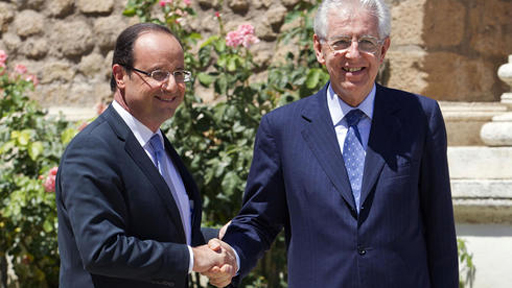
This, however, can only be the light of a train coming the other way, for no one in their right mind has a scintilla of doubt that the euro crisis is intensifying. And, as a measure of its intensity, we are toldthat France and Italy are planning a massive increase in the ESM, enabling the ECB to refinance without limit.
One can only assume that the two leaders (pictured above) have finally lost the plot, invoking a squawk of protest from Juergen Stark, former chief economist of the ECB, who sees a clear violation of European law.
This would mean, he says, that states would be financed indirectly by the European Central Bank, Stark, adding: "We are already stretching European law to its extremes, to say the least". And now the community is breaking the law, he says. All that is needed is a plaintiff.
That apart - as we keep saying - nothing can happen with the ESM until the Karlsruhe hands down its judgement in September, and the Germans are able to ratify the treaty, if at all. The Franco-Italian posturing therefore is typical of the fantasy politics which seem to be afflicting the "colleagues".
But it goes from the sublime to the ridiculous when the Luxembourg foreign minister Jean Asselborntakes it upon himself to warn German against "isolation in Europe".
So far from reality is the current game that one is lost for words. This can only be part of the continued effort to keep the lid on the markets, until everyone is back at work in September. Short-term, the markets are easily pleased, and seem to be going along with the fiction. But the reckoning cannot now be far away.
COMMENT: "EUROCRASH" THREAD
Richard North 31/07/2012 Eurocrash: the other side of the story
But there is another side to these hard-luck stories. Die Welt is reporting that "allegedly poor Greeks" have been depositing huge sums of money in foreign accounts. The most glaring case, according to a report in Athens newspaper Ta Nea is of a man who told the Inland Revenue he had zero income yet managed to deposit €25 million abroad.
This newspaper has published a copy of the list of alleged offenders, held by the Bank of Greece, authenticated by the Ministry of Finance. In 2010 alone, 731 Greeks have transferred nearly one billion euros to other countries, including the UK, Switzerland and Cyprus. Yet, according to their tax return, 403 of them were poverty-stricken.
Of course, one look at Piraeus Harbour will tell you that there is no shortage of the idle rich, even if so many ordinary people are indeed suffering real hardship.
Yet Drahgi and others, including now Monti, continue to bleat their mantra that they will do whatever it takes to save the euro. But Ambrose makes it clear that any efforts will have to be pretty heroic.
Given how much this is all going to cost, it isn't only the Germans who are asking whether it is all worth it. And when Ambrose cites an estimate that Spain and Italy amount will need €1.1 trillion bailout funds over three years, the question takes on huge importance.
Despite Draghi's rhetoric, that sort of money simply doesn’t exist. Any attempt to raise such sums on the open market would expose the bluff behind the bailout machinery, and bring the whole edifice crashing down. Unless the ECB pulls off the rescue of the century, we are looking at a re-run of 1931.
COMMENT THREAD
Richard North 31/07/2012 The Harrogate Agenda – direct democracy, part II

The idea goes back to Roman times and although it might sound attractive as a solution to modern problems, it is largely a gimmick. More particularly, it was resurrected in the 1992 Heseltine deregulation farce to give the appearance of "doing something". As far as I am aware, though, no law was ever subject to this provision as a result of UK deregulation initiatives.
One of the reasons why the idea became a non-starter was that, if the law was needed (and why else, in the view of government, would it be passed?) then it should remain on the statute book until it became redundant. Allocating an arbitrary expiry date, requiring active legislative input to keep a law going, merely adds unnecessary complications.
Picking up from part I of this piece, however, there is a better way of achieving the desired effect – of getting rid of unnecessary or unwanted law. And this is where direct democracy comes in.
In part I, we saw a system whereby all new Acts of Parliament underwent public rather than royal assent, via a referendum in need be, upon the deposition of the signatures of a stated number of objectors.
With existing legislation, the same system could apply, only the bar might be higher. Whereas a valid objection to new legislation might require 100,000 signatures, to object to an existing law might need as many as one million signatures to trigger a referendum.
Here, though, we are talking about Acts of Parliament, not the infamous Statutory Instruments (SIs) of which thousands are produced each year. During our conference, a strong preference was expressed for their abolition, but again – for the more substantive measures – we could again look at the objection/referendum route.
What we must recall though is the proposal on local government, where Counties or other agreed structures become legislatures in their own right. Many of the powers in the grip of central government are devolved, eliminating the need for most SIs.
It follows that no equivalent power to create secondary legislation should exist at the grass roots level. All law here should be primary legislation and, of course, there must be public assent, with provision for formal objections and referendums.
This is not the end of it though. There is a third element where direct democracy can apply, which has not yet been discussed – the approval of treaties. To say this is a complex subject is something of an understatement, so we'll look at it in part III.
COMMENT THREAD
Richard North 30/07/2012 Energy: the shape of things to come
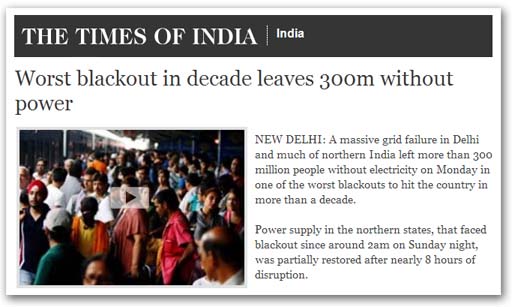
That could still be the case but only if, in my view, the western economies managed to decline faster than this bloc. But, on the evidence of this this example (above), even with our incoherent energy policy, we are going to be struggling to do things quite as badly as India.
This is the country, of course, which spawned Rajendra Pachauri, and the nonsense on sticks about climate change. Yet it is also a country which cannot even get the basics right. Despite grandiose plans to extend is power supplies, using next generation coal-fired plants, the commercial capital still generates less than 20 percent of its power requirement.
But then, this is a city which is failing even to manage the water supply properly – and don't even think about waste management.
Pervaded by political mismanagement and corruption, this country is going nowhere but down in the longer term, yet it is as much in the thrall of the mad fakir Pachauri as we are, selling us a useless bill of goods on climate change, when the real need is to deal with the energy shortfall and other basics.
At least, however, in Rajendra's home city, we can see the results of the stupidity of failing to meet electricity demand, in which event we can see the future mapped out for us if we continue following down the same path.
COMMENT THREAD
Richard North 30/07/2012 The end of the world is nigh (not)
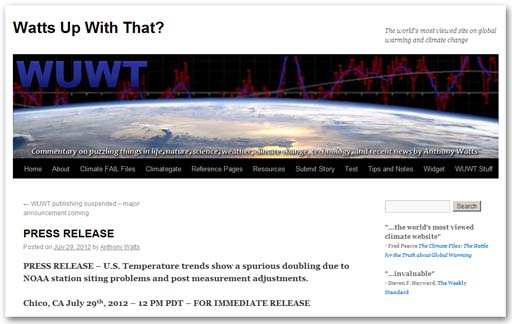
This is co-authored by Anthony Watts, Evan Jones of New York, Stephen McIntyre of Toronto, Canada, and Dr John R Christy from the Department of Atmospheric Science, University of Alabama, Huntsville, and is to be submitted for publication.
This is indeed an important development which shows that temperature monitoring problems have led to a spurious doubling of US mean temperature trends in the 30 year data period covered by the study from 1979 – 2008. A major chink in the warmist armour has been exposed.
However, in terms of the drama, what we have is an unpublished paper, co-authored by Anthony Watts, proving that the previous work by, er … Anthony Watts and team, was entirely correct. From an external perspective, this is not Climategate III. I suspect we are not going to see the limpiks taken off the front page.
COMMENT THREAD
Richard North 30/07/2012 Article 50: "causing dissent"

We saw some of the arguments in my earlier piece, but what is interesting is groupescule attitude to our original assertion that the best way to quit the EU is to invoke Article 50.
Even to assert this, it would appear, is wrong. By stating my view, say some members of this faction, Richard North is causing us to fall out and "is going out of his way to undermine UKIP and their leader over this, causing dissent". Thus we are told:The only possible reason we could put forward is that Richard, after 18 months sharing the same desk as Nigel Farage, has turned against anything that Nigel puts forward … Regrettably these schisms, which so often occur within the anti-EU movement, are what holds back a united front against the EUSSR.
It seems, therefore, that one must not offer views which differ from those promulgated by the Great Leader, otherwise this causes "dissent".
To call the discussion on Article 50 a "debate", however, is perhaps being too kind. The attitude seems to mirror exactly the authoritarianism of the EU that the groupescule so detests. It makes ex cathdra statements and then re-states the same points without conceding anything which contradicts the received wisdom. It then demands unquestioning conformity with the "line".
An example of the technique comes with yet another intervention from Ashley Mote. He continues to argue - without change - that, following the UK's notification of withdrawal, what follows are "so-called negotiations" over a period of two years.
This is starting point from which it is impossible to progress. If the negotiations mandated by Article 50 are not seen as genuine, then one can go no further. And indeed, according to Idris Francis, they are unlikely to be so as the "colleagues" are "liars, cheats and scum". And with that, the groupescule consensus is that Article 50 is "a trap".
No one, of course, is prepared to substantiate this assertion – it remains a raw expression of prejudice with nothing whatsoever to support it.
On the other hand, there is every reason to believe that the withdrawal clause is entirely genuine. First introduced in 2003 by the European Convention on the Future of Europe, it actually goes back further, to the Italian Communist and latterly MEP, Alterio Spinelli, author of the draft treaty of the European Union.
His work was later to form the basis of the Single European Act and the Maastricht Treaty and, even then – according to his political strategist, Richard Balfe – he was a strong advocate of including a withdrawal clause in the treaties.
As a Communist, Spinelli was very well aware of Lenin's condemnation of the Romanov empire as a "prison of nations" and was determined that the EU should not be likewise tainted. He felt strongly that the EU should be a voluntary association of nations, and not a trap for unwilling members.
Spinelli was by no means alone, although some favoured a withdrawal clause for other reasons – specifically, after decades of what they saw as Britain as a "reluctant partner", they very much wanted to give her an opportunity to leave, in the hope that they might the British government take it up.
Either way, Article 50 stands as the only measure within the EU treaties that enables member states, as of right, to demand negotiations.
This, of course, is not good enough for the likes of Ashley Mote, who maintains his standard doomsday scenario. Once the "so-called negotiations" start, his scenario is that the EU would mount a huge and sustained PR campaign in the UK to "warn" us of the terrible consequences of leaving.
In order to invoke Article 50, though, the UK would have to lodge formally its intention to withdraw – the decision to leave would already have been made.
Despite this, our own taxpayer's money would be used against us in a sustained campaign to undermine the then UK government's objective, says Mote. Every incident, problem, crisis would be "sold" to the BBC and the other pro-EU media as being the direct and inescapable result of the UK's decision to leave. Then develops the Mote fantasy:Any and every EU regulation and directive which has been passed into UK law would be nit-picked over and reinforced with threats of fines and prosecution in the European Court of Justice … Any interim activity planned by the British government would also be examined microscopically for any apparent unlawful activity, and again policed with threats. It would be a logistical and administrative nightmare for the then UK government.
We raised this before, but stopped short of shredding it. Nevertheless, this is truly fantasy of the most bizarre kind. It takes anything up to five years for the EU to take infringement proceedings through to the ECJ. Over a two-year time span of Article 50 negotiations, there is simply not enough time for the Mote scenario to take effect.
We could go further, but there is no great point. Speaking for the groupescules, Idris Francis betrays a deeper prejudice. He tells us that the Harrogate Agenda project is seen as "a wrecking device intended to disrupt if not wreck UKIP's chances", not least because of "personal issues and vengeance". In other words, says Idris, "hatred of UKIP that has become more important to those involved than their hatred of the EU or desire to leave it".
Idris, incidentally, conveys almost with a sense of pride, the fact that he does not read the EU Ref blog. Had he lowered himself to do so, he would have realised how mad his claim actually is. Needless to say, Idris does not make it to my face. That might cause dissent, and that is not allowed.
COMMENT THREAD
Richard North 29/07/2012
Tuesday, 31 July 2012
Up on the top menu you will notice a new archive feature. It works, which is a start, and I will sort out the look and feel of it later in the week. The full body of data from day one is now available. Any suggestions or tips would be very welcome.
Mario Monti is to meet Hollande in Paris later today, and we are to get another of those showpiece pledges about saving the euro. Indeed, Monti is already ramping up the rhetoric, telling us that the famous tunnel "is beginning to show some light".
The legacy media has been running endless stories about hard-done-by Greeks, on the brink of poverty. And doubtless they are all true.
One popular suggestion at our Harrogate conference was the idea of a "sunset clause" for new legislation – a provision whereby law automatically ceases to have effect when its expiry date is reached – unless it is renewed.
With those sort of "eurosceptics", you cannot have any debate.


 Posts
Posts

