
Monday 13 August 2012 Monday 13 August 2012 Monday 13 August 2012
Media: press-release misinformation

Businesses making job cuts, we are told, will have to measure how happy their staff are before and after redundancy and help those worse affected into new jobs, under draft EU proposals.
This requirement, according to Peacock, comes in "rules being drawn up by Spanish MEP Alejandro Cercas", which means that employers planning job cuts will have to measure the "psychosocial health" of staff before and after laying off people.
If there is a significant deterioration in workers' mental health and well-being, companies would be forced to offer retraining, coaching on interview technique and general help with finding a new job as a compromise for letting them go.
Companies also face having to outline the impact of redundancies on the local community, including how they would regenerate the area if significant job cuts meant thousands of local people were suddenly out of work.
And so we have another EU red-tape story in the making – except that the framing of the story is completely wrong. These are not new "rules" and nor even are they "proposals".
What we have here is a EU parliament own initiative report drafted by socialist MEP Alejandro Cercas. And, as such the report is a recommendation, with no legislative status whatsoever.
The actual recommendation comes on page 13 of the 14-page report, actually headed "Recommendation 14", which is a pretty good clue to anyone who had read it, which Peacock probably had not.
Her source of information appears to be EEF, the manufacturers' organisation, for she cites Tim Thomas, head of employment policy at the EEF, who is allowed to say: "The UK is trying to overhaul employment law but faces constant tinkering and daft new laws from the EU".
Thomas then complains that, under these proposals, employers will have to negotiate with unions over redundancies in a way they don't at the moment. The rules will make it far harder for employers to make people redundant".
Thus, Peacock is able to inform us that this is yet another example of the deluge of "burdensome" and "ridiculous" laws flooding Britain's way from across the continent – at the very time that UK policymakers are trying to scrap red tape.
But this is presaged on the basis that the "proposals" were voted through the European Parliament last month. But not only are they not proposals (only the EU commission can make proposals), they have not yet been voted on.
According to the legislative observatory, freely accessible on the EU parliament website, the report was only referred to committee on 20 April 2012, and is not due for a vote in committee until October, with a plenary reading scheduled for November.
What we really have therefore, appears to be another example of press-release journalism. And, without doubt, we have a journalist who is ignorant of the EU and its ways, and has not checked on the accuracy of what she has been told before pasting it into her copy.
And upon these people, we should rely on for our information?
COMMENT THREAD
Richard North 13/08/2012 Eurocrash: calm before the storm?
The parallel, of course, is not a good one. There is no comparison between the Germany of then and now. But what strikes one is the similar sense of great events on the horizon. Back in August 1939, though, it was British Cabinet members hurrying back from their holidays. This time, it is Merkelcutting short her break.
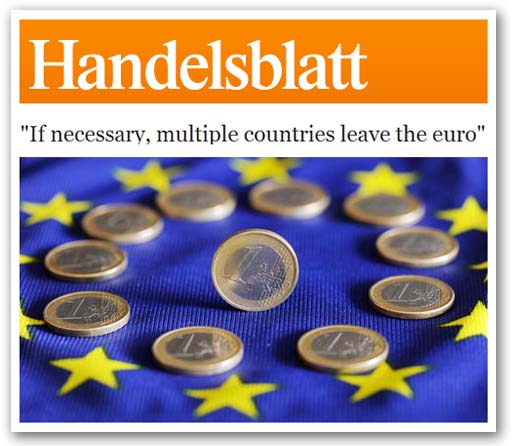
Making the weather, so to speak, is the German media, and amongst the many interesting headlines today is one from Handelsblatt proclaiming that, "If necessary, multiple countries leave the euro".
This is a quote from Martin Zeil, Bavaria's deputy prime minister – and the first time we are seeing a (relatively) senior German politician acknowledge that more than one country may have to drop out of the single currency.
Meanwhile, Rainer Brüderle, parliamentary leader of the Free Democrats, is adding his voice to the growing cacophony of German politicians calling for a referendum on the political future of the EU. "We have come to a point where a referendum on Europe is necessary", he says.
Moreover, Brüderle is joined by former finance minister Peer Steinbrück (SPD), and SPD leader Sigmar Gabriel. Both are arguing for a common European debt liability, but matched by EU " reach-through rights on national financial management".
Both also agree that the implementation of such an approach would be "very challenging" – and could not be done without asking the citizens if they wanted to go down this path.
Die Welt, on the other hand, is adding to the atmosphere of crisis, headlining about Day X - the day that Greece leaves the euro. Officially, the paper says, no one talks about it. But behind the scenes, the big banks have long been prepared for the euro-exit by Athens.
This, however, will be very far from a happy event, according to Kapffer Daniel, a partner and risk expert at Accenture. He predicts a collapse in value in the value of the euro against the dollar and [Swiss] franc, followed by a collapse of the stock markets.
What no-one is offering, though, is a timescale. This is all due to happen some time soon, but with no idea of when. Instead, we get Olli Rehn, EU commissioner for economic and monetary affairs, writing for the Wall Street Journal telling us that "the eurozone is at a decisive juncture - not only in its three-year-old debt crisis but in its 13-year-old history".
I guess if an EU commissioner feels it necessary to tell us that, it says more about him than us, but you can't help but snigger when he also informs us that "Europe is undergoing a correction …".
If this is all he has to offer, perhaps Mr Rehn should go on holiday and stay there.
COMMENT THREAD
Richard North 13/08/2012 Eurocrash: it's the politics, stupid!

These three dimensions, he says, must all be taken into account in judging whether the single currency will survive. Systemically this is an economic crisis of banking, refinancing and institutional deficits, he adds. But that it will be resolved politically is often underestimated in economic comment.
I've forgotten how many times I've written this, so it's nice to have someone else say it as well – particularly the bit about the politics very often being underestimated in economic comment.
Never were truer words spoken – much of the comment from that source is beyond useless, to the point of being completely misleading, especially in the British (and US) media, where economics correspondents so often have no feel for European politics.
Speaking of politics, el Mondo is telling us that Spain finally looks set to make a formal application for a bailout. "The bailout is inevitable and the only question is how", says Victor Alvargonzález, the CEO of Profim. "The solution is no longer in the hands of Spain, which has completely lost the confidence of creditors.
But, reinforcing Gillespie's view, any application by Spain will be made on political rather than economic grounds. And those political fault-lines run all the way back to Berlin, where a technical recession combined with the general election next year make for a toxic mix.
Klaus-Peter Schoeppner, head of the Emnid polling group, describes the bailouts as the government's Achilles heel. He predicts that it: "will only get bigger as the government's ability to dole out new money comes under strain" from a weakening economy. Then he warns: "They will have to be very careful going forward".
Thus, concludes Gillespie, "this autumn will see a determined effort to put politics back in the foreground of the crisis, even while the ECB takes most of the economic strain".
He is right, but only after a fashion - the politics have always been there.
COMMENT THREAD
Richard North 13/08/2012
Monday, 13 August 2012
What is also significant is that the paper is writing of the "escalating debt crisis" as a given, whilereporting separately that the Greek crisis is getting worse. The economy has contracted again, for the eighth consecutive quarter, shrinking between April and June by 6.2 percent compared with last year.
But let us not lay blame, the commissioner then tells his American audience. We are building "Economic and Monetary Union 2.0". Thus, he implores, "let's work together on both sides of the Atlantic to learn the lessons of the past and ensure that we emerge from the current crisis stronger".


 Posts
Posts

