

History: a People's War
Monday 1 October 2012
 Bognador, is a Research Professor at the Institute of Contemporary British History, King's College London and is writing a history of Britain in the 20th Century, so his offerings are of some interest, and especially his item 9 on the Second World War, of which he says: From June 1940 to June 1941. Without our heroic resistance, Europe would, Churchill predicted, have entered a new Dark Age. It changed the dynamic between leaders and troops. Field Marshall Montgomery asked a soldier to name his most important possession. The man said: "My rifle". Montgomery replied: "No. It isn't. It's your life and I'm going to save it". Such humanity by leaders led it to be called The People's War.What leaps out of the page is the claim on the "People's War", which is complete rubbish – a total re-write of the entire social history of that period. That particular phrasing emerged to some prominence during the second half of 1940, and was a major theme during the TUC annual congress in Southport of that year. It was then that Labour cabinet ministers were accused by union bosses of not doing enough to make the conflict a people's war, a "war fought for the people by the people". Previously, the term had been given considerable prominence by J B Priestley, in his Sunday "postcript" talks, which had also cemented it in the left-wing iconography, distinguishing it from the Tories' unpopular "bosses' war", made for spivs, capitalists and profiteers. The reason why it was a people's war, of course, was because it was at one the first "total war", which involved civilians as much as the military, and it was also an industrial war, where factory output had as much, if not greater influence on the outcome than military victories. Because of the left-wing connotations, right wing authors (and Churchill himself) have tended to play down the people's contribution in their post-war histories, as we saw in the Battle of Britain. Their vital role has largely been airbrushed out of the narrative, with the focus on the elites. But then to pretend that the term "People's War" emerged as a reflection of the "humanity" by leaders such as Montgomery is utterly bizarre. If Bognador really believes that, then he has no claim to the title of historian. If he doesn't, then his description is cynical beyond belief. Either way, it is so wrong that it is the sort of thing that you could only find in the pages of the Daily Mail, the newspaper which, before the war, was a great fan of Hitler, with its proprietor Lord Rothermere supporting Oswald Mosley and the National Union of Fascists. One can only reflect though, that if this is the sort of thing that Bognador was teaching Cameron at university, it is not surprising the prime minister has such a poor grasp of history. COMMENT THREAD Richard North 01/10/2012 |
Greece: a coup averted – a crisis defused?
Monday 1 October 2012
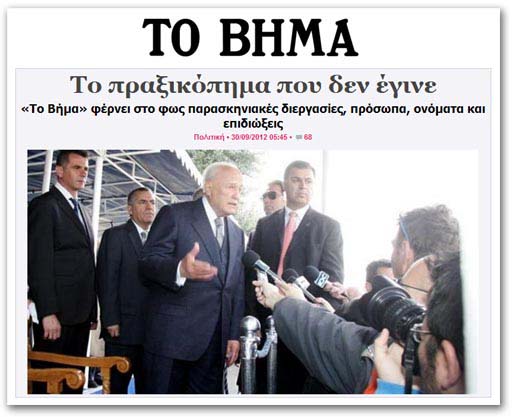
Played big yesterday in the Greek newspaper To Vima (Tribune) is the claim, under the headline, "the coup that never was", that on 1 November last year, then premier George Papandreou fired the Greek Armed Forces chiefs of staff to forestall a military coup.
We picked this up at the time, having speculated that a coup was in the offing, at a time of maximum instability, when anything seemed possible. Says To Vima, Papandreou's government never explained convincingly the surprise retirement of the entire leadership of the Armed Forces. But, it says, "authoritative sources" now assert that the move prevented political destabilisation and averted a coup. The coup would have been engineered by "ultra-nationalist patriotic officers" to restore the honour of Greece and to save the country from impending civil strife, the paper says. But, as suspicions hardened, the final decision to force the Service chiefs to stand down was taken at dawn on Tuesday 1 November. The unexpected resignations had been preceded on 26 and 27 October by Papandreou at the European Council, agreeing the second rescue package – which had been regarded as a "betrayal" by many in the armed forces and elsewhere. In Thessalonika, defence minister Panos Beglitis had been insulted at an official ceremony, and attacked by protestors, amongst whom had been members of the armed forces. On National Day, 28 October, there had then been riots in Thessalonika. A parade had then to be cancelled after the right- and left-wing protesters had condemned president Karolos Papoulias as a "traitor". Predictably, the current chief of general staff, Michalis Kostarakos, and one of the generals who was promoted last year, completely denies the story. "Such claims are totally unfounded and an insult to Greek armed forces", he says. The politicians, meanwhile have other fish to fry, after the news last week that dozens of their number, including the Speaker of the parliament, are under investigation for corruption. Before this is all over, therefore, some may regard last November as a missed opportunity. But, given the tensions at the time, and the certainty that many had – including this blog – that Greece was going to drop out of the euro, a failed coup may well be seen in retrospect as a turning point. Currently, Greece is expecting to be given its next tranche of €31 billion bailout funds without too much drama - even though it may not meet the reform criteria. And, although some media sources have hyped the latest round of street protests, the estimated 50,000 in Syntagma Square last week was only a tiny fraction of the numbers seen in earlier demonstrations. By contrast with the rage elsewhere, in Madrid, Lisbon and even Paris, Athens has been relatively calm. Thus does the New York Times report, after an interview with Greek premier Antonius Samras, that, "There is absolutely zero risk that Greece is leaving the euro". His message to his fellow Greeks is to keep the faith and that better days lie ahead. "What I am telling you", he says, "is that there is hope". With even the German opposition agreeing to the possibility of a further bailout, not for the best part of three years - as we come up to the third anniversary of the start of the crisis - have we heard such confident words. Whisper it softly for fear of being mocked, but the worst may well be over for Greece. COMMENT THREAD Richard North 01/10/2012 |
Media: taking in each other's washing
Sunday 30 September 2012
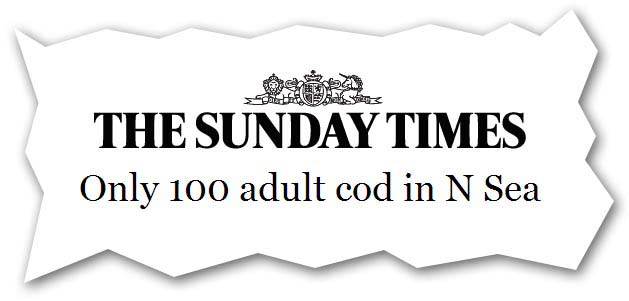 I did at the time think of writing a rebuttal piece to this (and in fact even made a start) but, on reflection, the headline was so obviously false that I didn't see the point in expending the energy. 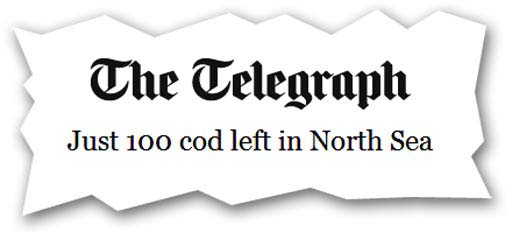 However, the obvious falsehood did not deter The Daily Telegraph from copying out the story, publishing on its website on the same day, the headline: "Just 100 cod left in North Sea". And, where the Telegraph leads, the Daily Mail so often uncritically follows. The following day it ran the story under the headline: "Scientists fear for cod stocks as study reveals there are just 100 adult fish in the North Sea". 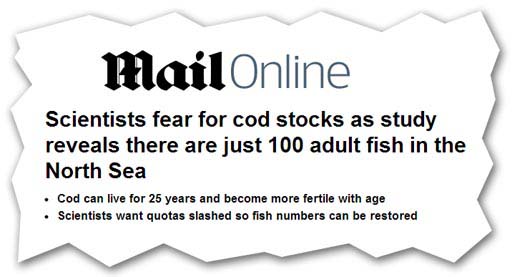 There, of course, you have the classic dog-whistle phrases, "scientists fear" and "study reveals", which is all the DM needs to make a story. It was matched by The Sun with the headline: "Good Cod!", telling us that "there are fewer than 100 mature cod left in the North Sea after years of overfishing, experts have warned". 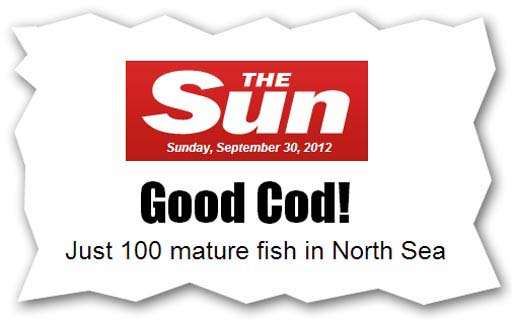 Of course, all these clever newspapers, with their skilled journalists and expensive fact-checking, couldn't possibly all be wrong … could they? Well, shortly thereafter, once Defra had issued a correction, there appeared an apology on the Sunday Times website, saying the headline over their article "over-simplifies a complex issue". But it was more than just "over-simplification". The story was completely wrong, the ministry said. "In fact we know there to be around 21 million mature cod in the north sea. Cod start to mature from a year old and are fully mature at age six". "There are a small number of cod over the age of 12 years old which has always been the case in the North Sea even when fished at lower levels in the 1950s and 1960s. Cod older than 15 have rarely been recorded in the North Sea", the ministry continued. Even the BBC then got in on the act, writing a story about how the original story had been wrong. But, as always, it missed the point. What shows up here is the sheep-like propensities of the media, and the derivative nature of their reporting. One newspaper publishes the report and the rest pile in, repeating the same inaccuracies and falsehoods without so much as a blush. And, if you are the Daily Mail, you don't even bother to issue a correction. Of course, hundreds more media outlets repeated this original story, as thousands every day repeat agency copy and plagiarise each other's stories without even the slightest hint of fact-checking. And mostly, right or wrong, the stories become part of the record, simply by dint of repetition by so many sources. Very few, like this one, are corrected. But it is good occasionally to have a fully documented example of the way the media takes in each other's washing, and so often gets it wrong in wholesale quantities. COMMENT THREAD Richard North 30/09/2012 |
Booker: the carbon tax cometh
Sunday 30 September 2012

Last Wednesday evening, according to BM Reports, we had an interesting energy mix – interesting in that the coal consumption was untypically high for the time of year at over 50 percent. Wind, incidentally, was with only providing 1.3 percent.
This sets the background for the lead piece in Booker's column this week, who warns us that the government has another massive shock in store for us with its weirdly distorted energy policy. Despite the abnormally high proportion of coal being used to keep our lights on, by next March, we learn, some of our largest coal-fired plants, capable of supplying a fifth of our average power needs, are to be shut down, much earlier than expected, under an EU anti-pollution directive. This is our old friend the Large Combustion Plants Directive, but the reason they are being hammered through their remaining quota of hours allowed by the EU is that a new UK tax comes into force next April, which aims to make fossil-fuel power significantly more expensive. In 2010, George Osborne announced his intention to impose, from April 2013, a "carbon floor price" of £16 on every ton of CO2 emitted by British industry, rising to £30 a ton by 2020 and £70 a ton by 2030. An explicit purpose of this tax is to make the cost of electricity from fossil fuels so uncompetitive compared with "renewables" that it will, in the Treasury's words, "drive £30-£40 billion" of investment into "low carbon" sources such as wind and nuclear. On paper, the effect of Osborne's new tax on our electricity bills looks devastating. Using the latest figures from the Department of Energy and Climate Change (DECC), our power plants burnt 40 million ton of coal in 2011, emitting 116 million ton of CO2. They also generated 175,000 gigawatt hours from gas, at just over half a ton of CO2 per gigawatt. At £16 a ton, this CO2 would cost £3.5 billion – on top of our total current wholesale electricity cost of some £19 billion. Thus the new impost would represent nearly 20 per cent added to our electricity bills next year, and would almost double them by 2030. Some of this, however, we already pay through the EU's Emissions Trading System (ETS), which counts towards our £16 floor price. Osborne's calculation in 2010 was that, initially, we would have to chip in less than an additional £2 per tonne to make up the £16 price. (The ETS price at that time was predicted to continue rising towards £40.) Since then, however, with falling demand due to the EU's recession, the price of EU carbon permits has fallen dramatically. Thus, to reach the initial £16 level, the Treasury says we will now have to pay nearly another £5, making our electricity significantly more expensive. But since it made that guess the EU price has slipped still further, to well under £6 – leaving a gap of £10 a tonne to be made up by Osborne's tax, rapidly rising every year thereafter. Thus, to meet that tax level in the years after 2013, we in Britain will have to pay electricity bills soaring to a level far higher than any others in Europe. And all this is to promote the building of thousands more heavily subsidised windmills, which will in turn require us to build more gas-fired power stations to provide back-up for the constant fluctuations in wind speed. These plants will then be paying Osborne's fast-rising tax on all the CO2 they emit, with the bill to be picked up by the rest of us on a scale which, within 18 years, could alone almost double the cost of our electricity. In short, the Treasury has made an incredibly damaging miscalculation. And even if there is little chance that our Energy and Climate Change Secretary, Ed Davey, could get his head round such lunacy, says Booker, perhaps someone might lay out for Osborne the bill that his delusional new tax is going to land us all with. As to the reason why people like Daley are impervious to reason, this comes in Booker's second piece, which records the latest instalment of the Great Arctic Ice Scare. Daley is a true believer, and is thoroughly imbued with warmist propaganda That we saw in spades in September 2007, when the summer melt reduced Arctic ice to its lowest level since satellite records began in 1979. Then, there were hysterical predictions that within five years, thanks to runaway global warming, Arctic summer ice would have vanished completely. Predictable, when Nasa satellites showed last month that this year's melt was about to break even that 2007 record, the same hysteria recurred. All the usual suspects, from the BBC's Roger Harrabin and The Guardian to Greenpeace and WWF, piled in to proclaim that the end was nigh. And from prof Peter Wadhams, that tireless alarmist, we got: "the final collapse… is now happening and will probably be complete by 2015/16". But then, as the sea recently began to refreeze, Nasa itself put up a video showing how a severe cyclone in early August had "wreaked havoc on the ice cover", pushing vast amounts of it into warmer waters further south where it melted. (Reuters headlined its report: "Nasa says Arctic cyclone played 'key role' in record ice melt".) A Nasa surface temperature graph has long shown that the Arctic was considerably warmer in the late 1930s than it has ever been since. Furthermore, what the warmist scaremongers always forget to tell us is that polar ice at the other end of the world has been reaching record highs in recent years. Last week, Antarctica's sea ice area was only just short of the greatest extent ever recorded at either pole. A graph on Watts Up With That, charting the combined global sea ice area over the past 33 years, shows the overall extent having remained virtually constant ever since 1979. Isn't the point about this warming that it is meant to be "global?", asks Booker – even if it's good enough for Daley, and excuse enough for Mr Osborne to double our electricity prices. COMMENT THREAD Richard North 30/09/2012 |


 Posts
Posts

