

Media: keeping up with the blogs
Tuesday 2 October 2012
 "Target 2 is the mechanism by which money is transferred around the euro area to ensure that each national central bank has sufficient euros to fund its banking system", Warner thus informs us. "Accumulated cross border claims are now so extreme", he then breathlessly goes on to say, "that they threaten to leave German taxpayers with huge losses should the euro break up, or any one of its members leaves". 
If we didn't know better, we might actually take the self-important Warner at face value. But, thanks to the miracle of the internet and Google translate, we know better than to do so. Far from the debates going on in euroland "right now" as the egregious hack would have us believe, these have been going on for many weeks.
We, after all, a mere lowly blog, picked it up on 16 August - six weeks ago – from Berliner Zeitung, which had published the detail two days earlier. That's the interesting thing about legacy hacks. They still haven't quite cottoned on to this interweb thingy, which breaks their monopoly hold over information. We now have equal access and are no longer reliant on their droppings. One of these days, they might realise it, and start catching up with the blogs. COMMENT THREAD Richard North 02/10/2012 |
EU Referendum: continental sentiment
Monday 1 October 2012
 However, it is useful to have such material for the record, even if it includes views from the unimpressive Hans Kundnani, editorial director of the German Council on Foreign Relations journal. Kundnani seems to be of the view, conveyed also by the BBC, that opinions vary on how likely or desirable a referendum would be. Some, we are told, would like Britain to stay in the EU, others consider that the country's eventual departure is all but inevitable, and a third group would positively welcome such a development. On the one hand, we thus have Alan Posener in Die Welt from 3 July, who writes under the headline, "Europe needs the Brits", telling us to forget the Franco-German axis. If the European Union wants to be a powerful force in the world, they should be inspired by the more liberal and global experience of Great Britain, he writes. On the other, we have Hubert Wetzel in Süddeutche Zeitung, writing even earlier on 7 April of this year. "Of course, a British departure would be a disaster for the Union", Wetzel says, "but with all due respect, Europe has bigger problems". Nothing of that, though, helps us understand the contemporary view of "Europe", or the consensus – if there is such a thing. And nor does it improve upon the appreciation of Julian Priestley, who asserts that the process of gradual disengagement is already under way. What we are not getting, so far, is any clue as to whether the "colleagues" are going to rig the treaty process, to allow Cameron a get-out when it comes to a referendum lock. Whether they include new powers, which will affect the UK, will shape the referendum that the British government will hold. And further affirmation that we will see a referendum – whatever the colour of government - comes from the Labour Party Conference, in the shape of shadow defence secretary Jim Murphy. He says that Britain should stage an in/out referendum, once the current crisis in the economy is over and the future shape of the eurozone has become clear. Despite calls for early action, and the ritual declamations from Farage, Murphy made it plain to BBC2's Daily Politics that it would not be immediately. "I think at some point, there will have to be a referendum on the EU", he said, adding: "I don't think it's for today or for the next year, but I think it should happen". However, this is not by any means just a British question. A recent Harris poll carried out in Francehad almost two in three respondents (65 percent) calling for the next EU treaty to be put to a referendum. The future of the EU may thus may lie in a referendum but it is not necessarily in the hands of the British. After the Germans, who have already expressed their desire for a referendum, there will be the French people to satisfy, and they may not be easy to please. COMMENT THREAD Richard North 01/10/2012 |
History: a People's War
Monday 1 October 2012
 Bognador, is a Research Professor at the Institute of Contemporary British History, King's College London and is writing a history of Britain in the 20th Century, so his offerings are of some interest, and especially his item 9 on the Second World War, of which he says: From June 1940 to June 1941. Without our heroic resistance, Europe would, Churchill predicted, have entered a new Dark Age. It changed the dynamic between leaders and troops. Field Marshall Montgomery asked a soldier to name his most important possession. The man said: "My rifle". Montgomery replied: "No. It isn't. It's your life and I'm going to save it". Such humanity by leaders led it to be called The People's War.What leaps out of the page is the claim on the "People's War", which is complete rubbish – a total re-write of the entire social history of that period. That particular phrasing emerged to some prominence during the second half of 1940, and was a major theme during the TUC annual congress in Southport of that year. It was then that Labour cabinet ministers were accused by union bosses of not doing enough to make the conflict a people's war, a "war fought for the people by the people". Previously, the term had been given considerable prominence by J B Priestley, in his Sunday "postcript" talks, which had also cemented it in the left-wing iconography, distinguishing it from the Tories' unpopular "bosses' war", made for spivs, capitalists and profiteers. The reason why it was a people's war, of course, was because it was at one the first "total war", which involved civilians as much as the military, and it was also an industrial war, where factory output had as much, if not greater influence on the outcome than military victories. Because of the left-wing connotations, right wing authors (and Churchill himself) have tended to play down the people's contribution in their post-war histories, as we saw in the Battle of Britain. Their vital role has largely been airbrushed out of the narrative, with the focus on the elites. But then to pretend that the term "People's War" emerged as a reflection of the "humanity" by leaders such as Montgomery is utterly bizarre. If Bognador really believes that, then he has no claim to the title of historian. If he doesn't, then his description is cynical beyond belief. Either way, it is so wrong that it is the sort of thing that you could only find in the pages of the Daily Mail, the newspaper which, before the war, was a great fan of Hitler, with its proprietor Lord Rothermere supporting Oswald Mosley and the National Union of Fascists. One can only reflect though, that if this is the sort of thing that Bognador was teaching Cameron at university, it is not surprising the prime minister has such a poor grasp of history. COMMENT THREAD Richard North 01/10/2012 |
Greece: a coup averted – a crisis defused?
Monday 1 October 2012
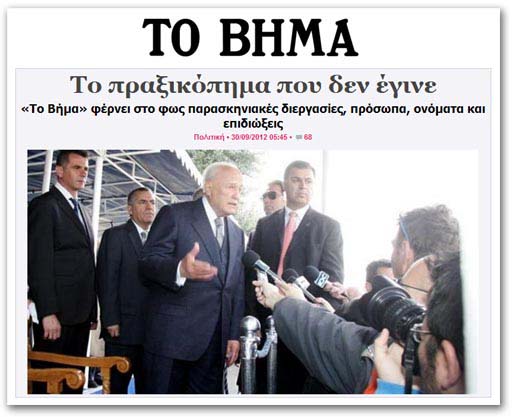
Played big yesterday in the Greek newspaper To Vima (Tribune) is the claim, under the headline, "the coup that never was", that on 1 November last year, then premier George Papandreou fired the Greek Armed Forces chiefs of staff to forestall a military coup.
We picked this up at the time, having speculated that a coup was in the offing, at a time of maximum instability, when anything seemed possible. Says To Vima, Papandreou's government never explained convincingly the surprise retirement of the entire leadership of the Armed Forces. But, it says, "authoritative sources" now assert that the move prevented political destabilisation and averted a coup. The coup would have been engineered by "ultra-nationalist patriotic officers" to restore the honour of Greece and to save the country from impending civil strife, the paper says. But, as suspicions hardened, the final decision to force the Service chiefs to stand down was taken at dawn on Tuesday 1 November. The unexpected resignations had been preceded on 26 and 27 October by Papandreou at the European Council, agreeing the second rescue package – which had been regarded as a "betrayal" by many in the armed forces and elsewhere. In Thessalonika, defence minister Panos Beglitis had been insulted at an official ceremony, and attacked by protestors, amongst whom had been members of the armed forces. On National Day, 28 October, there had then been riots in Thessalonika. A parade had then to be cancelled after the right- and left-wing protesters had condemned president Karolos Papoulias as a "traitor". Predictably, the current chief of general staff, Michalis Kostarakos, and one of the generals who was promoted last year, completely denies the story. "Such claims are totally unfounded and an insult to Greek armed forces", he says. The politicians, meanwhile have other fish to fry, after the news last week that dozens of their number, including the Speaker of the parliament, are under investigation for corruption. Before this is all over, therefore, some may regard last November as a missed opportunity. But, given the tensions at the time, and the certainty that many had – including this blog – that Greece was going to drop out of the euro, a failed coup may well be seen in retrospect as a turning point. Currently, Greece is expecting to be given its next tranche of €31 billion bailout funds without too much drama - even though it may not meet the reform criteria. And, although some media sources have hyped the latest round of street protests, the estimated 50,000 in Syntagma Square last week was only a tiny fraction of the numbers seen in earlier demonstrations. By contrast with the rage elsewhere, in Madrid, Lisbon and even Paris, Athens has been relatively calm. Thus does the New York Times report, after an interview with Greek premier Antonius Samras, that, "There is absolutely zero risk that Greece is leaving the euro". His message to his fellow Greeks is to keep the faith and that better days lie ahead. "What I am telling you", he says, "is that there is hope". With even the German opposition agreeing to the possibility of a further bailout, not for the best part of three years - as we come up to the third anniversary of the start of the crisis - have we heard such confident words. Whisper it softly for fear of being mocked, but the worst may well be over for Greece. COMMENT THREAD Richard North 01/10/2012 |


 Posts
Posts

