

Media: keeping up with the blogs
Tuesday 2 October 2012
 "Target 2 is the mechanism by which money is transferred around the euro area to ensure that each national central bank has sufficient euros to fund its banking system", Warner thus informs us. "Accumulated cross border claims are now so extreme", he then breathlessly goes on to say, "that they threaten to leave German taxpayers with huge losses should the euro break up, or any one of its members leaves". 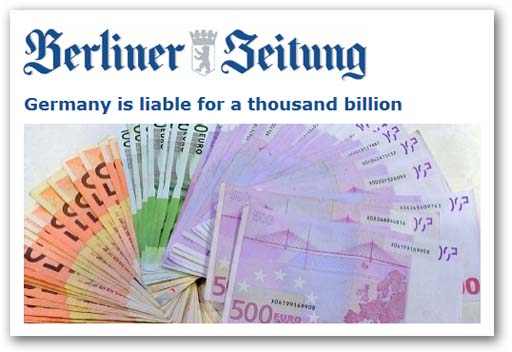
If we didn't know better, we might actually take the self-important Warner at face value. But, thanks to the miracle of the internet and Google translate, we know better than to do so. Far from the debates going on in euroland "right now" as the egregious hack would have us believe, these have been going on for many weeks.
We, after all, a mere lowly blog, picked it up on 16 August - six weeks ago – from Berliner Zeitung, which had published the detail two days earlier. That's the interesting thing about legacy hacks. They still haven't quite cottoned on to this interweb thingy, which breaks their monopoly hold over information. We now have equal access and are no longer reliant on their droppings. One of these days, they might realise it, and start catching up with the blogs. COMMENT THREAD Richard North 02/10/2012 |
EU Referendum: continental sentiment
Monday 1 October 2012
 However, it is useful to have such material for the record, even if it includes views from the unimpressive Hans Kundnani, editorial director of the German Council on Foreign Relations journal. Kundnani seems to be of the view, conveyed also by the BBC, that opinions vary on how likely or desirable a referendum would be. Some, we are told, would like Britain to stay in the EU, others consider that the country's eventual departure is all but inevitable, and a third group would positively welcome such a development. On the one hand, we thus have Alan Posener in Die Welt from 3 July, who writes under the headline, "Europe needs the Brits", telling us to forget the Franco-German axis. If the European Union wants to be a powerful force in the world, they should be inspired by the more liberal and global experience of Great Britain, he writes. On the other, we have Hubert Wetzel in Süddeutche Zeitung, writing even earlier on 7 April of this year. "Of course, a British departure would be a disaster for the Union", Wetzel says, "but with all due respect, Europe has bigger problems". Nothing of that, though, helps us understand the contemporary view of "Europe", or the consensus – if there is such a thing. And nor does it improve upon the appreciation of Julian Priestley, who asserts that the process of gradual disengagement is already under way. What we are not getting, so far, is any clue as to whether the "colleagues" are going to rig the treaty process, to allow Cameron a get-out when it comes to a referendum lock. Whether they include new powers, which will affect the UK, will shape the referendum that the British government will hold. And further affirmation that we will see a referendum – whatever the colour of government - comes from the Labour Party Conference, in the shape of shadow defence secretary Jim Murphy. He says that Britain should stage an in/out referendum, once the current crisis in the economy is over and the future shape of the eurozone has become clear. Despite calls for early action, and the ritual declamations from Farage, Murphy made it plain to BBC2's Daily Politics that it would not be immediately. "I think at some point, there will have to be a referendum on the EU", he said, adding: "I don't think it's for today or for the next year, but I think it should happen". However, this is not by any means just a British question. A recent Harris poll carried out in Francehad almost two in three respondents (65 percent) calling for the next EU treaty to be put to a referendum. The future of the EU may thus may lie in a referendum but it is not necessarily in the hands of the British. After the Germans, who have already expressed their desire for a referendum, there will be the French people to satisfy, and they may not be easy to please. COMMENT THREAD Richard North 01/10/2012 |


 Posts
Posts

