

EU politics: the games they play
Monday 19 November 2012
 Thus, since we are now seeing a week when David Cameron goes to Brussels to throw his weight about for domestic consumption, Ed Miliband has to keep pace and come up with some "robust" ideas of his own. So it is that this absurd man is calling for "major reforms of the European Union to make it work properly for Britain". Smile if you must, but this includes the budget, immigration policy and "rules banning national governments from helping business" – all the dog-whistle stuff that keeps Conservative leaders so entertained. Then, on the Beeb , we have shadow foreign secretary Douglas Alexander saying his party "could still be pro-European and argue for reform". This also puts Labour firmly alongside the Tories, so that there is not a smidgin of difference between them. The ploy is all so predictable that you can write the script for Miliband. One thing you can't do is take him seriously. They are taking us for fools. We are seeing classic party political maneouvring, all leading to an end game where the parties attempt to park "Europe" and get back into their comfort zones with their "schools 'n' hospitals" agendas". Meanwhile, Tory politicians are also doing their own manoeuvring. David Davis is suggesting a two-part referendum, first offering for approval a list of powers that we want repatriated, and then a second poll offering the choice of approving the deal negotiated or getting out. One suspects that the "colleagues" might call his bluff if Mr Cameron tried this, refusing to negotiate and thus leaving the government high and dry, stuck with a referendum where "out" was the only serious option. And this is why, of course, why it will not be offered just yet. Mr Cameron will try to get away with a promise of renegotiation followed by a referendum, some time after the general election. Now, very much as expected, that also looks like Miliband's direction of travel, with both leaders hoping this will be enough to slay the UKIP dragon. Possibly, though, something so transparently cynical might even further alienate voters, to the extent that the "UKIP effect" keeps the Conservatives out of office at the general. However, UKIP is not the immediate problem for Mr Cameron. We learn that EU officials have begun work on plans for a multi-annual budget that does not require UK approval. This could be seen as reinforcing the dynamic where, as we have previously reported, the "colleagues" might be quite happy to see the back of the UK. On that basis, the outcome of the budget negotiations this week could be Cameron creeping back from Brussels this week, able to convince only the British media that he has scored a "victory", while actually suffering a humiliating defeat. But then, since he is more concerned to play to a domestic audience, that won't matter. The games, for the moment, are more important than the reality. COMMENT THREAD Richard North 19/11/2012 |
EU Referendum: and yet another poll
Sunday 18 November 2012
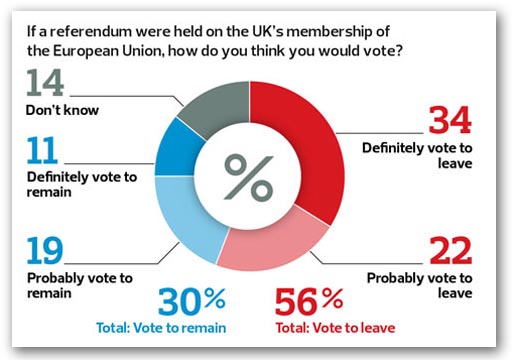 As an adjusted figure, removing the "don't knows" from the equation, that gives us a 65-35 percent split, giving the outers a 30 percent majority. That is slightly better than the last poll which gave us a 63-37 percent split and, while it is interesting, it is probably not yet sufficient to guarantee a win, should we be given an "on-out" choice. A margin of about 35 percent is probably the safe minimum. Even then the figure is almost certainly very soft, as the bulk of the vote comes from the Conservatives. They split 68-24 percent in favour of leaving. Given an "renegotiation" option, this cohort would probably vote tribally, and given a Conservative government support for renegotiation, we could see the "out" vote collapse. Nevertheless, the results are sufficient to invoke an editorial having the Observer squawking about the dangers of leaving.
A complete exit, it says, will be a disaster at every level. Britain's mass car industry would head to low-cost countries that have remained in the EU, and much other manufacturing, such as Airbus, would follow. The financial services industry would be regulated on terms set in Brussels and be powerless to resist.
British farmers, who had "prospered under the Common Agricultural Policy", would find "they become dependent on whatever mean-spirited British system of farm support that replaces it". Farms will survive by industrial farming, devastating the beloved English countryside. Tax avoidance and evasion would reach crippling levels as our economy becomes increasingly wholly owned by foreign multinationals that make tax avoidance in Britain central to their business strategy. This is very useful as an indicator of what sort of propaganda we might expect from the europhiles, and Readwald offers some counter-arguments. However, while some of the europhile claims are indeed nonsense, for a variety of technical reasons, our manufacturing output could be hard hit if we failed to negotiate a sound exit agreement. This is why, of course, it is vital to promote a negotiated exit based on an Article 50 settlement, tied in with membership of the EEA and the nationalisation of all unadopted EU law and secondary treaties. That way, we can affirm that the day after leaving the EU nothing will have changed. The main effect our departure would (and should) be to allow us to commence the careful process of transition from being an EU member to full independence – and also to work towards more democratic governance in the UK. Thus, if the europhiles are going to work on the fear factor, we have all the answers. Given a hearing, we can reassure people that there is no down-side to leaving. But, we are going to have to fight for that hearing, especially if any "no" campaign is hijacked by a "false flag" operation. In this basis, we are thinking in terms of the Harrogate Agenda bidding to become the official "no" campaign leader, making sure that the fear factor is removed. COMMENT THREAD Richard North 18/11/2012 |


 Posts
Posts

