

EU politics: misreading the signs
Friday 2 November 2012
 This is based on the BBC's political programme, "Question Time" - which only hardened masochists now watch – having had David Miliband break off from his wealth-creation activities to answer a few questions about the Party line. "What you have got", says our David, "is a repositioning in the Labour Party - not to go from being pro-Europe to anti-Europe but to take on this idea that to be pro-European you are always for more spending". He then adds: "We are not always for more spending. We are for a more effective European Union". Thus you can see that the two sides, Tory and Labour are lining up to give voters a real choice. Mr Cameron's Party wants spending restraint in the EU, and Mr Miliband's Party wants a "more effective European Union". But there is a more subtle issue issue here – one which the BBC could hardly have picked up, as an organisation which struggles to tell the difference between "Europe" and the "European Union". In fact, what we are seeing is the classic convergence of the political classes, where there is nothing between them on the substantive issues, reinforcing my contention that we no longer have left-right politics but above the line and below. The split is no longer vertical but horizontal. This is certainly the case with Miliband, a Labour politician who "earned" £416,000 last year from his outside interests, on top of his £66,000 salary as an MP, turning in a lamentable performance in Parliament, all on top of the £170,000 expenses, the second-highest claim for MPs in the North East and Cumbria. The convergence on "Europe", however, serves a fundamental need for the Westminster parties. None of them want to fight a battle over the European Union, which might have the public better understanding the issues. Thus, as the Conservatives move very slightly on the issue, the Labour Party has to realign its own policies, to stay in step. This is exactly what is going to happen over the referendum. At some time prior to the general election, Mr Cameron is going to make a promise of sorts, and this is going to be matched shortly thereafter by Labour, as the Party keeps in step - so avoiding any possibility of debate over the issue. Thus, at a political level in Westminster, there is only one real policy – to stay in the EU. Outside Westminster and the politico-media bubble, the below-the-line policy is withdrawal. And that is why the BBC will never notice. Its people are so far out of touch with the reality that they are incapable of understanding what is going on. COMMENT THREAD Richard North 02/11/2012 |
EU politics: Europe for the Europeans
Thursday 1 November 2012

I happened on this cutting recently (above), as one does, from the Catholic Herald archives. It is dated 1 November 1940 – exactly 72 years ago to the day … but sort of relevant in the light ofyesterday's debate.
In terms of timing, the Catholic Herald article comes in the wake of the Italian invasion of Greece, whence in the name of "European Solidarity", we are told that the primary aim of the Axis Powers consists not in conquering the whole British Empire east of Suez piece by piece, "which is impossible". The real aim - understood throughout the continent - "is to win strategic victories and seize strategic points such as Egypt and Gibraltar, and possibly Iraq". This, though, is merely “the stage for setting up a grand council of European solidarity to force peace on Great Britain”. The whole tone of Axis propaganda, says the paper, is now moving along these lines of "Europe for the Europeans without British interference". Following in the footsteps of Witterings from Witney, who has already trawled Hansard, and offered his views on the debate, I must do likewise and refer to the remarks of Mark Hendrick, Labour MP for Preston. A europhile to the hind teeth, he has recently been to Berlin and, fortified with that experience, expresses his fears that Mr Cameron "will isolate himself even more" if he attempts to veto the EU budget settlement. This actually tends to confirm that which we have been saying for months, that the mood amongst the "colleagues" is of some antagonism towards the UK, brooking no interference in their move towards further integration. One might even say that the policy is now moving along these lines of "Europe for the Europeans without British interference". What comes round goes round. Last time, though, we ended up (with a little help from the United States), invading Europe and joining the Common Market (with a little help from the United States). With George Osborne saying: "We'll only do a deal if it's good for Britain", what are we going to do this time? Certainly, we are not going to take Europe by storm this time - not with Nick Clegg ridiculing David Cameron's plan for repatriating powers as a "false promise wrapped in a Union Jack", dismissing it as "nonsensical" and "wishful thinking". Perhaps when the "colleagues" start saying openly again "Europe for the Europeans", Mr Cameron will take the hint and put in his papers for an Article 50 withdrawal. COMMENT THREAD Richard North 01/11/2012 |
Energy: Dellers speaks on wind
Thursday 1 November 2012
Over at the Daily Telegraph. His optimism is infectious, but perhaps a tad unrealistic. There has beenno change in coalition policy, and there is not likely to be one in the near future.
COMMENT THREAD Richard North 01/11/2012 |
UKIP: missing targets
Thursday 1 November 2012
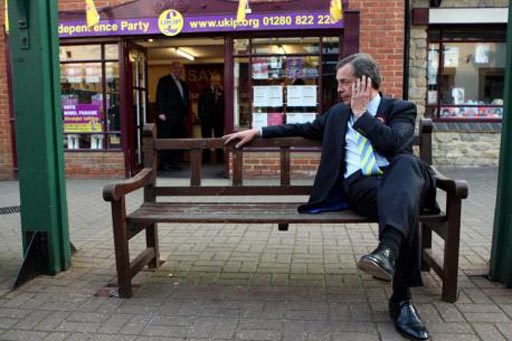 Generally speaking, I actually tend to write less about Farage than I should – in deference to the many active UKIP members, who have their hearts in the right place, and who deserve better than the lacklustre Party leadership with which they are saddled. My basic premise here is that if you have nothing good to say, then say nothing at all. However, I should not resist commenting on Farage's plans (or lack of them) for the 2015 General Election, as revealed in the article. Says Farage to Northern Echo reporter Mark Tellentire, "The pace of change over the past two years has been so great, it is difficult for me to see exactly where we are going to be in 2015". So far, that is fair enough but, if Farage has been qoted correctly, he then goes on to say: "But if the Conservative and Labour leaderships decide they will ignore Ukip's messages, then goodness knows what we can do". In commenting on this, one could easy become prey to accusation of taking it out of context, but the thrust of his what he says fits with the way Farage thinks and thus the way UKIP behaves. The point, thus, is that any proper political party would be addressing its "messages" to the voting public, for it is they whom they need if they are to get a sniff of power and the insides of ministerial limousines. But young Mr Farage speaks of Ukip's messages not to the people but, "to the Conservative and Labour leaderships". There, we get a brief glimpse into the very soul of UKIP – it is not a political party. It started off its life as a pressure group, and that – under the leadership of Farage – is what it remains today. Sadly though, the Conservative and Labour leadership will decide to ignore Ukip's messages, and thence we get the highly revealing glimpse into Farage's soul: when they do, as they have always done, he doesn't know what to do. Ten years ago when, every month, I used to sit across a desk from him, in our office in Strasbourg, he didn't know what to do - other than stand for any and every passing election. Now despite his publicity describing him as "Britain's most charismatic, plain-speaking politician", he still doesn't know what to do. Coming to Newcastle, therefore, was not the right thing for Farage to do. He is not the first politician to have done so and foundered. But at least his predecessors had some ideas. He has none of any worth. The only way he survives, of course, is because his political rivals are equally bereft. But the people of Newcastle – if they hold true to their political traditions – will be unimpressed. In olden days, he would have gone away empty-handed. That may still happen. The Northeast remains the only English region without a Ukip MEP. COMMENT THREAD Richard North 01/11/2012 |


 Posts
Posts

