

Booker: pollution and other affairs
Sunday 9 December 2012
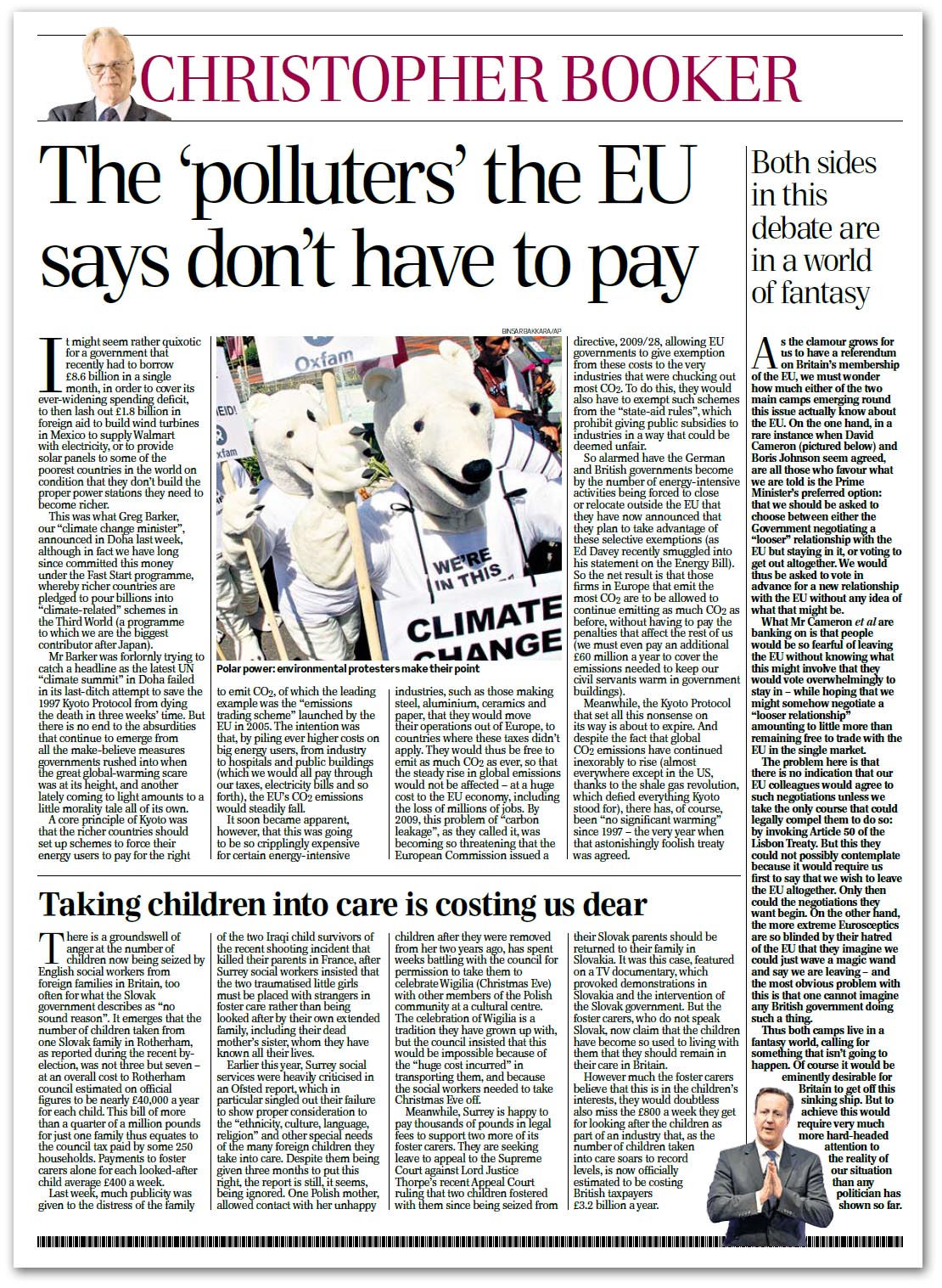 And the third story also breaks in ground well-tilled by this blog. Booker here notes that, as the clamour grows for us to have a referendum on Britain's membership of the EU, we must wonder how much either of the two main camps emerging round this issue actually know about the EU. This is an extremely pertinent observation for, in the light of David Cameron and Boris Johnson seeming to agree on the way to deal with "Europe". Both favour the idea that we should be asked to choose between either the Government negotiating a "looser" relationship with the EU but staying in it, or voting to get out altogether. What would happen her is that we would thus be asked to vote in advance for a new relationship with the EU without any idea of what that might be, with Cameron et al relying on people being so fearful of leaving the EU without knowing what this might involve that they would vote overwhelmingly to stay in. This, of course, is based on the promise that we might somehow negotiate a "looser relationship" amounting to little more than remaining free to trade with the EU in the single market. The problem here is that there is no indication that our EU colleagues would agree to such negotiations unless we take the only course that could legally compel them to do so: by invoking Article 50 of the Lisbon Treaty. However, says Booker, this they could not possibly contemplate because it would require us first to say that we wish to leave the EU altogether. Only then could the negotiations they want begin. On the other hand, the more extreme Eurosceptics are so blinded by their hatred of the EU that they imagine we could just wave a magic wand and say we are leaving – and the most obvious problem with this is that one cannot imagine any British government doing such a thing. Thus both camps live in a fantasy world, calling for something that isn't going to happen. Of course it would be eminently desirable for Britain to get off this sinking ship. But to achieve this would require very much more hard-headed attention to the reality of our situation than any politician has shown so far. That piece, though, was written before the Peterson interview, with neither of us knowing that the Secretary of State for Defra was going to come out into the open. Although Paterson stopped shot of recommending Article 50, we can see the direction of travel. Sooner of later, it must dawn on even the europhile politicians that this is the only reliable way of obtaining a "new relationship" with the EU. Perversely, the main blockage may well become what Booker calls the "extreme Eurosceptics", blinded by their hate and unable to respond to strategic necessity or think tactically. The thing is, immediate withdrawal from the EU is a very attractive option, but it simply isn't real world politics. Yet, while invoking Article 50, with all that that entails, may not be clean and simple, it does give us what is probably the only certain way of achieving a break. How ironic it will be then if the fantasists from either or both camps actually block this option and end up keeping us in the EU. And it the extremists ever prevent the Article 50 option happening, one might wonder what their real agenda really is. Do they really want to leave the EU, or it the gravy train too attractive. COMMENT THREAD Richard North 09/12/2012 |
Eurocrisis: muddling through
Sunday 9 December 2012
Whisper it softly for fear of being mocked, but the worst may well be over for Greece, I wrote on 1 October .
[T]he eurozone may be in crisis but there are still signs of hope, argues Huw Pill, Goldman Sachs' chief European economist, in today's Telegraph. A combination of economic, financial and political factors therefore serves to reinforce our expectation that the euro area will continue to muddle through, rather than progress towards resolution, he adds.
I guess we weren't so very far out.
Richard North 09/12/2012 |
UK politics: the Paterson interview
Saturday 8 December 2012
 As secretary of state for Defra, he is only too well aware that, in his department alone there are 40,000 pages of environmental regulations that originate somehow in the European Union. "You can’t just chainsaw them", he says. "You would still need laws to regulate the health of farms and the safety of abattoirs". This is a man who tells us his views on Britain and the EU are well known. He is counted among those around the Cabinet table who would opt for the exit. Furthermore, he genuinely holds that position, and has done so for many years, arguing that "we'd do a lot better if we made a lot more laws locally in our own Parliament". Paterson also has a better idea of what is happening than many. He points to what is going on as a result of the euro crisis: the EU is forging ahead with integration as a way of saving the single currency and the European project. Far from Britain leaving the EU, it will be the EU leaving Britain, he says. "If in order to resolve the Euro crisis there has to be this new arrangement that’s effectively creating a new country … from which we're excluded, [then] we want to get our country back which means making our laws in our own Parliament".
That is the nub of the issue. It is why it makes sense to wait a little until the fog over the Channel clears and we can see the shape of the new entity. That will tend to polarise public opinion here, and make it more likely that independence would be acceptable to the majority.
If we had a referendum now, Paterson believes ,we could well lose it. He prefers instead to pursue was his department's audit of EU competences, consultation on which was launched two weeks ago. This is the first time we have ever looked at how we are governed in this country, he says, the results of which he is sure will shape the future debate on the EU. That "we want our country back", Brogan writes in his piece, is a phrase that will echo loudly with all those who have been clamouring for David Cameron to give the British people a chance to do just that in an "in-out" referendum.
The Prime Minister is due to set out his thinking in a major speech in the next few weeks. Paterson, argues that the British public feel dangerously isolated from the European process. "It doesn't matter how you vote, you'll still have whatever directive you don’t like imposed upon you".
Nevertheless, he stresses that the "Doomsday Book" audit of EU competences is an important step towards negotiating our exit. "Everyone talks about Europe, but this isn't Europe at all", he tells us. "This is our day-to-day government, this is how we run things". Paterson gets "fed up with the E-word" though. He declares: "This is not about Europe. This is about how we run our country on a day-to-day basis".
He looks beyond the EU and sees prospects for trade with the Anglosphere, and with the giants of China and India. The world is evolving fast, and so is the EU. Britain's relationship with the EU will evolve too. "They are going to leave us… [the Commission] has come up with a very clear plan for what is effectively a new country". Likewise, he asserts, we must come up with our own plan for how Britain will manage its own affairs when the EU does leave us, and it is that which must be put to the country. And, while he has plenty to say on the other matters for which his department is responsible, from the moment he took over at Defra, "Europe" has dominated his in-tray. And, having written alandmark study in Opposition on the Common Fisheries Policy, he is well equipped to understand the detailed technical issues. He is particularly scathing about this "disaster" that is depleting our waters and driving British fishermen out of business. If the Tories were in power alone, he would be arguing for withdrawal from the CFP. That said, the Coalition appears to be on course to secure a ban on discards by which "perfectly good fish" are dumped dead overboard because they don't count towards the quota. There speaks a politician having to deal with real-world politics. Those distant from power can readily indulge in their fantasies about repealing the ECA and walking away from the EU overnight, but in Owen Paterson, we have a minister who has taken the time and trouble to explore the practicalities involved in standing on our own two feet.
It took him two years to produce his study on fisheries and he is conscious that it would take many more years to thrash out a workable policy. And as the debate on the EU intensifies, we will be hearing more of this practical approach, making it all the more probable that this "unknown" minister will not be unknown for very much longer - even despite the Independent.
COMMENT THREAD Richard North 08/12/2012 |
EU competences: first of the many
Saturday 8 December 2012

According to Owen Paterson, this is the first time we have ever looked at how we are governed in this country (separate post to follow). "A key question for this review will be whether the benefits to the UK of protecting the functioning of the internal market justify the high level of EU competence in this area," he says.
Every department of state is to take part in the process, which is intended to "give everyone, in Government, in Parliament and the British people a far better understanding of an important part of the governance of the UK, on which to ground and develop this country's policies in relation to the EU".
With the process now having been thrown open to public consultation, the lead has been taken by Defra, Paterson's department, as one of the government bodies which is most affected by EU law. The first of four tranches is now up on the Defra website, alongside the Department of Health which is also launching its own consultation with a detailed explanation of the process (see link). The Defra tranche covers animal health, animal welfare and food safety – including feed safety, food labelling, quality and compositional standards. The next stages in the review are Environment, in the spring of 2013, and agriculture and fisheries, both in the autumn. To help the current part of its review, Defra has published a list of EU law on which it wants comment. This encompassing some 76 (by my count) statutes, ranging from Council Directive 82/894/EEC on the notification of animal diseases within the Community, to Directive 2009/54 of the European Parliament and of the Council on the exploitation and marketing of natural mineral waters. While some of the law is of a relatively minor nature, also included are major statutes, such as: Regulation (EC) No 178/2002 of the European Parliament and of the Council laying down the general principles and requirements of food law, establishing the European Food Safety Authority and laying down procedures in matters of food safety. We also see Regulation (EC) No 726/2004 of the European Parliament and of the Council laying down Community procedures for the authorisation and supervision of medicinal products for human and veterinary use and establishing a European Medicines Agency, which is a massive piece of law. Helpfully, the department produces proforma for response, which is also available as a .pdf file, the former allowing it to be completed on screen an e-mailed back to the department. However, the semi-secretive way the review has been sneaked out, and the relatively short time given for the consultation, which ends on 28 February, suggests that there are dark forces at play. Clearly, the department is not too keen on seeking maximum public participation. On the other hand, this consultation has been mailed out to a comprehensive consultation list, which will include trade bodies and NGOs, including bodies like WWF and Friends of the Earth. Most of those expected to respond will be europhile in their demeanour, and we can also expect input from the likes of the europhile Open Europe. The exercise thus presents the eurosceptic community with a huge problem. If it ignores the exercise, the bulk of the public responses, which are to be published alongside the department's report, will be strongly europhile, supporting the status quo.
There is little doubt that such responses will be fed into the debate on the future of our relationship with the EU. Thus, we really do not have an option here. To balance the argument and get the points over that we want heard, there is virtually an obligation to take part in this process. It is too important to let go by default.
COMMENT THREAD Richard North 08/12/2012 |
Climate change: what can one say?
Saturday 8 December 2012
 "At one of the sessions, Monckton assumed the seat for Burma in place of the real delegate, and addressed the hall from his microphone. He spoke for nearly a minute, before being escorted out". "He was ejected from the conference centre, had his badge revoked, and is thought to have left the country. The UN later confirmed he had been permanently barred from future rounds of the talks. Monckton did not respond to requests for comment by the loss-making Guardian. In the Guardian version of the address, Monckton told the conference: "In the 16 years we have been coming to these conferences, there has been no global warming at all. If we were to take action, the cost of that would be many times greater than the cost of taking adaptation measures later. So my recommendation is that we should initiate a review of the science to make sure we are all on the right track". He was booed and heckled by other delegates, says the Guardian script, a claim repeated by Loopy Lou in the Failygraph. However, Mr YouTube does not support this claim, once again demonstrating much attention the legacy media give to reporting the truth.
The real delegates have now gone into extra time in an attempt to reach an agreement on how to bleed even more money out of the process than they already have done.
COMMENT THREAD Richard North 08/12/2012 |
Rotherham fostering scandal: wrong targets
Friday 7 December 2012
 The piece was to have been published last Saturday, but the paper had a touch of the wobblies when it discovered that that the issue centred on the Roma community, potentially having an "anti-immigration" paper seen to be supporting a community widely regarded as the plague of Europe (some would say "dregs"). Getting round this problem by keeping the references to "Roma" well down the page, and relatively low-key, this allows Reid to take the side of the parents who had their children removed by Rotherham social services and placed in foster care. The events that transpired will come as no surprise to readers of the Booker column, where the Slovak "kiddie snatching" propensities of social services has been charted. Reid has it that seven children from one family – six from the parents and a baby daughter of one of the married offspring – have been seized by social services, in highly contentious circumstances where the council is being branded as "rascist" for picking on the family because they are Roma, and social workers disapprove of their non-British lifestyle. Whatever the merits of the social services' actions, Reid asserts, the 46-year-old father is angry at the way his children have been separated from each other by the authorities and the brutal manner in which they were removed. The last "raid" on their home saw council staff and police hustle the children into cars as they screamed for their 34-year-old mother, who was left crying in the street. Neighbours who comforted her said the scene they witnessed was "appalling cruelty to an ordinary family". The father says: "What has happened has broken my wife’s heart. She has talked of killing herself since her children were taken away. I would like to leave Britain, but I cannot desert my six children who are living in different groups with strangers". As to the foster parents, on whom Farage spilled the beans to the Daily Telegraph, although they had three children removed, ostensibly because they were members of UKIP, behind this event is another more sinister issue where, in Rotherham, fostering Roma children has become a hugely profitable cottage industry. Sue Reid actually touches on this, citing Lib-Dem MP John Hemming, who says that 500 English children of all backgrounds are taken into care each week. "Few realise how many Eastern European children are being taken away by social services", he adds. But Hemming then reminds us of one of the more important issues here: "It will be costing Rotherham Council £40,000 a year for each of the seven children they have taken in this case", he says. That is a total of nearly £300,000 a year – to "support" one family. The cost of this cannot be over-emphasised. The council taxes from the best part of 250 households are being spent on the "support" of one single Roma family. This is money desperately needed for other functions paid by a council that claims to be (and undoubtedly is) short of money. Taken as a whole, "kiddie snatching" has become a multi-billion-pound "industry" and a huge burden on the public purse. When the tentacles extend to an immigrant community which we would rather were not here in the first place – at enormous cost to the taxpayer – this surely has to be a major issue. Therefore, looking at the thrust of the story, as released by Farage, it is not untoward to say that he was pointing us in the wrong direction. And one wonders what is really going on here when the UKIP-supporting foster couple are now refusing to comment on the issue, at the behest – we are told – of the freedom-loving UKIP. As we reported at the time of the by-election, Roma immigration was the real story in Rotherham, one which Farage and now the Mail is skirting round. A secondary by nevertheless important issue is the way the public sector is turning immigration into a job creation opportunity, and thirdly, we have the scandal of "kiddie snatching".
When public funds are so tight, this is costing a whole bundle more, the bill for fostering alonereaching £3 billion a year - the same as the entire annual budget for the Metropolitan Police, the largest police force in the country.
Even now, these issues are not getting the attention they deserve, and the reporting gets harder when the family courts are tightening their grip on the flow of information, while MPs and ministers are failing to get a grip of the situation.
From time to time, I am given to asking why it is that we do not rise up and slaughter "them", those of our public officials and politicians who are so profligate with our money – and would have us imprisoned if we refuse to give it to them. As time passes, I would really would like that question addressed. The dangerous thing is that there appears to be no plausible answer. COMMENT THREAD Richard North 07/12/2012 |
EU Politics: Swiss lessons for Britain
Friday 7 December 2012
 The BBC positions this membership as "the first step towards full membership of the European Union". Had it joined the EEA, by now, it says, "Switzerland would probably be one of the more longstanding members of the EU". The article is worth reading in full, but what is interesting is the way the EEA is seen as a halfway house to EU membership. Yet this very same organisation we see as a parking place for the UK, should we leave the EU. In fact, there is no contradiction here. What can be a way in can also be a way out. Membership of the EEA is a very good way of parking the Single Market issue, neutralising concerns about trade while we attend to the serious business of extracting ourselves from the acquis. Elsewhere, we have seen concerns that EEA membership does not distance us sufficiently from the EU. That concern is well-founded. In addition to the partaking in the Single Market, members are required to subscribe to the "four freedoms", which includes open borders within the area, with its unrestricted immigration. We heard of some of the effects of that unrestricted immigration recently, during a Westminster Hall debate. There are 1.4 million EU citizens working in the UK, with 107,000 unemployed and almost half a million economically inactive. Those EU citizens have some 400,000 children. And about half of the total, currently 1,079,000, come from the so-called A8 countries, the eight central and eastern European countries that became members of the EU in May 2004. However, that is only one side of the equation. On the other side, about 5.5 million British-born people live abroad, with roughly two million resident in EU member states. Walk away from the "four freedoms" and a very large number of expats are without a home. Unravelling this mess, therefore, is going to take time and care, which makes a halfway house a sensible proposition. But, with Article 50 and the EEA, a safe extraction is doable. Nevertheless, there are those who still argue for renegotiation route, not realising that the Article 48 "revision procedure" requires a majority on the European Council before a convention can be set up or an IGC declared. In order for the UK to introduce amendments to the treaty, it needs a majority on the European Council. As to the possibility of hijacking an existing IGC – which seems to be Boris "burbling" Johnson's preference – that can't happen without the support of the Council president, who controls the agenda. Should the UK seek to impose an agenda item, it is back to a majority decision of the European Council. The renegotiation route has nowhere to go. No one should run away with the idea, though, that membership of the EEA is the final solution for Britain. Looking at the Swiss scenario, we see that since 1992, Switzerland has concluded more than bilateral 100 agreements with the EU, including one that allows the free movement of people. That is something from which we can learn. An Article 50 agreement is not the end of the story. Once we have withdrawn from the EU and repatriated the acquis, we will have a similar ability to forge bilateral agreements with the EU, and there is nothing to stop us eventually walking away from the EEA - or seeking treaty amendments. But these are not options we have to consider at this time. Nor is it going to be easy. The BBC piece, suggests that an "era of agonised decision-making may be approaching", because Brussels has told the Swiss government the EU is no longer interested in pursuing bilateral agreements. Instead Brussels wants Switzerland automatically to adopt EU law - "a suggestion which is already causing Swiss hackles to rise". But Britain on the outside would change the calculus. Bullying Switzerland comes easy to the "colleagues" – especially when so many Swiss politicians would rather be inside the EU than out. Britain would be a different proposition. And, as Switzerland found, outside the EU, its economy is healthy and unemployment is low. Unsurprisingly, the Swiss people have little enthusiasm for Brussels: barely eleven percent, outside the political clique, want membership. The way things are going, the UK won't even have that number in favour of membership. In that, we would be happy to follow in Switzerland's footsteps. COMMENT THREAD Richard North 07/12/2012 |


 Posts
Posts

