

EU politics: "fax law" – a tired old canard
Tuesday 11 December 2012
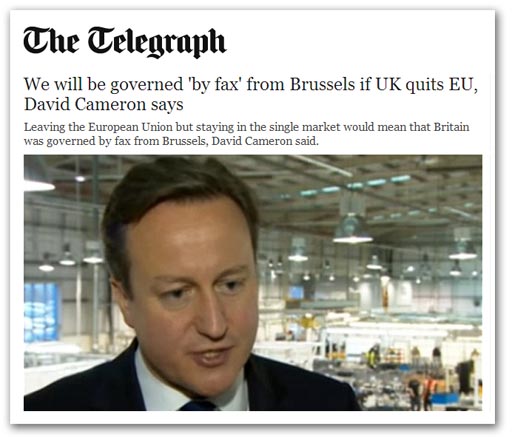
"I think it is worth understanding what leaving [the EU] would involve", says David Cameron, then offering us a completely false scenario which does nothing other than demonstrate his own lack of understanding.
Speaking to a brief straight out of the Open Europe book of lies he tells us that "there is the Norway option". "You can be like Norway", he says, "and you can have full access to the single market but you have absolutely no say over the rules of that market". Cameron was speaking at a lunch organised by the Parliamentary Press Gallery in Westminster saying he was in favour of staying in the EU because of its single market. But, he said, if the UK pulled out of the EU but wanted to keep the advantages of the single market it would be reduced to the standing of Norway, which has to abide by faxed orders from Brussels bureaucrats.
"In Norway", Cameron says, "they sometimes call it 'Government by fax' because you are simply taking the instructions about every rule in the single market from Brussels without any say on what those rules are".;
One despairs here at a man who cannot even show any imagination or originality. This tired old canard has been running for years, first raised by europhile Norwegian politicians who were trying to get their sceptical people to agree to joining the EU. It didn't play with them, but that doesn't stop Cameron trying it on here. He really is that lame.
It says something though, that we dealt with this in detail as early as May 2008, and we have returned to it several times, in October 2008, October 2009, in July 2012 and November 2012. EURef readers are better informed than the prime minister. Crucially, the essence of this is that most of the single market rules are negotiated at global and regional level. And, as this Bruges Group report makes clear, EEA/EFTA experts and representatives participate in over 500 committees and expert groups involved in what is known as "decision shaping". This, says the report, "is a valuable and appreciated opportunity for acquiring information and contributing to new legislative proposals at the earliest stages of policy formation". And what is decided at global and regional level - often tried into a network of intergovernmental treaties - cannot be changed. The EU simply acts as the middle-man, turning what are called "diqules" into actionable law. But, as long as we are in the EU, though, we have less control than we would like over the formulation of these "diqules".
Whether it is technical standardisation of transport requirements from UNECE, common banking rules from the Basel Committee on Banking Supervision, international food standards from Codex Alimentarius, animal disease controls from the Office International des Epizooties (OIE) – created, incidentally, in 1924 - or labour laws from the International Labour Organisation, a we usually defer to the "common position" decided by the EU when dealing with these bodies.
Outside the EU, we would regain our voice. Instead of the "common position" most often being decided by the French and Germans within the EU - and the British voice suppressed - our "say" would be improved by being expressed directly in global councils, without the "filter" of the EU.
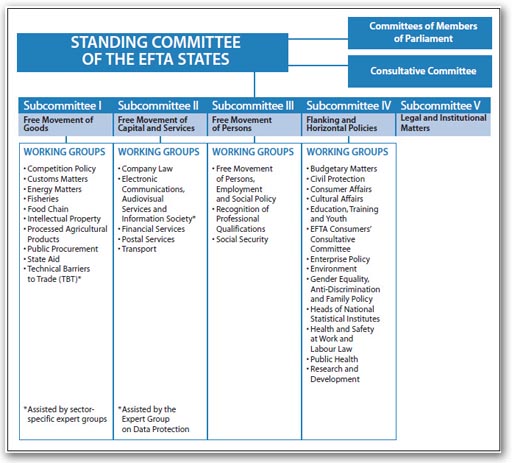 But there is even more to this than we have so far discussed. Within the structure of EFTA, which hosts the EEA agreement, there is a range of consultative bodies, including the EEA Council, three joint committees and then over 30 working groups (listed above). There is also the EFTA surveillance authority and the court. Thus, to suggest that that, outside the EU but inside the single market, the UK would have "no say over the rules" is absolutely untrue. It is grossly and completely untrue. There is an enormous network of discussion and consultation even withing EFTA/EEA, on a global and regional level, long before these rules ever get near a statute book. The UK would be an active part of this network. . However, this issue is clearly going to be one of the main battlefields. It is one the europhiles are milking for all they are worth, relying of the ignorance of people on how modern governance works - an ignorance shared by our own prime minister.
So far the europhiles have been allowed to make the running on this, but they must not be allowed to prevail. Mr Cameron should be ashamed for peddling such naked untruths and for displaying such ignorance and we should take every opportunity to improve his education.
COMMENT THREAD Richard North 11/12/2012 |
EU politics: the writing on the wall
Monday 10 December 2012
 That much has most certainly percolated into the higher echelons of the British government, witness the absence of David Cameron from the Nobel Peace Prize ceremony. Instead, in a remarkable gesture of contempt, the tarnished europhile Nick Clegg has been sent, ostensibly to represent the United Kingdom. In fact, he represents only himself and a diminishing band of euro-enthusiasts, none of whom can command majority support in this country. Thus, the loudest voices in the land are calling for more distance between the UK and the Union-across-the-water, with the latest contribution to come from erstwhile defence minister, Liam Fox. Speaking at RUSI, at an event organised by the europhile Open Europe, Dr Fox will reinforce his reputation as "damaged goods", stating that Britain's position should be: "Back to the Common Market", with the UK demanding a renegotiation, the results of which would be put to a referendum. In some influential quarters, the view is that Fox has not thought the issue through, and he is unlikely thus to have much effect on the continuing debate. What is going to drive that debate higher up the agenda, though, is the news that the long-awaited Cameron speech on the EU will probably be made "in the next few days". With the last European Council of the year starting at the end of the week, that might be considered unfortunate timing. However, with the EU "quartet" having issued its latest report, entitled "Towards a genuine economic and monetary union", it is getting all the more urgent that Cameron states his position. Rumour now has it that Mr Cameron is definitely moving towards an "in-out" referendum, based on a choice between a renegotiated relationship between the EU, and complete withdrawal. Still, then, the debate is being distorted by framing it in terms of "either/or" when, in fact, the most realistic choice is "negotiate and withdraw". This message, we understand, has percolated to the higher reaches of the Cabinet, although it is clear that the UKIP hierarchy is unable to come to terms with this option. The "trap" mantra continues unabated, which means that, in the longer term, UKIP will write itself out of the script. In the shorter term, though, there is little confidence in the Tory ranks that they will win the 2015 general election. It is possible that a robust speech on "Europe" by Cameron might claw back some hope, but with the prime minister embracing gay marriage and other issues inimical to the Tory Right, he is burning his bridges with some verve. Constituency activists are deserting him in their droves, with local parties in meltdown. Furthermore, bogged down with his own "renegotiation" manta, it is unlikely that Cameron will offer anything that will convince potential UKIP voters to switch to the Tories, or enthuse stay-at-home voters to flock to the polls. There is thus a distinct possibility that the "UKIP effect", combined with the Lib-Dim refusal to agree to new constituency boundaries, will see a narrow Labour win in 2015, and even a Lab-Lib coalition. In such an event, there is no doubt that the Party's treatment of Cameron will be merciless, and he will swiftly join the ranks of ex-Tory leaders. Possibly, that then open the way for a new champion of the Tory right to emerge. The pretender, Fox, is yesterday's man – as is David Davis - so we are likely to see an entirely new figure emerge at the head of the league. Unfortunately, that would mean we are looking at 2020 before we can see a serious attempt to withdraw from the EU, although this would not be very much longer than any timetable, should Cameron survive in office. The earliest one might expect an "in-out" referendum from him would be 2018. By that time, of course, anything could have happened, but considering that, on 1 January, we will have been in the EEC/EU for forty years, to have even the prospect of withdrawal within the decade is something of an improvement. And if we do then get out, it will be a delicious irony that we saw the writing on the wall on the day that the "colleagues" were preening themselves over their silly prize. COMMENT THREAD Richard North 10/12/2012 |
Light blogging
Sunday 9 December 2012
I have places to be, and will be in distant parts overnight, returning to base tomorrow. Meanwhile, Booker (and my input) has at least provoked the beast to come out of its lair, spitting and fuming.
We will return to this and other matters as soon as circumstances permit.
|


7:10PM GMT 08 Dec 2012
 145 Comments
It might seem rather quixotic for a government that recently had to borrow £8.6 billion in a single month, in order to cover its ever-widening spending deficit, to then lash out £1.8 billion in foreign aid to build wind turbines in Mexico to supply Walmart with electricity, or to provide solar panels to some of the poorest countries in the world on condition that they don’t build the proper power stations they need to become richer.
This was what Greg Barker, our “climate change minister”, announced in Doha last week, although in fact we have long since committed this money under the Fast Start programme, whereby richer countries are pledged to pour billions into “climate-related” schemes in the Third World (a programme to which we are the biggest contributor after Japan).
Mr Barker was forlornly trying to catch a headline as the latest UN “climate summit” in Doha failed in its last-ditch attempt to save the 1997 Kyoto Protocol from dying the death in three weeks’ time. But there is no end to the absurdities that continue to emerge from all the make-believe measures governments rushed into when the great global‑warming scare was at its height, and another lately coming to light amounts to a little morality tale all of its own.
A core principle of Kyoto was that the richer countries should set up schemes to force their energy users to pay for the right to emit CO2, of which the leading example was the “emissions trading scheme” launched by the EU in 2005. The intention was that, by piling ever higher costs on big energy users, from industry to hospitals and public buildings (which we would all pay through our taxes, electricity bills and so forth), the EU’s CO2 emissions would steadily fall.
It soon became apparent, however, that this was going to be so cripplingly expensive for certain energy-intensive industries, such as those making steel, aluminium, ceramics and paper, that they would move their operations out of Europe, to countries where these taxes didn’t apply. They would thus be free to emit as much CO2 as ever, so that the steady rise in global emissions would not be affected – at a huge cost to the EU economy, including the loss of millions of jobs. By 2009, this problem of “carbon leakage”, as they called it, was becoming so threatening that the European Commission issued a directive, 2009/28, allowing EU governments to give exemption from these costs to the very industries that were chucking out most CO2. To do this, they would also have to exempt such schemes from the “state-aid rules”, which prohibit giving public subsidies to industries in a way that could be deemed unfair.
So alarmed have the German and British governments become by the number of energy-intensive activities being forced to close or relocate outside the EU that they have now announced that they plan to take advantage of these selective exemptions (as Ed Davey recently smuggled into his statement on the Energy Bill). So the net result is that those firms in Europe that emit the most CO2 are to be allowed to continue emitting as much CO2 as before, without having to pay the penalties that affect the rest of us (we must even pay an additional £60 million a year to cover the emissions needed to keep our civil servants warm in government buildings).
Meanwhile, the Kyoto Protocol that set all this nonsense on its way is about to expire. And despite the fact that global CO2 emissions have continued inexorably to rise (almost everywhere except in the US, thanks to the shale gas revolution, which defied everything Kyoto stood for), there has, of course, been “no significant warming” since 1997 – the very year when that astonishingly foolish treaty was agreed.
TAKING CHILDREN INTO CARE IS COSTING US DEAR
There is a groundswell of anger at the number of children now being seized by English social workers from foreign families in Britain, too often for what the Slovak government describes as “no sound reason”. It emerges that the number of children taken from one Slovak family in Rotherham, as reported during the recent by-election, was not three but seven – at an overall cost to Rotherham council estimated on official figures to be nearly £40,000 a year for each child. This bill of more than a quarter of a million pounds for just one family thus equates to the council tax paid by some 250 households. Payments to foster carers alone for each looked-after child average £400 a week.
Last week, much publicity was given to the distress of the family of the two Iraqi child survivors of the recent shooting incident that killed their parents in France, after Surrey social workers insisted that the two traumatised little girls must be placed with strangers in foster care rather than being looked after by their own extended family, including their dead mother’s sister, whom they have known all their lives.
Earlier this year, Surrey social services were heavily criticised in an Ofsted report, which in particular singled out their failure to show proper consideration to the “ethnicity, culture, language, religion” and other special needs of the many foreign children they take into care. Despite them being given three months to put this right, the report is still, it seems, being ignored. One Polish mother, allowed contact with her unhappy children after they were removed from her two years ago, has spent weeks battling with the council for permission to take them to celebrate Wigilia (Christmas Eve) with other members of the Polish community at a cultural centre. The celebration of Wigilia is a tradition they have grown up with, but the council insisted that this would be impossible because of the “huge cost incurred” in transporting them, and because the social workers needed to take Christmas Eve off.
Meanwhile, Surrey is happy to pay thousands of pounds in legal fees to support two more of its foster carers. They are seeking leave to appeal to the Supreme Court against Lord Justice Thorpe’s recent Appeal Court ruling that two children fostered with them since being seized from their Slovak parents should be returned to their family in Slovakia. It was this case, featured on a TV documentary, which provoked demonstrations in Slovakia and the intervention of the Slovak government. But the foster carers, who do not speak Slovak, now claim that the children have become so used to living with them that they should remain in their care in Britain.
However much the foster carers believe that this is in the children’s interests, they would doubtless also miss the £800 a week they get for looking after the children as part of an industry that, as the number of children taken into care soars to record levels, is now officially estimated to be costing British taxpayers £3.2 billion a year.
BOTH SIDES IN THIS DEBATE ARE IN A WORLD OF FANTASY
As the clamour grows for us to have a referendum on Britain’s membership of the EU, we must wonder how much either of the two main camps emerging round this issue actually know about the EU. On the one hand, in a rare instance when David Cameron (pictured below) and Boris Johnson seem agreed, are all those who favour what we are told is the Prime Minister’s preferred option: that we should be asked to choose between either the Government negotiating a “looser” relationship with the EU but staying in it, or voting to get out altogether. We would thus be asked to vote in advance for a new relationship with the EU without any idea of what that might be.
What Mr Cameron et al are banking on is that people would be so fearful of leaving the EU without knowing what this might involve that they would vote overwhelmingly to stay in – while hoping that we might somehow negotiate a “looser relationship” amounting to little more than remaining free to trade with the EU in the single market.
The problem here is that there is no indication that our EU colleagues would agree to such negotiations unless we take the only course that could legally compel them to do so: by invoking Article 50 of the Lisbon Treaty. But this they could not possibly contemplate because it would require us first to say that we wish to leave the EU altogether. Only then could the negotiations they want begin. On the other hand, the more extreme Eurosceptics are so blinded by their hatred of the EU that they imagine we could just wave a magic wand and say we are leaving – and the most obvious problem with this is that one cannot imagine any British government doing such a thing.
Thus both camps live in a fantasy world, calling for something that isn’t going to happen. Of course it would be eminently desirable for Britain to get off this sinking ship. But to achieve this would require very much more hard-headed attention to the reality of our situation than any politician has shown so far.


 Posts
Posts

