

UKIP: not up to the job
Saturday 29 December 2012
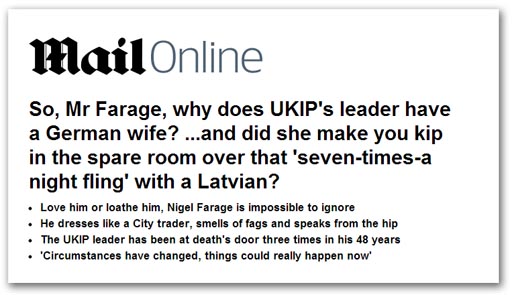 One might thus question the judgement of Farage and his press team in allowing such a travesty to be published. It may play well with his fans, but its portrayal of Farage as the "Jack-the-lad" can do nothing to attract voters looking for a serious politician with workable policies. However, even when the message is totally under the control of the party, as in this seasonal message on YouTube, we don't get a much more coherent picture. Farage, for instance, in a public utterance on Article 50, displays little of the tactical acumen than one needs of a successful party leader. The test of this – and the evidence of failure - is in the way that the media, when looking for serious discussion on EU issues, tend to treat Open Europe as the "go-to team". Farage is "good for a larf", and jokes about "Latvian mistresses", but no one in their right mind would ask for his analysis on an EU exit plan. For those of my readers who observe that I have "issues" with Farage should thus note that, in 1999, the objective for UKIP was to acquire a degree of gravitas that was hitherto lacking in the Party. Compare Farage's speeches then, with his most recent "rants" and the difference in strategy immediately becomes apparent. The schism which then developed was entirely the result of differences in strategy. It became clear to some of us that, in order to progress the eurosceptic cause, we would need a structured, fully developed and realistic exit plan. But it was not to be. And now, when we so desperately need clear directions, Farage is interviewed about Latvians and Open Europe is asked about withdrawal options. Sadly, the lesson Farage has never learnt is that it takes more than an affinity for booze, fags and wenches to get us out of the European Union. The British public will need good, hard reasons, and reassurance that withdrawal is feasible without causing irreparable damage to the economy and our international relations. Therein lies the ultimate failure of UKIP. A political party must have a coherent vision and – expressed in modern parlance – a "route map". Furthermore, the vision must be a positive one, ideas that can offer people hope of a better world, in a way that captures the imagination. In these vital respects, UKIP has nothing to offer. UKIP's absence from the field of battle, however, does not remove the need for both exit plan and a vision. But what the Daily Mail has done today is illustrate, unequivocally, that Farage is not up to the job of providing either. That, I suppose, is some small service. Now we must press on without him. COMMENT THREAD Richard North 29/12/2012 |
EU politics: a message to the dark side
Saturday 29 December 2012
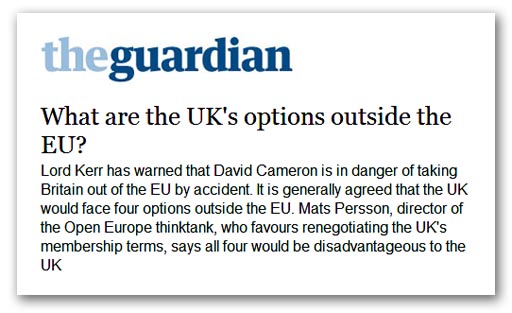
Judging from the output of the loss-making Guardian over the least few days, an EU referendum is a thing to be dreaded – purely on the basis that we are going to have to suffer the tedium of europhiles offering the same stale, tired arguments for EU membership that we have heard so many times before.
So far, we have a fairly good handle on their tactics, and they are all so predictable that one is tempted to go to sleep and wake up nearer the time, when the fight has picked up a bit of pace. However, there is one new tactic we need to watch, and that is the recruitment of Open Europe as a "false flag" operation, offering a europhile pitch in the guise of a "moderate" eurosceptic operation. It should come as no surprise, therefore, to see the EU-loving Guardian giving space to Open Europe's Mats Perrson, to tell us that the UK would face four options outside the EU, and "all four would be disadvantageous to the UK". Perrson then indulges in the classic "straw man" technique of presenting distorted views of each option, starting with the EFTA/EEA (Norwegian) option, which he classifies as "the worst of all worlds … it would literally be: not in the EU but run by it". Bluntly, this makes Perrson a liar – a thoroughly dishonest apparatchik, sucking up to his paymaster, Lord Leach, to spread disinformation in a manner that would have made Goebbels proud. We get nothing of the basics - just sheer propaganda which demonstrates that Open Europe has joined the dark side. Fortunately, though, Perrson's lies are in the Guardian, read mainly by those whose sympathies already rest with the EU, so the damage done is limited. However, one can expect to see more of Perrson as the campaign hots up. He will be much in demand as an aid to wrecking any "no" campaign. On the other hand, we seems to have recruited an unlikely ally in the form of Jacques Delors who acknowledges that Britain could leave the European Union and enter into a different sort of partnership with the EU. "If the British cannot support the trend towards more integration in Europe, we can nevertheless remain friends, but on a different basis", says Delors, actually suggesting " … a form such as a European economic area or a free trade agreement". Perrson notwithstanding, the EFTA/EEA option is very far from being in the EU, and as a halfway house towards a complete exit, it could be the ideal way to ease ourselves out of the EU with minimum disruption. Given that the Delors suggestion would require us to invoke Article 50, there is nothing to stop us seeking a time-limited membership of EFTA/EEA, with break options – say – at five year intervals. Furthermore, with the UK in EFTA, it would become a very different and much more powerful organisation, which could then seek to renegotiate the EEA agreement. One other issue that could also be explored is the possibility of other EU members joining us. With the UK out of the EU, we could even see Ireland, Denmark, Sweden (where hostility to the euro is atrecord levels), Finland and the Baltic states following in our wake. The point here is that the EU itself is set on altering its own geometry, creating its inner zone and an "outer circle". We have no need to accept this second class status, and can use Article 50 to define a relationship with the EU and, as Delors, indicates, remain friends. Here, there is one thing for certain. As long as we remain in the EU, we can never be at ease. To progress, we must leave. That is not only in our interest, but in that of all the other members. Continued membership, with or without the fabled "unicorn" option (renegotiation), is simply not real world politics. COMMENT THREAD Richard North 29/12/2012 |
EU politics: rolling out the scare
Friday 28 December 2012
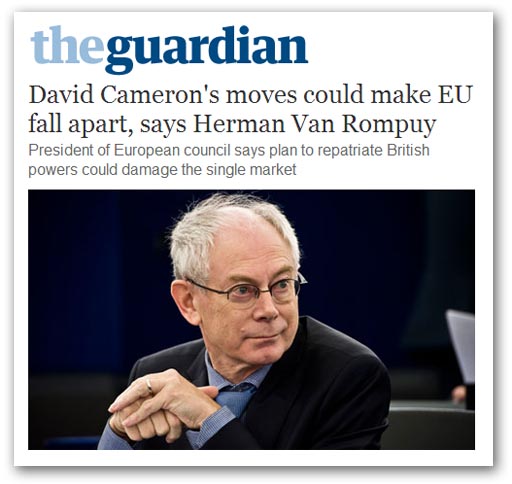 A little while ago, we identified a three-legged europhile strategy - "renegotiation-reform-scare". The three legs are intended to blunt calls for a referendum or blur and confuse the issues so that any result is indecisive. And Van Rompuy is doing the scare bit for us. All the same, there is probably a little more subtlety to his game, which is probably also designed to detach the UK from any potential allies. After all, if the core "colleagues" are seen to be picking on the UK, or driving Cameron into a corner, he will attract a sympathy vote. But if everything is sweetness and light, Cameron is positioned as the bad boy, "isolated" in Europe. That suggests we can add another leg to the europhile tactics, making it a four-legged stool. We can even get a four-letter acronym out of it: "RRIS", even if the components are all rather familiar. Wolfgang Schäuble, has also been recruited, to tell the Guardian that Britain would be shooting itself in the foot if a Cameron government second term resulted in the UK terminating more than 40 years of European membership. The paper also has Robert Cooper, "a leading UK diplomat and until recently one of the EU's most senior foreign affairs officials", telling us that any British attempt to disentangle itself from the EU through "repatriating" powers from Brussels would generate great rancour and recrimination. Few policymakers in the EU would be willing to do Cameron any favours, resulting in an "enfeebled, lonelier" Britain. There we have another of the classic "scare" ploy – we would be "enfeebled" and "lonelier". One weeps – but with boredom. Is this the best he can do? Nevertheless, Cameron is being left with little room for manoeuvre. Van Rompuy highlights his problem, for any significant renegotiation would require a new treaty. "The treaties allow a considerable degree of flexibility and much can be done without needing to amend them," says Van Pompuy. "It is perfectly possible to write all kinds of provisions into the treaties, but amending them is a lengthy and cumbersome procedure needing the unanimous agreement of every single member government and ratification". On the other hand, there is europlastic Andrea Leadsom, front-lady for the thoroughly europhile Open Europe having her rather stale "Fresh Start" group promise next month to publish proposals for a renegotiation. Leadsom is still locked into the idea that the "colleagues" will trade UK approval of "their" treaty changes for concessions on UK demands. But it is one thing adding more integration to a treaty built for integration. It is quite another reaching into it to break it apart. And there lies the mountain Mr Cameron has to climb – he needs the unanimous agreement of every single EU member to bring home the renegotiation bacon, which he ain't going to get, while the fairy Leadsom is his ball and chain, bleating (if balls and chains can bleat) for the very thing that isn't on offer. The way out for Mr Cameron is, of course, Article 50, but it will take more courage than he has ever shown to exercise that option. But when he finally realises he has nothing left, perhaps even he may see that this is his way out. COMMENT THREAD Richard North 28/12/2012 |
EU politics: why integration must fail
Thursday 27 December 2012

The article referred to proposals for full-blown integration which pre-dated the last-ditch attempt by Churchill (with the aid of Jean Monnet) in June 1940, aimed at forestalling the collapse of France. However, the whole of my story was based on secondary accounts, without any primary sources.
Browsing though the National Archives, though – as one does – I have come across bundles of documents, comprising over 1,000 pages, which provide a comprehensive record of Anglo-French relations between 1939 and 1940. One of the most interesting though is this one - CAB/85/18 - relating to the "Interdepartmental Committee on Post-War Anglo-French Collaboration". The purpose of bringing some extracts from these documents to light is that they have considerable relevance to the ongoing debate on our membership of the European Union. On the agenda then, back in early 1940 was the prospect of a Customs Union – the very thing at the core of the European Union – and this was explored by Sir Arnold Overton in a memorandum dated 9 May 1940, studying the implications of an "Act of Association between the United Kingdom and France". His comments are equally relevant to us now, as he observes: … an Anglo-French Customs Union would be beset with many serious political and administrative difficulties … a pooling of Customs revenue would probably be involved, requiring an agreed division of receipts between the two Governments, or at all events some kind of inter-Governmental financial adjustments which would link the budgetary finances of the countries together. But as finances are the key of general policy, so to speak, we should inevitably be brought very near, at least, to a fusion of the two Governments. It is believed that there us hardly a single instance on record of a Customs Union between two or more States, each of which retained political autonomy. Either one member is so small as to be politically inert or a mere satellite of its larger partner, or else political unification has followed.Also being considered was a common currency and there another official made an observation with which we are only too familiar, that "a common currency had never been possible historically without a common Government". Then followed on note from Lionel Curtis who wrote of "composite systems" such as treaty alliances. That they are highly unstable as compared with sovereign states is a fact, he stated: A state exists wherever the people living in a definite area are organised under one authority which claims a right to demand unlimited sacrifices from each individual in the interests of all the others in that area, and when also that claim is sufficiently recognised and obeyed by enough individuals to enable it to be enforced against all in the area.Lincoln called this factor "dedication" and it is this readiness of the more public-spirited citizens to obey a claim to unlimited self-sacrifice, and also to make less public-spirited citizens also obey it, that is the root of sovereignty, Curtis added. It enables one authority in the state to override all other authorities in the last resort. It enables that authority to make decisions, and make them in time. He went on: The doctrine that the state can be based on compact (a treaty) in any shape of form is the master fallacy of political thought. It is of all illusions that which has brought most suffering to civilised man. Compact is based on a balance of interests. It is bilateral or multilateral. The interests on which it is based shift and change like a bed of sand under moving water. What Lincoln called "dedication" is unilateral, and, because the claim to unlimited loyalty of each to all is not subject to change by changing events, it creates a stable system. It is a bed-rock compared with the shifting sands of balanced self-interests. Attempts to create stable political systems by compacts between sovereign states must from their nature fail.Such words, communicated to the Secretary of State for Foreign Affairs (Lord Halifax) on 21 May 1940, set out the reasons why, more than 70 years later, the European Union must fail. It inevitably involves political unification but it can never attract the "dedication" of the people. It can never demand and nor will it ever get the unlimited sacrifice of its "citizens. Thus, the idea that the EU can replace the sovereign state is indeed a "master fallacy of political thought" and those who believe it has a stable future are deluded. The European Union must fail – because of its very nature. The sovereign state is the only political entity which can provide stability. COMMENT THREAD Richard North 27/12/2012 |


 Posts
Posts

