

EU politics: Cameron – stale and out of touch
Friday 4 January 2013
 He promises in that oh-so-patronising way of his to give us "a real choice" over relations with Europe, but then, twitching a strategically-placed veil, he tells us that we will have to wait until his speech later this month to see if an "in-out" referendum is on the cards. Something of the direction of travel is nevertheless evident from the discourse, which took place on BBC Radio 5 Live earlier today. Then, he said it was "perfectly reasonable" that as the EU had asked for treaty changes to make the single currency work effectively, so it was right that the UK could ask for changes in its relationship with the EU. Lodged in his brain, therefore, is the renegotiation scenario. The man is still convinced that he can hijack an IGC and impose his agenda on it, asking the "colleagues" to unravel the treaty just for the benefit of the United Kingdom. This, Cameron evidently believes, "will demonstrate very clearly that it is the Conservative party at the next election that will be offering people a real change in terms of Europe and a real choice about that change", then conceding that any renegotiation would be "tough". Pursuing his usual line, he then says that it is not in Britain's national interest to withdraw and no longer be "round the table writing the rules", adding: "I don't think it's right to aim for a status like Norway or Switzerland where basically you have to obey all the rules of the single market but you don't have a say over what they are". So here we go again, the same old discredited "fax law" meme, with the prime minister not having changed his position one iota from when he last offered this canard last month (other than, mysteriously, to add Switzerland to his list).  What we now see though is that this is morphing into a "top table syndrome", where Cameron, afflicted by delusions of grandeur, appears to show that his main concern is to sit at the banqueting table with the "colleagues", rather than seek a sensible solution to the EU question. This simply isn't good enough, and it provides further evidence that David Cameron is both badly advised, and out of touch. In this internet age, you have to be faster on your feet and more responsive to public opinion, which is often better informed than the wonks in the Westminster bubble. The "lack of influence" lie has now been thorougly discredited and, although only a small number of blogs have taken part in the exercise, our combined readership is well over 100,000 a month. We have lodged our rebuttals in multiple posts, the latest coming from Witterings from Witney. These posts are permanently on the internet as searchable assets and, if Mr Cameron persists in asserting that which is patently untrue, he risks looking flat-footed and even stupid – at best. At worst, he stands charged, as WfW would have it, of being "disingenuous", a "liar" and "guilty of misleading the public". He may get away with it for now, but this is going to be a long and bitter debate, and Cameron can ill afford to be caught out perpetrating untruths, as indeed he will be, again and again. Whether he is lying or just ill-advised makes no difference. The effect will be the same. Before he delivers his speech in the next few weeks, therefore, he needs to move out of his comfort zone and realise that the politico-media bubble no longer holds the monopoly on the flow of information. Much of his audience is better informed than he is: Boiling Frog and Autonomous Mindare already on the case. If Cameron peddles rubbish, he will be called out, and very quickly indeed. Much is at stake here, and Mr Cameron – rightly – believes that the contents of his forthcoming speech will have a significant effect on his electoral prospects. But if he treats us with the same disdain that he gives to the facts, the speech will backfire on him. It will do nothing but confirm that he is not to be trusted. Taking us for fools is no longer an option. He must up his game, or lose it. COMMENT THREAD Richard North 04/01/2013 |
EU politics: the immigration card
Friday 4 January 2013
 That much is very similar to what we were seeing in 1975, when the media piled in behind the Government to support Britain's continued membership of the (then) Common Market. Forty-plus years later (when we expect to have our next referendum), things will not be quite the same, as we now have the experience of the "benefits" of membership, one of which has been unrestricted immigration from accession countries. Thus, even the europhile Economist is not able to maintain a wholly optimistic front, currently reporting concerns over the Balkans and the abuse of the asylum system. Recently, there has been a surge in numbers, especially from Serbia and Macedonia. Says theEconomist, in 2009, before visas were lifted for them, 9,860 of their citizens applied for asylum in the EU. In 2012, with incomplete data to October, the figure stood at 33,530. Serbians in Germany made 10,412 applications and Macedonians 6,012. Serbs topped the list of asylum seekers there, well ahead of Afghans and Syrians. Soon we are to see a new wave of Romanians and Bulgarians, with potentially half a million immigrants from those countries landing in the UK after this year. The threat was enough to spark a debate in Westminster Hall recently, and there is no disguising the concerns. In the UK there are now almost 1.1 million eastern Europeans from the original "A8 accession countries" and another half million would be most unwelcome. But there is an even bigger threat in the offing, as turmoil in Syria puts pressure on the Greek borders. Nearly 100,000 immigrants were arrested while trying to cross from Turkey in 2011, and despite the erection of a new border fence, the authorities are seeing seemingly endless waves of illegal immigrants taking to small boats in order to reach the European Union.  With this and other stress points, we can be assured that immigration will become a referendum issue in a way that it did not become in 1975. The prospect of further migration could well be a pivotal factor, driving voters into the "out" camp. Perversely, any temporary deal along the lines of EEA membership will not solve the immigration problem, as "freedom of movement" is very much part of the Single Market package that goes with the EEA. Furthermore, with an estimated two million British citizens resident in EU countries, we are not in a position to exclude nationals from other EU member states, without causing serious disruption to the lives of our own expats. Many of those retain voting rights in the UK and, with the resident immigrant population, their votes could tilt the balance in a referendum. This notwithstanding, the highest immigration of any ethnic group into the UK comes from India, beating the Irish, the Polish and even Pakistanis. Non-EU immigration will be used by the europhiles as evidence that immigration from EU members states is of lesser significance, although even migration from this sources is significantly affected by EU law. Especially significant is Directive 2003/86/EC on family reunification, which accounts for 17 percentof UK immigration. Significantly, permits for non-EU families as a percentage of total legal immigration in 2011 amounted to 13 percent. The problem here, though, will be that family reunification is a right recognised in the European Convention of Human Rights, which presumably would continue to apply even if we leave the European Union. Unless there is an explicit commitment to abrogate this convention, leaving the EU will not resolve anything. And that epitomises the broader issue. As Norway has found, being outside the EU does not automatically solve the "immigrant problem". Domestic law, and the elimination of "pull" factors, such as an over-generous benefit system, have an impact on inwards migration, while some of the issues have to be dealt with on a global level, with the United Nations centre stage. Thus, while immigration might become a major issue in any forthcoming referendum, the issues are not straightforward, and there are arguments on both sides of the divide. A post-EU policy needs to be devised and it is moot, in the shorter term at least, whether departure from the EU, per se, will afford any relief at all.
At best, leaving the EU will be only one of a package of measures that will enable us eventually to regain control of our borders. In any campaign, therefore, we need to manage expectations, or the immigration "card" could backfire on us.
COMMENT THREAD Richard North 04/01/2013 |
EU politics: desperation takes over
Friday 4 January 2013
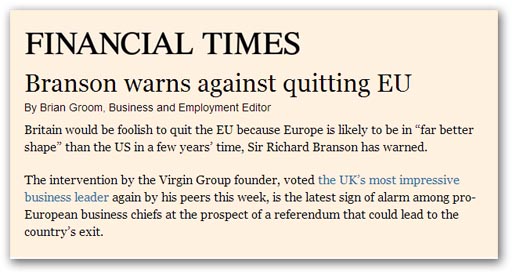
Getting so far down into the barrel that they are not so much scraping the bottom, as breaking through to the floor beneath, the Financial Times dredges up Richard Branson, for their latest scare on how terrible it would be to leave the EU.
In a way, it is rather appropriate to recruit a man who built his fortune on VAT fraud , this being an EU-originated tax. Branson, by this means, provides living proof of how the EU (or the EEC in his case) helps businesses get established. And, although governments prefer to keep quiet about this "benefit" of the EU, many other businesses have enjoyed a kick-start through ripping off the taxpayer, although not all have been as lucky as Branson. Anyhow, this ex-thief, one-time beneficiary of the "project", convinced warmist and serial loser, with a record for dishonesty, now tells us that Britain would be "foolish to quit the EU". This is because, in his opinion, "Europe" is likely to be in "far better shape" than the US in a few years’ time. With that quote safely in the bag, the FT then tells us that this intervention by the Virgin Group founder is "the latest sign of alarm among pro-European business chiefs at the prospect of a referendum that could lead to the country's exit". Put a different way though, "pro-EU business owner is against leaving EU", doesn't exactly have the same cachet. Nor is ex-thief Richard Branson really in a position to determine whether "an exit would be very bad for British business and the economy as a whole", as he avers. Not least, whether business would be adversely affected would depend on the settlement reached with the EU and, if the EEA "Norwegian" option was adopted, Richard and his fellow corporates would be entirely unaffected by a UK withdrawal. However, Branson seems to think that, because the EU was the UK's biggest trading partner, we must stay in and help rebuild it. Unless it did this, he says – demonstrating a limited grasp of logic - "Britain could be an island completely adrift in 20 years". Just to get this right, it seems the man would have us stay in to save the EU, but if we don't, one presumes the EU collapses, and we end up being cast adrift? 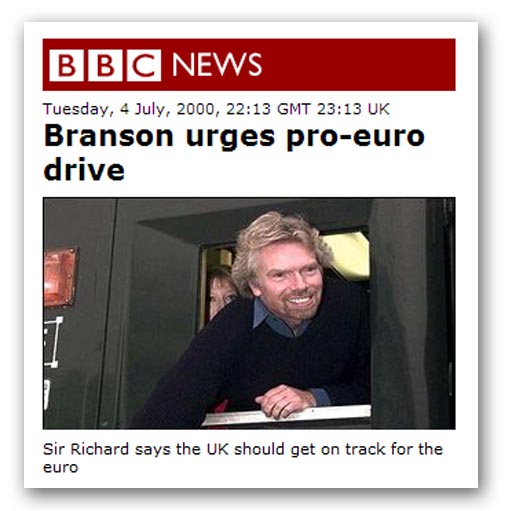 Then, this is the man who in the year 2000 urged the government to start campaigning for the single currency, warning that jobs would be lost and interest rates would be higher without signing up. "We cannot be members of the single market without being part of the single currency, the euro. We must fight the xenophobia that surrounds so much of the debate", he said.
At least the FT has the grace to admit that big business is "strongly pro-European" (meaning, of course, pro-EU, but they're a bit thick), but that self-same "big business" has been reluctant to get into the referendum debate, in part because public trust in corporate Britain is low and credibility was lost in past campaigns in favour of euro membership.
But concern has grown about backbench pressure on David Cameron to promise an in-out referendum, and now the group that so wanted to be in the euro is telling us how important it is to stay in the EU. One would think that, with his flair for marketing, Branson could then come up with something new or interesting to say about the EU, but we get the same leaden prose that we get from all the rest. "The UK must not become a peripheral country on the edge of Europe", he says. "This will be damaging to long-term prospects of British business and also in the country’s ability to attract new international companies to set up and employ people in the country", he says. "We need to be constructive. Britain needs to get together with Germany to restructure Europe", he says. "We are in a position where, if we take a positive approach, Germany and ourselves could be the key two countries to the restructure of Europe". Boring, boring, boring. It will be worth leaving just so that we don't have any longer ex-thieves pontificating about the EU. COMMENT THREAD Richard North 04/01/2013 |
Open Europe: hunting as a pack
Friday 4 January 2013

In "attack dog" mode, Witterings from Witney takes on Open Europe on its own turf, arguing the case on Norwegian "influence". And, by the time WfW had been joined by Boiling Frog, Autonomous Mind, and yours truly, plus the invaluable input of Christina Speight and others, Open Europe had nowhere to go.
Chief propagandist, Mats Persson has in the past been determined to project Norway as having "virtually no way of influencing the decision-making process [in the EU] to reflect its national interests", but the "team" now has to concede that the country does have "some" influence, although the boys and girls insist it is "marginal". What they cannot do, however – and make no attempt at doing – is to address the issue of Norway's membership of a multiplicity of international organisations, which give it a huge amount of influence, and enable it largely to dictate EU laws, at a global and regional level. Thus, even by withholding posts through its pre-moderation system, Open Europe cannot win the debate on its own blog, then failing to respond to the charge that it is the EU's lapdog. Given that you would be hard put to discern any fundamental differences between the European Movement and Open Europe, the charge is not at all misplaced, especially when the europhileProspect Magazine gives it the accolade of "2012 International Affairs think tank of the year", while sharing exactly the same ill-informed view on Norway. Given how attractive the "Norwegian option" is, at least in providing a refuge for the UK while it makes up its mind how to reorder its relationships with EU member states, one can quite see how necessary it is for the europhiles to pour cold water on the idea. But Open Europe should be different. It has masqueraded as a eurosceptic organisation. For it now to join in the fray supporting the EU is unforgivable.
Hunting as a pack, though, a quartet of bloggers and others has exposed the organisation for what it is, nothing more than a rather sad apologist for the EU that cannot even stand up its own arguments when challenged.
COMMENT THREAD Richard North 04/01/2013 |
EU politics: "stopping the cheques"
Thursday 3 January 2013
 In his piece, however, AM extends the critique to the performance of UKIP and, in particular, Nigel Farage. The issue of how we leave the EU, AM says, strikes at the heart of Farage's credibility as a politician and explains why he cannot and will not support UKIP with him as leader. He goes on to say: Farage's stated position is that the UK should simply up and leave the EU. It is what UKIP says it would do if by some quirk of fate it found itself forming a government. It is a broad stroke of a policy that utterly fails to acknowledge or address the difficulty and consequences of doing so. It demonstrates that Farage has not only failed to grasp the issues at stake but staggeringly, nay, disturbingly, that he has no coherent strategy for extracting the UK from the EU in a manner that protects this country's economic and commercial interests.Therein lies much of the problem with the eurosceptic community, for if UKIP, as the leading eurosceptic party, cannot offer a credible extract strategy, then the cause is in dire trouble. But, there is still the tendency which sees withdrawal in over-simplistic terms, arguing that all we have to do is "stop paying any money to the EU" and to "stop implementing any new EU regulations". And it is this and variations on this theme that drive the UKIP approach. Nevertheless, through AM's comments on his blogpost (and others), it is clear that the rule of law, even (or especially) in international dealings, must apply. And dealings with the EU "must fundamentally adhere to the Rule of Law", says Andy Baxter. "Failing to do so creates immediate chaos". Getting out of the EU thus demands more than Farage's brand of Jack-the-Lad, cheeky chappie punchline populism, and as long as there is a procedure set out in the treaties, which has been signed and ratified by the UK (whether we like it or not), we are obliged, at the very least, to attempt that route. This, of course, is the Article 50 negotiation process, and while the debate has raged in some quarters, Farage stands aloof from one of the most important issues of the day, devoid of sensible opinion or realistic strategy. Echoing my own words, AM states: "We have to negotiate the dotting of every 'i' and crossing of every 't' to extract ourselves from the tangled web woven over a period of decades. Withdrawal from the EU would be a serious business requiring serious people who can master fine details". So far, Farage has not shown himself in any way to be a master of detail. Thus, allowing him to hold a prominent position on the eurosceptic side of the argument in light of his ill-considered and shallow exit policy is nothing less that lethal, says AM. UKIP does not "own" this issue, and if it cannot up its game, then it should admit its own incompetence and stand aside. At the moment, it risks doing more harm than good. COMMENT THREAD Richard North 03/01/2013 |
EU politics: the European Year of Citizens
Thursday 3 January 2013
 The year marks the 20th anniversary of the establishment of the European Union Citizenship under the Maastricht Treaty and, on 10 January 2013, commission president José Manuel Barroso and vice-president Viviane Reding will join forces with Irish Taoiseach Enda Kenny and Minister for European Affairs Lucinda Creighton to open the European Year of Citizens 2013 in the Rotunda of Dublin City Hall. Over 200 citizens from Dublin will participate in an open debate with Europe's leaders on the future of the European Union. The Tánaiste (deputy prime minister) Eamon Gilmore and Irish MEPs from the region will also participate in the debate. "We need the direct involvement of citizens in building a stronger and more political Union. That is why 2013 is the European Year of Citizens – a year dedicated to you and your rights as Europeans," says Vice-President Viviane Reding, the EU's Justice Commissioner in a press release dated 23 November 2012. "Union citizenship is more than a concept. It is a practical reality that brings tangible benefits to citizens. The European Commission wants to help people understand how they can directly benefit from their rights and listen to their views about where Europe is headed. European citizens' must be able to voice their concerns and prepare the ground for future European elections. It's time we all took ownership of our common future". So there you are, you good little Europeans you. You can now rush off and join in with the "EU-wide alliance of civil society organisations" which has set itself up expressly to collaborate with the Commission on the European Year. This "European Year of Citizens Alliance" is a key strategic partner representing "civil society". I am sure that we will be only too keen to subscribe to its manifesto, putting European citizenship at the heart of the EU political agenda. You will be pleased to know that: Relying on the experience and the expertise of its members who continuously act for citizenship to become a permanent and transversal dimension of European public policies decision-making, implementation and assessment, the EYC2013 Alliance will promote activities aiming to have an impact on the building of a citizen-friendly European Union which would no longer be reduced to merely economic preoccupations and would facilitate and support various expressions and mobilisation of active citizenship. We shall accompany an EU citizenship building process which, beyond an individual rights-based approach, tackles the Europeans' sense of belonging to a common European future.Doubtless, they believe this drivel, or they would not have written it. But you can see why the "project" is going nowhere. Anyone who writes this sort of guff does not belong on this planet. But then you see the range of organisations supporting the "initiative" … European Civic Forum, European Movement International, the Social Platform, European Disability Forum, European Civil Society Platform on Lifelong Learning – EUCIS-LLL, Culture Action Europe, European Youth Forum, European Foundation Center, European Public Health Alliance – EPHA, European Association for the Defense of Human Rights – AEDH, European Women’s Lobby, Eurochild, Confederation of Family Organisations in the EU – COFACE, CONCORD, ESN – Erasmus Students Network, Association Internationale de la Mutualité – AIM, AGE Platform, European Federation of Older People – EURAG, SOLIDAR, European Association of Service Providers for Persons with Disabilities – EASPD, European Council of Associations of General Interest – CEDAG, European Federation of National Organisations Working with the Homeless – FEANTSA, Volonteurope, European Volunteer Center – CEV, Conservation Volunteers Alliance – CVA, World Association of Girl Guides and Girl Scouts (Europe Region), Association of local democracy agencies - ALDA, Central and Eastern European Citizens Network - CEE CN, Combined European Bureau for Social Development - CEBSD, European Community Organising Network - ECON, EUCLID Network, European Network for Education and Training e.V. - EUNET, Confederation of European Senior Expert Services - CESES, JEF - Europe, Platform for Intercultural Europe, European Alternatives, European Network of National Civil Society Associations - ENNA, ATD Quart Monde, ISCA - International Sports and Culture Associations, ENGSO – European Non-governmental Sports Organisation, AEGEE-Europe – European Students Forum Association, European Anti Poverty Network – EAPN, Mental Health Europe, Europa Nostra, Balkan Civil Society Development Network – BCSDN, Civilscape, European Forum of Muslim Women – EFOMW, European Citizen Action Service – ECAS.… and you can see why we have problems. COMMENT THREAD Richard North 03/01/2013 |
EU politics: Britain would vote to stay in the EU
Thursday 3 January 2013
 Mr Cameron, Rachman reminds us, has been promising a big speech on "Europe" for months (another one of this brilliant media commentators who can't tell the difference between the continent and the European Union). And Cameron's strategy for keeping the UK inside the EU, we are told by this great sage, is fairly clear. This "clear" strategy, it would thus appear, is that he is "likely" to demand a renegotiation of Britain's terms of membership, involving the repatriation of some powers from Brussels. He will promise to put the result to a referendum, in which voters will be invited to accept the new deal or quit the EU. Wearily, we learn that "the other EU members will not make a British renegotiation easy. But they will probably throw a few token concessions in Mr Cameron's direction, rather than force Britain out of the union". In any referendum campaign, the leaders of all three leading parties – the Tories, Labour and the Lib Dems – would campaign in favour of a "yes" vote. Ranged against them would be UKIP, "a party that Mr Cameron uncharitably – but not entirely inaccurately – in 2006 described as made up of fruitcakes, loonies and closet racists". The "no" campaign would also be bolstered by some of the angrier and less attractive members of the Conservative party. Faced by this line-up, the British public would almost certainly opt for the status quo – staying inside the EU. This process, Rachman acknowledges, "would strongly resemble the last British referendum on the EU in 1975", when Harold Wilson had also insisted on "renegotiating" Britain's terms of membership and putting the results to a referendum. Although the British public has become less deferential over the past 40 years, the EU has been transformed in size and purpose, and a lot has changed since the 1975 referendum, the end result, Rachman believes, is likely to be the same. And how brilliantly the man has missed the point. While he may well be accurate in his prediction for such a referendum, if it ever happens, the offer of a faux renegotiation will not get Mr Cameron successfully past the general election. And that will what he will be trying to do with his big speech on "Europe". That is its real purpose. Here, Cameron will not only be confronting a less deferential public. There is also the internet. Opinion is less dependent on the established media and there are more and better means of disseminating the truth. Thus, a promise to renegotiate will be seen by enough people for what it is, and they will rob him of his chance of re-election. For Mr Cameron to get past his 2015 hurdle, therefore, he is going to have to offer something much more imaginative. And there he is running out of options – and time. COMMENT THREAD Richard North 03/01/2013 |


 Posts
Posts

