

EU politics: hammering it out
Monday 14 January 2013

Offhand, I cannot recall a torrent of EU publicity of such intensity, running for so long, directed at the withdrawal issue. No one can say that this is no longer an agenda item, bringing the scaremongers out in full force.
Latest in the long list of recruits to these ranks is Danny Alexander, the Lib-Dem Treasury Secretary and full time europhile. But, in the considered opinion of this man, no responsible leader could "contemplate" leaving the European Union, an interesting development. You will note that the offence here is to "contemplate" – now we're not even supposed to think about leaving. It is also interesting to see how the 'philes are quick to invoke "national interest", with Alexander asserting that this – i.e., europhilia – should "trump party political difficulties". At the heart of his pitch, though, is fear. "I just think that any responsible British politician should not be contemplating British exit from the EU given how serious the consequences should be", he says. So there you are – think of the consequences, but whatever you do, don't even think of leaving. Fortunately for Cameron, he is not entirely on his own with the chief executive of the retailer Next,Lord Wolfson telling the prime minister that although the UK should remain part of the EU it had nothing to fear from being in the "slow lane". Britain should stay in Europe, he says, "but only on the right terms". We also see the British Chambers of Commerce (BCC), which represents many smaller firms, falling into line with the Cameron line, agreeing that EU membership should be renegotiated. However, coming up fast on the other side of the track is Eric Pickles, another cabinet minister whois saying that we have to up sticks and leave. This is on the back of Mr Cameron apparently deciding to reject "nuclear" proposals that are to be outlined by the Fresh Start group of MPs this week – allowing for certain proposals to be vetoed. And now we also get an intervention from George Eustice, who says of Fresh Start: "We have put forward a wishlist which we think is a helpful contribution to the debate. The government has a difficult job in deciding what it can achieve in the negotiations. Putting constructive ideas on the table is preferable to the alternative of everyone obsessing about a referendum on leaving the EU". The man, for once, isn't totally wrong, as there are still a number of Conservative MPs – Bill Cash being one – who want to see an immediate referendum, to give Cameron a mandate to negotiate. Simply, that isn't going to fly, which means that the debate is solidifying without reaching a conclusion. Some are thus arguing that we need to hammer out a change in the terms of the debate, and the vocabulary. Instead of talking about leaving, for instance, the view is emerging that we should instead be talking about "decoupling" trade from political integration. And for this, it just happens that Article 50 is the most appropriate mechanism. Unless someone can come up with such means, to break the logjam, Cameron's "Europe" speech is heading for disaster. The race is on for a magic bullet. COMMENT THREAD Richard North 14/01/2013 |
EU referendum: the sum of all our fears
Sunday 13 January 2013
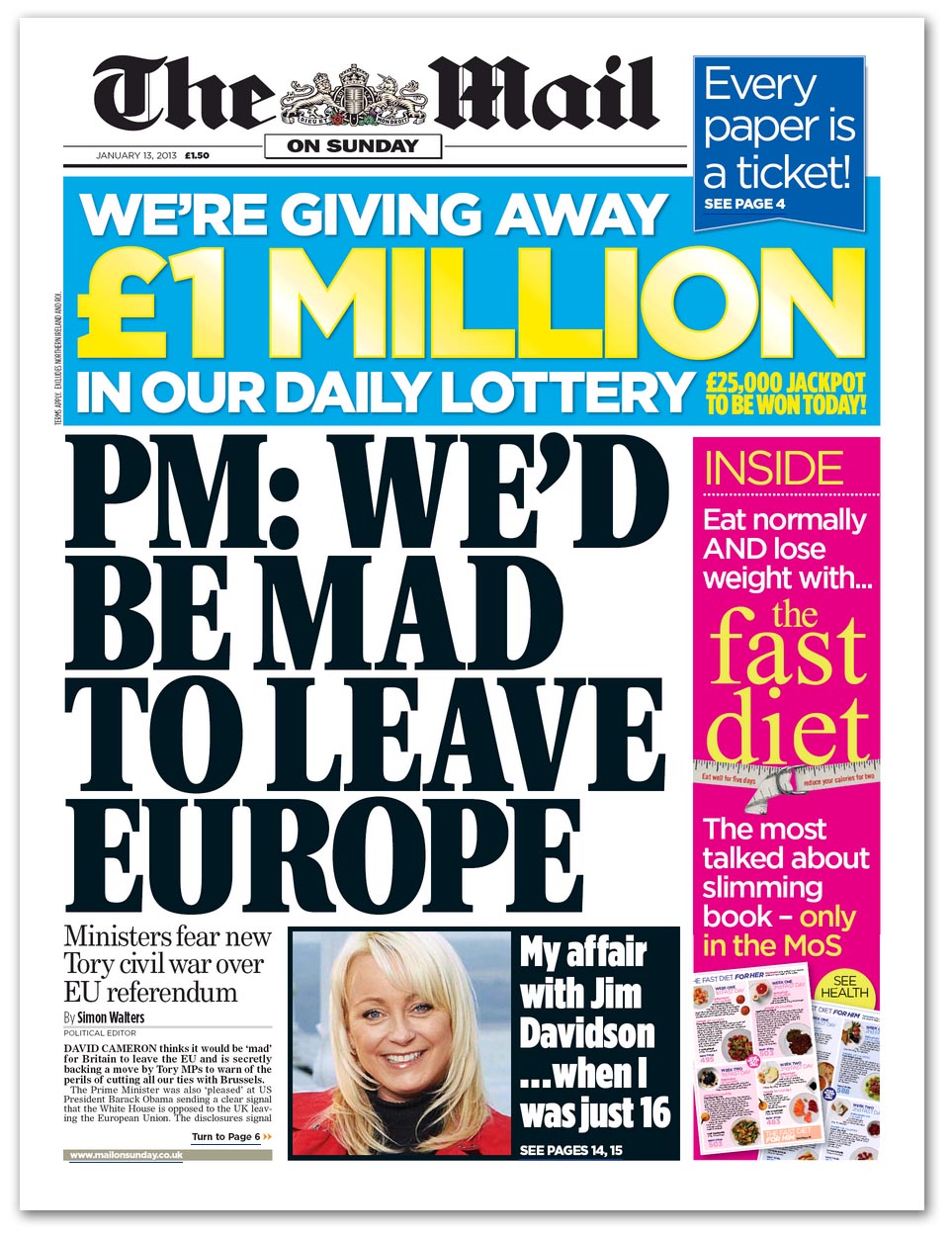 But, we might say, no one in their right mind would argue that Britain could – or even should - "go it alone", except that UKIP is arguing precisely that, with its plan to repeal the European Communities Act and then start negotiating with the EU. In this very narrow respect, Cameron is right. One can therefore see another part of the europhile strategy unfolding, alongside which UKIP is excluded from the serious debate while being exposed to knocking copy as the europhile Sunday Mirror offers details of the "ugly face" of the "homophobic" and "racist" UKIP. Meanwhile, the debate is further confused by the emergence of Swindon MP Robert Buckland, who hijacks the title of "Eurorealist" for himself. He is neither "Europhobe nor Europhile", he declares, as he rounds up around 20 Conservative MPs to publish a letter claiming that leaving the EU would cause "massive damage" to Britain economically and diplomatically. "There is a silent majority out there", he says, "who do not want Britain to leave the EU. It would be defeatist and of massive detriment to the UK and our influence would be greatly diminished, as the White House made clear". He adds: "The danger for the Tories is that because the Right-wing Eurosceptics are making the most noise, we could slide towards the exit door of the EU". What thus started as a simple question of whether we should stay in or leave the EU, therefore, is getting bogged down in a quagmire of claim and counter-claim. Loose terminology and imprecise definitions blur the edges while the lies confuse and deceive. All the time, the issue is being cast as an "economic" question, with the constitutional arguments relegated to the back burner. The "European Union" becomes "Europe" and the reality of us having been shackled to a system of government dedicated to political union has been all but completely lost. One bright note is that the push for renegotiation seems set to backfire. As it stands, Angela Leadsom et al are backing Mr Cameron into a corner, making it impossible for him to progress without making some concessions, while the "colleagues" are making it increasingly clear that they are not prepared to deal. Taking into account the latest polls, this offers some intriguing possibilities. At the moment, it is virtually a given that we would loose a straight "in-out" referendum, and is also likely that when offered a choice between a renegotiated deal and withdrawal, the majority would go for the deal. However, there the polls suggest that there is a third possibility, where the "offer" is between a failed or refused negotiation and withdrawal. In that event, the "out" proposition could well succeed. This puts Mr Cameron in an even more difficult position. He or his advisors will doubtless be aware of this possibility, which will add even more complications which he must factor into his forthcoming speech, making a referendum even more perilous. Yet another uncertainty is developing: Ed Miliband indicates that he will not follow Cameron in pledging a referendum, dismissing the prime minister's strategy as "incredibly dangerous". What is now beginning to shaping up is the classic Tory nightmare, with clear blue water between the two main protagonists, while their own party is irretrievably split over "Europe", leading to slaughter in the polls. This presents Cameron – and us all - with a lose-lose scenario. Whether he offers a referendum or not, his party splits, leaving it terminally weakened for the 2015 election, opening the way for a Labour government that has managed to avoid any commitment to a referendum. That will lock us into the EU for the foreseeable future. Probably, the only way out for Cameron is to make the weakness his strength, and go full-frontal for the exit, burying UKIP and recruiting not just part but most of the eurosceptic vote. If he then wholeheartedly made the case for a Britain outside the EU – which would not be difficult to do – this could be just enough the secure electoral victory. Sadly, there seems no way that Mr Cameron could countenance such a bold step, which means that we must suffer another five years of Labour before the EU gets back onto the agenda. And that is another price of "Europe" – the destruction of the Conservative Party. COMMENT THREAD Richard North 13/01/2013 |
EU politics: the gathering of the dinosaurs
Sunday 13 January 2013

True to form, the old dinosaurs of europhilia are joining forces to protect their precious "Europe". These are Ken Clarke and Lord Mandelson, in what the loss-making Observer calls "a historic cross-party bid to turn back the rising tide of Euroscepticism".
This is by no means the first time we have seen such cross party alliances, of course, and although this dreadful pair hardly agree on anything, they are united in their love for their common cause. Along with Liberal Democrat Lord Rennard, we are thus told that Clarke and Mandelson will spearhead a new organisation, the Centre for British Influence through Europe, (CBIE), which we have already met. It styles itself as "independent" and is set to support a cross-party "patriotic fightback for British leadership in Europe". Peter Wilding, director of the CBIE, and a former head of media for the Conservative party in the EU parliament, is fronting the organisation. He says: "Both Mandelson and Rennard are closely involved in our policy and campaign strategy. Having them with Ken Clarke on one platform, we think, says something in itself about the need for grown-up, consensual politics on Europe". It certainly does say something about the paucity of support for EU membership, when these two dinosaurs are all the campaign can find but, undaunted, Wilding goes on to say: "We would argue – and many in the Tory party would agree – that disengagement from Europe is profoundly contrary to Britain's national interests". The group claims that Eurosceptic plans for repatriation of powers are not supported by practical methods to achieve the objectives, while many proposals could be achieved by negotiating with allies within the system rather than through demands for treaty change. They also warn that an aggressive approach to reform could provoke a damaging backlash from other EU member states. COMMENT THREAD Richard North 13/01/2013 |
EU referendum: a mixed picture in the polls
Sunday 13 January 2013

An illiterate headline in the Sunday People launches a ComRes poll on voting intentions in next year's EU parliament elections. To no great surprise, 35 of those polled opted for Labour, 23 percent for UKIP and 22 percent for the Conservatives. The Lib Dems polled a dismal eight percent.
However, what is probably far more significant – pointing to the reason for the great angst amongst the Conservatives - is a finding that a significant tranche of UKIP support (37 percent of a sample size of 304) - sloughs away if Mr Cameron offers an "in-out" referendum on the EU.
This finding has Tory Diary's Tim Montgomerie commenting that, "Unless Cameron commits to an In/Out vote in his looming speech, I can't see how we are going to begin to cap the Farage phenomenon".
As to a referendum, the ComRes poll records 63 percent of its sample in favour of holding one, down from the last poll fifteen months ago when 68 percent favoured an "in-out" referendum. And, according to the poll, 42 percent would vote to stay in the EU, compared with just 33 percent intent on leaving, giving a clear majority to the "inners". Predictably, treaty renegotiation gets more support than a straight "out" option, with 42 percent in favour, compared with 41 percent in 2011. And a clear sixty percent oppose the idea of Britain joining the euro, even if the debt crisis is solved. From an Opinium poll in The Observer, though, we get a more nuanced picture, with only 25 percent of respondents believing that Cameron could claw back powers from the EU, as opposed to 47 percent who believe this unlikely. Here, the finding are more encouraging for the "outers", with the poll having 53 percent of respondents believing the UK should withdraw from the EU if Cameron could not negotiate a significant return of powers, compared with 19 percent who would want to remain in.
Despite this, Andrea Leadson and her "Fresh Start" group - supported by Open Europe - still want Cameron to renegotiate. Later this week, she will call for the repatriation of more than 130 powers which are claimed to be vital to retain "national democratic accountability", to "protect British interests and resist the rise of the EU superstate".
Nevertheless, out in the real world, the indications are that anti-EU sentiment is soft. There was, according to the Optimum poll, "a strong feeling" that people could support continued membership of the EU if it could be shown to have economic benefits. Two out of five (41 percent) agreed that being a member of the EU was a price worth paying if it benefited the economy, while only 30 percent disagreed. On general voting sentiment, incidentally, Labour are on 41 percent, the first time they have passed 40 percent since the end of October, while the Conservatives rise to 31 percent after over a month of being on 29 percent. A straw in the wind for UKIP has it dropping back to 12 percent, ending its recent surge but still putting them five points ahead of the Lib Dems, who drop to 7 percent , the lowest figure Opinium have ever recorded for the party. Real election results, however, tend to give a different picture. Altogether, on the EU front, these mixed results show there is everything to play for. Give a strong pro-EU campaign, the indications are that the europhiles could carry the day. COMMENT THREAD Richard North 13/01/2013 |
Booker: another fine Met they got us into
Sunday 13 January 2013
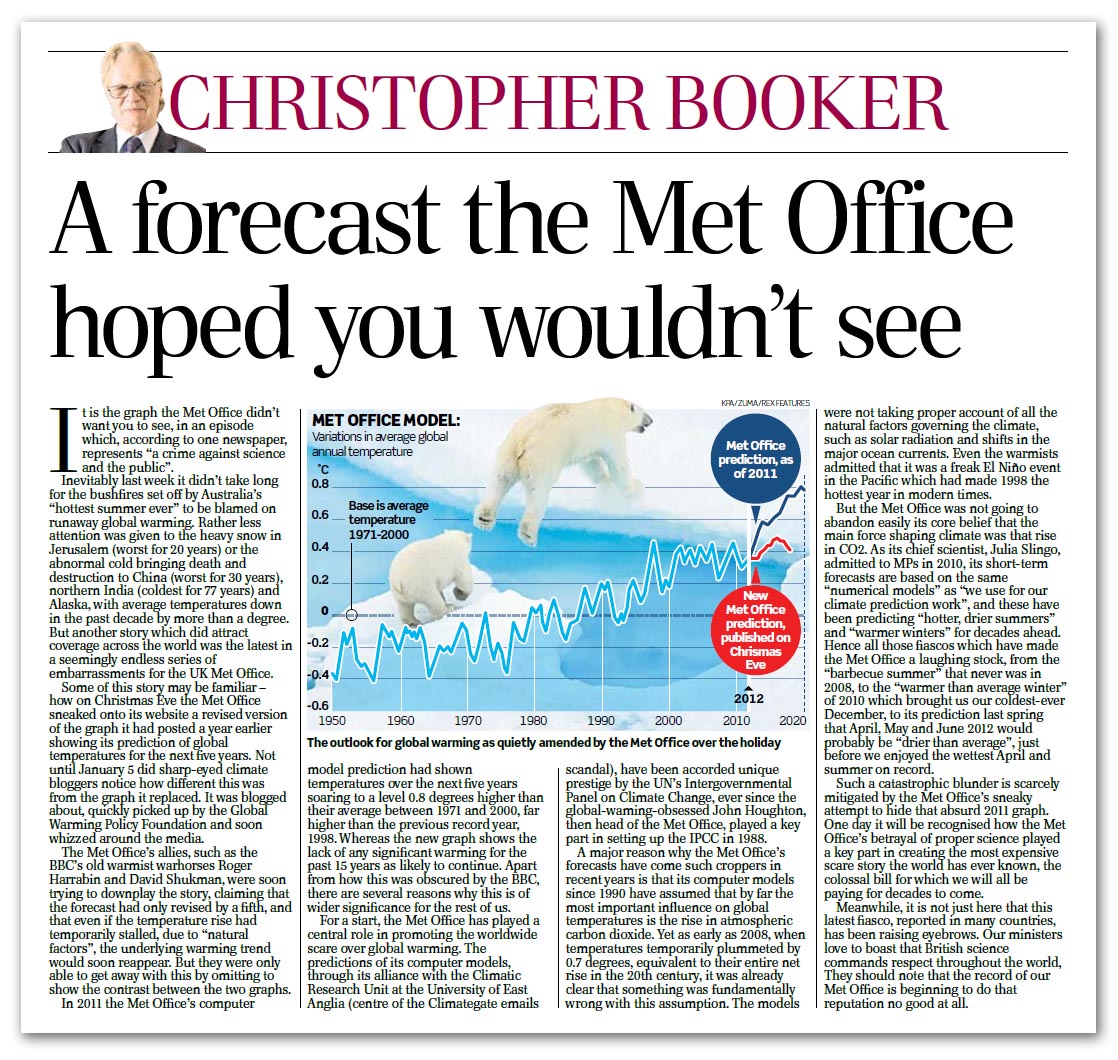
In his main piece today, Booker has a side-swipe at the Met Office and its attempt to bury bad news on Christmas Eve last, when it revised downwards its predictions for temperature increases for the next five years, displaying a revised graph to replace earlier higher predictions.
In 2011, the Met Office's computer model prediction had shown temperatures over the next five years soaring to a level 0.8 degrees higher than their average between 1971 and 2000, far higher than the previous record year, 1998. Whereas the new graph shows the lack of any significant warming for the past 15 years as likely to continue. Apart from how this was obscured by the BBC, there are several reasons why this is of wider significance for the rest of us. For a start, it is not generally realised what a central role the Met Office has played in promoting the worldwide scare over global warming. The predictions of its computer models, through its alliance with the Climatic Research Unit at the University of East Anglia (centre of the Climategate emails scandal), have been accorded unique prestige by the UN's Intergovernmental Panel on Climate Change, ever since the global-warming-obsessed John Houghton, then head of the Met Office, played a key part in setting up the IPCC in 1988. A major reason why the Met Office's forecasts have come such croppers in recent years is that its computer models since 1990 have assumed that by far the most important influence on global temperatures is the rise in atmospheric carbon dioxide. Yet as early as 2008, when temperatures temporarily plummeted by 0.7 degrees, equivalent to their entire net rise in the 20th century, it was already clear that something was fundamentally wrong with this assumption.
The models were not taking proper account of all the natural factors governing the climate, such as solar radiation and shifts in the major ocean currents. Even the warmists admitted that it was a freak El Niño event in the Pacific which had made 1998 the hottest year in modern times.
But the Met Office was not going to abandon easily its core belief that the main force shaping climate was that rise in CO2. As its chief scientist, Julia Slingo, admitted to MPs in 2010, its short-term forecasts are based on the same "numerical models" as "we use for our climate prediction work", and these have been predicting "hotter, drier summers" and "warmer winters" for decades ahead. Hence all those fiascos which have made the Met Office a laughing stock, from the "barbecue summer" that never was in 2008, to the "warmer than average winter" of 2010 which brought us our coldest-ever December, to its prediction last spring that April, May and June 2012 would probably be "drier than average", just before we enjoyed the wettest April and summer on record. Such a catastrophic blunder is scarcely mitigated by the Met Office's sneaky attempt to hide that absurd 2011 graph. One day it will be recognised how the Met Office's betrayal of proper science played a key part in creating the most expensive scare story the world has ever known, the colossal bill for which we will all be paying for decades to come. Meanwhile, concludes Booker, it is not just here that this latest fiasco, reported in many countries, has been raising eyebrows. Our ministers love to boast that British science commands respect throughout the world, They should note that the sorry record of our Met Office is beginning to do that reputation no good at all. COMMENT THREAD Richard North 13/01/2013 |
Intermittent service
Saturday 12 January 2013
We are experiencing a rash of hosting problems, out of our immediate control. Once again, we are being let down by a provider. North Jr is on the case, and we hope to have a solution soon. I am reliably informed that homicide is not an option.
Richard North 12/01/2013 |
EU politics: Cameron's strategy in tatters?
Saturday 12 January 2013
 Cameron's current strategy (or so we are told), is to wait for the expected IGC, when the "colleagues" planning to go for a treaty revision, and then hijack it with demands to allow repatriation of powers to the UK. The theory was that the threat of a veto would force the issue and give Cameron what he wanted. However, it is now "understood" that Merkel has given up on the idea of a major treaty revision for the moment, having decided that it is fruitless to push for a treaty revision in the face of strong opposition from France and elsewhere. That would leave Cameron with nowhere to go. If this is the case, though, there is nothing new. We have already reported that Merkel was not going to push for any treaty revision before her general election later this year, and a timetable for action has already been flagged up by Barroso, which delays an IGC and puts back a referendum to 2017 or 2018. What we are seeing, therefore, is The Guardian beginning to catch up with the idea that there cannot be an IGC in the immediate future. A delay of four to five years is, in political terms, sometime never. It is certainly not a bankable commitment that Cameron can put in front of the nation and expect a positive response. And adding to the sense of disarray is Georg Boomgaarden, the German ambassador to London. He is said to have rejected the idea that Britain demand a "pick-and-choose" treaty revision, again a threat of leaving. The ambassador is reported to have said, "This is really a choice between out and out … If you pick and choose you blow up the single market". Then we get Austrian Chancellor Werner Faymann launching a broadside at Cameron, accusing him of sending mixed messages when it comes to the EU. What he said depended on whether he was addressing the British people or a meeting in Brussels, Faymann told Saturday's edition of Austria's daily newspaper Standard. This is certainly stacking up against Cameron. It never was the case that renegotiation was a realistic option, although the prime minister and his supporters have clung to the idea that they could "handbag" their way through Brussels, and make enough of a show to convince the nation that concessions had been achieved. With the weakness in that strategy now exposed, Douglas Alexander, the shadow foreign secretary, is piling on the agony. He says that Cameron is risking pushing Britain towards exit from Europe, as he is not in control of the agenda. However, it remains the view in Whitehall that eurozone governance arrangements will need "greater democratic accountability" underpinned in another EU treaty, so there will eventually have to be an IGC. "Europe is dealing with an existential crisis," one British source is cited as saying. But while that may be correct, the key word here is "eventually". There is no expectation that an IGC will be some time soon. In the meantime, the europhiles are out in force, ramping up the scare, in an attempt to dissuade Cameron from taking Britain to the exit. The latest is an apparent piece of corporate blackmail, with Dave Hodgetts, Honda's job-shedding UK managing director, calling for Britain to stay "close to the heart of Europe". Hodgetts warns that the UK risks losing out if a subsequent referendum voted for the UK to leave. "It depends on what's negotiated. There would have to be a some penalty to being outside rather than inside that’s the risk I think", he says, although he does concede that Honda would accept a changed relationship between the UK and the EU if it didn't affect the competitiveness of UK manufacturers. With ten days to go before Cameron gives his speech, we can expect to see much more of this, as the europhiles make a last-ditch effort to block anything that might edge the UK towards the exit. The are even resurrecting the old warhorse Heseltine, dragging him out of the mortuary to tell us that an "ill-advised" referendum would jeopardise the UK's business prospects. "To commit to a referendum about a negotiation that hasn't begun, on a timescale you cannot predict, on an outcome that's unknown, where Britain's appeal as an inward investment market would be the centre of the debate, seems to me like an unnecessary gamble," he adds. But, with the renegotiation option seeming less and less credible, all the naysayers are doing is closing down the options. A renegotiation "sometime never" is not going to satisfy the eurosceptics, leaving the prime minister with almost no room for manoeuvre. What the europhiles do not seem to realise is that doing nothing is not an option either. Cameron must be looking for an exit plan of his own, but all we can hear is the sound of doors slamming. The sins of the past are catching up with him. COMMENT THREAD Richard North 12/01/2013 |
EU politics: BBC plugs europhiles
Saturday 12 January 2013
 That aside, one cannot help but contrast the difference in treatment between the eurosceptic UKIP, and the europhile wing of the Conservative Party. On the one hand, we have the BBC reporting onAmy Lame talking about "political oddness" – which is about as near as UKIP gets to any recent publicity. Yet, all it needs for the europhile case to be aired is for the leader of the UK Conservative MEPs, Richard Ashworth, to speak at what is labelled a "debate", this one organised by the europhileBusiness for New Europe in London. Then, he gets full-frontal treatment on the BBC website, where he is allowed to deplore the UK's "pitbull" image. Says Ashworth, according to the BBC, stridently Eurosceptic opinions give the wrong impression that Britain is one against the rest in the EU, with the BBC helpfully conveying his view that, "we're making ourselves look pretty darned unattractive" as a partner in the EU. Mr Ashworth wants to see "an evolutionary solution" to current problems, rather than "the nuclear option" of withdrawal, and asserts that a lot of nations were on the UK's side, including Sweden, Finland and Denmark. However, although the BBC styles this as a debate, its organisers actually call it a panel, with no attempt to represent a wide spectrum of views, or offer anything that could approach balance. The nearest thing one might get to the "other side" – apart from Bill Cash, whose input was not reported - was Conservative MP Andrea Leadsom, of the "Fresh Start" group. Her version of euroscepticism is that Britain "needs to be at the heart of the EU", but also "needs to articulate a new relationship" with its EU "partners". Amongst other things, Leadsom believes it would be feasible to negotiate a new "multilateral" arrangement on justice and policing with the rest of the EU, though conceded that it could be difficult. However, the BBC helpfully "balanced" this dissident view with a contribution from Lord Kinnock, former Labour Party leader and ex-commissioner. Amazingly, he attacked the Conservative drive to repatriate powers from Brussels. He doubted whether the Nordic countries, with their generous social welfare, would accept the UK unilaterally diluting workers' rights and still remaining in the EU single market. That would distort the market's level playing field, he argued. He also dismissed the idea of a special "multilateral" deal on justice and policing for the UK, saying the EU had no mechanism to do that. Such changes in the UK's relationship with the EU would have to be negotiated with the other EU countries. Now, it may well be that Farage and his party are so lightweight that their views on the European Union are scarcely worth listening to. And it is certainly the case that you would struggle to find on its website the party's views on key issues pertaining to the EU – such as Britain's membership of the EEA. But it also does seem that the only formal anti-EU political party is being grossly under-represented in the current discourse. Nor is it the case that we are hearing from any other anti-EU groups (Better Off Out springs to mind), which means there is no "debate" at all, despite the BBC purporting to be reporting on one. Much the same lack of balance is visible in the print media with, for instance, no corrective allowed to the open lies being told about Norway and influence over EU rules. The best we get, of late, is Thomas Pascoe, who is at least allowed to say that, the "constraint without influence" argument made by the "in" camp is a possible outcome of a Brexit. It is not an inevitable one. That is worth keeping in mind over the coming weeks and months. Weak as ditchwater, that's as good as it gets, with the Financial Times still pedalling the lie on Norway or Switzerland, that "both countries have to accept the rules of the club, while exercising no voice in making them". It really doesn't that UKIP has been silent on this issue, and its loudest voice has been heard most recently on gay marriage. It is all very well it seeking to convince people that it is no longer a single issue party, and has policies on a wide range of subjects, but it would be useful to hear, on occasions, what its policy on that single issue actually was. What we are getting, though, is another illustration of what it is going to be like come a referendum campaign. The voice of the true eurosceptic will be submerged in the babble, and the lies will dominate, unchecked – with the willing help of the BBC and the rest of the media. We cannot profess to being surprised though. This was always going to be the case. When it comes to arguments on whether we should leave the EU, there never was going to be a level playing field. COMMENT THREAD Richard North 12/01/2013 |


 Posts
Posts

