

EU politics: nothing to offer
Friday 18 January 2013
 One past of the mystery, however, is solved by Polly Toynbee in the loss-making Guardian. There, she refers to the 1963 "Elysée treaty that founded the EU and celebrated an end to a century of three Franco-German wars". There is something of a cottage industry in fisking Polly but, to my mind, life is too short. The only thing to do with such a profound level of ignorance is to ignore it. Witterings from Witney is right. These people have nothing to offer. COMMENT THREAD Richard North 18/01/2013 |
EU politics: they just don't get it
Friday 18 January 2013
 Today's pride of place, though, goes to Gavin Barrett in an opinion piece in the Irish Times, discussing the possibility of a British exit from the EU. Here, Barrett acknowledges that a Norway-type relationship with the EU, with full access to the single market, is conceivable. But he then goes on to write: "Norway is effectively in a 'fax union' with the EU – accepting EU regulations without any say in their shaping – as the price for single market access". So pervasive is this myth that we even have the erudition of Conservative Home poured into the problem, with no expense spared. But not one commentator, any one of which might elsewhere glibly talk about "globalisation", shows any shred of understanding of the background to this issue, and quite how important it is. The fact is that the European Union is increasingly a backwater in world affairs. Take the time out to google "global governance" and then start doing some selective searching under the sub-head "United Nations". It is quickly evident that the action is no longer regional, in tiny blocs such as the EU, but on a global scale. Then, to get an appreciation of the sheer scale of the endeavour, look to the World Forum for Harmonization of Vehicle Regulations, hosted by UNECE. Then look at a recent meeting agenda and you will be staggered by the volume of work and the amount of detail. There is no conspiracy here. The advocates and practitioners of global governance are entirely openabout their agendas. But, despite this, alongside the globalisation of trade, the globalisation of government remains almost invisible. It is almost as if people can't cope with it, and shut it out of their minds. The irony is that, by focusing on Brussels, and concentrating our energies there, we miss the bigger picture. Since the coming into force of the Lisbon Treaty on 1 January 2009, the EU assumed a legal identity. With that, we see the EU joining a huge number of international organisations, such asCodex Alimentarius, where it now represents Member States in discussions. Increasingly, therefore, membership of the European Union means that we have no direct say in global trade negotiations, while independent countries such as Norway retain their influence and have, effectively, equal status with the EU, on international bodies and in negotiations. Very much under the horizon, what is happening is that the globalists now want every country to join in a regional bloc, so that the number of delegates (and voices) can be reduced, and the "unfair" advantage that independent countries have can be removed. After all, they argue, it cannot be right that tiddlers such as Norway can have equal status with the EU and even the United States. With the compliance of their own political elites, such countries must be reined in. Unsurprisingly, therefore, globalists such as Obama would like us to stay in the EU. But that simply reflects a game the US has been playing for decades, and especially through the WTO, where it prefers to deal with trade blocs rather than messy groups of individual countries. A similar agenda drives the business corporates, who would also much rather see the world grouped into convenient blocs. Nationalism to them, is an anathema. World governance is very much their preferred option, and their view the break-up of regional blocs such as the EU with absolute horror. This, though, is where the debate needs to lie. It is invisible and unspoken because the politico-media bubble barely understands it and is frightened to talk about it. For, not only is this happening, it creates a world where not even the vestiges of democracy exist. Bizarrely, by contrast, the EU is a paragon of virtue – a blinding example of "democracy". And that illustrates just how bad it is getting. We need to wake up to the reality. We need to look at what is, and create our own agenda. COMMENT THREAD Richard North 18/01/2013 |
EU politics: speech cancelled
Friday 18 January 2013
 As the legacy media catches up with this development, public opinion is divided. One the one hand, we see this comment: Sad and distressing though the hostage situation in Algeria is it is no reason for the person supposedly leading this country to postpone a major speech - this is Cameron using it as an excuse to prevaricate. When is the next "ideal" time for this speech? He doesn't know what he is doing - can't make his mind up how to present what he wants in a way that is acceptable and has used this to buy time. I am really sorry for the poor people and their families who will be suffering but the work of government goes on.At the other extreme, we see: Brits could be being murdered all over the globe, yet the Europhobes believe that the PM should be giving a speech concerning their obsession is more important. What will they do tomorrow night when they have nothing to rant and rave about? That is their only concern - not the lives of Brits.For the moment, the situation in Algeria calls for Mr Cameron's attention, even though we have no assets in place and there is nothing specifically for the prime minister to do, other than manage expectations and handle the government publicity. One has to say that, had Mr Cameron not decided to showboat and planned to speak in London instead of Amsterdam, he could perhaps have set aside the time to speak to us on the EU. And there will be more than a few suggesting the Mr Cameron is more than a little bit relieved to have something else dominating the news agenda. In that, everything has suddenly changed. But none of the underlying issues have changed. Brutal though the Algerian siege is, in the grander scheme of things it is a relatively minor event, compared say, with the Battle of el Alamein - the toll of death and injury representing less than a week's carnage on our own roads. And, on the EU front, No 10 is as impenetrable as ever. Mr Cameron is still surrounded by the ignorant and the agenda seekers. The issues are still being misrepresented. Despite that, as a result of the delay, we still might see a different speech. We don't know. We are in uncharted territory. It's time for a rethink, to retrench, and to watch for further developments. COMMENT THREAD Richard North 18/01/2013 |
Climate change: winter warming?
Thursday 17 January 2013
 
This, was in March 2000 in the Independent, the very same newspaper which is telling us: "Don't go out! Rare red alert as blizzard heads in". Meanwhile (top), a "rare and exciting event" in our local park. We're frobbin', I tell yer, frobbin'.
Richard North 17/01/2013 |
EU politics: we should listen to these?
Thursday 17 January 2013
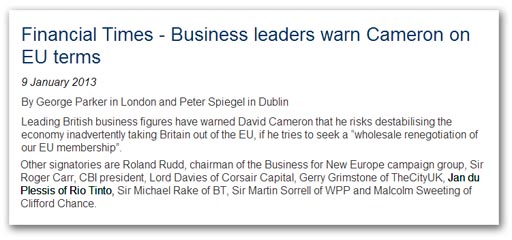
A few days ago, "leading" British business figures were warning in a letter to David Cameron that he risks destabilising the economy inadvertently taking Britain out of the EU, if he tries to seek a "wholesale renegotiation of our EU membership".
Interestingly, one of the signatories was Jan du Plessis of Rio Tinto, the self-same Rio Tinto, presumably, that has had its chief executive, Tom Albanese, stepping down today because of a $14 billion write-down on the value of assets that he helped acquire. With such towering giants of business acumen supporting the europhile cause, we can only wonder how long it is before their FUD campaign collapses and these "leading business figures", which include ex-thief Richard Branson, become the laughing stock that their political skills merit. COMMENT THREAD Richard North 17/01/2013 |
EU politics: how to lose a referendum II
Thursday 17 January 2013

Its heart is in the right place but the tactics are also wrong: "Yesterday the Prime Minister signalled that he backs a referendum on European Union membership – but not for years to come", says the paper.
"Today the Daily Express calls on him to stop the dithering and end the uncertainty", it adds. "He could secure a place in history by announcing a referendum on EU membership to be held before the next election – and then leading the campaign for withdrawal".
If we had an "in-out" referendum now, or in the near future – before the europhiles' FUD (fear, uncertainty, doubt) had run its course - we would lose. In five year's time, there is a chance we would be better prepared, and the sky wouldn't have fallen in, any more than it did when the self-same europhiles told us to join the euro, or else. Fortunately, what the Express says doesn't matter. The campaign – if we have one – is not going to depend on the legacy media. Nor is the timing.
Furthermore, following the unacanny parallels with 1975, we must expect that the legacy media will sell us out, just like it did last time. For all that they occasionally give space to licensed dissidents, papers like the Telegraph and the Mail are europhilic at heart. When the time comes, they will opt for remaining in the EU.
But a long campaign has a completely different dynamic to a "quick and dirty" blitz. What will win the long game is, first and foremost, the power of ideas. We need to spend more time generating ideas at this stage, and less time worrying about the mechanics of campaigning. The right ideas will spread themselves. This, of course, is partly the reason for the Harrogate Agenda. Decoupling from Little Europe isn't enough. We need positive motivation as well, and a "new settlement" which prevents anything like the EU being foisted on us again. In short, we need to recover power from our masters. They are not going to give it away. It must be taken. Thus, the EU referendum campaign has to be a people's campaign, or it is nothing. Sitting around waiting for someone else to take the lead doesn't cut it. We all have to lead in our own ways. Now is the time to make it so. COMMENT THREAD Richard North 17/01/2013 |
EU politics: how to lose a referendum
Thursday 17 January 2013
 Instead of watching Yes Minister, however, Hannan has been reading "Biggles does Churchill", calling up the spirit of the Great Man standing on the White Cliffs of Dover, shaking his fist at the Hun. But this is not 1940, we're not at war (yet), and Mr Cameron certainly isn't Winston Churchill. To strike a defiant pose and declare, "If necessary, we will stand alone in Europe", as Hannan would have him do, is not only preposterous but wrong. Few things could actually be more spectacularly misjudged. The idea of being "alone" (not that we ever were in 1940) so easily translates as "isolated" and provides manna from Heaven for the europhiles. They are only too keen to invoke images of "little England" retreating into isolation. They don't need any help from us. "Standing alone" is precisely the negative language we need to avoid if we are win a referendum, should we be given one. Choice of vocabulary is crucial. Britain in a post-EU world should always be painted in a positive, upbeat manner. The current position should be coloured black. Thus, we are not leaving "Europe". Nor indeed, are we leaving the European Union – a system of government rather than a continent. The EU is descending into the abyss of political integration. We are standing on the edge of the precipice, holding back, refusing to plunge to destruction. As to our trading position, we are trapped in the small-minded purgatory of regulation and protectionism, isolated in "Little Europe". The sunlit uplands of the wider world and its trade liberalisation beckon us. Thus, we should ask our prime minister to "decouple" us from this "Little Europe", so that we can "re-engage" with the international community and take our proper position in the world. And that goes for Article 50. Hannan has at last discovered it but he completely miscasts it. This should not the last resort – the last, despairing throw after everything else has failed. It is the "golden key" to a happy and more prosperous future. It is the means by which we unlock the shackles and rejoin the world. This, at least, the Democracy Movement, has understood. Article 50, it says, "is the only method by which a significant renegotiation can be guaranteed". But even then, it tells us that, "if David Cameron is serious about renegotiation, he must first notify the EU that Britain will leave". We should avoid the l-word. We are invoking Article 50 to "decouple" ourselves from a train that is going the wrong way. We will then "re-engage" and continue to the correct destination. Soon enough, the "colleagues" will realise they have got it wrong, and follow our lead. When it comes to the points we wish to project, therefore, it's how you tell 'em that counts. There's the right way and the wrong way. "Standing alone" is the wrong way. Hannan, with the help of theMail, is trying to lose us the game. COMMENT THREAD Richard North 17/01/2013 |
EU politics: the globalisation of regulation
Thursday 17 January 2013
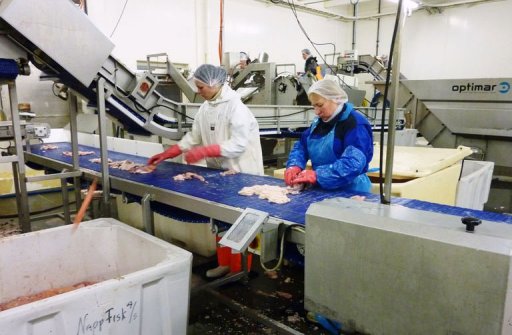 Even (or especially) Roger Helmer, in dissing Fresh Start, is drawn to recommend a paper by Ruth Lea and Brian Binley for Global Vision, entitled: "Britain and Europe: a new relationship". And there, on page 17 where the EEA is discussed, we see this: The EEA Agreement is revised frequently reflecting changes in EU legislation to maintain the "principle of homogeneity" of the EEA. The EEA/EFTA member states are given the opportunity to influence the shaping of EU EEA-relevant legislation, but they have little influence on the final EU decisions. They can neither sit nor vote in the major EU legislative institutions. They therefore have to agree to incorporate into the EEA Agreement what has ultimately been decided, if not necessarily shaped, by others. This state of affairs is sometimes referred to as "fax democracy".This is a straight cut-and-paste job from an EFTA "fact sheet", taken wholly uncritically. It ignores the fact that there is a huge propaganda campaign going on to downplay the advantages of the EFTA/EEA agreement, by officials and politicians who are keen to see Norway (and Iceland) join the European Union. To counter this propaganda, I have been for the last few days working flat out on a report which I hope to publish shortly, under the working title of "The Norway Option". In this, I address some of the myths and misunderstandings surrounding the issue. The main problem, I argue, is that commentators (like Ruth Lea and Brian Binley) are only looking at part of the picture, not realising that the visible, formal part of the law-making process managed by the European institutions is a tiny part of the whole. This is a point I have already made, also offering many examples of how, in a global trading environment, regulation is being globalised as well as trade. And it is at global level that influence must be exerted in order to shape the legislative agenda. "Little Europe" is far to small and isolated to be able to set the agenda. As I have been trawling through the examples, though, I have come up with what must be a perfect example of how this works in practice, looking at that vitally important but little-known organisation,Codex Alimentarius. Just to put this organisation in context, I wrote earlier of rule formulation, that matters relating to trade in agricultural products, and in particular barriers to trade, are handled by the UN Food and Agriculture Organisation (FAO). At a global level, this organisation takes the lead on agriculture, forestry, fisheries and rural development, feeding in to WTO negotiations. Most of the work, though, is not done directly by the FAO, but by three subsidiary bodies, the International Plant Protection Convention (IPPC), the Office International des Epizooties (OIE) andCodex. These, it turns out, are known as the "three sisters" of international standard setting organisations recognised by the World Trade Organisation (WTO) "Sanitary and Phytosanitary (SPS) Agreement". The SPS Agreement, virtually unknown outside the domain of trade specialists. Is a vitally important part of the WTO settlement, a wide-ranging agreement which allows that: ... no Member should be prevented from adopting or enforcing measures necessary to protect human, animal or plant life or health, subject to the requirement that these measures are not applied in a manner which would constitute a means of arbitrary or unjustifiable discrimination between Members where the same conditions prevail or a disguised restriction on international trade.This places Codex as a vital standard-setting organisation at a global level, and it is this organisation that dictates the detailed rules on food composition, additives, treatment, processing, hygiene and much else besides. Because of the pivotal importance of this organisation to world trade, all 27 EU Member States are members of the governing Commission. But so is the EU. As the European Community it joined in 2003 and, since the entry into force of the Lisbon Treaty on 1 December 2009, the EU became the nominal body, taking over the membership. With the accession of the EU, though, competence on many of the subject areas is now shared with EU countries depending on the level of harmonisation of the respective legislation. In some crucial areas, the Member States have ceded complete authority to the EU, allowing it exclusive "competence". Thus, the UK, with massive interests in the food industry, where it needs to retain control over food standards, no longer gets a vote on key committees. The EU votes on behalf of the member states, working to a "common position" agreed beforehand, on the basis of EU position papers. Now compare this situation with that of Norway. Fish and fishery products comprise its third largest export sector, accounting for €5.6 billion exports in 2009. With a diversified ocean-going and coastal fleet of approximately 6,800 vessels, the industry as a whole employs between 30,000 and 40,000 people. As regards food standards and related matters, therefore, it is very much in the Norwegian national interest to take an active part in Codex affairs, whenever fisheries sector matters are dealt with. Here, fortune smiles on Norway. Not only is this country an independent member of the organisation, but, it hosts the all-important Fish and Fisheries Products Committee. Thus, it is the lead nation globally in an area of significant economic importance to itself.
When it comes to trade in fish and fishery product, Norway is able to guide, if not control, the agenda on standards and other matters. The EU then reacts, turning the Codex standards into Community law, which then applies to EEA countries, including Norway. But it is Norway, not the EU, which calls the shots.
In all respects, Norway has greater say in Codex Alimentarius affairs than does a UK which is isolated in "little Europe". Yet Norway is supposed to be the country that is subjected to "fax diplomacy" and has "no influence" over EU law. It must simply adopt all the Single Market laws coming out of Brussels – or so we are told. Fortunately, though, we now know different. COMMENT THREAD Richard North 17/01/2013 |
EU politics: a lame finish
Wednesday 16 January 2013
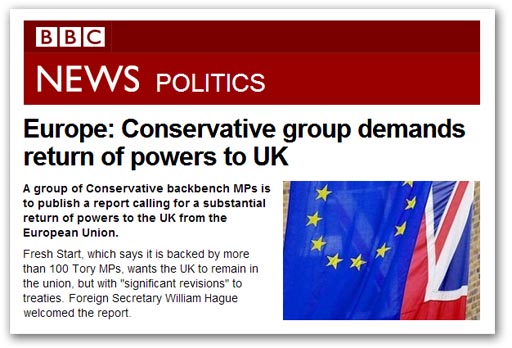 Andrea Leadsom, one of the leaders of the group of MPs, tells the BBC's Daily Politics show that leaving the EU would be a "disaster" for the British economy but says she wants powers to be repatriated. The BBC report tells us this is backed by 100 Conservative backbench MPs, and welcomed by Hague, but the thinking is stale, derivative and unrealistic. Nevertheless, Hague writes of the production, "It is a well-researched and well-considered document full of powerful ideas for Britain's future in Europe and, indeed, for Europe's future". Actually, I can't be bothered with this. It's not worth bothering with. This is "little England" playing on the fringes of "little Europe". There is a whole world out there, and they don't even know it exists. Intellectually, they are not even past first base. COMMENT THREAD Richard North 16/01/2013 |


 Posts
Posts

