
Booker: "gay marriage" and the Council of Europe
Sunday 10 February 2013
 In the incredibly limited space allowed him, he starts in 2010 with three main players, the Home Secretary Theresa May, our former Lib Dem equalities minister, Lynne Featherstone, and that shadowy institution, the Council of Europe in Strasbourg, with its controversial adjunct, the European Court of Human Rights. In March 2010, ministers from the 47 countries represented in the Council of Europe agreed a "Recommendation" on "measures to combat discrimination on grounds of sexual orientation or gender identity". Section IV focused on Article 8 of the European Convention on Human Rights, guaranteeing "respect for family life". It proposed that where national legislation recognised same-sex partnerships, these should be given the same legal status as those between heterosexuals. There was no mention of marriage as yet, except in a proposal that "transgender persons" should be entitled to "marry a person of the sex opposite to their reassigned sex". Four days before the 2010 general election, the Tory party issued a pamphlet, signed by Theresa May, in which a section on "lesbian, gay, bisexual and transgender [LGBT] issues" promised that the party would "consider the case for changing the law to allow civil partnerships to be called and classified as marriage". But this was not in the manifesto, nor, after the election, in the Coalition Agreement. In June that year, the European Court of Human Rights (ECHR) ruled that, though there was no obligation on countries to recognise same-sex partnerships, Article 8 did not specify that the right to enjoy family life applied only to couples of different sexes, it could be taken as equally applying to same-sex couples. Crucially, the court proposed that, when a "consensus" emerged among the member states, this could allow the right to same-sex marriages to be recognised under the convention. Shortly afterwards, Lynne Featherstone, the equalities minister, set out new guidelines allowing "religious music" to be used in civil partnership ceremonies. She suggested that this should be regarded as a step towards allowing gay marriages. In September, the Lib Dem party conference backed her call for same-sex marriages to be legalised. Then, in December a campaign group, Equal Love, helped a group of British same-sex couples to launch an action in the ECHR asking for civil partnerships to be given full marriage status. They were supported by Peter Tatchell, who told the BBC that banning gay people from marriage sent "a signal that we are regarded as socially and legally inferior". The campaign – with much conferring behind the scenes between ministers and gay lobby groups – was under way. In March 2011, May and Featherstone issued an official work programme, "Working for Lesbian, Gay, Bisexual and Transgender Equality: Moving Forward". It committed the Government to work "with all those who have an interest in equal civil marriage" on how "legislation can develop". Furthermore, it committed the Foreign Office and the new Gender Equality Office to work for "full implementation" of the Council of Europe’s 2010 Recommendation, with a target date of June 2013. In November 2011, when Britain took over the six-monthly chairmanship of the Council of Europe, it put this at the top of the agenda. Featherstone had already committed £100,000 of government money to creating an LGBT unit in Strasbourg to plan implementation of the policy, which she formalised in a grand signing ceremony with Thorbjørn Jagland, Secretary General of the Council of Europe, on 27 March last year. That same date, the UK's representation in Strasbourg organised the Council's first "closed conference" (ie, public not admitted), to agree detailed plans for the June 2013 implementation, with a keynote address from Featherstone. A speech by the British judge, Sir Nicolas Bratza, then head of the European Court of Human Rights, signalled that the court was ready to declare same-sex marriage a "human right", as soon as enough countries fell into line. The court, he said, had found that "the recognition in national law of same-sex relationships had, by our present day, reached a degree that justified a broader understanding of family life as that term is used in Article 8 of the Convention". Such are the real reasons that our Government needed to rush through last week's vote on gay marriage. We are committed to "full implementation" of the Council of Europe's policy no later than this June (and hence the similar law now being rushed through in France). It had been a brilliant political coup by the gay lobby, aided by Featherstone, May and those shadowy European bodies that, in so many ways, now rule our lives. In a mischievous conclusion, Booker asks what we weren't told more honestly and openly why this had all happened, but even then the reasoning does need spelling out. For that, we have to go back to 2009 when, in opposition, Mr Cameron had pledged to repeal the Human Rights Act. This "cast iron promise" had gone the same way as his Lisbon Treaty referendum promise, leaving him politically vulnerable every time the ECHR made a judgement that adversely affected the UK. With Tatchell engineering a case in the ECHR, and the Council of Europe Recommendation adding to the corpus of opinion that was signalling to the court that member states were prepared to accept gay marriage, it must have been obvious that the Court was gearing up to rule in favour of the LGBT lobby. The timing of any judgement would have been close to the 2015 general election, putting Cameron in the embarrassing position of having to conform to a highly contentious judgement at the same time he was seeking re-election. Thus, if it was going to happen better it was to do it early, mid-term, and get it out of the way. Recommendation CM/Rec(2010)5 was the tip of the spear, and triggered Cameron's action. This was "soft law" in action, exerting its effect. It swung the balance of convenience and made something that was probably going to happen anyway happen that bit quicker. COMMENT THREAD Richard North 10/02/2013 |
Local authorities: hiding the rise
Saturday 9 February 2013
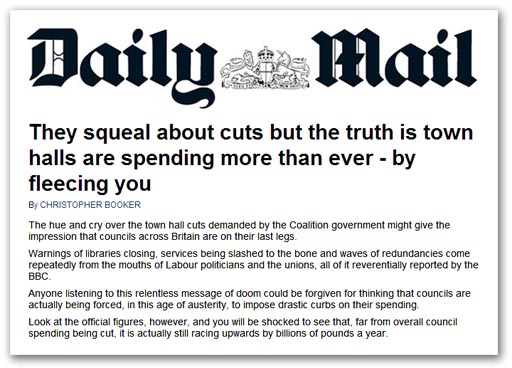 The article is loosely based on this, which a wrote back in October 2011, pointing up a major structural change in the way local government is funded, with a gradual shift from Council Tax to fees and charges, so much so that this source of income now exceeds the headline income from Council Tax. Overall, we then see that, despite the rhetoric on "cuts", in the past six years local government spending in England alone has risen by more than 25 percent to an all-time record of more than £170 billion. The freeze on Council Tax rates is so much window dressing. The fact is, writes Booker, that our bloated local authorities, with so many of their senior officials now being paid far more than the Prime Minister, have been cunningly devising every kind of new way to take money off us. It is one of the best-kept secrets in British politics, he says, costing us all ever-more billions of pounds every year. Yet we are scarcely aware of what a revolution it represents in the way we are governed. The truth is that these new money-grabbing ploys earn councils as much every year as they get from council tax itself. Some of the biggest beneficiaries of this "smoke and mirror" financing, Booker writes, are all are those who, for one reason or another, take early retirement, such as the Cumbria CEO who walked off with £464,000, or the South Somerset CEO who left early with a pay-off of £570,000, or the controversial CEO of Suffolk who stepped down at a cost to the taxpayers of £350,000, plus another £115,000 to pay for an investigation into her "domineering management style". How telling that it should be these self-same people who are still presiding over the greatest explosion of local authority spending in Britain's history - and how clever they have been to hide the way they are extorting that avalanche of money from the rest of us. This is what the Harrogate Agenda is about. It is all very well Pickles having his silly little referendums if local authorities want to raise Council Tax by more than two percent, but while we are watching the front door, the officials are creeping round the back and raising income anyway, but under different categories. Thus, the only way to control the local authorities is to bring the entire budgets under public control, and put them annually to a referendum. Instead of focusing on just a tiny part of the budget, we need to be looking at the whole thing. COMMENT THREAD Richard North 09/02/2013 |
Horsemeat scandal: a porous network
Saturday 9 February 2013
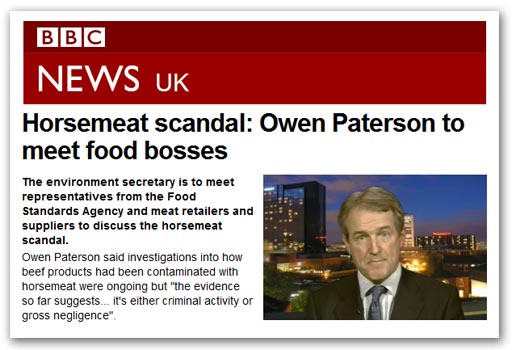
The horsemeat "scandal" grumbles on, with the media not even beginning to get to grips with the issue and its implications. Thus, we have Owen Paterson talking to a confused BBC, with the presenter trying, but failing, to make sense of it.
One of our own forum members (a retired policemen) puts his finger on it. He observes that the media wrongly refer to the supply system as "a food chain". It is not a chain. It is a network and like a network, the internet for example, when one or a number of hubs go down another route is quickly found and the whole thing carries on as before. If, as is suspected, criminality is involved, the crooks will always be at least one step ahead of enforcement agencies. I'd never thought of it so clearly in those terms ... one falls so easily into the "food chain" jargon. But he is absolutely right. The "network" is a much better way of describing it. And it is also a very porous network, with multiple entry points. The regulatory idea is that all the entry points (slaughterhouses) are policed. Everything passing down the chain is then recorded, so that what comes out at the other end is, theoretically, the same standard as what went in. Hence, as always the regulatory system is based on a false premise. The "network" is worldwide and impossible to police. No wonder the criminals are prospering. All they have to do is gain access to the "network". Once the meat is in the system, it is accepted at face value and no more physical checks are made. Controls are entirely paper-based, reliant on accurate and honest record-keeping. By the time the problem is discovered, the crooks are long gone. It is also germane to remember that these frozen blocks of meat, the preferred format for horse meat, have a notional shelf-life of a year in normal commercial freezers. But in strategic storage at -40ºC - they can last thirty years old without any noticeable deterioration in quality. The meat could even be old, Soviet era strategic stocks that have been repackaged several times for all we know. Or the Mafia could be behind it. Italy is the biggest horsemeat producer in Europe. The meat could also be Mexican (slaughtered). There is a huge horsemeat trade in that country, where they also deal with US horses after the slaughter ban in the US in 2007. Loads are shipped over to Europe (about 9,000 tons in 2012), sometimes to provide cover for drug shipments. The illegal drugs are put into distribution but the meat, which has no immediate buyer, is then held in cold stores and dribbled into the system, so as not to give the game away. What must be considered is that some of this stuff has been in the system many years, and has gone through multiple repackaging, so that its original identity has long been lost. If that is the case, it will be very difficult if not impossible to trace.
However, there are only a limited number of strategic cold stores. In the UK, most will be known to the authorities as they are very difficult to hide. But stocks could be anywhere in Europe, or even Russia. Already, we have seen the involvement of units in Ireland, the UK, France, Sweden, Luxembourg, the Netherlands and Poland.
Often being drug-related, the illegal meat industry is also well-organised – and ruthless. In investigations I carried out for television programmes (never broadcast), we took testimony from owners of slaughterhouses and cutting plants, on how it operates. Most significant of the many lines we followed up, one cutting premises owner told of getting "a phone call" telling him he would receive a truck-load of meat. It was to be repackaged and relabelled to a certain specification. And it was made very clear what would happen if the work was not done. This was not a request. You do not mess with these people. On the day, the truck arrives. The labels are supplied, complete with official stamps, and the work is done. Another truck arrives. Cash changes hands, the load is collected and that is the last of it, until the next one. The meat can then turn up anywhere in the world. This is the criminal underbelly of the meat trade, and there are many variations. It used to be fairly local, small-scale and contained. But, with the advent of the Single Market, it has gone international, and multiplied in value. There is a huge amount of money in it, with just one container-load turning in over £100,000 profit.
What we are seeing, therefore, could well (and almost certainly is) be the tip of an iceberg. No one has yet addressed it – it turned out to be too dangerous to research for a television programme. But we are now seeing one of the side-effects of a flawed system.
Richard North 09/02/2013 |
Sunday, 10 February 2013


 Posts
Posts

