

EU politics: coming our way soon
Tuesday 26 February 2013
 Currently, there are an estimated 209,000 Romanians and 121,000 Bulgarians living in Germany, although how many are Roma is not known. Thousands more from southeastern Europe arrive every month and some cities have reported a six-fold increase since the two countries became EU members. Officials in Duisburg, in an internal report of September 2012, offer a troubling assessment. "As long as there is unrestricted immigration and unregulated settlement, the problems are not controllable by the police", they say. The police in Duisburg have suffered particular pressures. Last year, they recorded some 13,000 staff hours on immigration-related issues, trying to prevent tension escalating. And they have nearly 350 live investigations, mainly for fraud and simple theft. Officials warn of an additional area of conflict. It is not only the Germans who feel threatened, but Turkish and Lebanese immigrants. Several times the police have had to intervene to break up armed fights. There was a major confrontation in September 2012, when the police recorded a targeted attack by young men of Turkish origin against young Romanian Roma. The police consider that the ever-increasing and uncontrolled growth of the Roma was the catalyst of this type of attack. In the UK, Nigel Farage may be over-egging the numbers we can expect from 1 January 2014 but, if this German experience is any guide, he cannot over-exaggerate the problems that will arise from unrestrained Roma immigration. A potential ally is the head of Dortmund Social Department, Birgit Zoerner. She is head of the German Association of Cities and a member of the newly established federal-state working group on "poverty migration from Eastern Europe". Her focus, though, is on financial support from the EU – of which Farage would doubtless not approve. The EU can organise bail-outs for banks, Zoerner says, and we now need urgent rescue packages for people. But she also argues for restriction of free movement until the EU is able to control immigrants and manage their distribution. The current European-led movement, she says, disrupts communities because new immigrants mostly prefer the districts which have already succumbed to major social challenges. And in a new development, Interior Minister Hans-Peter Friedrich is demanding that the EU make money available for the integration of Roma into their native countries. These people, he says, present schools, municipalities and charitable organisations with unique challenges. Local governments are complaining that they are now being made to bear the costs of EU expansion, concerns that the federal government in Berlin have thus far ignored. That presents a somewhat different perspective to the immigration debate. While national politicians parade on the European stage, it is local government – and local taxpayers – who are bearing the costs, as we have already seen with Rotherham.
EU membership, therefore – always regarded as mainly a national issue – now has an even greater and more urgent relevance to local politics.
COMMENT THREAD Richard North 26/02/2013 |
Horsemeat fraud: organic eggs – the next instalment
Monday 25 February 2013
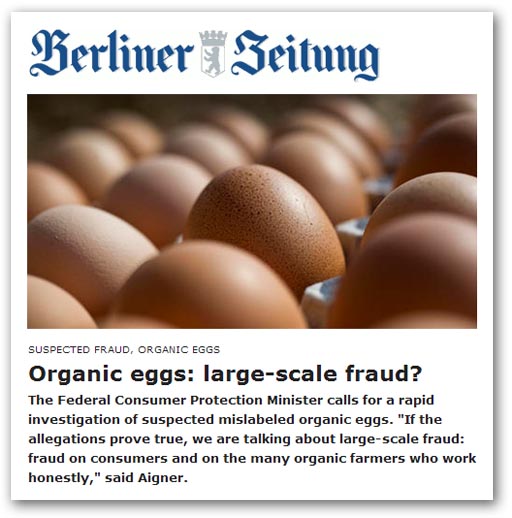 The hare has been set running by the Arbeitsgemeinschaft bäuerliche Landwirtschaft, reflecting the German genius for making even a benign producer group sound like a paramilitary organisation. This is the Small Farmers' Association (AbL) who are complaining of a "giant fraud", with large egg packers sending their supermarket customers the right packaging, without too much concern about what is inside it. Also being criticised are the "lax EU organic standards", pointing once again to the situation where the EU has exclusive competence in dictating the standards for this fabulous Single Market about which Mr Cameron is so enthusiastic. Handelsblatt takes it further, reporting that the "deliberate deception" of consumers is probably "widespread practice", with millions of eggs involved. It also seems to have got the point. The second major labelling swindle after the horsemeat scandal, it says, "casts doubt on the success of food inspections". Says Federal Consumer Minister Ilse Aigner (CSU), "It's all about checks and here I have to clearly say that the controls for which the countries are indeed responsible have to be carried not just from your desks. One must, of course, be on the ground, looking at the plants". Oldenburg prosecutor Roland Herrmann agrees that fraud involving the keeping of chickens and eggs is widespread. His authority is investigating some 100 farms in Lower Saxony. Profits from illegal substitution are, as one might expect, enormous. As a guide from the UK, Tesco sells a half-dozen "everyday value" eggs for £0.95, compared with £1.70 for free-range and £2.15 for a half-dozen organic eggs. Given that these eggs are chemically indistinguishable – and there is no known test that can identify substitution – the temptation is massive. And while this "scandal" is at the moment confined to Germany, anyone who thinks it doesn't happen here is in the land of the fayries. Outside one of the largest, prestige egg packers in the country, I've personally seen anonymous shipping containers, stacked full of eggs, unknown to the egg inspector, which are brought out to make up for shortfalls on any one line – irrespective of type. This has been going on for years. Egg marketing in Europe is a truly international business, as the consumption cycles in each Member State are slightly different, while egg laying is a constant. You can't switch laying hens on and off like a light switch. Thus, there is free trade between producers and wholesalers in different countries, to balance supply and demand. With no cross-border checks, there is ample room for fraud and substitution, and precious little policing. Because the egg regulations are of EU origin, and highly complex, Defra runs its own egg inspectorate, too few in number (and lacking the skills) to be able to detect structured fraud. Once again, though, we confront the same problem. Where the value of a product depends not on its intrinsic characteristics but on the paperwork accompanying it, there will always be scope for fraud. And, when the system is governed by Brussels, and the checks are determined by the European Commission, the fraudsters are always going to have an easy time of it. That, though, has ministers from 27 Member States in Brussels today discussing more and better labelling for meat products. Without the first idea of whether they can be enforced, or how, they labour under the illusion that their regulations will actually achieve anything, other than create more and better opportunities for fraud. These people, with the European Commission alongside them, are oblivious to the reality of the world outside their little bubble. COMMENT: "HORSEMEAT" THREAD Richard North 25/02/2013 |
Horsemeat fraud: expanding the European dimension
Monday 25 February 2013
 The Czech State Veterinary Administration reported its findings to the EU's Rapid Alert System for Food and Feed (RASFF), after its inspectors took samples for DNA tests in IKEA's unit in the city of Brno from a product labelled as "beef and pork meatballs" (87%). IKEA, according to other press reports, has said that the meatballs were made by the Familjen Dafgård group, located in central Sweden, a firm which claims to put a "lot of love and care" into its products (as well as horsemeat). However, the family Dafgård is not alone. The Czech inspectors also found horsemeat in burgers from Poland labelled as "beef pre-fried burger" supplied to the food trader and distributor BidVest in the Czech Republic. The IKEA suppliers have not yet disclosed the source of their meats, but in the "beef pre-fried burger", we have another finger pointing at Poland. This link is being pointed up by Die Welt and others, although information on origin is no proof of complicity in fraud. This we saw with the Romanian link. Nevertheless, as the days pass, we are getting the full flavour of the European dimension of this fraud. So far, we have information of adulteration events in Ireland (several), the UK (two), Germany (two or three), Luxembourg (one), France (one or possibly two), Italy (possibly one) and now Denmark and possibly Sweden, with persistent but unproven claims of Polish involvement. The little Englanders of the media are still keen to plant their Union Jacks on the issue, making mischief on the FSA and other local matters, but the facts demonstrate that this is a pan-European failure, with the EU's regulatory system at the heart of it. Not only does the media seem to be having difficulty with this, they are also still using the phrase "food chain", when "network" would be much more appropriate. Thus we have a Swedish furniture shop in the Czech Republic selling meatballs which were also on sale in Netherlands, Belgium, Portugal. They were made by a completely different firm in Sweden, although they were claimed to be "IKEA food", and were made from ingredients supplied by other companies (as yet undisclosed, but which could be anywhere), all to a common regulatory standard decided in and enforced from Brussels. What is fascinating to see, though, is that FAK notes that IKEA's food sales worldwide amounted last year to €1.3 billion, making it a major food retailer in its own right. Yet, despite the value, and the prestige of the brand name, this firm – along with many others – have put their trust in the Brussels regulatory system and ended up selling adulterated foods. UKIP should be having a field day. COMMENT: "HORSEMEAT" THREAD Richard North 25/02/2013 |
Horsemeat fraud: regulatory aftermath
Monday 25 February 2013
Instead of a widespread, international police investigation, to track down the criminals in a multi-million pound fraud, we are entering what is more like the classic final stage of the scare dynamic, the so-called "regulatory aftermath", with the politicians braying for more legislation to fix the problem.
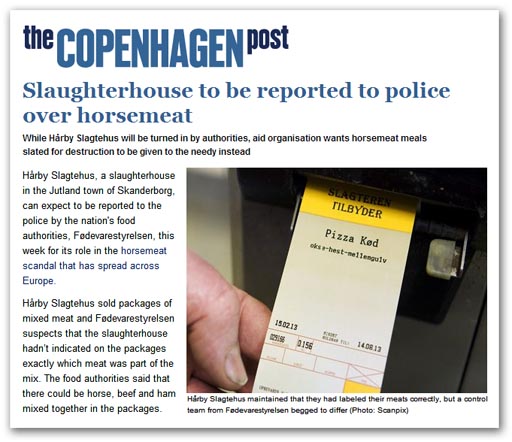
In this case, they are calling for "speedier action on introducing country-of-origin labelling for processed beef and other meat products" – or so says the loss-making Guardian, as if putting different labels on packs is somehow going to prevent fraudsters adulterating the food which goes into the packs. Meanwhile, the sainty, law-abiding Danes have discovered that one of their own has been doing naughty things. Hårby Slagtehus, a slaughterhouse in the Jutland town of Skanderborg, we are told, can expect to be reported to the police by the nation's food authorities, Fødevarestyrelsen, after it sold packs of mixed meat without indicating which meat was part of the mix. The food authorities said that there could be horse, beef and ham mixed together in the packs. Hårby Slagtehus maintained that the restaurants it supplied with meat were aware that the meat, which the slaughterhouse sold under the labels of 'pizza meat' (pizzakød) and 'formed beefsteak' (formede bøffer), could contain horsemeat. Fødevarestyrelsen went to six customers of the slaughterhouse and all said they thought they were purchasing beef. A control team took a total of nine samples from the six restaurants and found traces of horse DNA in three of the tests, traces of pig DNA in one sample and a combination of horse and pig DNA in five of the samples. But while the Danes are putting their hands up – albeit to minor infractions – the Poles are rejecting allegations that they are involved in the scams. Agriculture Minister Stanislaw Kalemba claims that: "Poland is so far clean as a whistle. Poland is off the hook", stating that nationwide inspections have failed to find existence of horse in beef products. He also takes a pop a the Sunday Telegraph for claiming that "Polish authorities" suspect that horses are being used in a form of money laundering, noting that no official from Poland is quoted as saying so. Kalemba says that the original allegations coming from Ireland were "unfair" and that "there are at least a dozen countries in Europe and South America under suspicion" of adulterating beef with horse. 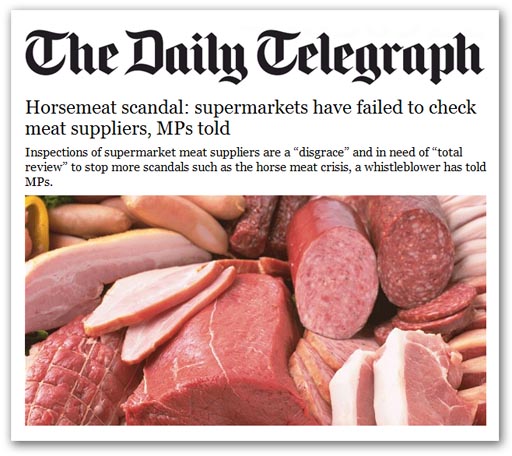 Back in Britain, the Daily Telegraph is getting excited over a report from Paul Smith, a retired auditor of food safety standards, that there is a "massive failure" of retailers to monitor their suppliers and have their meat inspected at "appropriate intervals". Had the paper been reading this blog (and the Booker column), they would have already known this. We had, after all, written on 8 February (our very first piece on the current crisis) that the supermarkets operate what is known as "plausible deniability". As long as they have the paperwork to say they are in the clear, they are happy, we wrote. Needless to say, in recounting Smith's "evidence" - which takes the form of a written statement to the Commons environment committee - the Telegraph omits any mention of the European Union, despite it having exclusive competence in food law. Smith is cited as saying: "The whole system is a disgrace and in need of total review", and that he has spoken out to help bring about "appropriate changes so as to ensure the horse meat incident and related incidents do not reoccur". But, since we have yet to work out the detail of what has been going on, with all sorts ofcomplexities and inconsistencies, we really should be focusing on the investigation - whence, of course, it will fall to the EU to take action.
As it stands, the "colleagues" seem to be rushing to slam closed the wrong door, long after the horse has been slaughtered. But then, you cannot expect them to admit their own failures.
COMMENT: "HORSEMEAT" THREAD Richard North 25/02/2013 |
Horsemeat fraud: criminality and confusion
Monday 25 February 2013
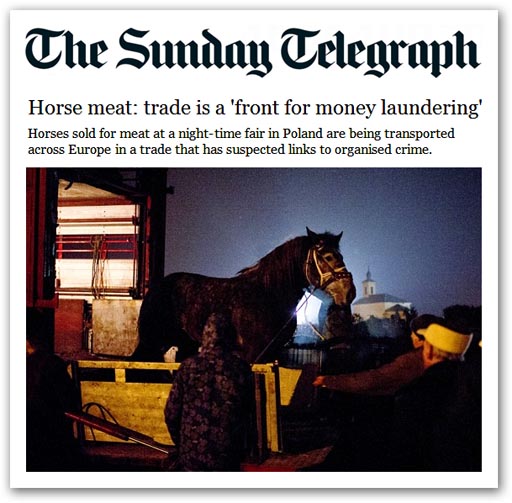 The only useful information could have been covered in an article a fraction of the length, pointing to what appear to be over-generous prices paid for horses on the hoof. An old mare, it was claimed, had been sold through the Skaryszew market for 7,000 zloty, equating to about £1,400 or €1,700. We were further told that the farmer selling the animal expected 5,000 zloty. Journalist Claire Duffin thus asserted that the farmer was paid almost £3.40/kg for his horse – close to €4/kg. Yet, she wrote, the most expensive horse meat, from foals, fetched only £2.40/kg (€2.75/kg) in Italy, where the animals are mostly slaughtered. By contrast, in the UK, unwanted horses which end up in the food supply, can – according to one horse charity - be sold for £100 or less, making slaughter a lucrative proposition in the UK. On this basis – and with the help of the World Horse Welfare charity – Duffin concluded that "a more sinister set of suspicions hang over the whole horse trade in Poland: that it is a front for crime". The charity, and the Polish authorities, suspect that the horses are being used in a form of money laundering. Horse selling is a trade that has been going on a long time. In February 2000, the BBC reported on it, using Compassion in World Farming (CIWF) to claim that about 100,000 horses a year were exported by road to Italy, mainly from Poland and Lithuania, and about 7,000 donkeys, most of them from Romania. The movement of horses, Duffin tells us, creates a convenient paper trail for gangs to "clean up" dirty money. By exaggerating the value and number of horses moved, they can explain the existence of large amounts of cash gained from less legitimate enterprises. Paying farmers "slightly over the odds" for their animals is, then, a small price compared with the potential profits. It would have helped here if we actually had the comparator, in order to understand what we are dealing with.. Duffin's data seems thin, and she could be getting her information from something likethis site, which offers an untypically low figure for meat, from France in 2004. We don't really get an idea of what is involved. Currently, it seems, trade prices for Romanian carcase meat can be €3.50/kg. Frozen Polish (boneless trimmings) can be bought for €4/kg, but there have been reports of sales at as little as €2/kg. Doing our own calculations, meat yield from a horse may be less than 40 percent of live weight. Thus, to cover a price on the hoof of €4/kg, boneless meat would have to average at least €10/kg - to which must be added transport and processing costs. Duffin and her sources are thus right to be suspicious of the prices paid in Skaryszew market, especially if meat is being sold at €2/kg. There is another oddity about the Polish market though, which Duffin does not discuss – the fact that almost its entire legitimate horsemeat export volume was sold to Italy. According to Eurostat, of the 13,016 tonnes exported by Poland in 2010, valued at €34,625,817, 12,988 tonnes went to Italy. In 2011, the Polish exported 12,598 tonnes, valued at €35,299,856. Of that all but ten tonnes ended up in Italy. What is not explained is why so much is trade is done with Poland. The next largest trading partner is Spain, from which Italy takes 3.8kt. Belgium supplies 3.7kt, while France sends 2.6kt. Romania sends a mere 1.7kt. As to the statistics for Italy as a whole, home meat production (2011) was recorded (by Eurostat) as 24.5 kilotonnnes (kt), with imports of 27kt. A negligible 1.7kt of exports are recorded, making total home consumption in the order of 51kt, over 60 percent of total EU consumption. What goes into Italy seems to stay in Italy, in a market that worth about €100 million at wholesale prices. However, both the Observer and the Daily Mail assert that Polish and Italian "mafia gangs" are involved in the trade. If this is the case, it may well be through unrecorded trade, a situation which is compounded by the poor state of official statistics. Not only do there seem to be significant differences between Eurostat and FAO databases, which ostensibly measure some of the same things, there also seems to be a mismatch (in Italy at least) between datasets on domestic meat production and number of horses slaughtered. Italian data, for instance, has 67,000 horses slaughtered in 2010, producing 17.9kt of meat (carcase weight – 178,827 metric quintals), as opposed to the figure of nearly 25kt meat, offered by Eurostat (equivalent to 34kt carcase weight - nearly double that recorded). It would be easier (although somewhat dishonest) to pick one set of statistics, and stick to them. You get this with newspapers, having The Daily Telegraph report in 2010 what it claims to be the FAO figure of 213,000 horses being slaughtered for food in Italy "every year". Yet the Italian government recorded for 2009 the number of 84,063 – of which 45,757 were imported. All the indications are, therefore, that there are significant gaps – or discontinuities – in some of the statistics.  Even then, the plot thickens. While the bulk of horsemeat in Europe is processed in Italy, so far, as of yesterday, only one Italian processor has been implicated in the horsemeat fraud. This is the Prima group. From this firm, so far, only about six tons of frozen beef lasagne have been seized. By contrast, there have been two major units in Germany, with another implicated. This latter unit is the German firm Dreistern Konserven, which produced goulash for Aldi, in which horsemeat was found - and which bought its meat via a dealer from Mipol, a Polish-based firm. There have also been – as yet unproven – links with the Irish horsemeat findings and Poland. It cannot thus be said that Poland is in the clear, but it also cannot be said that we yet have anything like a clear picture of the horsemeat trade in Europe, nor even the movement of horses. There may well be Polish/Italian mafia links - but that may not be behind the current horsemeat fraud. However, there is another dagger at the heart of the EU's Single Market. We are told so much about how much trade is facilitated through this construct, but when a light is shone on just one tiny sector, the statistics fall apart, and the mechanisms of trade are unknown in detail. Neither the European Commission, nor anyone involved in it, really knows what is going on. Interestingly, there is an EU Agricultural Council today (Monday), at which our own Mr Paterson will be present. The one thing he could demand, rather than more labelling, which might obscure more than reveal, is for the European Commission to come up with a definitive report, with reliable statistics, on how the horsemeat trade actually works. COMMENT: "HORSEMEAT" THREAD Richard North 25/02/2013 |


 Posts
Posts

