

Local authorities: hiding the rise
Saturday 9 February 2013
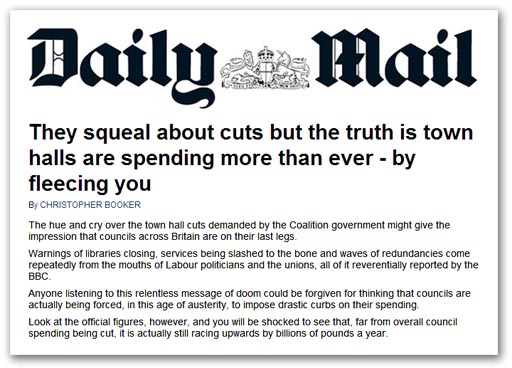 The article is loosely based on this, which a wrote back in October 2011, pointing up a major structural change in the way local government is funded, with a gradual shift from Council Tax to fees and charges, so much so that this source of income now exceeds the headline income from Council Tax. Overall, we then see that, despite the rhetoric on "cuts", in the past six years local government spending in England alone has risen by more than 25 percent to an all-time record of more than £170 billion. The freeze on Council Tax rates is so much window dressing. The fact is, writes Booker, that our bloated local authorities, with so many of their senior officials now being paid far more than the Prime Minister, have been cunningly devising every kind of new way to take money off us. It is one of the best-kept secrets in British politics, he says, costing us all ever-more billions of pounds every year. Yet we are scarcely aware of what a revolution it represents in the way we are governed. The truth is that these new money-grabbing ploys earn councils as much every year as they get from council tax itself. Some of the biggest beneficiaries of this "smoke and mirror" financing, Booker writes, are all are those who, for one reason or another, take early retirement, such as the Cumbria CEO who walked off with £464,000, or the South Somerset CEO who left early with a pay-off of £570,000, or the controversial CEO of Suffolk who stepped down at a cost to the taxpayers of £350,000, plus another £115,000 to pay for an investigation into her "domineering management style". How telling that it should be these self-same people who are still presiding over the greatest explosion of local authority spending in Britain's history - and how clever they have been to hide the way they are extorting that avalanche of money from the rest of us. This is what the Harrogate Agenda is about. It is all very well Pickles having his silly little referendums if local authorities want to raise Council Tax by more than two percent, but while we are watching the front door, the officials are creeping round the back and raising income anyway, but under different categories. Thus, the only way to control the local authorities is to bring the entire budgets under public control, and put them annually to a referendum. Instead of focusing on just a tiny part of the budget, we need to be looking at the whole thing. COMMENT THREAD Richard North 09/02/2013 |
EU regulation: a porous network
Saturday 9 February 2013
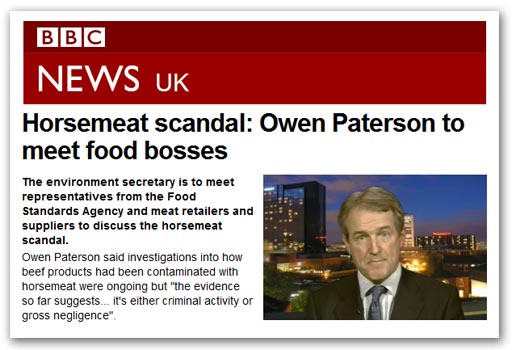
The horsemeat "scandal" grumbles on, with the media not even beginning to get to grips with the issue and its implications. Thus, we have Owen Paterson talking to a confused BBC, with the presenter trying, but failing, to make sense of it.
One of our own forum members (a retired policemen) puts his finger on it. He observes that the media wrongly refer to the supply system as "a food chain". It is not a chain. It is a network and like a network, the internet for example, when one or a number of hubs go down another route is quickly found and the whole thing carries on as before. If, as is suspected, criminality is involved, the crooks will always be at least one step ahead of enforcement agencies. I'd never thought of it so clearly in those terms ... one falls so easily into the "food chain" jargon. But he is absolutely right. The "network" is a much better way of describing it. And it is also a very porous network, with multiple entry points. The regulatory idea is that all the entry points (slaughterhouses) are policed. Everything passing down the chain is then recorded, so that what comes out at the other end is, theoretically, the same standard as what went in. Hence, as always the regulatory system is based on a false premise. The "network" is worldwide and impossible to police. No wonder the criminals are prospering. All they have to do is gain access to the "network". Once the meat is in the system, it is accepted at face value and no more physical checks are made. Controls are entirely paper-based, reliant on accurate and honest record-keeping. By the time the problem is discovered, the crooks are long gone. It is also germane to remember that these frozen blocks of meat, the preferred format for horse meat, have a notional shelf-life of a year in normal commercial freezers. But in strategic storage at -40ºC - they can last thirty years old without any noticeable deterioration in quality. The meat could even be old, Soviet era strategic stocks that have been repackaged several times for all we know. Or the Mafia could be behind it. Italy is the biggest horsemeat producer in Europe. The meat could also be Mexican (slaughtered). There is a huge horsemeat trade in that country, where they also deal with US horses after the slaughter ban in the US in 2007. Loads are shipped over to Europe (about 9,000 tons in 2012), sometimes to provide cover for drug shipments. The illegal drugs are put into distribution but the meat, which has no immediate buyer, is then held in cold stores and dribbled into the system, so as not to give the game away. What must be considered is that some of this stuff has been in the system many years, and has gone through multiple repackaging, so that its original identity has long been lost. If that is the case, it will be very difficult if not impossible to trace.
However, there are only a limited number of strategic cold stores. In the UK, most will be known to the authorities as they are very difficult to hide. But stocks could be anywhere in Europe, or even Russia. Already, we have seen the involvement of units in Ireland, the UK, France, Sweden, Luxembourg, the Netherlands and Poland.
Often being drug-related, the illegal meat industry is also well-organised – and ruthless. In investigations I carried out for television programmes (never broadcast), we took testimony from owners of slaughterhouses and cutting plants, on how it operates. Most significant of the many lines we followed up, one cutting premises owner told of getting "a phone call" telling him he would receive a truck-load of meat. It was to be repackaged and relabelled to a certain specification. And it was made very clear what would happen if the work was not done. This was not a request. You do not mess with these people. On the day, the truck arrives. The labels are supplied, complete with official stamps, and the work is done. Another truck arrives. Cash changes hands, the load is collected and that is the last of it, until the next one. The meat can then turn up anywhere in the world. This is the criminal underbelly of the meat trade, and there are many variations. It used to be fairly local, small-scale and contained. But, with the advent of the Single Market, it has gone international, and multiplied in value. There is a huge amount of money in it, with just one container-load turning in over £100,000 profit.
What we are seeing, therefore, could well (and almost certainly is) be the tip of an iceberg. No one has yet addressed it – it turned out to be too dangerous to research for a television programme. But we are now seeing one of the side-effects of a flawed system.
Richard North 09/02/2013 |
EU budget: not a foregone conclusion
Saturday 9 February 2013
 Says Mary Ellen Synon, Spiegel and many others, battle is not over. The European Parliament must still approve it, and that is not a foregone conclusion. One needs to repeat this. It is not a foregone conclusion. We are told that Joseph Daul, chairman of the European People's Party parliamentary group, which represents the Continent's Christian Democrats, says a budget of €960 billion would be unacceptable. "These proposals are going in the wrong direction, attacking one of our best tools to generate growth - the European budget - of which 94 percent goes back to the member states. The proposal we have today is a political capitulation and we are going to reject it," he says. Synon is even more robust on this, making talks of "victory" extremely premature. One wonders, though, whether Mr Cameron has really registered what is going on, but then this is a man who confused "debt" with "deficit" and believes that Norway has "no influence at all" over EU regulation. That said, the media, as in the loss-making Guardian here have no excuse for their headlines. They are badly misrepresenting the situation. Then, we've seen a lot of that lately, on fishing and the CAP. The British media really doesn't "get" the European Parliament, any more than it does the EU generally. If Mr Shulz, has his way, though, Mr Cameron's "victory" will not be lasting very long. Then, perhaps, the media might wake up to what is happening, but I somehow doubt it. COMMENT: "THEATRE" THREAD Richard North 09/02/2013 |
EU regulation: criminal negligence
Friday 8 February 2013
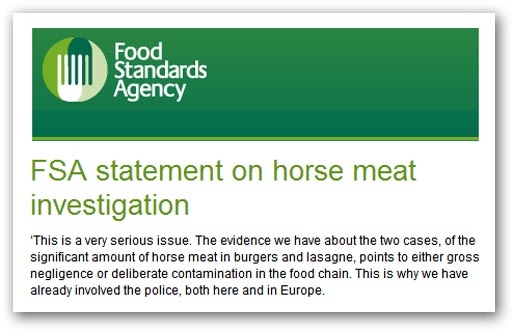 That is an explicit admission that imported meat is involved – which we already know, because produce of Irish and Polish origin has already been mentioned in media reports. What is not mentioned is the elephant in the room – the EU. The whole of the meat chain, from farm to store, is regulated by EU law, with meat and meat products subject to a stringent and expensive regulatory regime which replaced the British system. But what also goes with the territory are the Single Market rules. Produce from an EEA member, with paperwork that conforms with EU requirements, cannot be checked at port of entry. Neither, without firm evidence of a problem, are we allowed to check imported meat at the point of sale (or at any point in between, during processing and distribution) on a scale greater than we do meat of domestic origin. This is prohibited under EU law, as discrimination on the ground of nationality. Therefore, our system is entirely dependent on the good faith and efficiency of EU member states in policing food standards, to make sure that what is in the boxes is what is on the EU-regulated label. Of course, the system does not work, and will never work without the back-up of routine regulatory spot-checks, with special emphasis on imported goods, which are most likely to be substandard. That deterrent effect is lacking in the current system – the crooks know there will never be any checks until it is too late. But, not only are we not allowed to do this, we are not allowed to know that we are not allowed to do this. The FSA is utterly silent on the root cause of the problem. But this, as with the breast implants, and the hip-joint replacements, is another good example of an EU regulatory failure. But if we are never told of it, how will we ever know? The criminal negligence here is in a criminally inadequate regulatory system, one imposed for political expediency rather than efficacy. COMMENT: "LET THEM EAT HORSE" THREAD Richard North 08/02/2013 |
EU regulation: let them eat horse
Friday 8 February 2013
As the horsemeat scandal enters its second month, and seems to be intensifying rather than fading, not a few people are asking how it is possible that such huge quantities of burgers and other meat products could end up contaminated. After all, horse meat has a very obvious smell, different colouration and fat conformation, and surely would be recognisable to anyone making the products.
While this would most certainly be true in the domestic kitchen, what people do not always appreciate is that things are very different on the industrial scale. The quantities are so huge and the speed of processing so high, that it is impossible to check all the ingredients going through the system. What is more, even lines which predominantly use chilled meat will also use a proportion of frozen blocks, at anything up to 25kg weight, which - as graphically illustrated by the video above - is used without defrosting. This is most probably how the horsemeat gets into the system. And in that state, the people handling it will have no idea what it actually is. They are totally reliant on the labelling and the official stamps. The insertion of frozen meat into the process is in fact vital to keep the mix temperature down – otherwise, the cutting, grinding and mixing will overheat the meat and lead to undesirable changes. Thus insisting only on the use of chilled meat, and perhaps running an inspection belt, is not a practical option. Thus, the detection of product contamination, especially cross-species substitution (either accidental or by way of deliberate fraud), requires a pre-production checking regime, possibly augmented by post-production sampling, at the pre-delivery stage and throughout the distribution chain, right up to point of sale, with laboratory testing for rogue proteins. However, since the food scares of the late 1980s and '90s, we have seen a sea-change in regulation, both in scale and type, with the introduction of predictive control systems, known generically as Hazard Analysis and Critical Control Points (HACCP) and paperwork auditing. HACCP in particular, has been adopted with enthusiasm by the EU and incorporated into basic Food Safety Regulations, as the primary mechanism of control. The knock-on effect of this is that both physical checks during processing have been scaled down, with greater reliance of the paperwork trail, while regulatory visits tend to focus more on determining whether HACCP regimes are in place, with extensive paperwork audits, rather then on physical inspections. Under these regimes, it is not unknown for official inspectors to carry out their work without ever leaving the offices of the companies they are visiting, while end product testing also has been progressively abandoned, in favour of cheaper paperwork audits. That has been matched byreductions in regulatory manpower and testing budgets. Another development has been the introduction of the "Due Diligence" defence into food law, where retailer can claim immunity from prosecution provided they can show they have taken "reasonable precautions" to ensure the safety of the food and its conformity with relevant standards. This is achieved by insisting on a rigorous paper-chain from their suppliers, all attesting that necessary checks have been made, and systems maintained. When it comes to packaged, processed products such as frozen burgers, the supermarkets have used this to such effect that they can effectively absolve themselves of any responsibility for food standards. However, no one with any deep knowledge in the system can have any confidence in it. Paperwork and sundry records – and even official stamps, so beloved of the EU – can easily be forged or doctored, more so since the advent of computers and high-tech printers. And, where the value of a product is entirely dependent on its labelling and its paperwork, fraud is an inevitable consequence. That is why, to this day, there is more home-grown organic chicken sold in London than is produced in the entire UK. Here lies the central deception in the system. Most people in the business know it is flawed, but no one will rock the boat. The supermarkets operate what is known as "plausible deniability". As long as they have the paperwork to say they are in the clear, they are happy. And if the supermarkets are happy, everybody else is happy. But it is into this uncontrolled space that it appears the criminals have moved in and flourished. Actually, the criminals were always there, but with the centralisation of the meat inspection service, and its detachment from the local authority base, the intelligence network has broken down, marking the final degradation of the food surveillance system. As a result, in the early 21st Century, food standards are probably less well-policed than they have been for the bulk of the second half of the last century. And, since food safety and food standards are exclusive EU competences, there is no immediate (or any) chance of improvement. There are too many vested interests to permit change, and the last thing the EU is ever going to do is admit that it got it wrong. Thus, for us mere plebs, the word from Brussels is stark and simple: "let them eat horse". COMMENT THREAD Richard North 08/02/2013 |


 Posts
Posts

