

Christopher Booker: Passing of the People's President
Saturday 9 March 2013
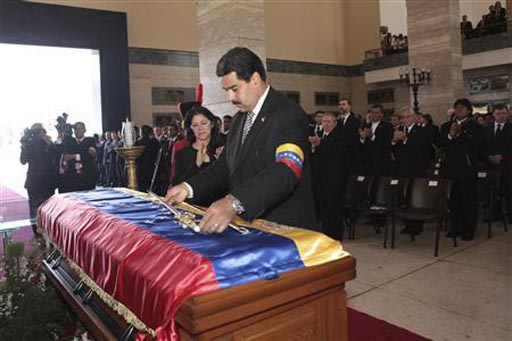
Since the proprietor and chief author of this blog is very careful to avoid listening to the Today programme or watching Channel 4 News, I have had to keep him posted in recent days on the remarkable coverage given by the BBC and the Channel 4 team to events in Caracas and the death of that legendary hero of our times, Hugo Chavez.
In its general tone this has been so striking that I was tempted to write about it in this week's Sunday Telegraph column, until more pressing subjects intervened. From the moment Chavez's death was announced, the BBC went into adulatory meltdown. "Charismatic and controversial" was the mantra phrase repeated half a dozen times before 9 o'clock that morning, to mark the passing of "the People's President", who among his many other achievements could have boasted that, under his benign rule, Venezuela became in 2010 the country with the highest murder rate in the world. Where these reporters really came into their own was when they could wander round the streets of Caracas marvelling at such an astonishing explosion of collective grief, as vast crowds spontaneously gathered to mourn the passing of the man they looked on as their "Father". According to Channel 4's Matt Frei, he could think of nothing remotely to compare with it since the scenes in Rome which marked the passing of Pope John Paul II. To the BBC, the comparison was with the upwelling of national grief at the death of Diana Princess of Wales. As millions turned out for the lying-in-state – and 30 world leaders converged on Caracas for the state funeral, led by the rulers of some of the world's nastiest and most despotic regimes, such as Ahmedinajad of Iran, Lukashenko of Belarus and Raoul Castro of Cuba – I was irresistiibly reminded of the not dissimilar scenes in Moscow in 1953 when Stalin likewise lay in state in the Hall of Columns. By a brilliant coup de theatre, Chavez even managed to die on 5 March, exactly 60 years to the day after the death of Stalin. And what a masterstroke it was to announce that Chavez's corpse is to be embalmed and put on permanent public show as an object of worship, just as was Stalin's until he had to be secretly hurried away for burial seven years later after being denounced by his successor Nikita Khruschev. Accounts of the mood in Moscow in 1953 are remarkably reminiscent of what we have seen being reported on in Caracas, the vast, grief-stricken crowds counted in millions, the interviews with sobbing citizens, the sense of a people suddenly robbed of the man who had given them and their nation an elevated sense of identity. To be fair, at least Matt Frei gave a brief interview with one man who was not entirely carried away by the general mood, who refused to say that he was sad at Chavez's passing, but then also refused to explain why. In terms of group psychology, obviously these two events had much in common, as a monster whose presence had dominated all their lives for so long departed, leaving a horrible sense of vacuum behind. But at least in Moscow in 1953 the crowds became so great that they had to call in the tanks of the Red Army, leaving hundreds of people crushed to death. When it comes to real monsters, the friend of Ken Livingstone and George Galloway was no more than a beginner. PS. If you want to know more about Chavez, it's no good looking at Wikipedia. His entry has been taken over by Friends of Chavez, just as those on climate change have been hijacked by the warmists. COMMENT THREAD Richard North 09/03/2013 |
EU politics: Alternative für Deutschland
Saturday 9 March 2013
 The government is depriving voters of a voice through disinformation, is pressuring constitutional organs, like parliament and the Constitutional Court, and is making far-reaching decisions in committees that have no democratic legitimacy". Thus does Spiegel tell us of a anti-euro party in Germany, its founders a collection of some of the country's top economists and academics. Named Alternative für Deutschland (Alternative for Germany), the group has a clear goal: "the dissolution of the euro in favour of national currencies or smaller currency unions". The party also demands an end to aid payments and the dismantling of the European Stability Mechanism bailout fund. And it also demands referendums on fundamental social issues. "Blatant bad decisions by our elected officials", it says. "need to be corrected. This especially applies to the assignment of important powers to the EU". The party has yet to produce a party manifesto but its "impressive" list of prominent supporters includes a large number of conservative and economically liberal university professors. The most notable name on the list is Hans-Olaf Henkel, the former president of the Federation of German Industries, but it also includes such economists as Joachim Starbatty and Wilhelm Hankel, who were part of the group that challenged Greek bailout aid at Germany's Constitutional Court. The main founder, Bernd Lucke, a professor of macro-economics from Hamburg, was a member of Chancellor Angela Merkel's Christian Democrats for 33 years before leaving the party in 2011 as a result of euro bailout efforts. "The current, so-called rescue policies are exclusively focused on short-term interests, primarily those of the banks," he says. Nevertheless, it is not yet certain that the party will be able to collect the requisite number of signatures in time to be included on the ballot in general elections this autumn - a minimum of 2,000 in each of Germany's 16 states or 0.1 percent of each state's population, whichever is lower. "We will make that decision based on the support we receive," Lucke adds. "But we have been overwhelmed by the public's reaction thus far". Even if the party does get on the ballot, it remains unclear whether it will attract significant support, says Spiegel. So far, it remains a single-issue party - and even on that single issue there is a lack of clear consensus on exactly how to proceed. There is a feeling though that, with concern in Germany growing that the country has become the de-facto paymaster for the rest of the euro zone, Alternative for Germany could attract a fair number of protest votes from frustrated conservatives. But, most likely, the party's success will depend on the state of the euro at the time of the election. Should the crisis flare up, so too could anti-euro sentiment. If it does, concludes Spiegel, that sentiment in Germany now has a political home. COMMENT THREAD Richard North 09/03/2013 |
Climate change: playing the health card
Friday 8 March 2013
 Translated into journalese by AFP, this becomes a tale about how Emissions from coal-fired power plants in the European Union contribute to over 18,000 premature deaths a year and cost an annual €42.8 billion. The basis of this calculation is the allocation of a direct cost of €2.3 million to each premature death, at an upper range, which is a classic scare tactic. To put it in perspective, we are told that lung cancer in Europe (2008) caused 367,000 premature deaths. Applying the same value (€2.3 million) to those deaths, we come up with a cost of €844,100,000,000. With the entire EU GDP standing at a mere €12 trillion, that would suggest that lung cancer deaths alone cost the EU economy a full seven percent of GDP. It is worth remembering that yesterday, we had the great hoo-ha about processed meats adding 20,000 premature deaths to the list, in the UK alone. That, by the same reckoning, would cost the UK economy €46 billion. Now, ignoring causes of premature death such as heart disease, and concentrating just on cancer, the deaths for the EU are about 550,000 a year. By definition, all of these are premature. Thus, if we apply the €2.3 million cost, we arrive at €1.265 trillion. Then, if we take on board cardiovascular diseases (CVD), there are about two million deaths a year, of which, it is calculated that 80 percent are preventable and therefore – by definition – premature. Apply the €2.3 million cost to this group, and we are looking at €3.7 trillion. This brings the total cost burden to the EU economies from cancer and CVD to nearly €5 trillion. Add other causes of premature death and we are easily looking at €6 trillion plus – more than half the entire annual EU GDP. Clearly and very obviously, the figure of an annual cost of €42.8 billion for the health effects of coal-related air pollution is a gross exaggeration, more so when we look at some other claims in this respect. For instance, in 2005, we had a BBC report on a study by the European Commission which had air pollution (as a whole) responsible for 310,000 premature deaths in Europe each year, costing "more than" €80 billion. So, when the European Commission looks at 310,000 deaths a few years back, they "cost" €80 billion, or thereabouts, but when the Health and Environment Alliance (HEAL) – the author of the current report – looks at just over 18,000 coal-related deaths, they cost €43 billion.  Look at the Commission and HEAL, though, we find – effectively – they are one and the same. The HEAL study is part-funded by the EU and the cost assessment is based on data reported under the Large Combustion Plants Directive (LCPD). This relies on an assessment published in The Lancet in 2007, based on the results of the EU funded research project ExternE (to which the European Commission contributed €10 million), where one Terawatt hour (TWh) of electricity produced from hard coal was reckoned to cause on average 24.5 air pollution related deaths. Then, the calculation of health impacts and related costs is based on the same methodology as used by the Clean Air For Europe (CAFE) Programme – also funded by the EU. Small wonder that the Commission prefers to use its paid proxies to spread its propaganda, with very convenient timing as the LCPD is set to knock out a major component of our generating capacity. Playing the "health scare" card is always a winner, especially if you can call in aid the "non-profit" Health and Environment Alliance to do your dirty work. COMMENT THREAD Richard North 08/03/2013 |
UK politics: Lib-Dems "cockroaches"
Friday 8 March 2013
The ghastly Tim Farron meant "strong as" cockroaches. "We are a bit like cockroaches after a nuclear war, just a bit less smelly, we are made of sterner stuff", he says.
But other characteristics come to mind. In London especially, they infest the sewers and come up through the toilets to plague homes and businesses. That seems more akin to the Lib-Dem way of operating. COMMENT THREAD Richard North 08/03/2013 |
UK politics: grinding us down
Friday 8 March 2013
 There can be no doubt about the number one political story of the moment – as far as the personality-obsessed media goes: the conviction ofVicky Price. We are left with the prospect of her, and her former husband, Chris Huhne going to jail in the near future. There can be no doubt about the number one political story of the moment – as far as the personality-obsessed media goes: the conviction ofVicky Price. We are left with the prospect of her, and her former husband, Chris Huhne going to jail in the near future.What struck me though was the recent picture of Huhne in the Daily Mail. Out of office and no longer an MP, he somehow looks shrunken and ordinary – so very far from the puffed-up, self-important secretary of state that he once was. The machinery of state, however, goes on, demonstrating that the placeholder has limited ability to affect the course of a department, and can so easily be replaced when he (or she) falls out of favour. But then, Huhne was going with the flow, an identikit warmist preaching to a gang of warmists. No wonder he is so easily replaceable. Nevertheless, his potential to cause political damage does not seem to have ended, as there is some talk of the Lib-Dem hierarchy having known of his transgressions long before they become known to the police, leading to charges of a political cover-up. This may have legs but it may also die a death. Either way, it is probably no longer an issue in the grander scheme of things. What is more significant, perhaps, is a sudden sense of loss of direction, as if the body politic has been stricken with an outbreak of what the French Foreign Legion used to call le cafard. The politicians posture and prattle as before, but their behaviour had acquired a sense of pointlessness. The coalition is dead men walking. Everybody now is waiting for it to die. Perhaps that's why Murdoch is making some moves, although if they were that secret and important, their nature would not have been revealed. Murdoch is sending a message to Cameron, and doesn't care who knows it. With that, and talk of rebellion in the ranks, high and low, Cameron seems to have lost any control, any semblance of conviction. He talks the talk, but one senses he is just going through the motions, waiting for the end. Unlike Huhne, though, he looks bloated and podgy. But speaking in a West Yorkshire factory yesterday, he had as his background, "high-precision cylindrical grinding machines". Nevertheless, his incipient corpulence conceals the fact that he has a grinding machine of his own. The question is whether it is grinding him down, or us – or all of us. COMMENT THREAD Richard North 08/03/2013 |
UK politics: aid for industry
Thursday 7 March 2013
 A slight downside to this award is that it is not for the hard-pressed British industry, but for thecorruption-prone Afghanistan Ministry of Mines, whose minister of mines reportedly accepted a bribe of $30 million in exchange for awarding the country's largest development project to a Chinese firm. This was the $3 billion contract to extract copper from the Aynak deposit, considered one of the world's largest unexploited copper deposits. Last year, however, the project ground to a halt over the deteriorating security situation and the Chinese now need additional financing to restart the work. It is that, to which much of the British finance will be directed, giving the Chinese developers an annual income of close to half a billion dollars, based on current copper prices. Meanwhile, back in Britain, we celebrate the final closure of one of Britain's last coal mines, with the loss of 650 jobs, brought about by an underground fire which continued to burn ferociously two weeks after it started. The mine, which was once seen as the future of the industry in the UK but, with its owner UK Coalunable to obtain government support, there is now little option but to close the mine. On the other hand, Drax power station in Yorkshire is to import millions of tons of wood chippings from the United States, to benefit from renewable subsidies which will double the cost of the electricity produced to the consumer. Somehow, out of all this, one presumes that Mr Cameron wants us to believe that his coalition government has a coherent industrial and energy policy. But, if he is so determined to wreck our domestic enterprises, and burden us with unnecessary costs, while continuing to support his extravagant aid programme, it is unsurprising that he cannot afford any tax cuts. But, when he blithely tells us there is "no magic money tree", he should perhaps be listening to himself. COMMENT THREAD Richard North 07/03/2013 |
UK politics: an ironic contrast
Thursday 7 March 2013
 This is as we approach the tenth anniversary of the invasion of Iraq, with troops crossing the border from Kuwait on the 20 March 2003. I wonder if Hague appreciates the irony of the moment – that our troops then were not equipped either with sufficient body armour, or suitable armoured vehicles. And here we are, ten years later, giving away exactly that kit to people who could just have easily been on the other side and, at some time in the future, probably will be. COMMENT THREAD Richard North 07/03/2013 |
UK politics: the dishonesty of the "Left"
Thursday 7 March 2013
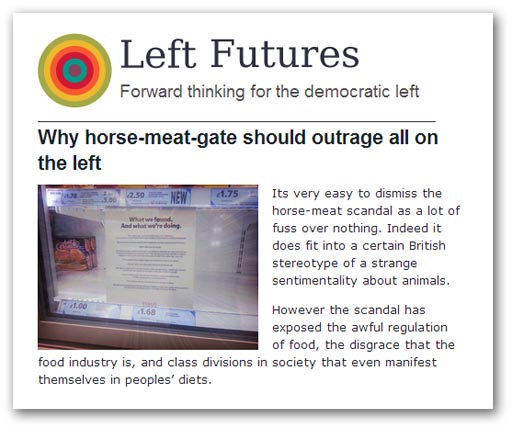 And when it came to the recent horsemeat issue, this was something where I could certainly contribute, having been in the food safety business for thirty years, with a comprehensive overview of food legislation and safety systems. The sadness is that while you can offer knowledge and insight, there is no way one can – or should - force it on others. But it remains troubling that so many seem to revel in their own ignorance, and make no attempt whatsoever to remedy it. One can take a horse to water, as I am prone to say, but you cannot make it think. When it comes to cultivating ignorance, though, none seem to cultivate their ignorance more assiduously than the so-called "Left", as in this very recent example by Left Futures, its dissertation faithfully reflecting the views of the Labour front bench. The horse-meat "scandal" it thus tells us, "has exposed the awful regulation of food, the disgrace that the food industry is, and class divisions in society that even manifest themselves in peoples' diets". That then is the mantra and, to illustrate the first point, we are referred to the "Any Questions" programme a few weeks ago when Nigella Lawson said she did not know what the fuss was about. She had eaten horse plenty of times in restaurants. This, apparently, had evoked a response from Helena Kennedy, who had been "quick to point out Lawson’s privileged position", saying "the horse she'd eaten hadn't come from the knackers yard and not been properly regulated like the horse found in this scandal". Now, if one recalls the early phase of the publicity on this issue, where Findus was in the frame, the source of the horsemeat was tracked to a slaughterhouse in Romania. And there, no one suggested that the slaughter had not been unregulated in what was a fully approved EU-standard slaughterhouse. In fact, if you want to eat rotten meat, the place to have been might have been the branded 220-strong French restaurant chain Flunch, which was last year caught up in a rotten meat scandal, where the Castel Meat Group had been implicated in "repackaging" spoiled meat and sending it on to its restaurant group customers. The scandal emerged after a "Peter H", former quality director, had discovered that employees of the company had been selling lots of spoiled meat. He had ordered the meat destroyed but had found that, behind his back, they had continued selling it. When Peter H had challenged the practices, he had been fired, the complaining at the end of 2012 to the veterinary services. Ironically, as with so many others, Castel Meats claims to have ISO 9000 certification and HACCP plans, the latter being a statutory requirement under EU law. But surely, this must be an example of "poor regulation" about which Left Futures complains, for it is exactly the same legal framework under which horsemeat has been sold as beef. Interestingly, Left Futures - which exhibits strong europhile tendencies – does not identify the source of its "awful regulation of food", and nor does it suggest where improvements might lie, other than to say: "We have to have proper food regulations to make sure that companies cannot exploit the less well off with sub-standard products". To support these claims for the less well off, we are earnestly told that the horse DNA "has all been found in cheap meant that many people who are less well off have to buy", something which simply is not true. Not only do we have Davigel, the high-end French catering supplier, there have also been several kebab suppliers, and we have also seen adulterated corned beef. In fact, the very latest findings from Berlin involved two doner kebabs, corned beef, a fresh meat product and one ready meal. The adulteration is by no means confined to foods eaten by the less well-off. This is a widespread international fraud, involving multiple actors in many nations. Only by complete disregard of the evidence, therefore, could Left Futures assert that we "should make no mistake". The horse-meant scandal, it tells us, "has class at its core". Its about "the rights of all people, whatever their means, to be able to have the dignity to have decent food". Now add another lefty mantra – the "cuts". The adulteration of beef with horse-meat "was driven on as a race to the bottom for ever cheaper meat by local authorities. With non-essential budgets being cut from hospitals and schools, procurement departments were handing food contracts to the cheapest bidder".
That, it is then asserted, "made companies look outside the law to get cheaper meat and ended up with unregulated horse in our food-chain".
The libel there is, of course, non-specific, but the inference is that companies producing the end products knowingly broke the law. No allowance is made for the probability that some of those companies were themselves victims of this massive epidemic of fraud, and the flawed regulatory system on which they were unwise enough to rely. In the simple world of the lefties though, there are no greys. It is all black and white. "Ultimately, they advise us, "the scandal has exposed all the problems in the modern food industry". What those problems are, we are none the wiser. And we are not left to dwell on the issue. The real message is - poor regulation aside - that "there is a clear class division in terms of diet, with those less well off being forced to eat poor quality food that leads to ill health". Then, sneaked in at the final furlong is the real message: "Government cuts to services" have resulted "in sub-standard food making it onto the plates of schoolchildren and patients". There you go – you knew it was that all along. Like the europhiles, with their "more Europe" as the answer to every problem, the cause of every problem for the lefties is "government cuts". We don't need inquiries; we don't need knowledge. The answer was there all along. All we needed to do was to read Left Futures. COMMENT THREAD Richard North 07/03/2013 |
Media: cleaping up its act
Wednesday 6 March 2013

But, like the payday lenders, the Telegraph is only interesting in taking your money for minimum input. It certainly isn't about giving us accurate news.
If you are tired with following the media agenda, though, just ignore it. That's what Bill Whittle says. It gets interesting about 45 minutes in, and those who have been following the ideas here will recognise elements of the Harrogate Agenda. He talks about the "Common Sense Resistance" – the thinking is muddled, but he's getting there. COMMENT THREAD Richard North 06/03/2013 |
EU politics: budget veto on the cards
Wednesday 6 March 2013
 This, the paper claims as an "exclusive" and that it may be, although the Irish Independent was forecasting problems last week. Nevertheless, we have heard very little recently about the budget from the British media, even if EP rejection was always on the cards, kicking another of Mr Cameron's great victories into touch. Parliament president Martin Schulz, we are told by Welt, has had initial exploratory talks with the Irish EU Presidency and the European Commission and has demanded that the Council should agree to a "package of demands". This includes a "mandatory mid-term revision of the budgetary framework" by the Parliament and the EU Commission. There will be an insistence on a "legally binding resubmission" to be enshrined in the Finance Act. Herbert Reul, Chairman of the CDU/CSU parliamentary group in the European Parliament is also demanding more flexibility in reallocating individual budget items. He wants surpluses to "be transferred automatically into the next financial year". Another demand is for the reallocation of funds within the budget, and the Parliament thus demands "comprehensive negotiations" with the Council. Negotiations could include aspects that were not part of the Council decision. The test of whether the EU leaders are ready to return to the negotiating table will come the by the end of the week following the plenary session in Strasbourg, when they meet in Brussels for European Council meeting. This could be a testing time for the "colleagues" as it was difficult enough for them to reach an agreement in the first place. As for Mr Cameron, the very last thing he needs is for his budget "triumph" to unravel. COMMENT THREAD Richard North 06/03/2013 |


 Posts
Posts

