
EU politics: a growing sentiment
Tuesday 19 March 2013

Whatever else there is to say about the Cyprus situation, it is fair to say that it has turned out to be a PR nightmare for the "colleagues" – with this AP photograph doing the rounds (above). This has been an enormous boost to the anti-EU cause.
However, there is not much sympathy for the Cypriots to be found in Handelsblatt. For years, it says, the banks on the island nation have operated risky businesses, investing in high-interest loans, including those from Greece. The business model seemed to work, at least for a while, allowing the total assets of the island's banks to expand to seven times the total economic output of the country. Over term, this has benefited their depositors. An account with a Cypriot bank has earned more than 24 percent. Someone placing €10,000 in January 2008 - the year Cyprus adopted the euro – would have earned €2,420 by today. That is almost double what German saver might have earned with a similar account in Germany. According to data from the Bundesbank, the increase would have been about €1,300. Thus asks Dirk Becker, a bank analyst at Kepler Capital Market: "Could banks in countries such as Cyprus and Greece to pay higher interest rates because their savers are more deserving?" As always, therefore, there are two sides to the argument. The levy is a blunt instrument , but the there must have been a core of "investors" who should have known that nothing is for nothing. The lesson is there in the high interest rates offered by Icelandic banks. However, amongst those hit are the less sophisticated Cypriots. They can hardly be blamed for putting their money in their own national banks, yet they are being forced to for the sins of their bankers, many of whom have become very rich on the proceeds of the bonuses paid. One way of separating the sheep from the wolves would, of course, be to penalise offshore depositors, leaving residents' accounts untouched. But that would be contrary to EU treaty law – discrimination on the grounds of nationality. The "colleagues" are, therefore, hoist with their own petard. They cannot target the real speculators, for fear of falling foul of their own treaties. Hence, there are working on the idea of a €20,000 euro cut-off, below which the levy will not apply. Nevertheless, the move is still being described as financial genocide. "We feel like during the war", says president of the Chamber of Commerce and Industry in Limassol, Philokypros Andreou. "We feel like in 1974 when the Turks invaded. Today there is only one difference: The weapons directed against us are not more guns, but financial instruments. For us this is a financial genocide". As the implications of what has been done become clearer though, the Cypriot parliament is firming up against the scheme, while the Cyprus Central Bank warns of massive capital flight. Meanwhile, as the scheme unravels, there are fears mounting that the modifications are chipping away at the package to such an extent that it will not bring in enough money. At that point, the "colleagues" will have achieved the worst of all possible worlds – having upset just about everybody without achieving their stated objective. And it could not have happened to a nicer bunch. COMMENT: CYPRUS COMBINED THREAD Richard North 19/03/2013 |
Media: lone bloggers not under threat
Tuesday 19 March 2013
There has been a certain amount of concern as to whether bloggers might be caught by the proposed press regulations, and thus be exposed to crippling fines. However, in the debate last night in the Commons, the position was made clear by culture secretary Maria Miller.
A clause inserted into the coming Bill makes the law apply only to a "relevant publisher". Such a publisher would have to be publishing news-related material in the course of a business, the material would have to be written by a range of authors and it would have to be subject to editorial control. These tests, says Miller, "would exclude a one-man band or a single blogger". The clause added is "specifically designed to protect small-scale bloggers", she said. Lone bloggers clearly do not meet the criteria necessary to include them in the regulatory maw. However, online news sites such as Huffington Post, may well be caught in the net. Thus, if anything, this new law will have the effect of levelling the playing field between the clogs and the independent bloggers. I am sure that is an unintended consequence, but I am not going to shed any tears if parasites such as Huffpost find life a little more difficult. COMMENT THREAD Richard North 19/03/2013 |
Eurocrash: Germans on the make
Tuesday 19 March 2013
 The "colleagues" have allowed the Cypriot government a little more flexibility on how they structure their bank raid, exempting sums under €20,000. But, looking at the faces of these women (above), any Cypriot politicians venturing on the streets might measure their lifespans in nanoseconds. Says Marchel Alexandrovich, at the brokers Jefferies, though: "what should really worry European policymakers is not the €5.8 billion in money which is being extracted in Cyprus, but the €2,754 billion of deposits in the Spanish banking system". Of that, €182 billion comes from deposits outside the euro area. And that can very easily find different homes to go to. Not least, there is the Russian money and Putin is a seriously unhappy bunny on behalf of his friendly neighbourhood oligarchs. , His view of the levy is that it is "unfair, unprofessional and dangerous". A promised bilateral loan of €2.5 billion may now not materialise. Surprisingly, even the Turks are unhappy. Although they don't recognise the Greek Cypriot government, and have almost zero commercial links with the Greek side, the EU is Turkey's biggest trading partner and the turmoil has affected the value of the Turkish lira, cutting 0.9 percent from its value. The euro, predictably, hasn't done too well either, losing a full one percent of its value against the dollar – a three-month low. But there is one great beneficiary from all this – the German economy. Die Welt reports that the rush of investors to buy German government bonds had brought Finance Minister Wolfgang Schäuble an interest rate saving of at least €15 billion. This is because the federal government has to refinance annually about one-fifth of its €1.3 trillion debt mountain each year by issuing new securities. Servicing the interest costs around €30 billion. But for the crisis, though, this sum would be even higher. And, according to calculations by the Kiel Institute for World Economics (IfW), this so-called "safe-haven" effect will get stronger as the eurocrisis persists. By 2023, the federal government will have saved about €80 billion, from reduced interest, compared with pre-2009 levels when the crisis started. Rather than getting so angry, therefore, Cypriot grannies should be comforted by the thought that Angela Merkel is saving a lot more than they are having to find. Somehow, though, one gets the impression that they are not as enthusiastic as they might be. Some people are so hard to please. COMMENT: CYPRUS COMBINED THREAD Richard North 19/03/2013 |
EU politics: the elephant in the refuse tip
Monday 18 March 2013
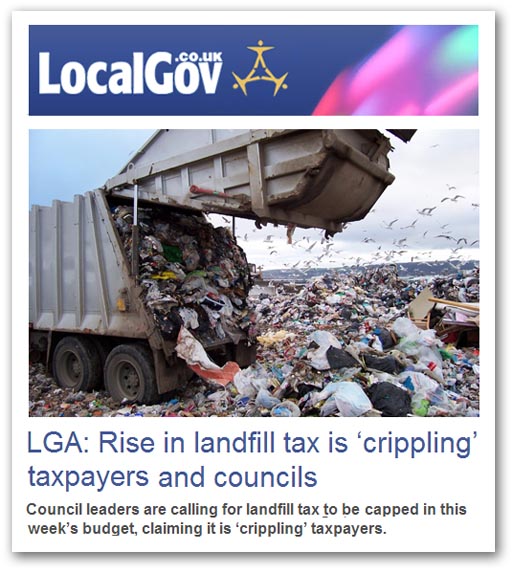 The LGA say the eleven percent automatic increase is being used to fill the "black hole" in Treasury's books, and will only lead to money being diverted away from local services. Mike Jones, Chair of LGA's Environment and Housing Board, said: ‘Since central government started collecting the money generated through landfill tax they will have almost quadrupled the charge from £24 to £80 a ton. This, he complains, equates to almost six times the average rate of inflation, yet none of this extra money is being invested in developing our waste infrastructure or helping us hit our recycling targets. But nowhere do we hear Mr Jones tell us that the reason this tax has been levied is to force local authorities to meet EU targets under the landfill directive. One might have more sympathy with Mr Jones if he did, especially if you add the extra cost of the fruitless recycling. And this, as Raedwald points out, has special relevance, as there is no market for much of the recycled material anyway. COMMENT THREAD Richard North 18/03/2013 |
Media: a free press? In your dreams, Melanie
Monday 18 March 2013
 Wolfe was born in Milan, Italy, in 1885, of a Jewish family, but was brought up in Bradford, West Yorkshire and was a pupil at Bradford Grammar School. He was one of the most popular authors of the 1920s. The quote comes from the Uncelestial City published in 1930. And now, in the wake of Leveson and in anticipation of a Commons vote tonight, Melanie Phillipspitches in on behalf of her employer, to plead for the continued privileges of this multi-million business sector. Interestingly, the press is never so voluble as when it is defending its own privileges, to which effect it will always call in aid the higher cause of defending democracy. However, as we have observed earlier, so much of that is self-serving cant. Not least, as we said then, while the press bleats about its "vital role in a democracy", it has presided over – and largely supported – the steady transfer of power to the anti-democratic European Union. The Daily Mail , which now so assiduously champions press freedom is one of those newspapers which supports the UK's continued membership of the EU. The press wants it "freedom" only to preserve its license to maintain the status quo. It is not, and never has been interested in the needs and aspirations of its readers. It is concerned only to shape opinion and to contain dissident thought, protecting the establishment of which it is part. Thus, while we would not wish to see the press hampered even more than it is – for anything which gives the executive more power is a bad thing – the special pleading we are hearing is unconvincing. The only sensible response to the current furore is to wish them a plague on all their houses. The interests of the press are not our interests, and the likelihood of the press ever going out on a limb to protect our interests, over and above their own, is nil.
Rather than freedom of the press, our own interests might be best served by freedom from the press. Until we, not they, are setting the agenda, we will always be in their thrall.
COMMENT THREAD Richard North 18/03/2013 |
Eurocrash: Cyprus - a massive own goal
Monday 18 March 2013
 Spiegel, for instance warns of the compulsory levy ensuring "massive trouble", with bank customers "outraged". There are even doubt as to whether the Cypriot parliament will agree. But there is little choice on offer. The country has the choice to accept the package, and thus to prevent a chaotic national bankruptcy, or reject it, and then accept the consequences, says the deputy chairman of the conservative ruling party Democratic Rally (DISY) Averof Neophytou. The Green MEP Georgios Perdikis speaks of a "lose-lose situation". That said, today is a bank holiday in Cyprus, and a parliamentary vote planned for yesterday has been transferred to this day, while the banks remain closed. So uncertain is the outcome of the vote that there is talk of keeping the banks closed on Tuesday as well, to avoid "a stampede of outraged savers". To try to soften the blow, attempts are being made to open talks to renegotiate the deal, even if Angela Merkel and her finance minister are defending the bailout plan in public. But there is no certainty that the Bundestag will back her. Crucially, Die Welt calls the rescue "wrong and risky", not least for the effect if will have on Spanish and Italian sentiment. "Who can now say that Spanish or Italian banks will not proceed under Cypriot model?", it asks. Effectively, this is a massive "own goal" in the part of the eurozone as, in one fell swoop, the "colleagues" have destroyed will little vestigial trust there is in the banking system. You can not blame any Spaniard, if he puts his money s under the mattress, says Die Welt. And thus is exacerbated the banking crisis. Handelblatt has detail on the proposed renegotiation, which will attempt to exclude small savers, exempting sums less than €25,000. The British government, meanwhile, has moved quickly to protect the deposits of military and government personnel who are stationed in Cyprus. The euro will became legal tender on all British military bases in Cyprus, when the country joined in January 2008, the first part of sovereign British territory to adopt the currency. "We are going to compensate anyone who is affected by this bank tax. People who are doing their duty for our country in Cyprus will be protected", says George Osborne.  Needless to say, the British government is taking the line of least resistance, undertaking to pay the levy on behalf of Crown employees, rather than objecting to its imposition. This is something theDaily Mail is quick to point out. It leaves us, as taxpayers, to pick up the bill. An estimated 60,000 expats, however, will get no assistance.
Putting the whole affair in perspective is Frankfurter Allgemeine Zeitung, which talks of the destruction of trust. "For euro-based investors, there is no more security for their savings", the paper says.
Pointing out that Cyprus has a minute economy, smaller than the Saarland, and that the "colleagues" are claiming there is no systemic risk to the eurozone, where central bank balance sheets fall in the trillion range, it questions why such dramatic action has been over a loan of €10 billion, the amount being advanced to Cyprus. So many things simply do not stack up that that the ECB is seen to be stoking up fear of contagion – especially as Greek savers are heavily exposed. This does not touch the banks or deal with the underlying problems. It is a tax on wealth. Thus does Die Zeit believe that we have reached a new stage in the eurocrisis. The rescue has turned into a "nail-biter". No one is now prepared to predict what will happen next. COMMENT: CYPRUS COMBINED THREAD Richard North 18/03/2013 |
Tuesday, 19 March 2013


 Posts
Posts

