

EU Referendum: whatever happened?
Friday 15 March 2013
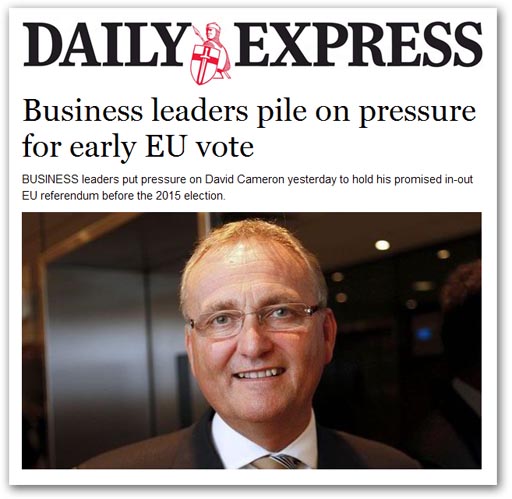 Via the Express, though, we get a glimpse of it at the British Chambers of Commerce annual conference, where John Longworth, director general, is calling for an early vote. "Once again the Government has chosen to push a decision until after the next election", he says. "Uncertainty is not helpful and the Prime Minister should consider engaging in negotiations this side of the election and bringing forward a referendum". If this is leadership, then Heaven help up. Longworth backs the PM's stance on renegotiating membership, but if he really thinks that Cameron is able to mount a renegotiation with the "colleagues" in time for a referendum before the next election, he is either ill-advised or terminally stupid.
Further, the last thing we need right now is a referendum. Still we are not ready as a movement to fight an effective campaign. Generally, we see the arguments frozen in time, with the focus on whether we should leave, when the real issue should be "how", part of which being to determine the shape of a post-EU Britain.
But what is remarkable, perhaps, is that the BCC is a voice in the wilderness. From being centre stage, with alarming rapidity, the EU referendum has dropped off the political agenda and is barely discussed in polite company. Some are trying to resuscitate it, but the issue is going nowhere soon. The heat has dissipated and it is going to take some effort to bring it back. That, at least, gives us time to come up with a better campaign strategy than is currently on offer. COMMENT THREAD Richard North 15/03/2013 |
EU politics: friends of the Mafia
Friday 15 March 2013
 This is because, by tradition, the Spring European Council is devoted to economic matters. And, to greet the event, Frankfurter Allgemeine Zeitung is running a long article about fraud, the Mafia and EU structural funds. The story is not new and actually picks up on a piece this newspaper did last year when it reported on a "record" €400 million being diverted by fraud on road construction in southern Italy. The specific focus this time is on Calabrai, and the appalling story of the upgrading (not) of the A3 highway. This ambitious project, now considered as the main European gateway for Colombian cocaine, is in a region which has so far absorbed €2 billion of EU subsidies. The highway was built in the sixties and seventies, and connects the provincial capital of Reggio Calabria on the outermost tip of the boot to the northern city of Salerno, 300 miles further north. Italy started in 1997 to upgrade the road and the EU contributed half a billion euros to the construction work. Since that time, the A3 has been one huge building site, a perilous obstacle course for every driver. It is built of concrete supplied by the Mafia, cut with sea sand. It is so weak that structures fall apart as soon as they are built.. The A3 tunnel linings have crumbling and cracked pillars; the road surface is bumpy and beset with ripples. Nobody knows when it will ever be ready.  On 3 July 2012, investigators of the European Anti-Corruption Authority, Olaf, told the Brussels press corps that the worst case of fraud involving EU subsidies ever encountered had been between 2000 and 2006 in Calabria. Some €453 million had been spent on roads, especially on the upgrade of the A3, of which €205 million came directly from the EU structural funds. Local politicians, officials and businessmen were bribed by the Mafia to fix contracts, resulting in an epidemic of overcharging or the presentation of invoices for services never rendered. But despite this, and despite reports to the contrary, there is no obligation on Italy to pay back the money. It has simply been required to spend the equivalent amounts on another, "clean" project. MEP Ingeborg Gräßle, sitting on Budgetary Control of the European Parliament, was not alone in angrily querying whether Italy had any "clean" projects. What comes over here is the weakness of Olaf. It makes threats, but they have no teeth. Barely 25 officials are involved with the subsidies from the Structural Funds. Nevertheless, the EU was told about the A3 in 2006, and informed of "serious irregularities". Between 2006 and 2010, what the EU Commission unearthed was so outrageous that it stopped funding the project. But, from the very first moment, the project had been "under the influence of the Mafia". This has been described by the Anti-Mafia Commission of the Italian Parliament. Emilio Santillo, Director of Police in Reggio Calabria during the seventies described the activities of the 'Ndrangheta – the Calbrain Mafia - in a detailed report. Each family was given a special section. They then installed at each construction site one of their men, the "site manager". The construction companies paid these "bosses" three percent of the estimated costs as protection money. They also had to let them dictate who they had hired: mostly young, unemployed men from nearby villages. The "bosses" then forced the companies to work only with subcontractors, which were controlled by the gangs, and only with suppliers who were approved by the Mafia. Inevitably, materials supplied were of catastrophically poor quality and overpriced. With the A3 funding, the EU has since 1994 invested almost three billion euros of taxpayers money in Calbria. This was to produce a "new Calabria" of which EU Commissioner Michel Barnier boasted in 2001. Yet, as to what the money has actually achieved, there has been no formal evaluation. The EU Parliament produced in 2009 a report which questioned the effectiveness and value of aid programmes in southern Italy, as long as the "threat posed by organised crime" continues to exist. But, even then, road construction was only one of the many criminal enterprises. Drug trafficking, money laundering, extortion, property scams and even food fraud, are all grist to the mill. Last week, an Italian paper noted that the 'Ndrangheta had become one of the world's biggest criminal organisations. Experts say it is richer and more powerful than the Sicilian Mafia. Cocaine is thought to be its biggest source of revenue, along with extortion and money laundering. It controls the European cocaine trade, and has close ties with south American drug cartels. It also operates in northern Europe, Australia and Canada. And decades of EU subsidies, paid for mainly by British and German taxpayers, have helped them acquire their riches. Today, oblivious to the effects of their policies, EU leaders are meeting to discuss growth and jobs. Yet, on the basis of the current track record, the main beneficiaries will be Mafia gangsters and the drug cartels. What is so significant, though, is that newspapers such as FAZ are choosing to remind their readers of it. COMMENT THREAD Richard North 15/03/2013 |
Media: Pope Francis on journalists
Thursday 14 March 2013
Courtesy of he loss-making Guardian, we see what the pontiff thinks of the fourth estate. "Journalists sometimes risk becoming ill from coprophilia and thus fomenting coprophagia: which is a sin that taints all men and women, that is, the tendency to focus on the negative rather than the positive aspects", he says.
Could be that he has been reading the blog, where we used exactly the same definition, or is my Jesuit training showing? Either way, it's nice to have a papal endorsement. COMMENT THREAD Richard North 14/03/2013 |
Horsemeat fraud: mischievous media
Thursday 14 March 2013
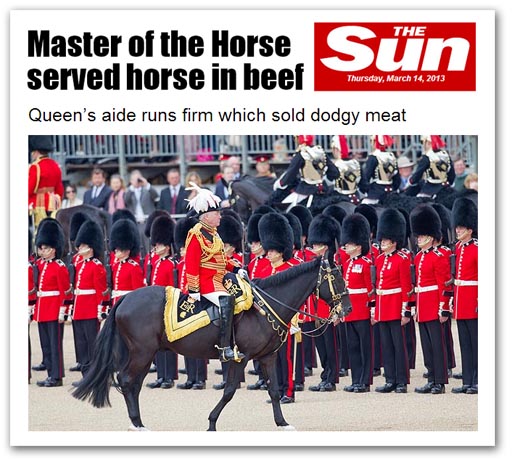 This goes back to late February when the caterer Sodexo was reported to have withdrawn products from sale after horsemeat was found in them. At the time, Sodexo refused to name their supplier, and both the FSA and ministers refused to make the name public, claiming that this could prejudice further investigations of what, on the face of it, were criminal offences. Last night, however, the supplier was named, which The Sun names as one of the Vestey Foods Group, a privately owned group of thirteen food companies trading all over the world. Picking on the name, however, allows the tabloid (followed by the rest of the personality-obsessed media) to pick on Lord Vestey (pictured), chairman of the group and former chairman of Cheltenham Racecourse. Since 1999, he has served as the Queen's Master of the Horse - a ceremonial role responsible for the "horses of the sovereign". The way the story reads, one could almost take it that Lord Vestey personally dropped chunks of horsemeat into the Sodexo order, while, according to The Sun and the dreadful Mary Creagh, "Tory ministers" are engaged in a high level cover-up, "protecting their friends in high places rather than the interests of British consumers". In fact, the supplier is GA International Food Services Ltd in the Labour heartland of Pontefract, one of the Vestey Group enterprises which moved into the area in 2004 to give jobs to unemployed miners, and their wives, after the collapse of the coal industry in the region. Lord Vestey would have no more knowledge of the detail of the operation that Mary Creagh herself, or her partner in crime, Labour MP Jon Trickett, in whose constituency the plant is situated. But, given its location, this is obviously clear evidence of a plot to destabilise Tory ministers. In fact, the clue to what has gone wrong lies in the company's website, where we see that it conforms to BRC Global Standards on food safety – part of the same madness that spawned HACCP and which drives the food safety industry, leading down the cul-de-sac of paper-led certification instead of intelligence-led inspections and traditional enforcement measures. You can tell where their interests lie from the introduction: The BRC Global Standards are a leading global safety and quality certification programme, used throughout the world by over 17,000 certificated suppliers in 90 countries through a network of over 80 accredited and BRC recognised Certification Bodies. The BRC Global Standards are widely used by suppliers and global retailers. They facilitate standardisation of quality, safety, operational criteria and manufacturers' fulfilment of legal obligations. They also help provide protection to the consumer.The essence here is standardisation, which stems back to the 70s when supermarkets started employing their own inspectors and setting their own hygiene standards. Suppliers found themselves besieged with rival inspectors, often requiring wildly different and often contradictory standards, so much so that a large plant could be getting two or three inspection a week. To resolve this problem came the industry bodies such as the BRC to produce their own standards, the name of the game being to reduce the number of inspections to, latterly, to provide evidence of conformity which could be used in any "due dilligence" defence. Note how "protection to the consumer" comes as an afterthought. From what I know of Vestey Group operations, they always were a cut above the rest, but aggressive in defending their interests against local authority inspections. It would be a brave inspector who took them on, and rare to have your council back you, as the expense of taking a case against a Vestey Group company could be prodigious. Latterly, the "BRC Global Standards" and similar scheme, have provided the "get out of jail free" cards to the food industry, enabling companies to protect themselves from the risk of food safety and related prosecutions, while providing their supermarket and corporate customers with the paperwork needed for their "constructive ignorance" defences. It was this ethos which infected the EU at the turn of the century, and led to the current food safety package, brought about by intensive corporate lobbying and ignorance on the part of the legislators. Throughout this affair, this has been at the heart of the problem, and how nice it would be if the media actually focused on the real issues. I did, in fact, take a phone call from Reuters, taking ninety minutes to explain to a journalist the failings of the regulatory system to a Brussels correspondent. But no story was ever published. The issue is beyond the competence of the media to report. Strangely, though, at a higher level than the EU, in UNECE, we are beginning to see a glimmer of intelligence. Says Alberto Alemanno. Assessing the EU response to the horsemeat fraud, he sees policymakers selling the EU consumer "the illusion of addressing their concerns while instead relying on the first available policy option that promises a quick fix". "Creating rules is definitely easier, though more expensive for tax payers, than making sure that they are abided by", he adds, offering a truism that is easy to say but hard to put into practice. Not least, policymakers tend to want panaceas. Devising real solutions is far too difficult for EU politicians and risks upsetting too many powerful people. COMMENT THREAD Richard North 14/03/2013 |
Is the pope a catholic?
Thursday 14 March 2013
Well, he's a Jesuit. That may be better. We are warned not to expect too much, but you never know with Jesuits. If he doesn't surprise, I'd be surprised.
COMMENT THREAD Richard North 14/03/2013 |
Horsemeat fraud: back in the news
Thursday 14 March 2013
 This is 600g packs of frozen meatloaf, sold as "Tesco Simply Roast Meatloaf", manufactured between October 2012 and January 2013 at Eurostock in Craigavon, Northern Ireland. The product has now been withdrawn and Tesco is telling the world that said it would complete its own investigation into tracing the "source of contamination" before it took a call to continue with the supplier. If Tesco is still referring to "contamination", that suggests it is either being a little bit coy about being associated with the "adulteration" word, much less admitting to their involvement in what is a growing epidemic of fraud. However, if the corporate Tesco is playing games, it is not alone. Food adulteration never actually went away. Over the weekend, for instance, the Scottish Sunday Mail reported that one in three curries tested in Scottish restaurants were "fake", using cheap beef instead of lamb in popular Indian dishes such as bhoona and korma. Substitution was found in 46 of 129 restaurants tested; 33 contained no lamb at all and the remaining 13 had some lamb, a raw ingredient priced at about £9 a kilo, adulterated with cheaper cuts of beef which could be bought for £5 kilo. Officials have not so far taken any action against the restaurants, but are trying to track down the suppliers who, in some cases, are as far away as Birmingham. Slightly further away is Romania, where Doctor Yordan Voynov, Executive Director of the Bulgarian Food Safety Agency, reveals that his agency has discovered unreported horsemeat instead of veal in four products: boiled smoked sausages and one cold smoked flat sausage. That is four out of 25 samples, the first batch of 100 samples taken from the commercial network. France also has been testing and admits to horsemeat having been found in pre-cooked beef meals prepared meals from four companies other than the already-identified Spanghero-Comigel. So far, out of 140 tests, two of the new companies, Covi and Gel Alpes who supply William Saurin and Panzani, were associated with Dutch firm Draap Trading – which has already been implicated as a source of the horsemeat. The two others were Davigel (Nestlé) and corned-beef maker Toupnot, but the reports says they have had very little horsemeat. France, though, has not just had horsemeat to contend with. Like the Americans, they too are aware of the possibility of large-scale fish substitution . Anti-fraud agents from the DGCCRF have been ordered by Consumer Minister Benoît Hamon to check sole, halibut and sea bass, to ensure that cheaper fish has not been substituted. DGCCRF agents say they have uncovered 15,700 frauds in 740,000 checks in 142,000 businesses last year and Hamon says that, despite a 16 percent reduction in staff over the past five years he was ringfencing jobs in 2013. He also called for increased use of "mystery shoppers" to uncover fraud. The Germans, of course, have had their aflatoxin in animal feed and their organic egg scandal to deal with. And now, it seems, the Hungarians have something fishy going on with eggs – to coin a phrase. Recently, the Customs and Finance Guard discovered in a warehouse in the southeast of the country 864,000 undeclared eggs of unknown origin, worth over €100,000. The goods have been seized and proceedings initiated against the owner of the warehouse. Alert veterinary officials in Poland have also been busy, raiding a manufacturer in the Bydgoszcz district. It is alleged to have mixed rotting meat with expired shelf-life meat to produce sausages. To date, 25 military units have been supplied with meat from this sausage company. Iceland went to the other extreme, their investigators finding that one meat product tested for horsemeat adulteration passed the test with flying colours, but only because no meat at all was found in the product. Into this heady mix, though, wafts the Consumers Association (CA), full of its own importance, telling "government" what action it should take. "The answer is simple, something must be done", is almost the tenor of the advice, as it calls for, "more surveillance that's better coordinated", even though the chances of picking up adulteration from random sampling across the whole range of products on sale is slight indeed. The CA wants Defra and the FSA to improve co-ordination, but there is nothing about involving the international police agencies, which are in the forefront of the fight. The same limited vision afflicts their advice on "tougher enforcement", with "tough penalties" for those prosecuted. Tough penalties, there already are. Penalties for fraud include prison. But nothing is said of the effect of "due diligence" or of the role of paper-based controls, which have weakened the control system. Instead, the CA calls for better "traceability", and "improved labelling", even though neither would have an impact on food fraud. And the one thing we have not seen throughout the continent is the structures of the control services having any impact on the prevalence of fraud. Yet the all-knowing, all-wise CA demands that the split between food standards and labelling issues between the FSA and Defra should be ended, with the responsibility for labelling and standards moved back to the FSA. Never mind that, throughout Europe (and most developed countries), there is a split between food safety and food standards activities – for good reasons. The skill-sets required are different, and the disciplines are very separate. What we see, though, is the failure to recognise that we are talking about criminal enterprise, with a strong international dimension. Beyond the limited vision of the Consumers Association, we need to see police and fraud specialists in the loop. Once again, it has to be emphasised, this is primarily a criminal issue, something which the CA clearly does not understand. More usefully, we get Petra Wissenburg corporate quality projects director for Danone telling us that we must think like criminals to beat the food fraudsters. And that again is another skill set. The fish products industry adds that the industry sectors must cooperate and work together. That means taking food fraud seriously, which even now – to judge from Mr Tesco – is not yet happening. But only when fraud is seen for what it is will we start to see some serious progress. COMMENT THREAD Richard North 14/03/2013 |
EU budget: procedures baffling brains
Wednesday 13 March 2013
 This is all the more puzzling as Die Welt signalled story weather ahead last week, which we reportedon the day – almost the only English-language report on the net. Current reports focus an a Motion for a Resolution drafted by the leaders of the main political groups in the parliament. This is a potentially explosive document as it asserts that the European Council's conclusions on the MFF (Multiannual Financial Framework), is "no more than a political agreement between Heads of State and Government", and "rejects this agreement in its current form, as it does not reflect the priorities and concerns expressed by Parliament". Euractiv, in its detailed report, suggested that there was strong pressure from national delegations to water down this wording. We were told that amendments tabled would remove the word "reject" and the proposed revisions would be voted upon in this week's session in Strasbourg. The debate was held this morning, without the final text of the resolution being listed on the agenda, with a counter-motion proposed by Richard Ashworth on behalf of the ECR Group. The vote was scheduled for the midday session. However, even if this resolution falls – which it well might – the battle is far from over. Procedurally, the Parliament is still required to come to an agreement with the Council on the detail of MFF. Formal negotiations are set to start in April with a target for an agreement by the summer. Meanwhile, the procedure for agreeing the annual budget for 2014 is going ahead, on which there was a debate yesterday, on a separate motion. On this, a formal proposal is expected from the Commission in April, although without an agreement on the MFF, it is not clear how the budget will be framed. All of this makes the position as clear as mud, so one can quite understand the media walking away from the complications, and going for the easy option of reporting on possible changes to the euro elections. After all, the EU comes under foreign news, and people aren't interested in what goes on in foreign parts, especially when there is so much important domestic news to absorb.
UPDATE: The EP appears to have adopted the resolution rejecting the budget, and Schultz is now saying that the parliament will not accept the budget until all payments for 2012 have been made and there are agreements in place on future funding and a comprehensive revision.
On the face of it, this does drive a cart and horse through Mr Cameron's budget "victory", effectively reversing the 3.3 percent headline budget cut. The precise details remain to be established, but it could mean that the Member States have to find as much as €217 billion more, to cover existing commitments. However, since the details remain obscure - for the moment - this is a slow-burn defeat for Mr Cameron and the other EU leaders. The extent of what could amount to a humiliating reversal will only emerge gradually, as the negotiations progress. As it stands, though, the MEPs will be chalking this up as a victory. COMMENT THREAD Richard North 13/03/2013 |
Climate change: not just us
Wednesday 13 March 2013
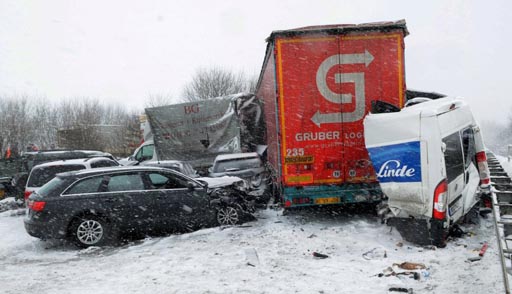 Inevitably, there are questions about the lack of preparedness, leading one researcher to note that sudden changes in weather do create a special hazard. But, just for once, this is not the UK. The A45 in question is in Hesse, near Münzenberg, as opposed to the A23 in England which took the brunt of the weather here. As always, there were complaints from motorists stranded overnight, but there were similar problems in the Channel Islands, and throughout Northern Europe, including France, Belgium. Holland and Germany. Eurostar train services between London and Paris were suspended after snowfall of up to two feet on the tracks in northern France and Belgium, leaving passengers stranded at St Pancras. But then, nearly a third of France's regions were on alert and the government activated a ministerial crisis group. Both of the main airports serving Paris were badly affected by the weather, with Charles de Gaulle and Orly cancelling up to a quarter of flights. No aircraft took off from the nearby Beauvais airport, which serves mainly low-cost airlines. At Orly, a Tunisair flight carrying 140 people from Djerba skidded off the runway on landing but no one was injured, an airport source said. And a traffic accident near Lille injured 14 people and a 58-year-old homeless man was found dead, presumably from the cold, outside a building in the town of Saint-Brieuc in Brittany. Belgium had its share of chaos, experiencing nearly a thousand miles of traffic jams on motorways caused by snowdrifts and ice. Buses and trains were cancelled or delayed in Brussels and other towns and the high-speed Thalys service linking Paris and Brussels was suspended. Thus, it is not only Britain that suffers unduly when there is unexpected snowfall. Most of the European authorities seems to have been unprepared – as indeed were many drivers. But most unprepared of all were the warmists. They have been very quiet indeed, although in due course they will be telling us that this unseasonable snow is down to global warming. For us in the sunny North, though, this is the fifth bout of snow this season, with one session having lasted well over a week. We have not experience conditions like this for more than 20 years, and I can't remember when we last had snow this late. With that, it doesn't matter what the warmists say. They really have lost the public argument. And when the lights go out, I suspect it will be open season for greens. And the more they parade their propaganda, I guess the worse it will be for them. COMMENT THREAD Richard North 13/03/2013 |
Energy: Japan extracts methane hydrate
Wednesday 13 March 2013
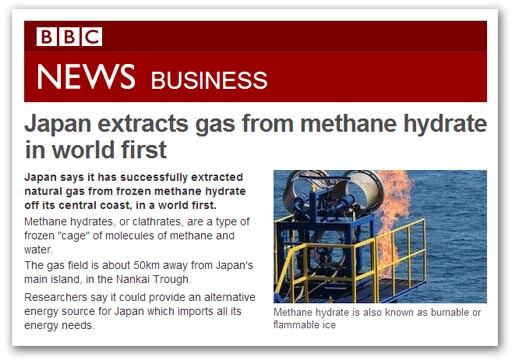 Methane hydrates, or clathrates, we are told, are a type of frozen "cage" of molecules of methane and water. The gas field in question is about 30 miles away from Japan's main island, in the Nankai Trough, extracted from about 1,000 feet below the seabed. Researchers say it could provide an alternative energy source for Japan which imports all its energy needs, and the estimated deposits in the Trough amount to at least 40 trillion cubic feet, sufficient for a decade or more of Japan's gas consumption. Total reserves may be sufficient to supply Japan for a century. Globally, by some estimates, the energy locked up in methane hydrate deposits is more than twice the global reserves of all conventional gas, oil, and coal deposits combined. Other countries including Canada, the US and China have been looking into ways of exploiting the deposits and are also reporting promising results. The Japanese aim is to establish methane hydrate production technologies for practical use within five years, following which substantial quantities will doubtless be extracted. Any exploitation is bound to have a global impact as, since the backlash against the nuclear industry after the Fukushima disaster two years ago, Japan has become a major player on the global gas market, driving up prices of internationally traded gas. A major new source of Japanese gas, therefore, is bound to have an effect on relieving the pressure on gas prices – even in the UK – making this fossil fuel more attractive, until the carbon tax wipes out its cost advantage. This notwithstanding, a substantial addition to global reserves from this unconventional source further weakens claims that there is a global energy shortage. Success by other countries, and exploitation of what will then be proven energy reserves, will remove energy shortage from the political agenda, with interesting knock-on effects. COMMENT THREAD Richard North 13/03/2013 |
UK politics: the "Europe" card
Tuesday 12 March 2013
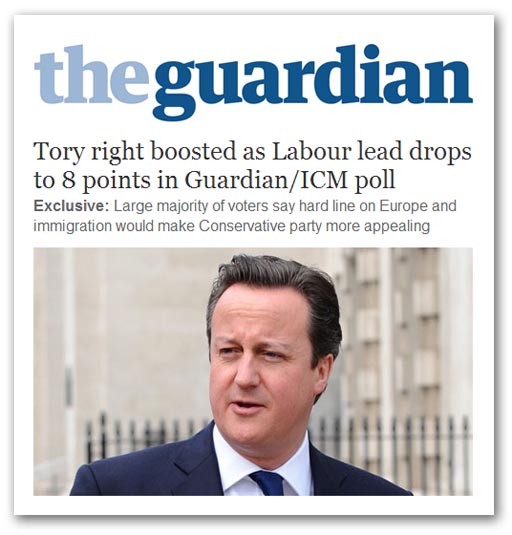 A month after Eastleigh, it has the Conservatives clawing back some of Labour's lead, to stand at 31 percent, while Ed Miliband's party stands at 39 percent. The Lib-Dems are up two, on 15 percent, and the UKIP "fever" has abated somewhat, with that party dropping from nine to seven percent. But what is more significant is that there is apparent support across the political spectrum on issues such as the EU. By a majority of 67 to 25 percent, voters across the spectrum say "the Conservatives would be more appealing if they took a tougher line with Europe". Thus, the poll indicates that the "right" is solid in believing a tougher line would boost the Tories. We get 83 percent of Tories, and 100 percent of UKIP supporters favouring this line, but even among Labour and the Lib Dems majorities of 56 and 64 percent respectively take the same view. An even larger majority say the same about "a tougher line on immigration". Overall, a tougher policy is favoured by 75 to 21 percent. And in what the right may seize on as a rejection of gay marriage, voters judge by 69 to 24 percent that the Tories' appeal could be boosted by keeping "themselves on the side of traditional families". Interestingly, though, there is little support for views of former defence secretary Liam Fox, who on Monday called for lower taxation as a priority, with a freeze on public spending. That attracts only 21 percent of the poll – respondents who hope for "lower taxes" above all else. As regards the bigger picture, Fox in any event is seen as a busted flush and would be unlikely to attract any significant support in the Tory leadership stakes. Teresa May, having gone out early, with Hammond as a possible running mate, is attracting a degree of opprobrium for her lack of "loyalty". She, like others (although she should know better) has been gulled by the media chatter about leadership contests – the standard fare of the media claque, whose political correspondents have long since ceased to report serious politics and are entirely focused on personalities and gossip. However, going too early likely means she will crash and burn – the early front-runners rarely win the race. And, if this poll is any indicator, the "Europe" card may be as significant as we hoped it would be. COMMENT THREAD Richard North 12/03/2013 |


 Posts
Posts

