
Eurocrash: the cat and mouse wags the dog
Wednesday 20 March 2013
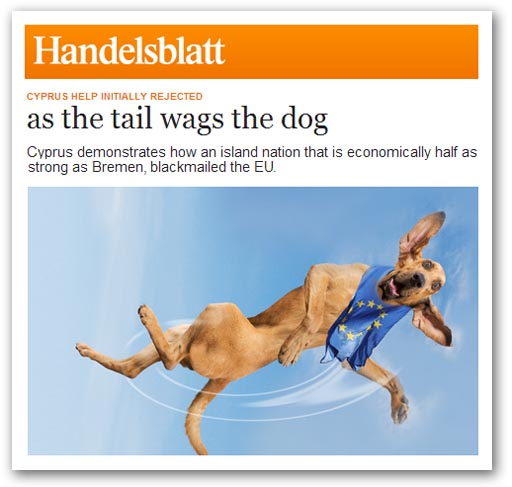 A tiny island, with the economic power about half the size of Bremen, it notes, is playing a game of cat and mouse with the second largest economic power in the world. By comparison, the GDP of the eurozone is more than 550 times as large as that of Cyprus. Mixing metaphors outrageously, it then presents this cat and mouse player as the tail wagging the dog, nevertheless recoding the words of the chairman of the ruling party Disy, Averof Neofytou. He speaks openly of how critical the situation is, declaring: "We are on the verge of a disorderly bankruptcy". Clearly struggling with the enormity of it all, Handelsblatt now has Cyprus racing "straight for the abyss". This, I suppose, is multi-tasking , while playing cat and mouse and wagging the dog, Cyprus also finds time to race for the abyss, although how it manages a straight path while doing so much else must remain a mystery. And just in case you missed the impression that it was, the paper also tells you that the Cyprus crisis is getting worse, adding that the vote against the rescue is "a catastrophic political defeat for conservative president Nikos Anastasiadis". The vote is far more catastrophic for the "colleagues" though. Having declared Cyprus of systemic importance, to let it now collapse is unthinkable. The disastrous effect on its own credibility, especially in relation to Spain and Italy, would be irrecoverable. Their word would no longer have any value at all. For the moment, the island's economy is being kept afloat by the same mechanism which kept the wolf from the door – the so-called Emergency Liquidity Assistance (ELA). Beyond that, the "colleagues", famous for never having a "plan B", don't seem to have anything else on offer. No one has ever said "no" to them in such unequivocal terms. But if they continue to insist on the compulsory levy, it would wreck the European principle of community and solidarity. Cyprus as a financial centre would be buried and destroyed Yet there is no real alternative - other than the sale of the natural gas that can be realistically exploited only in years. So, as the demonstrators in Nicosia shouted with joy at the news from their parliament, there must have been some very glum faces in Brussels. Possibly, Russia will come to the rescue. Finance minister Michael Sarris is leading talks in Moscow with Russian officials today, and he may come back with a bag of roubles. It may be either that, or don't come back at all – roubles or rubble, so to speak. And then there is another hurdle. There is yet another day to go before the Cypriot banks open. It there is no levy in place, the government is going to find it hard keeping bank accounts frozen. But it is going to find it very hard to prevent a run on the banks. Events will be watched very closely across the world, but nowhere more closely than in Spain and Italy. One false move to add to the many others will give "contagion" a new meaning, as cash pours out of the coffers of the banks in these two states. This makes it hard to disagree with former governor of the Cyprus central bank, Anthanasios Orphanides. He concedes that there has been a "very serious blunder" by eurozone governments. They are, he says, "blackmailing the government of Cyprus to confiscate the money that belongs rightfully to depositors in the banking sector in Cyprus". Orphanides thinks we are witnessing the slow death of the European Project, but we've been witnessing that for so long that one can never be sure. If nothing else, though, it is going to be very interesting indeed to see how the "colleagues" get themselves out of this mess. COMMENT: CYPRUS COMBINED THREAD Richard North 20/03/2013 |
EU Regulation: a glimpse of UNECE
Tuesday 19 March 2013
 The story is so utterly, bizarrely wrong that it took me quite a while to track down the actual facts, and this the newspaper illustrates once again the slender understanding British journalists have of European Parliament procedures. But, in this case, it also lifts the lid on the alternative world of ours, giving us a glimpse of that part of world government managed by UNECE. The Guardian story starts by picking up a story run last week by the paper, which tells us that car manufacturers are manipulating fuel efficiency tests. A campaign group, we were then told, was complaining that carmakers exploit loopholes in EU law to achieve favourable but unrealistic miles/gallon results. Obviously wanting to report developments, the paper now tells us that "the EU has taken a step towards reforming [these] vehicle tests", with "a vote on reforms to the system in an influential committee of MEPs on Tuesday". Cited in this respect is Lib-Dem MEP Fiona Hall and that gives us the clue to what is going on. She is rapporteur for an opinion delivered by the Committee on Industry, Research and Energy for the Environment Committee, "on the proposal for a regulation amending Regulation (EC) No 443/2009 to define the modalities for reaching the 2020 target to reduce CO2 emissions from new passenger cars". What's this got to do with proposals for a new testing standard, you might ask, and the answer would be "not a lot". The proposed regulation is not about testing standards, and the responsible committee is not Hall's industry committee, but the environment committee. However, what Hall does in her "opinion" is point out that there is "the growing gap between type-approval and real-world emissions from new passenger cars", which is "largely due to the methods which car manufacturers use when measuring CO2 emissions according to the current test cycle procedure". She therefore, adds, "It is vital to address this discrepancy, not least because CO2 reductions directly translate into fuel savings for consumers and lower oil imports", and then states that she would "like the Commission to review, by 2014, the EU's regulatory test procedure for measurement of specific CO2 emissions established under Regulation (EC) No 715/2007 and its implementing measures". So, we have a proposal for a regulation which is not about vehicle testing, which is being handled by the environment committee of the European Parliament. In response to this a member of another committee offers an opinion on the regulation, expressing a wish for the Commission to review the regulatory test procedure. The opinion was voted on by the industry committee yesterday and this, according to The Guardian, is interpreted as: "the EU has taken a step towards reforming [these] vehicle tests", with "a vote on reforms to the system in an influential committee of MEPs on Tuesday". Facile this claim may be, the paper then goes to report that the Commission "plans to follow the new ínternational procedures which are currently being negotiated by the informal United Nations Economic Commission for Europe (UNECE) working group on worldwide harmonised light vehicles test procedure (WLTP) in Geneva". These negotiations, we are told, are expected to conclude by 2014, but Hall want the Commission to update the EU test cycle by January 2015, regardless of whether or not the new UNECE test is finalised.
Here, then, is an acknowledgement that UNECE is actually making rules which the EU is following, about which we reported in detail last January. Needless to say, though, the Guardian hasn't got it right, because it talks about an informal UNECE working group, with Hall thinking that the Commission can by-pass this procedure and act unilaterally.
Thus – not unusually – we have an MEP as well who doesn't know the procedure. UNECE is managing harmonisation on a global scale, these current negotiations involving the EU, Japan and India, working alongside the United States EPA. The procedure is very far from being informal. UNECE is calling the shots and the procedure cannot be by-passed. In the fullness of time - sometime around 2015 - its test will be implemented by the EU.
But you will never learn of this from the Guardian, although at least it does now know of the existence of this higher regulatory body.
COMMENT THREAD Richard North 19/03/2013 |
EU politics: a growing sentiment
Tuesday 19 March 2013

Whatever else there is to say about the Cyprus situation, it is fair to say that it has turned out to be a PR nightmare for the "colleagues" – with this AP photograph doing the rounds (above). This has been an enormous boost to the anti-EU cause.
However, there is not much sympathy for the Cypriots to be found in Handelsblatt. For years, it says, the banks on the island nation have operated risky businesses, investing in high-interest loans, including those from Greece. The business model seemed to work, at least for a while, allowing the total assets of the island's banks to expand to seven times the total economic output of the country. Over term, this has benefited their depositors. An account with a Cypriot bank has earned more than 24 percent. Someone placing €10,000 in January 2008 - the year Cyprus adopted the euro – would have earned €2,420 by today. That is almost double what German saver might have earned with a similar account in Germany. According to data from the Bundesbank, the increase would have been about €1,300. Thus asks Dirk Becker, a bank analyst at Kepler Capital Market: "Could banks in countries such as Cyprus and Greece to pay higher interest rates because their savers are more deserving?" As always, therefore, there are two sides to the argument. The levy is a blunt instrument , but the there must have been a core of "investors" who should have known that nothing is for nothing. The lesson is there in the high interest rates offered by Icelandic banks. However, amongst those hit are the less sophisticated Cypriots. They can hardly be blamed for putting their money in their own national banks, yet they are being forced to for the sins of their bankers, many of whom have become very rich on the proceeds of the bonuses paid. One way of separating the sheep from the wolves would, of course, be to penalise offshore depositors, leaving residents' accounts untouched. But that would be contrary to EU treaty law – discrimination on the grounds of nationality. The "colleagues" are, therefore, hoist with their own petard. They cannot target the real speculators, for fear of falling foul of their own treaties. Hence, there are working on the idea of a €20,000 euro cut-off, below which the levy will not apply. Nevertheless, the move is still being described as financial genocide. "We feel like during the war", says president of the Chamber of Commerce and Industry in Limassol, Philokypros Andreou. "We feel like in 1974 when the Turks invaded. Today there is only one difference: The weapons directed against us are not more guns, but financial instruments. For us this is a financial genocide". As the implications of what has been done become clearer though, the Cypriot parliament is firming up against the scheme, while the Cyprus Central Bank warns of massive capital flight. Meanwhile, as the scheme unravels, there are fears mounting that the modifications are chipping away at the package to such an extent that it will not bring in enough money. At that point, the "colleagues" will have achieved the worst of all possible worlds – having upset just about everybody without achieving their stated objective. And it could not have happened to a nicer bunch. COMMENT: CYPRUS COMBINED THREAD Richard North 19/03/2013 |
Wednesday, 20 March 2013


 Posts
Posts

