

Horsemeat fraud: the Irish dimension - part 2
Saturday 16 March 2013
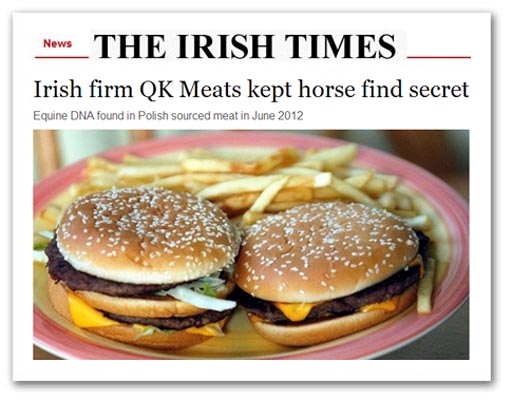 Look for the Queally Group on the web, however, and you will come up with this website, which advertises its flagship company, Dawn Meats. Of QK Meats, you will find no official company presence. Its website address is qkmeats.com, but this has evidently been taken down, for good reason. All we get is, "Error: The Query produced no records". Thanks to the cleverness of the Wayback Machine though, we can see the website in all its former glory (pictured below - click to enlarge), noting that the company has supplied meat products to over 40 countries world-wide since 1991. 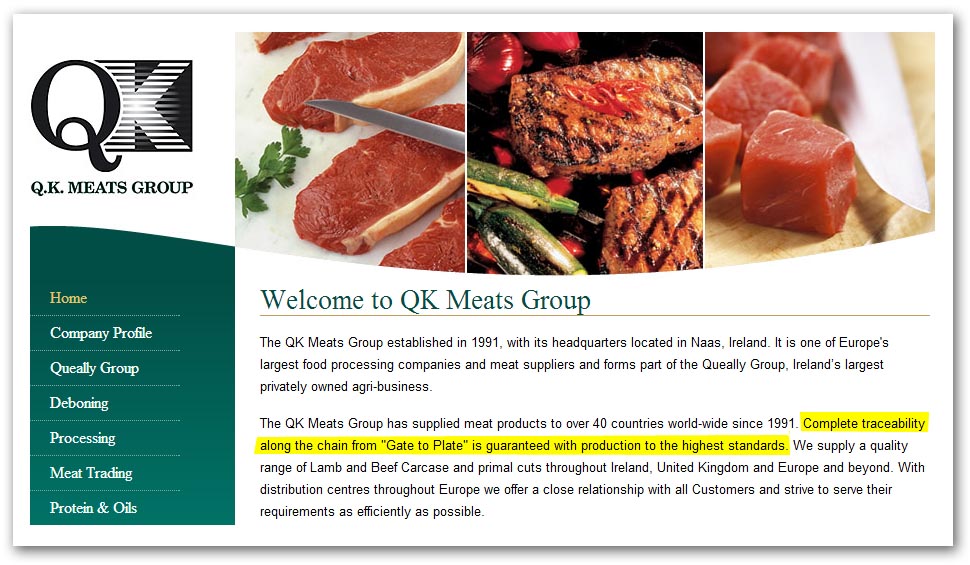 Ironically, it claims that, "Complete traceability along the chain from 'Gate to Plate' is guaranteed with production to the highest standards". And a separate page on food safety tells us: To enable both QK and its customers to serve the market at the highest levels we have achieved accreditation's such as higher level EFSIS, British Retail Consortium (BRC) membership of the Bord Bia quality assurance scheme, triple hygiene award from Excellence Ireland and a fully implemented HACCP system.The irony starts to become apparent when the company was recently implicated in the supply of meat to Frigilunch which in turn had supplied Birds Eye with a number of products. Birds Eye had been drawn into the drama when one of its chilli con carne products had tested positive for horse DNA in Belgium. Birds Eye then withdrew Spaghetti Bolognese and Beef Lasagne in the UK as a precaution, and subsequently confirmed that these products had tested positive for horse DNA as well. 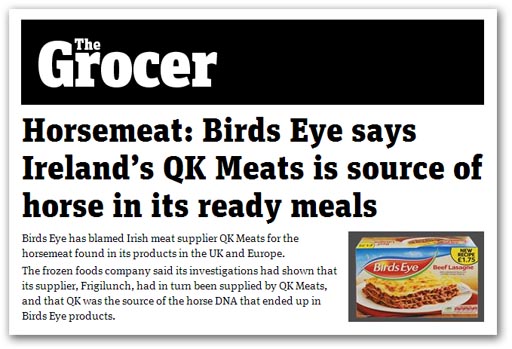 Birds Eye said it believed QK Meats was the source of horse DNA in both UK products and the chilli con carne from Belgium. That was on 5 March, but we now find from the Irish report that QK Meats had been involved much, much earlier. Details in fact started to emerge after the Irish Department of Agriculture had found horsemeat at Silvercrest. It had then conducted further enquiries to establish whether Polish labelled product had been used in other meat processing plants in Ireland. This led to QK Meats informing the Department on 5 February last that it had imported consignments of Polish labelled beef trimmings. Some of these had tested positive for equine DNA. The company then told the Department that products had been sourced from some 19 different Polish suppliers over a sustained period and these stocks had been stored in QK Cold Stores, in Naas, Co. Kildare. QK Meats subsequently admitted that, based on its own "risk assessment", it had tested 15 consignments from nine of its 19 different Polish suppliers. Seven of these had been positive for equine DNA. What has shocked an outraged both the Department and the media in general, though, is that the first positive test result was on 27 June 2012. Yet, instead of warning the Department, the company kept the information secret, simply contacting the Polish supplier whose representative visited the plant and arranged to take back the consignment. And this had by no means been the end of it. Further positive tests results on other consignments of Polish labelled product were obtained by the company in October, November, December 2012 and January 2013. QK Meats claimed that none of the equine positive raw material entered the food chain, but nevertheless continued to source raw material from Poland while being aware of its suspect nature. Another damning fact is that QK Meats was buying the Polish-labelled beef at €400 per ton less than the price of corresponding beef trimmings available in Ireland, making it clear that price had been the primary motivator in utilising imported ingredients in the manufacturing process. Still it goes on. Despite having found some products positive for horsemeat, the company did not test other consignments. Some of these were used in the manufacture of frozen minced meat preparations at a rate of between 10 and 40 percent, for a range of customers in six countries.
Other than suggesting that there were "mumblings" in the trade about suspect Polish raw material, QK Meats did not explain fully why it was testing for equine DNA since last June or why, having found equine DNA in some products did not test all such products.
Thus, says the official report, while these findings are extremely disturbing, QK Meats, knowing that the State was involved in a full public investigation into the source of equine contamination during the latter part of January, failed to inform the Department of its earlier findings following positive DNA test results. These facts, it says, would have informed the official investigation in a significant way and, most likely would have led to earlier conclusions on the source of equine DNA. Failure on their part to act at a much earlier time was inexcusable. It then adds that the this failure on the part of QK Meats senior management showed scant regard for the public good and was a serious failure of judgement on its part in not revealing to the official authorities. The information could have shortened the initial phase of the investigation in identifying the likely source of the equine DNA. But hey! The company can't be that bad. It has all its certifications and accreditation, it conforms with BRC Global Standards, it has a triple hygiene award from Excellence Ireland and it has a fully implemented HACCP system. All the bells and whistles were there. How could there possibly be a problem? COMMENT THREAD Richard North 16/03/2013 |
Horsemeat fraud: the Irish dimension - part 1
Friday 15 March 2013
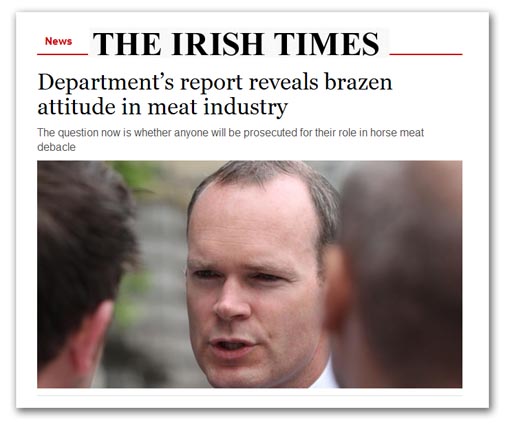 Bizarrely, although it was the Irish finding that triggered the whole of the horsemeat "scare", I have yet to see any reports in the British press, even though, as the Irish Independent picks up, a major Irish food company kept secret its discovery of horse meat in beef products last summer and was later found to have supplied contaminated meat found in school meals and Birds Eye products. The company was slated for its "inexcusable" delay in notifying Coveney's department of its discovery of horse DNA in imported meat until weeks after the Europe-wide crisis broke. Coveney then criticised QK Meats in the Irish Parliamant, for "knowingly withholding information about problems in the supply chain". He also criticised management at the ABP food group for failing to maintain proper oversight of its Silvercrest plant and warned that QK and ABP were "risking reputational damage to the Irish food sector itself".
The official report concludes that there was "no evidence that Silvercrest knowingly purchased horsemeat", but the company itself has admitted that "it had used non-approved suppliers in breach of specifications laid down by some of its major customers".
The "failure of management in this regard and the inherent disrespect for customer requirements", says the report, "has led to very serious consequences not just for the company concerned but has also put at risk the reputation of the entire agri-food sector in Ireland". "It is a real concern that management oversight and corporate governance structures were not in place to prevent the failures detected in this investigation in Silvercrest", the report adds, noting that, Silvercrest did not fulfil its responsibility to ensure the quality and authenticity of the products it was selling. It "deliberately failed to respect its customer expectations and agreed supply contracts". 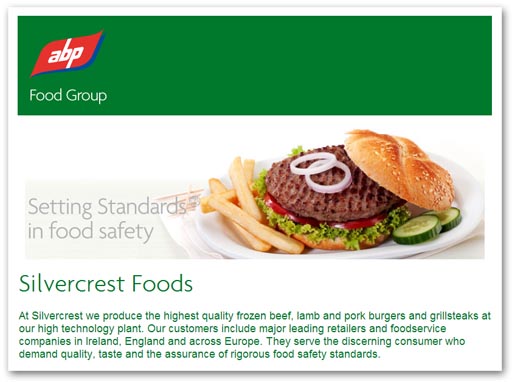 Now compare and contrast the corporate BS on the company website (above): At Silvercrest we produce the highest quality frozen beef, lamb and pork burgers and grillsteaks at our high technology plant. Our customers include major leading retailers and foodservice companies in Ireland, England and across Europe. They serve the discerning consumer who demand quality, taste and the assurance of rigorous food safety standards.Then, we get the usual litany of high-flown claims about monitoring and standards (illustrated below), with again reference to the BRC Global Standard that we identified yesterday, on the GA International website – the industry equivalent of "go-faster" stripes, with now just as much credibility. 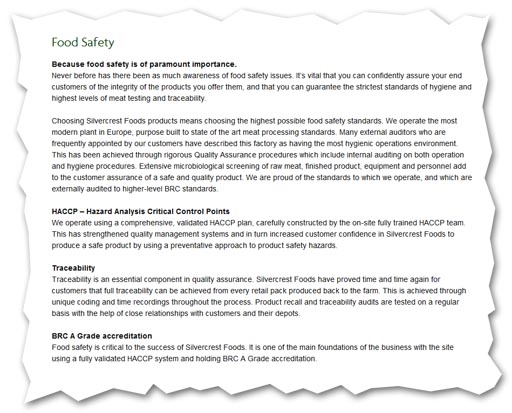 Also we see the corporate BS in full spate, as the company tells us: We operate using a comprehensive, validated HACCP plan, carefully constructed by the on-site fully trained HACCP team. This has strengthened quality management systems and in turn increased customer confidence in Silvercrest Foods to produce a safe product by using a preventative approach to product safety hazards.And yes, all the staff will have been "fully trained" in the procedures, and the plant will have been inspected by diligent "auditors", who will have rigorously filled in their tick-boxes and compiled their independent certification awards. So to complete the charade, the company proudly displays its awards (below), including the 2012 SuperMeat & Fish Award. There is no truth, of course, that the company has been shortlisted for the best adulterated food award of 2013, sponsored by the Garda National Bureau of Criminal Investigations. 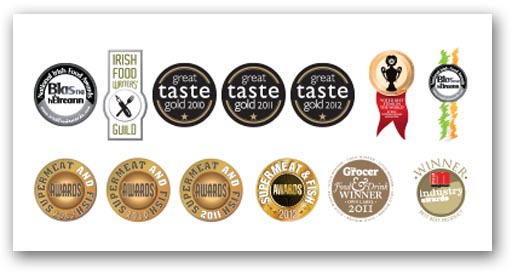 As we observed yesterday, though, this is precisely the BS that the European Union bought into when establishing its own legislation, supported by national enforcement agencies, turning standards into a corporate charade that puts the consumer last and least, at the end of a long list. Says the Irish report, "The disclosure in Ireland of adulteration of beef products with equine DNA has prompted other authorities to examine this issue". And, surprise, surprise, "It transpired that what had been uncovered was a pan- European problem of fraudulent mislabelling of certain beef products". "Almost all Member States have been affected by the problem. Indeed it has been uncovered outside of the European Union. It became a global problem affecting some large global companies and international food brands". Corporate BS, is indeed a global problem, and it is going to take some fixing. Whether banks, the food industry, water providers or energy suppliers, they are all at the same game. The only difference now is that it is the meat industry's turn to be caught out. The question is, as the Irish Times asks, whether there are to be any prosecutions. COMMENT THREAD Richard North 15/03/2013 |
EU Referendum: whatever happened?
Friday 15 March 2013
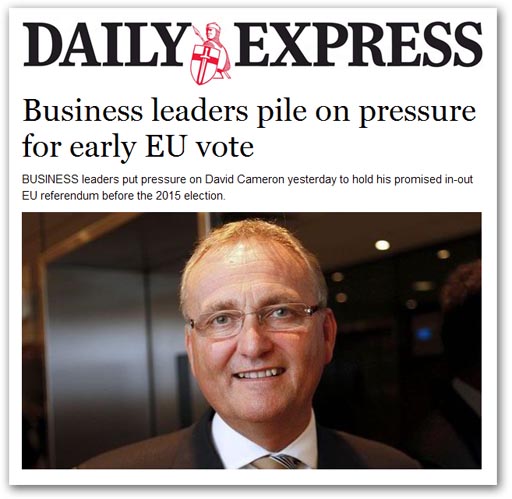 Via the Express, though, we get a glimpse of it at the British Chambers of Commerce annual conference, where John Longworth, director general, is calling for an early vote. "Once again the Government has chosen to push a decision until after the next election", he says. "Uncertainty is not helpful and the Prime Minister should consider engaging in negotiations this side of the election and bringing forward a referendum". If this is leadership, then Heaven help up. Longworth backs the PM's stance on renegotiating membership, but if he really thinks that Cameron is able to mount a renegotiation with the "colleagues" in time for a referendum before the next election, he is either ill-advised or terminally stupid.
Further, the last thing we need right now is a referendum. Still we are not ready as a movement to fight an effective campaign. Generally, we see the arguments frozen in time, with the focus on whether we should leave, when the real issue should be "how", part of which being to determine the shape of a post-EU Britain.
But what is remarkable, perhaps, is that the BCC is a voice in the wilderness. From being centre stage, with alarming rapidity, the EU referendum has dropped off the political agenda and is barely discussed in polite company. Some are trying to resuscitate it, but the issue is going nowhere soon. The heat has dissipated and it is going to take some effort to bring it back. That, at least, gives us time to come up with a better campaign strategy than is currently on offer. COMMENT THREAD Richard North 15/03/2013 |


 Posts
Posts

