

UK politics: the joys of representative democracy
Monday 4 March 2013
 It takes Jon Snow in his error-strewn Snowclog to represent the broadcast media. He observes that the government, "so keen to test public opinion on Europe", would never brook such a test of public attitudes to banking remuneration and working practices in the UK. The Swiss, he says, have often been ridiculed for their love of referendums. Not any more. Certainly, in Germany, there is no ridicule. The media give the referendum full coverage, many newspapers offering several stories, while the politicians have been quick to react, sparking a vibrant debate. Thus, Handelsblatt led on SPD Vice Joachim Poss, retailing a report from Neue Osnabrücker Zeitung, which had him saying, "The referendum is an important step in the right direction to meet the rip-offs in management elsewhere". Such is the emasculation of the German political classes, though, that Poss, instead of calling on the Federal Government to introduce a new law, called for an EU Directive, perhaps oblivious to Article 153(5) of the Treaty, which makes it clear that the EU cannot legislate on pay. But, when it comes to views of the referendum result, though, even the CDU economist Michael Fuchs approves. According to Die Zeit he is happy that salary decisions should not be taken by the state. "The shareholders know exactly what they can afford", he says. Green party leader Jürgen Trittin said that Switzerland was "a model for the compensation excesses in the financial sector" and wanted stricter rules in Germany would "stricter rules" are introduced. Sahra Wagenknecht, deputy parliamentary leader of the Left Faction asked Germany to take action. Her country, she said, was "a paradise for executives, undermining the merit principle". The North Rhine-Westphalian FDP chairman Christian Lindner criticised the multi-million bonuses paid by Deutsche Bank, calling for "a sense of responsibility". That was echoed by economist Michael Huether from the Institute of the German Economy in Cologne. While welcoming the public debate, his view, "instead of more laws, we need more boards of directors and board members who take personal responsibility". But it is precisely because the "thieves in suits" are devoid of any sense of personal responsibility that the people of Switzerland felt impelled to act. And, it appears, they haven't finished yet. Piggy-backing on Minder's success, the Swiss Young Socialists are campaigning to prevent executives from being paid more than twelve times the wage of their lowest-paid employee. A referendum on this is expected in the second half of this year, the group says. That formula would be particularly appropriate to the public sector, with a complete prohibition on performance bonuses, non-contributory pensions and excessive payoffs. But what a contrast we are seeing. While the Swiss people are able to force action, we are forced to rely on laborious progress of Mr Pickles, doing very little very slowly. Such are the joys of representative democracy. No wonder the British media, guardians of the status quo, are reluctant to talk about it. COMMENT: "BONUSES" COMBINED THREAD Richard North 04/03/2013 |
UK politics: the people don't decide
Monday 4 March 2013
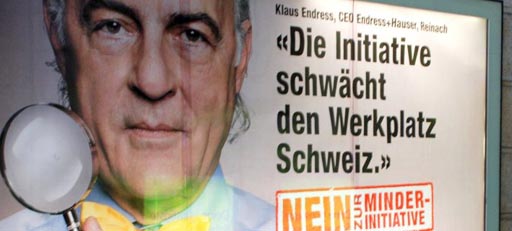 This is the result of the latest referendum where 67.9 percent of Swiss voters coming out in favour of the so-called "Minder initiative", the brainchild of entrepreneur and independent MP Thomas Minder. Also called the "rip-off initiative", it prohibits managers (or remuneration committees) deciding their own wages. Shareholders will have to the right to vote on the total of all remuneration of Directors, the Executive Board and the Advisory Board. This also extends to base salaries as well as bonus payments. During the voting, supporters had the upper hand in all language regions and both in urban and rural areas, in what was the third highest approval rate ever for a popular initiative. It was driven partly by big bonuses blamed for fuelling risky investments that nearly felled Swiss bank UBS, as well as outrage over a proposed $78 million (£51 million) payment to outgoing Novartis chairman Daniel Vasella. Judging from responses to the news of the EU attempt to curtail bonuses, such a move in the UK would be highly popular, where corporate greed has taken on a life of its own, in both the public and private sectors. Certainly, that is the case in Germany where 79 percent of respondents to a Handelsblatt Onlinesurvey opted for shareholder control of salaries and bonuses. An almost identical majority voted in a poll held by an online market research company. Few things, therefore, better illustrate the parlous lack of democracy in this country where our own politicians oppose mandatory restraint in the private sector and have no plans whatsoever to control the "thieves in suits" in the public sector. Whether you approve of the Swiss initiative or not, in that country the people can make the decision as to whether to clamp down on the "fat cats", as opposed to British citizens relying on the "undemocratic" intervention of the European Union in the teeth of the opposition from our own "democratically elected" politicians. Of course, if the Harrogate Agenda was in place, we could make our own decisions on this and many other issues, without having to wait for politicians – in Brussels or London – to make up their minds, or not. In Switzerland, the Business Federation Economiesuisse fought the initiative with a million dollar campaign, and now regrets the referendum decision. At the same time, however, the Federation has issued an assurance the will of "of course" be respected. When we the people can tell our corporates what to do, and get the same response, we can start to claim that we have elements of a democracy. As it stand though, the idea that the UK is a working democracy is a pretence to which we should not subscribe. In the meantime, we can expect the "rip-off" to continue, a standing testament to where the power really lies in this country, a country where the people don't decide and the political classes have no intentions of letting us anywhere near the reins of power. COMMENT: "BONUSES" COMBINED THREAD Richard North 04/03/2013 |


 Posts
Posts

