

Energy: they really are serious
Tuesday 30 April 2013
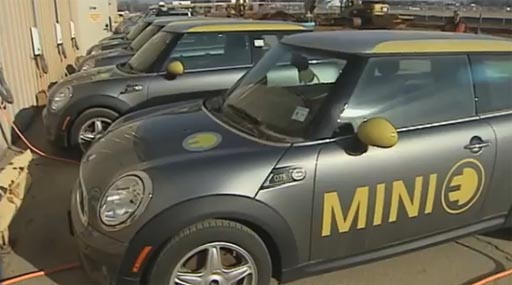 There has to be a reason why a website specialising in EU news should be carrying this item, and that is undoubtedly because V2G is slated as an essential of the EU's response to increased use of intermittent and highly variable renewable energy, and in particular the use of windmills. A more detailed story about the cars is here, which highlights the upside of this event. Vehicle owners are actually getting paid to connect their vehicles to the grid, but only as long as their stored electricity is available when called for. To explore this further takes us into highly complex areas, delving into the realms of "dynamic demand" – a sophisticated means of adjusting load demands. This is seen as an alternative to the "spinning reserve" system which is based on providing additional power when the demand increases. In the traditional electrical supply system, generators feed electricity into the grid and, when demand increases, as it can do very quickly, additional capacity is brought on-line, usually fossil fuel plants (gas), already warmed up and "spinning", able to feed power into the grid within seconds. With the advent of wind power, when supply can drop very quickly and cannot be increased, things change. "Spinning reserve" would have to be massive, the costs enormous, and the emissions high. Thus, the alternative being proposed is this "dynamic demand". The basis of "dynamic demand" is regulating the grid not by adding capacity but by adjusting (i.e., removing or shifting) the demand continuously, using (in one system) the frequency of the electricity supply as the trigger. In the UK, mains electricity is normally supplied at 50 Hertz. When it drops below a certain frequency level (which happens when the supply is low), the system is geared to shed load. In the case of electric cars in the V2G system, charging is interrupted – thus the load is shed. But, as an added refinement, the accumulated power is returned to the system as a contribution to stabilising the frequency. When there is an excess of power in the grid, the electricity frequency increases and the cars start charging again, bring the frequency back down. When the car batteries are fully charged, there is even a suggestion that the car heaters should be automatically turned on, to use up the "wrong-time" electricity. That is what is meant in practice by yesterday's piece, in which we identified a report to governmentrecording that, "No longer is it considered viable for electricity to be provided 'on demand' in response to the requirements of end-users". In November 2010, former energy minister Chris Huhne called this a seismic shift in energy policy and one which EU commissioner for energy, Günther H. Oettinger, called in the same month a "paradigm shift in the way we produce, transmit, distribute and trade energy". The importance of this cannot be over-emphasised. The historical relationship between supplier and customer has been completely turned on its head. Instead of providing the capacity to meet demand, industry is required to make its priority "decarbonisation". In this new "paradigm", customers will have to make do with what the industry can supply. When electricity runs short, there are two options available. The first is called "demand management" and the second, "demand response" – sometimes called "demand-side response " or DSR. "Demand management" is a euphemism for cutting supply, while "demand response" is a bundle of techniques for shifting consumption from peak periods to times of lower demand. And in what is known as the "market-based approach", the response is initiated at the customer end, on the basis of variable price signals. Underpinning this is a triad of "smart" technology, the "smart" grid, the "smart" meters and "smart" appliances. In the fully developed system, the grid is able to communicate with appliances, via the smart meters, sending information on price levels, which can be changed – increased or decreased - at half-hour intervals. The theory is that individual appliances will be programmed to accept electricity only below pre-set price levels. When the price is increased above the levels set for the appliances, they will either not start, or shut down, and remain inactive until the price drops. In this context, the electric car is just another "appliance", accepting electricity only when the price barrier allows. But, with the V2G system, there is that additional refinement of returning electricity to the grid. A more basic system, though, is set out by the European electricity group ENTSO (European Network of Transmission System Operators), which is defined as "Low Frequency Demand Disconnection (LFDD). Arguably, this is a form of demand management. This does not need a "smart" grid, or even a "smart meter". Instead, appliances rely on the grid supplying electricity at the set frequency. The frequency of the electricity supplied is continuously "read" by chips embedded in domestic appliances and when it falls below pre-set levels, the appliances shut down and will not restart until the frequency is back within limits. What makes this different, in principle, from the "market-based approach" is that there is no communication between the generator and the customer. There is no data transfer. This is "autonomous DSR". But, like the "market-based approach", if it is to support frequency regulation in case of extreme events – severe supply shortages – a large number of appliances must be fitted with chips. Here we come the bombshell. ENTSO is telling the EU commission that the best way to secure the necessary number of appliances is to make fitting chips "a mandatory requirements for a pre-defined list of devices". Fridges are high on the list. Looking at the way the supply situation is deteriorating, it might well come to the stage where the commission believes it has no option but to agree. It will be either that, or Europe-wide power outages. Therefore, in a very short time – by EU standards – we could find a large range of electrical appliances compulsorily "chipped". And then the fun will start. COMMENT: "BIG BROTHER" THREAD Richard North 30/04/2013 |
Local politics: taking us for fools
Monday 29 April 2013
 Doubtless, there may be a few people impressed with his claim – retailed by the Express, but very few other newspapers - that "we" (the Conservatives) will peg Council Tax, but he might be more convincing if he admitted that local authority spending is largely out of control. A more serious politician would, for instance, acknowledge that, while rises in headline figure of Council Tax are being held down, local authorities are simply ramping up their charges elsewhere, and devising new ways of extorting revenue from increasingly unwilling "customers". Thus, as Booker was able to point out last February, there has been a gradual shift from Council Tax to fees and charges, so much so that this source of income now exceeds the headline income from Council Tax. But, like the proverbial snake oil salesman, Mr Cameron seeks to keep our attention focused on just the Council Tax. He neglects to tell us that, in the past six years local government spending in England alone has risen by more than 25 percent to an all-time record of more than £170 billion. The freeze on Council Tax rates, therefore, is so much window dressing, making Mr Cameron's entreaties an irrelevance. And although not all people will realise this, we have learned to adopt the default position that, when politicians tell you something, they are either lying or trying to hide something. In this particular case, such a position would be completely justified. Before leaving this subject, though, we might perhaps pass further comment on the controversyraised yesterday over UKIP's lack of policy. Here, it is all very well complaining about Mr Cameron's dissembling, but – in the policies area of its website, UKIP doesn't even have a dedicated local government section. Its latest manifesto, however, tells us of its belief that "council taxes should go down, not up, especially when times are tough and people are finding it hard to make ends meet". Then says UKIP, in a sort of "no-shit, Sherlock" sort of way, "That means finding ways of delivering services more cost-effectively, not just automatically cutting service delivery". Like Cameron, though, no mention is made of the way local authorities are grabbing money from other sources. On the plus side, the party tells us "it's time to bring power back to the people", so major decisions should be subject to binding local referendums, if the people demand it. On the petition of five percent of the local population, it says, major planning and service provision decisions should be put to a local vote. Strangely though, the party fails to notice the failure of the referendum initiative of Council Tax, devised by Mr Pickles, where a proposed increase of two percent on the tax triggers a referendum. We note that councils have simply responded by increasing rates by 1.99 percent, by-passing the referendum requirement. Putting local government budgets on the map, by requiring them to be submitted, in toto to referendums, would be a real exercise in bringing power back to the people. One longs for the time when local people really do exert their power and reject a council budget. But such issues are not for politicians, neither Tories nor UKIP. They are all taking us for fools. COMMENT THREAD Richard North 29/04/2013 |
EU politics: Iceland breaks from the corpse
Monday 29 April 2013
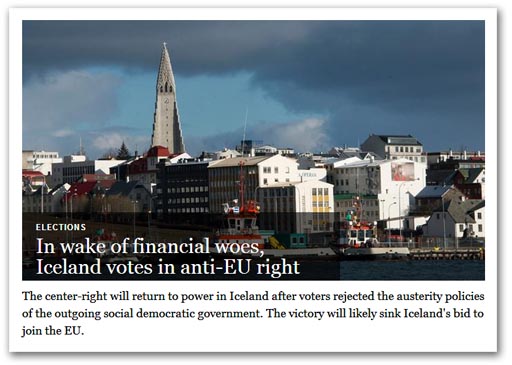 Any road, one part of that dream is well and truly shattered with the general election in Iceland. There, the centre-right has returned to power after voters rejected the austerity policies of the outgoing social democratic government. The victory, it is generally acknowledged, will sink Iceland's bid to join the EU. With the votes now counted, the Independence Party and the Progressive Party gained a combined total of 38 seats in the 63-member parliament, taking 51 percent of the national vote. The Social Democratic Alliance and its junior partner, the Left-Green Movement, were projected to lose just over half of their seats. Before the elections, Bjarni Benediktsson, leader of the Independence Party, together with the Progressive Party – the two big winners of the day – had made it clear that they could terminate EU accession negotiations, which had in any case been suspended since January, in anticipation of the elections. And no one can suggest that this is anything other than a full-blooded rejection. Unlike so many other countries, where apathy rules, in Iceland there is no shortage of interest in the political process. Turnout was over 80 percent of the nearly 238,000 voters. With a population of 320,000 little Iceland is going it alone. Despite the huge problems it has confronted, this is a self-confident nation that does not feel the need to shackle itself to a corpse. The rejection is complete, and effectively final. COMMENT THREAD Richard North 29/04/2013 |
UK politics: UKIP doesn't do policy – shock!
Sunday 28 April 2013
 Then, one can only marvel at the irony at the Observer identifying the ghastly Bloom as the "senior MEP" complaining about the lack of policy. Farage aside, if there is one man at whose door responsibility can be laid for the policy vacuum, it is Godfrey Bloom. On the other hand, though, this is a win-win situation for UKIP's critics. Given a policy vacuum, they can criticise the party for its lack of policy. But, had the party actually develop any policy worthy of its name, it would then be open house on attacking UKIP policy. The fact is, of course, that no matter what UKIP did at this current juncture, it is creating such a "disturb" that its rivals would be seeking weaknesses to bring to the attention of the electorate. That is what party politics is all about. The great shame is that, should UKIP actually succeed in gaining a number of seats, then the policy vacuum will really matter. Successful candidates will find themselves having to make policy on the hoof, with all the lack of coherence and contradictions that that implies. From there, the likelihood is that we will see a familiar pattern. The newly emergent party will be no more able to deliver than the ones it replaces. After a short honeymoon, faction fighting will break out (as it always does). Disillusionment will sets in, the public will loss faith and move on to another potential saviour – or give up altogether. It is never possible, nor wise, at this juncture, to predict what will happen, but one can always learn from the past and what has happened. And here, for more then ten years, I have been warning UKIP about its lack of intellectual base, and the lack of is policy development. Now, the wasted years are taking their toll. Needless to say, Lord Ashcroft in the Mail on Sunday has a different "take", charging that the UKIP leader is in it for himself, destroying the only chance eurosceptics have of getting an "in-out" referendum. If it was the case that Cameron's offer of a referendum was genuine, and that he was truly set to give us an "in-out" choice, instead of a rigged poll, based on some mythical renegotiations. But, since the offer lacks any credibility, Ashcroft's points simply amount to special pleading. What the establishment politicians cannot cope with though, is that they are so tarnished by their lies, deception and indifference to public wishes, that an increasing number of voters would prefer the dubious blandishments of the Farage show, compared with anything that they have to offer. No one with any intelligence seriously expects UKIP to deliver anything of substance. But as a commentary on the poverty of establishment politics, it is very hard to beat. To the extent that a vote for UKIP is a vote against the establishment, it doesn't really matter what the likes of the Observer or Lord Ashcroft say. In fact, the more they squeak and squirm, the more attractive UKIP becomes – since the whole objective is to see the establishment in disarray. But when the UKIP supporters are done, there will still be that policy vacuum, and there will still be some serious politics to do. One trusts that there will be some grown-ups left to fill the gaps that UKIP leaves. COMMENT THREAD Richard North 28/04/2013 |


 Posts
Posts

