
Media: Booker uncensored
Monday 20 May 2013
 On the Friday of that week, as usual, Christopher Booker submitted his column for the Sunday Telegraph, including a lengthy item analysing why it was already clear that what he called "the greatest gamble in modern British politics" had not come off. This was Mr Cameron's attempt to turn the Tories into a "Not The Conservative Party", contradicting pretty well every principle the Tory grass roots believed in. On the Saturday afternoon, just when the paper was due to go to press, he received an incandescent call from his then-editor, Patience Wheatcroft. There was no way she could allow such a piece to appear in her paper. That week's Booker column would have to appear in absurdly truncated form. This little incident briefly caused a flutter of interest behind the journalistic scenes, prompting some mischievous observer to post entries for Wheatcroft and Booker on Wikipedia, describing what had happened, But these before long disappeared, Ms Wheatcroft herself did not last much longer as editor, her successors never censored Booker in such a way again, and history rolled on. Six and a half years later, however, as the rift between Cameron and the Tory grass roots, contemptuously dismissed by his party chairman as "mad, swivel-eyed loons", makes front-page headlines - with Nigel Farage taking out a full-page advertisement in the Daily Telegraph inviting disaffected Tories to come over to UKIP en masse - those words which Telegraph readers were never allowed to see now seem even more apt than they might have done at the time, This was what Booker wrote: David Cameron ends his first year as leader of the Opposition, there are clear signs that the greatest gamble in modern British politics has not come off. The little group of ex-public schoolboys who last year hi-jacked the Conservative Party have seemed to gamble on just one strategy. List everything the Party used to stand for – low taxes, the family, rolling back the power of the state, encouraging business, upholding our defences, curbing criminals, common sense – then go for the opposite.And that was more than six years ago. Even more so now than then, we are asking the same question. As the Conservatives go into complete meltdown, where does all this leave our country? COMMENT THREAD Richard North 20/05/2013 |
EU referendum: none of your business
Monday 20 May 2013
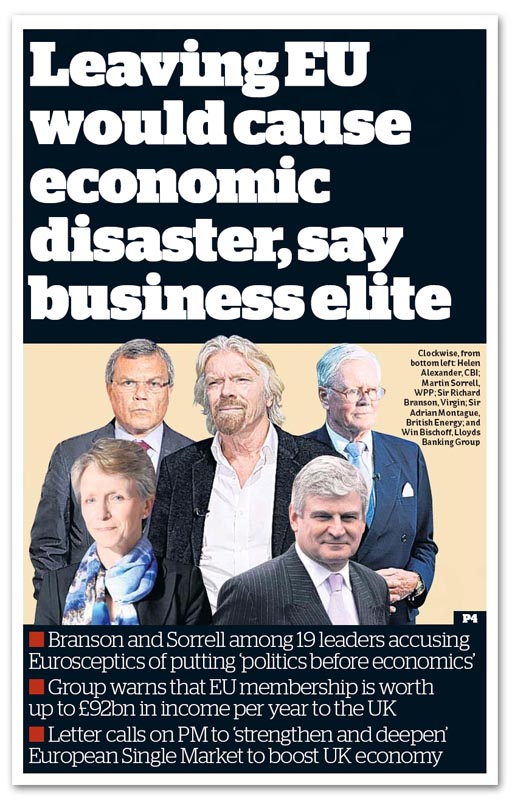 It is in the latter paper that the lie is at its most prominent, the front-page legend (illustrated above) having it that, "Leaving the EU would cause economic disaster". And an egregious lie it is. Given our exit scenario, where we maintain the Single Market through membership of the EFTA/EEA, and then repatriate the acquis, the net effect of our withdrawal from the EU is economically neutral. For sure, we lose some of our influence in the decision-making on the EU's versions of the rules for the Single Market, but this is largely compensated for by our regaining our influence on international bodies such as the WTO, UNECE, etc., from where most of the rules originate in the first place. What these corporate pirates are doing, though, is conflating membership of the Single Market with membership of the EU. The very last thing this dishonest crew wants to do is admit that we can be members of the Single Market without belonging to the EU. In peddling their lie, however, the corporates are aided and abetted by the "unilats" – the eurosceptic groupuscules who are wedded to the idea of unilateral withdrawal. These people are intent on precipitating exactly the economic disaster of which the corporates are now warning. Nevertheless, the corporates have over-reached themselves. In complaining about eurosceptic MPs putting "politics before economics", they are placing their interests above those of the people. The EU is a political construct, and the argument over withdrawal is political. It is not about economics. It is about who governs Britain. In this, elected MPs are perfectly right to put politics before economics. It is totally out of order for former VAT fraudsters like Branson to suggest otherwise. Business has every right to expect that its interests are taken account of, but when it comes to how we are governed, that is none of their business. We the people must make that decision, and without the interference of the self-interested corporates, represented by the chairmen of BT, Deloitte, Lloyds, Centrica and others, who, when push comes to shove, are only interested in lining their own pockets at our expense. COMMENT THREAD Richard North 20/05/2013 |


 Posts
Posts

