
19 May 2013


Ukip Councillors In Lincoln Refuse To Sign 'Multicultural' Anti-Racism Pledge
Posted: 18/05/2013 16:24 BST | Updated: 18/05/2013 18:12 BST

Pain insisted Ukip were not racist
All 16 Ukip members of Lincoln council have refused to sign an anti-racism pledge set up to ensure all county residents are treated equally and have the same rights to services.
Chris Pain, leader of the county council’s Ukip group said he could not sign the document as it "pushes forward the chance of multiculturalism, one of the fundamental things that’s wrong with our society," reported This is Lincolnshire.
The document was a reaffirmation of an equality pledge put forward under Labour six years ago, which states that Lincolnshire County Council recognises the diversity of communities in Lincolnshire and is committed to serve all people equally.
Pain told the Huffington Post UK: "I have friends of all creeds and colours, there is no way you can describe this [abstention] as a racist act.
"This had not been presented to us before and when we looked at the wording, it was pushing out the idea of multiculturalism rather than integration. Multiculturalism is out-dated; the concept of multiculturalism has been dropped by Labour and Conservative governments. It's not fit for purpose.
"I've said if they want a correct agreement I will contact my barrister and they will draw one up."
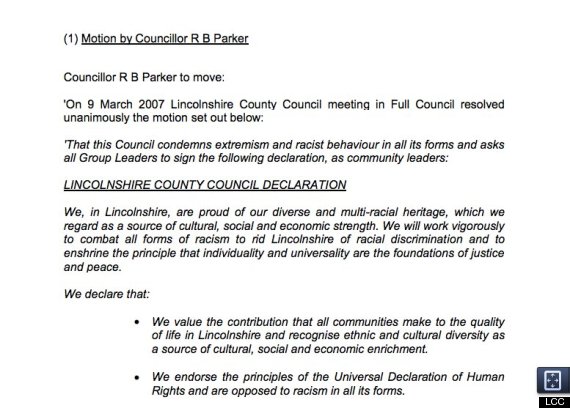
The motion, put forward by Labour councillor Rob Parker was signed by all the councillors six years ago. He told The Huffington Post Uk he was disappointed by Ukip's abstention.
He said: "I wanted to reassure the people of Lincolnshire they were adequately represented. Of the 76 councillors there, 60 voted in favour, only Ukip abstained.
"Their reasons for not signing were not substantiated. They didn't refer to anything apart from the race issue, which they were not in favour of and they didn't make much of a case for it. I'm disappointed in the message about where Ukip stand that has been sent out to the electorate."

Labour councillor Sarah Dodds told The Huffington Post UK that Ukip showed "preposterous arrogance" by refusing to sign the document.
She said: "It was felt that now Ukip have seats on the council it was important they signed up to it too. Signing it would also give them an opportunity to reassure other councillors they are committed to the role. However they just refused point blank.
"Lincolnshire County Council have a legal responsibility to provide services in a way that is non discriminatory. Whether or not Ukip want to do that is up to them. They were elected to represent all of Lincolnshire and if they don't want to do that then shame on them. It shows the preposterous amount of arrogance the party has, that they think they can flout the vote and go against the law.

Ukip Councillor Richard Geoffrey Fairman told The Huffington Post UK they were surprised by the motion, which was put forward so late as to give the party little time to digest it. He said: "Some parts of it were politically correct and therefore not right. My main stance is anything that is politically correct is probably wrong. These parts concerned racism and human rights, the human rights that are allowing criminals in this country to avoid deportation."
After last month’s election, the Conservatives lost overall control of the council, with 36 Tory councillors in a coalition with three independents and three Lib Dems. Ukip has 16 seats; there are seven independents in opposition and 12 Labour councillors.
Telegraph
Police arrest 58 as anti-fascist protesters clash with BNP
Police have arrested 58 protesters after anti-fascist protesters clashed with the British National Party (BNP) over the killing of a British soldier last month.

Police carry away a masked protestor outside the Houses of Parliament this afternoon. Photo: LEWIS WHYLD/PA

6:09PM BST 01 Jun 2013
Ranks of police battled to keep the two groups apart when fights began to break out, with tensions running high following the murder of Drummer Lee Rigby outside his Woolwich barracks.
It came as police were questioning one of the men suspected of killing Drummer Rigby. Michael Adebolajo, 28, was released from hospital on Friday night and taken into police custody.
Michael Adebowale, 22, has already been charged with murdering the young soldier and is due to appear at the Old Bailey on Monday.
Two men aged 42 and 46 arrested on suspicion of being involved in the illegal supply of guns were also bailed today.
BNP members had gathered outside the Houses of Parliament on Saturday for a planned march, holding Union Jack flags and calling for "hate preachers out" – a reference to radical Muslim clerics they say should be deported from Britain.
However, police said some of the UAF protesters refused to remain in their designated penned area and 58 were arrested.
Scotland Yard said that by just after 5pm there had been 58 arrests for breach of Section 14 of the Public Order Act, adding: "These are part of the United Against Facism protest."
The far-right group cheered as handcuffed demonstrators from the rival protest were led away by police to a red double decker London bus hired in for the event.
The BNP originally wanted to march through Woolwich, the neighbourhood in southeast London where 25-year-old Drummer Rigby Rigby was killed, but the police banned them from the area because it could have resulted in "ugly scenes on our streets".
Another far-right group, the English Defence League (EDL), skirmished with police in Woolwich on the night of the killing and mustered about 1,000 protesters in central London on May 27 to chant slogans like "Muslim killers off our streets".
The family of Drummer Rigby have stressed that the young soldier would not have wanted violent attacks to be carried out in his name, and urged protesters to remain peaceful.
In a statement released through the Ministry of Defence, members of Drummer Rigby's family including his mother Lyn, stepfather Ian, wife Rebecca and son Jack, said: "We would like to emphasise that Lee would not want people to use his name as an excuse to carry out attacks against others.
"We would not wish any other families to go through this harrowing experience and appeal to everyone to keep calm and show their respect in a peaceful manner."
Labour leader Ed Miliband today joined celebrities and thousands of others in signing a letter to a newspaper in protest at far-right groups using the death of Drummer Rigby for their own agenda.
In the letter to the editor of the Daily Mirror, they wrote: "The EDL and Islamic extremists are more similar to each other than to us. They share a violent, hate-fuelled desire for conflict and war, and we will not let either group tear our country apart.
"We condemn the shameful rise in anti-Muslim violence since Drummer Rigby's killing. The fair-minded majority of Britons understand that a community cannot be blamed for the actions of just two.
"We know that the EDL does not speak for all Britain, just as we know that Muslim extremists do not speak for all Muslims."
The letter was signed by stars including Eddie Izzard, union bosses including TUC general secretary Frances O'Grady, politicians and leaders of Islamic, Jewish and Christian organisations.
Hundreds of people visited Greenwich Islamic Centre, also known as Woolwich Mosque, after Friday prayers for tea and biscuits in an event aimed at calming tensions.
Representatives of Christian, Muslim, Sikh and Jewish communities also placed flowers arranged to spell the word Peace amongst the thousands of bouquets, cards, poems and candles left in memory of Drummer Rigby near the scene of his killing.
An inquest was opened and adjourned into the father-of-one's death at Southwark Coroner's Court, where it emerged that he had been working at the Tower of London on the day he died.
The Queen also visited the barracks where he was based, and met soldiers and officers from his chain of command.
Meanwhile officers in Scotland last night said a 25-year-old man had been charged in Inverness in connection with an alleged hate crime on an internet memorial page for Drummer Rigby.
In a statement, police in Scotland said a man was charged "in connection with an inquiry into alleged hate crime comments on Facebook".
The man is expected to appear at Inverness Sheriff Court on Monday.
Telegraph
We need to talk about Islamism

Islamist fighters in Somalia (Photo: AP)
If I had slept through yesterday, woken up this morning, and gone online, I might have thought the EDL beheaded someone. There is a lot of displacement on Twitter and FB, as if it's all too politically difficult and socially awkward to talk about the killers' ideology, or the place of religion in that ideology. So we talk instead about the EDL, or John Reid, or drones, or "the religion of peace" or say "Christians kill too" or "what about Anders Breivik", or, well, anything but the brute fact that the murderers, like so very many before them, shouted "Allahu Akbar".
Of course we need to condemn every form of racist backlash and seek unity between Muslims and non-Muslims against extremism of all kinds. And much of the response, beginning with those truly heroic women who risked their lives to protect that young man's body from further mutilation, has shown the best of us, just as our reaction to 7/7 did. But it isn't enough. We need to discuss the elephant in the room – the radical and sectarian, often violent, and sometimes fascistic political ideology and global movement of Islamism.
Why? Because we are fighting against a religiously inspired ideology, jihadism, but we don't want to talk about religion. There are many reasons for our reticence but here are three for starters: two are unattractive, while one is laudable, if misplaced.
First, we are frightened to talk freely.
Not, hitherto, because we fear that our throats will be slit, although since the Rushdie Affair that fear has produced much artistic self-censorship, as the artist Grayson Perry once had the courage to admit. No, intellectual self-censorship begins elsewhere, in the fear of losing one's place in the warmth of the tribe, huddled together by the fire. We fear that if we look too closely or think too clearly, or talk too much about the problem of Islamism, and the connections as well as the separations between it and Islam, then we will be sent into the cold – shunned by colleagues, not invited to this dinner party, or that conference. We may even face social death itself by being called "Islamophobic". The university today is a stultifyingly conformist institution, reminiscent of those old Soviet-era "cultural associations". The standard version, the line, is policed rigorously. And the only accredited language in which people are allowed to speak is full of well-rehearsed evasions and apologias and exculpatory frameworks.
Second, we are ignorant of what to talk about.
In our intellectual culture religion is a mystery. That's why the commentators mostly refuse to believe religion, any religion, can have anything to do with terrorism. So they either translate terrorists screaming "Allahu Akbar!" into something they can understand – economics, foreign policy, identity – or just change the subject altogether, writing instead (not as well) about the dangers of a racist backlash, the threat of the loss of civil liberties, and so on.
In the last 24 hours I've read again and again about the need not to talk about Islam. "All religions are the same," say the commentators and politicians. Well, are they? Is anything? Yes and no. Try sentences that begin "all political parties are…" Or "all governments are…" "All sports are…" "All art is…" In every case you can say some sensible things in the rest of the sentence but you have walled yourself from most things, and most of the things that matter most, about any particular political party, government, sport, or art form. The fact is that there are all sorts of differences between religions and they matter. For example: the character and reception of the founding revelation, not least whether it is understood as mediated or not (and therefore open to reform or not). Or the content of the revelation, including the very understanding of God. Other differences include the relation to other religions, to the secular world, to human-made power and law (e.g. "Rome"). Does the religion view the very idea of a separate political realm as a kind of impiety, an affront to God? Was the prophet his own Constantine or not? The answers diverge and radically. Religions, in other words, can't just be analysed as barely distinguishable forms of the same impulse, as if we were all in an A Level Religion class. They have radically specific contents, unique and conditioning histories, and those differences matter profoundly when they bump up against the secular world.
Third, we want to protect a vulnerable minority.
The last reason for our reticence about talking about Islam and Islamism is the best one. We are frightened of giving comfort to those who would exploit the actions of radical Islamists to attack ordinary Muslims. We worry that if we link this terrorist murder to big words like Islam and Islamism then we will unleash reaction, encourage the EDL and BNP, and the victims will be ordinary Muslims. And that is a good impulse which should condition how we talk about Islam and Islamism. But it should no longer determine whether we talk about Islam and Islamism. It's all too late for that.
Muslims like the Canadian writer Irshad Manji will tell us that the people who would benefit most from a free-wheeling conversation would be ordinary Muslims who are perplexed by our society's pussy-footing indulgence of the extremism which has taken root in some places and would feel licensed to speak out. We can defend religious freedom and defend Muslim reformers, but what we can't do anymore is just change the subject.
Anyway, it's too late, for another reason. One of the fruits of globalisation is that the walls separating what concerns "us" from what concerns "them" have tumbled down. We are all "us", now. The global is local. Woolwich made plain that the fear and the violence and the grieving that has spilled over from what the Muslim political scientist Bassam Tibi calls "Islam's predicament with modernity" are now also ours to bear, and they will borne also by our children and our grandchildren. No more changing the subject.Telegraph
Telegraph
Woolwich and the dark underbelly of British Islam
The EDL's dim, tattooed thugs can barely spell the word 'fascist' – so let's concentrate on what really threatens our way of life, argues Tom Harris MP.

EDL supporters try to reach anti-fascist protesters during a rally outside Downing Street on May 27 Photo: AFP/Getty

1:00PM BST 03 Jun 2013
Reading over press summaries and conversations on Twitter in the last fortnight, you could be forgiven for concluding that the most important event in that period was an act of violence wrought by the English Defence League (EDL).
Just about everyone, from every political party and from none, is lining up to have a go at our dim, tattooed thugs, so they must have done something. And, of course, they have. Their aggressive and moronic behaviour has caused offence and fear and may even have directly contributed to acts of violence against UK citizens and residents.
And yet the murder of Drummer Lee Rigby overshadowed – or should have overshadowed – everything. The attack by adherents of a hateful and violent iteration of Islam was an awful reminder that Islamism remains, even 12 years after 9/11, the greatest threat to our way of life.
There are people living in this country who believe as an article of faith that it is acceptable, even necessary, to kill citizens of any country which has dared to attack a Muslim country. They believe that the kaffir, as they insultingly refer to non-believers, are of less value to their God than Muslims. They despise a culture which extends equal rights to women and gays, and scorn those women who dare to dress “immodestly” as whores.
Such attitudes result in women being harrassed by groups of militant youths near British mosques, warning them not to walk in “Muslim areas” while dressed “inappropriately”. It can and has also resulted in rather more violent expressions of their beliefs, such as detonating suicide bombs on the London Underground and murdering off-duty soldiers. And that’s before we consider the numerous failed attempts to take the lives of non-believers in the name of jihad.
I noted one Tweet from Owen Jones, a well-known political commentator, last week extorting his followers to “Stand united against the EDL, in the tradition of all those who have stood against racism and fascism before”. I didn’t need to delve into his Twitter history to know that no similar exhortation had been made to stand firm against Islamism.
The irony is that Islamism is itself fascistic. It is violently intolerant of women’s and gay rights, and supportive of the Iranian regime’s policy of public hanging for homosexuals. It allows no room for individual freedom of expression and deals with its opponents in the most ruthless way. Saddam’s regime was explicitly and intentionally modelled on that of Nazi Germany’s.
And, of course, many commentators are more comfortable discussing the jihadists’ “justification” for the Woolwich attack. They will offer the cursory condemnation of violence that is expected of them, then spend the rest of their time explaining that “well, they have a point about Iraq, don’t they...?”
As it happens, they don’t. But even if they did, even if they believe that their own grievances are real, so what? EDL members have their own “justification” for their marches and aggression, but no one would ever say: “Well, they’ve got a point about the desecration of war memorials, haven’t they...?”
I understand the reticence of those who see the word “Islamist” and are reluctant to condemn it because, well, it sounds a lot like “Islam”, doesn’t it? After criticising adherents of Islamism on Twitter, it doesn’t take long for some oddball to accuse you of racism, either because they’ve misidentified the word or because they’re stupid.
Uncomfortable though it is for some, we need to examine the dark underbelly of what goes on in some of our mosques. True, the vast majority of British Muslims would never associate themselves with Islamism. Yet preachers of hate as well as their followers and fellow travellers, worship in the same buildings, speak to, work with, and are related to that sensible majority. And those law-abiding citizens have a duty to challenge them, expel them and, if necessary, report them to the authorities.
Calls for unity in the face of terrorism are correct and necessary. But that doesn’t mean we ignore the real implications of a nauseating act of violence against a brave young man who served our nation in its defence.
Focusing on the EDL might salve the conscience of some, but it’s a strategy that will come back to haunt us in the most awful way imaginable.
Tom Harris is the Labour MP for Glasgow South and Shadow Minister for the Environment in the House of Commons.
http://www.telegraph.co.uk/news/uknews/10087753/EDL-supporters-exposed-in-hacked-list.html
EDL supporters exposed in hacked list
A councillor who represents Muslim voters and a Baptist church minister are among hundreds of supporters of the English Defence League whose names were revealed after the group was hacked.
 EDL leader Tommy Robinson speaks to supporters during a rally Photo: Getty Images
Their names were among more than 200 included on a document listing donors and sympathisers of the EDL which was published on the internet yesterday after the far-right group’s records were hacked by the activist group Anonymous.
The list of supporters also includes teachers, company directors, former and serving soldiers, council officials and small business owners from across Britain. Several others are listed as living in the United States, France, Australia, Norway, Belgium, Holland and Canada.
Among the donors listed is John Fletcher, a City of London Corporation member for the Portsoken ward – which includes part of Tower Hamlets and Whitechapel. Nearly a third of residents in his ward are Muslim.
Mr Fletcher told the Daily Telegraph he had donated around £20 to the EDL after a small group of Islamist extremists set fire to a poppy wreath in Kensington, London, on Armistice Day three years ago.
He said: “At the time the EDL seemed to be the only people who were prepared to stand up against this kind of thing. I am and ex soldier with 12 years regular Army and 5 years Territorial Army service and the poppy burning made me so angry and left me feeling such rage that I felt the need to make a donation to them.”
EDL leader Tommy Robinson speaks to supporters during a rally Photo: Getty Images
Their names were among more than 200 included on a document listing donors and sympathisers of the EDL which was published on the internet yesterday after the far-right group’s records were hacked by the activist group Anonymous.
The list of supporters also includes teachers, company directors, former and serving soldiers, council officials and small business owners from across Britain. Several others are listed as living in the United States, France, Australia, Norway, Belgium, Holland and Canada.
Among the donors listed is John Fletcher, a City of London Corporation member for the Portsoken ward – which includes part of Tower Hamlets and Whitechapel. Nearly a third of residents in his ward are Muslim.
Mr Fletcher told the Daily Telegraph he had donated around £20 to the EDL after a small group of Islamist extremists set fire to a poppy wreath in Kensington, London, on Armistice Day three years ago.
He said: “At the time the EDL seemed to be the only people who were prepared to stand up against this kind of thing. I am and ex soldier with 12 years regular Army and 5 years Territorial Army service and the poppy burning made me so angry and left me feeling such rage that I felt the need to make a donation to them.”
EDL leader Tommy Robinson speaks to supporters during a rally Photo: Getty Images
Their names were among more than 200 included on a document listing donors and sympathisers of the EDL which was published on the internet yesterday after the far-right group’s records were hacked by the activist group Anonymous.
The list of supporters also includes teachers, company directors, former and serving soldiers, council officials and small business owners from across Britain. Several others are listed as living in the United States, France, Australia, Norway, Belgium, Holland and Canada.
Among the donors listed is John Fletcher, a City of London Corporation member for the Portsoken ward – which includes part of Tower Hamlets and Whitechapel. Nearly a third of residents in his ward are Muslim.
Mr Fletcher told the Daily Telegraph he had donated around £20 to the EDL after a small group of Islamist extremists set fire to a poppy wreath in Kensington, London, on Armistice Day three years ago.
He said: “At the time the EDL seemed to be the only people who were prepared to stand up against this kind of thing. I am and ex soldier with 12 years regular Army and 5 years Territorial Army service and the poppy burning made me so angry and left me feeling such rage that I felt the need to make a donation to them.”
However Mr Fletcher said he now regretted giving the group his financial backing.
“I am against extremism in all its forms and I do not support what the EDL stand for in any way, shape or form. Many of the people in the ward I represent in the east of the City are Muslim and I abhor what the EDL says about them,” said Mr Fletcher.
Also on the list is Hugo Schonhaar, a Nottingham-born pastor with the Toronto Baptist Church, who says he supports the EDL because of his fear of “creeping Sharia law” in Britain and for its stance against Muslim radicals.
Pastor Schonhaar refused to reveal how much he had given the organisation – which was involved in clashes with police in Woolwich town centre last week following the murder of Drummer Lee Rigby by two suspected Islamists.
He said: “I felt that [EDL leader] Tommy Robinson is one of the few people in Britain standing up for the traditional British values I grew up with, such as freedom of speech and freedom of religion,” he said.
Pastor Schonhaar claimed that parts of London and Birmingham were now 'Sharia no-go areas’ for non-Muslims. Challenged to substantiate the claim he replied: “You try walking through some of those areas wearing a yamulcha [Jewish headgear] and see if you feel safe.”
Pastor Schonhaar admitted, however, that he now felt uncomfortable at reports that many EDL activists have taken part in violent attacks against individual Muslims, mosques and community centres. Muslim community leaders have reported an increase in such attacks since the murder of Drummer Rigby outside the Royal Artillery’s barracks in Woolwich, last Wednesday.
Pastor Schonhaar said: “I do not support violence by the EDL. I would see a conflict of interest between my position as a church minister and any violence from the EDL, but otherwise I feel it is legitimate for me to support their peaceful aims.”
Others named on the list appeared to be a former teacher, a retired council finance manager and a doctor of medicine in Texas.
Also on the list is a Stephen M Slaughter, from Allen, Texas. This matches the name of Dr Steven M Slaughter, an anaesthetist practicing at a medical centre 16 miles away in Dallas, Texas. Dr Slaughter could not be contacted.
A close examination of the list by the Daily Telegraph has revealed that some of the names appear on it only because they donated small amounts to an online poppy appeal, without realising the money went to the EDL.
One man, who gave £2 to the appeal through Facebook, only to find that the cash went to the organisation and not to veterans’ groups, said: “I am very upset that this happened. I don’t support the EDL in any way and I’m outraged that my money went to them rather than to a genuine poppy appeal. I would never want my name associated with what they do.”
Also on the list of EDL supporters are a number of individuals with criminal records, including Louise Leslie, from Carlisle, who was sentenced to 15 months in prison after taking part in the racist abuse of two care workers in the town.
Leslie was part of a gang of thugs who terrorised the two men, both of Turkish extraction, during weeks of abuse in February last year. The court heard the 42-year-old mother of two swore repeatedly at the men, who she mistook for Pakistanis.
Another person named as a donor is Anthony Rimmington, a set designer who was convicted in 2006 of possessing three prohibited pistols and ammunition.
Rimmington was sentenced to six months, suspended for two years, after the weapons were found at his flat in Ealing. On a separate occasion Mr Rimmington was convicted of posting racially offensive and threatening material to members of the public, although the conviction was quashed on appeal.
EDL supporter Andrew Ossitt, 41, from Newquay, Cornwall, who is also on the list, was found guilty in 2011 of using threatening words and religiously aggravated harassment after taking part in a march through Halifax, during which he chanted “Muslims off our streets” and “You burn the poppies, and we will burn the mosques”.
Anonymous UK said the EDL “should have expected this” and warned it to “expect more”.
The publication followed an audio message, recorded with a computerised voice and published on YouTube, from Anonymous UK to the EDL that accused the group of exploiting Drummer Rigby’s death and taking “advantage of moments of fear and terror to spread hatred and animosity”.
“I am against extremism in all its forms and I do not support what the EDL stand for in any way, shape or form. Many of the people in the ward I represent in the east of the City are Muslim and I abhor what the EDL says about them,” said Mr Fletcher.
Also on the list is Hugo Schonhaar, a Nottingham-born pastor with the Toronto Baptist Church, who says he supports the EDL because of his fear of “creeping Sharia law” in Britain and for its stance against Muslim radicals.
Pastor Schonhaar refused to reveal how much he had given the organisation – which was involved in clashes with police in Woolwich town centre last week following the murder of Drummer Lee Rigby by two suspected Islamists.
He said: “I felt that [EDL leader] Tommy Robinson is one of the few people in Britain standing up for the traditional British values I grew up with, such as freedom of speech and freedom of religion,” he said.
Pastor Schonhaar claimed that parts of London and Birmingham were now 'Sharia no-go areas’ for non-Muslims. Challenged to substantiate the claim he replied: “You try walking through some of those areas wearing a yamulcha [Jewish headgear] and see if you feel safe.”
Pastor Schonhaar admitted, however, that he now felt uncomfortable at reports that many EDL activists have taken part in violent attacks against individual Muslims, mosques and community centres. Muslim community leaders have reported an increase in such attacks since the murder of Drummer Rigby outside the Royal Artillery’s barracks in Woolwich, last Wednesday.
Pastor Schonhaar said: “I do not support violence by the EDL. I would see a conflict of interest between my position as a church minister and any violence from the EDL, but otherwise I feel it is legitimate for me to support their peaceful aims.”
Others named on the list appeared to be a former teacher, a retired council finance manager and a doctor of medicine in Texas.
Also on the list is a Stephen M Slaughter, from Allen, Texas. This matches the name of Dr Steven M Slaughter, an anaesthetist practicing at a medical centre 16 miles away in Dallas, Texas. Dr Slaughter could not be contacted.
A close examination of the list by the Daily Telegraph has revealed that some of the names appear on it only because they donated small amounts to an online poppy appeal, without realising the money went to the EDL.
One man, who gave £2 to the appeal through Facebook, only to find that the cash went to the organisation and not to veterans’ groups, said: “I am very upset that this happened. I don’t support the EDL in any way and I’m outraged that my money went to them rather than to a genuine poppy appeal. I would never want my name associated with what they do.”
Also on the list of EDL supporters are a number of individuals with criminal records, including Louise Leslie, from Carlisle, who was sentenced to 15 months in prison after taking part in the racist abuse of two care workers in the town.
Leslie was part of a gang of thugs who terrorised the two men, both of Turkish extraction, during weeks of abuse in February last year. The court heard the 42-year-old mother of two swore repeatedly at the men, who she mistook for Pakistanis.
Another person named as a donor is Anthony Rimmington, a set designer who was convicted in 2006 of possessing three prohibited pistols and ammunition.
Rimmington was sentenced to six months, suspended for two years, after the weapons were found at his flat in Ealing. On a separate occasion Mr Rimmington was convicted of posting racially offensive and threatening material to members of the public, although the conviction was quashed on appeal.
EDL supporter Andrew Ossitt, 41, from Newquay, Cornwall, who is also on the list, was found guilty in 2011 of using threatening words and religiously aggravated harassment after taking part in a march through Halifax, during which he chanted “Muslims off our streets” and “You burn the poppies, and we will burn the mosques”.
Anonymous UK said the EDL “should have expected this” and warned it to “expect more”.
The publication followed an audio message, recorded with a computerised voice and published on YouTube, from Anonymous UK to the EDL that accused the group of exploiting Drummer Rigby’s death and taking “advantage of moments of fear and terror to spread hatred and animosity”.
Telegraph
'RIP Woolwich Soldier': over a million people may have accidentally 'liked' a covert EDL Facebook page

Over a million people may have "liked" a covert EDL Facebook page
Since the Woolwich attack, far-Right groups like the English Defence League (EDL) have hugely magnified their presence online, in an effort to harness public anger. This has largely been successful; their Facebook page has received thousands of new "likes", and their Twitter account has garnered many new followers.
However, it is possible that they are also using covert means. A Facebook page entitled RIP Woolwich Soldier has sprung up, and so far has accumulated 1.1 million "likes". Some of my friends have "liked" it, and probably some of yours. There is no hard-and-fast evidence that this page is actually run by the EDL. However, there are various indications that this may be so.
For one thing, the design of the page, which is heavily dominated by a shimmering Union Flag, is very similar to the official EDL Facebook page.
Moreover, the first post on the page was "Time for the people who want to be apart of Britain to stand up against those who want to destroy us!" Not only does this seem to be of a piece with your average typical EDL call to arms, both in tone and in substance, but it also contains a prominent typo, which has emerged as the fingerprint of the EDL (recent examples include "respect are country speak English" and "never submit to Aslan", rather than "Islam").
Most significantly, the first organisation that the "RIP Woolwich Soldier" page "liked" was the official page of the English Defence League.
If you have visited the page and pressed the "like" button, RIP Woolwich Soldier updates will from now on appear on your timeline. Most Facebook accounts have a whole host of pages that the owner has "liked" in the past and neglected to "unlike"; from time to time, an update appears from a page you have completely forgotten about.
In other words, 1.1 million people have now made their names available to the owner of the RIP Woolwich Soldier page, and opened their timelines to his or her messages.
It may be that this unidentified owner is not officially linked to the EDL, but just harbours an affection for it. It could be, on the other hand, that the page is run by EDL activists, or even the EDL leadership.
Either way, it is possible that if you've "liked" RIP Woolwich Soldier, you may have unwittingly "liked" the EDL.
.Telegraph
The far-Right EDL is using Twitter and Facebook to exploit the Woolwich terrorist attack

The English Defence League has been mobilised in Woolwich
In the immediate aftermath of the tragic attack in Woolwich, one would assume that the matter would be trending massively on Twitter. Instead, however, the hashtag #woolwich has had an erratic presence in the top 10 most popular terms. For much of the evening, it was absent altogether.
Instead, for a while the phrase "Allahu Akhbar" was trending, due to a frenzied discussion about whether the suspects shouted the phrase or not. More significantly, firmly in the top five has been "EDL", which stands for the English Defence League, who, led by Tommy Robinson, have been fighting the police in Woolwich.

A pro-EDL tweet posted this evening
There could be no clearer demonstration of the nature of terrorist attacks. Horrendous as it was, the attack was on a relatively small scale, mercifully claiming only one victim. Yet the societal impact it has created has been huge, and it is only just beginning. Political and community leaders across the board are appealing for calm. Yet there are many groups who care nothing for this; they exist in a state of perpetual febrility, gunpowder waiting for a spark.
Since the attack, the English Defence League's Twitter account has gone into overdrive. Whereas it normally tweets only a few times a day, it has been tweeting every few minutes. The account has accumulated large amounts of new followers, and the EDL Facebook page has received thousands of new "likes".
Interestingly, however, the polarisation of opinion does not seem to have gone both ways. Muslims have tended to take to Twitter to condemn the attacks; a selection has been compiled by the Spectator.
Of course, this is only Twitter. It would be a mistake to see it as representative of public opinion in Britain and around the world. Nevertheless, it is fair to say that tonight, the micro-blogging site is speaking volumes about the opportunistic nature of the far Right, and the type of emotions on which it thrives.
Telegraph
The far-Right EDL is using Twitter and Facebook to exploit the Woolwich terrorist attack
The English Defence League has been mobilised in Woolwich
In the immediate aftermath of the tragic attack in Woolwich, one would assume that the matter would be trending massively on Twitter. Instead, however, the hashtag #woolwich has had an erratic presence in the top 10 most popular terms. For much of the evening, it was absent altogether.
Instead, for a while the phrase "Allahu Akhbar" was trending, due to a frenzied discussion about whether the suspects shouted the phrase or not. More significantly, firmly in the top five has been "EDL", which stands for the English Defence League, who, led by Tommy Robinson, have been fighting the police in Woolwich.
A pro-EDL tweet posted this evening
There could be no clearer demonstration of the nature of terrorist attacks. Horrendous as it was, the attack was on a relatively small scale, mercifully claiming only one victim. Yet the societal impact it has created has been huge, and it is only just beginning. Political and community leaders across the board are appealing for calm. Yet there are many groups who care nothing for this; they exist in a state of perpetual febrility, gunpowder waiting for a spark.
Since the attack, the English Defence League's Twitter account has gone into overdrive. Whereas it normally tweets only a few times a day, it has been tweeting every few minutes. The account has accumulated large amounts of new followers, and the EDL Facebook page has received thousands of new "likes".
Interestingly, however, the polarisation of opinion does not seem to have gone both ways. Muslims have tended to take to Twitter to condemn the attacks; a selection has been compiled by the Spectator.
Of course, this is only Twitter. It would be a mistake to see it as representative of public opinion in Britain and around the world. Nevertheless, it is fair to say that tonight, the micro-blogging site is speaking volumes about the opportunistic nature of the far Right, and the type of emotions on which it thrives.
14,305 48 13
48 13
48 13Pregnant Woman Arrested for carrying Union Jack in Oldham. See :
http://www.youtube.com/watch?feature=player_embedded&v=ex8w2BWcCJg
Telegraph
It feels like the Right has split irrevocably
Prime Minister David Cameron’s carelessness has mixed with public contempt for politicians to create a toxic brew

Unlikely revolutionary: there is now a serious chance that Nigel Farage will smash the existing party system and usher in a very different structure at Westminster Photo: Getty Images


Nigel Farage is a most unlikely revolutionary. In his covert coat and pinstripes, with a pint in one hand and a fag in the other, the leader of Ukip looks like a Conservative archetype: the over-taxed Tory of the shires who has nipped outside for a smoke before he begins the long commute home after toiling all day in the City.
Yet he stands on the verge of pulling off a remarkable coup. If he succeeds in his mission – if Ukip does not blow up on the launch pad before the next general election – there is now a serious chance that Mr Farage will smash the existing party system and usher in a very different structure at Westminster.
Of course, the realignment of the British party system has been predicted, wrongly, on many occasions since the Second World War. Most commonly, the mooted redrawing of the tribal map has involved the parties of the centre-Left reconfiguring themselves in order that they might stand a better chance of defeating the once-mighty Tory machine.
There was even a time, in the late 1980s and early 1990s, when it was fashionable to say that there might never be another Labour government, and that to stand a chance the party would require a pact with the Liberals and (for a while) their erstwhile colleagues in the SDP.
Indeed, the creation of the SDP, a breakaway of moderates from embattled Labour in the early 1980s, was said to have “broken the mould”. The new party scored the kind of stratospheric poll ratings of which Mr Farage can only dream. It did have a major influence, although not in the way that its four founders intended: its main contribution was to create the climate in which Tony Blair could emerge as Labour leader. Then the SDP vanished. Labour, written off for more than a decade, came roaring back in 1997 and won three successive general elections. Once again, one of the two old parties had reasserted itself following an existential crisis.
Suddenly, a significant chunk of conservative opinion is rejecting this historically successful approach. It is nothing like a majority, but it is a large proportion and it is starting to feel as though the split may be irrevocable.
In part, this is Mr Cameron’s fault. He was so determined to attract new supporters – a noble and necessary aim – that he became careless about the feelings of his party’s existing voters. The Prime Minister’s casual decision to pick a fight on gay marriage with so many Tory members reinforced the idea that he does not like or respect the traditional wing.
On the back of it, Ukip membership is rising (next stop 30,000) and Conservative membership looks likely to dip below 100,000. Describing those left in the Tory fold as “swivel-eyed lunatics” can only speed up the process.
Worse, Mr Cameron has made these mistakes at just the moment when public contempt for existing institutions and professional politicians has boiled over. This has given the populist Mr Farage the most tremendous opportunity. Last night his party surged to 22 per cent in the latest poll, just two points behind the Tories.
I do not mean to suggest for a moment that Ukip will win many Commons seats, or perhaps even any, at the next general election. Yet it does not need to replace the Conservative Party to cause great harm. If it polls around 6 per cent in 2015, that will be double what it managed last time. If it can get closer to 10 per cent – not inconceivable – then the old party system may be done for.
For two decades or more, that system has been decaying and disintegrating. It is not just the rise of a third party in the shape of the Liberal Democrats (which sprang from the Liberal and SDP Alliance) that matters here. Scotland now has an entirely different electoral ecosystem, with a Nationalist government. The Conservatives consider themselves a national party, yet they have no chance of a revival north of the border and are locked out of the north-east of England and many major cities.
Equally, Labour is going nowhere in the southern, populous places where Tony Blair made inroads. Last week, it sunk to 34 per cent in an opinion poll. Neither of the two larger parties any longer seem capable of rallying above 40 per cent of the vote and winning a strong mandate.
The implications are potentially enormous. If the trend for fragmentation is sustained, it will most likely mean the introduction of a new voting system: proportional representation. If Labour is the largest party, but short of a majority, after the next election, its logical next step is a deal to change the voting system in alliance with all the other parties, bar the Tories. It would get Ed Miliband into power and probably lead to further splits on the Right as all manner of factions – the tiny band of Tory Europhiles, for example – struck out on their own, confident under PR of picking up a few seats and bartering their way to a slice of power.
The prospect of PR should fill us with horror. It allows politicians to stitch up deals after the voters have had their say and denies the country strong government at moments of crisis. But if neither Labour nor the Tories are capable of commanding a broad sweep of public opinion on polling day, it is where we are headed.
Telegraph
Nigel Farage condemns 'fascist scum' who forced him to take refuge in Edinburgh pub
The Ukip leader Nigel Farage has condemned "fascist scum" for haranguing him in Edinburgh and hung up on a BBC interview in outrage at its tone of "hatred".

9:44AM BST 17 May 2013
The leader of the UK Independence Party said the "excesses of Scottish nationalism" can be "pretty ugly" and "deeply unpleasant" after hardline demonstrators forced police to barricade him in a pub for his own safety.
He later spoke to BBC Good Morning Scotland about his ordeal, but ended up ending the phone call early in protest at the interviewer's line of questioning.
Asked about how many elected representatives he has in Scotland, Mr Farage said: "Absolutely none, but rather more than the BBC. We could have had this interview in England a couple of years ago, although I wouldn't have met with such hatred as I'm getting from your questions. Frankly, I've had enough of this interview, goodbye."
The Ukip leader subsequently spoke to BBC Radio Four's Today programme, repeating his view that the "hate mob" who intimidated him were "fascist scum" and "filled with total and utter hatred of the English".
He linked their views to the Scottish National Party led by Alex Salmond, the First Minister, and challenged him to "condemn this sort of behaviour".
However, he insisted that Ukip would still make in-roads with the Scottish voters, including getting an MEP at next year's European elections.
"I do not believe 15 yobs not prepared to engage in debate represent the views of the Scottish people," he said.
The incident in Edinburgh on Thursday rattled Mr Farage as he was giving media interviews. He was left stranded in the middle of Edinburgh’s Royal Mile, surrounded by around 50 nationalists and socialists calling him a racist, demanding that he: “Go home to England”.
Police attempted to persuade two taxi drivers to take Mr Farage away from the trouble but both refused as the protesters continued to barrack the MEP with chants of “racist Nazi scum”.
Officers then insisted for his own safety that he enter the Canon’s Gait pub, the wooden doors of which were then locked.
The protesters continued to jeer and shout abuse, with some unveiling a 20ft banner that, referring to next year’s referendum, stated: “Vote Yes for Scotland”.
Telegraph
Topless protesters disrupt demonstration in Paris
Topless protesters from the libertarian Femen group have disprupted a right-wing demonstration in Paris5:28PM BST 12 May 2013
Several hundred far rightist activists gathered in Paris on Sunday to protest against globalisation and celebrate the feast day of French folk heroine and adopted icon of right-wing nationalists - Joan of Arc.
Outside the Hotel Regina stands a gilded bronze statue of Saint Joan, and the surrounding Place des Pyramides was the chosen gathering place for the right-wing activists.
But clashes between protesters and police began when the libertarian Femen group, appearing in their usual topless manner, hung a banner from the top of the hotel reading "Sextermination for Nazism."
After half-an-hour, fireman and police removed the four Femen activists by fireman's ladder.
Telegraph
Giulio Andreotti
Giulio Andreotti, the former Italian premier who has died aged 94, was for more than 40 years the godfather of Christian Democracy in Italy’s first post-war republic, until even the “Old Fox” — as he was widely known — was tainted by the corruption scandals that removed from office virtually the entire political class.

Giulio Andreotti Photo: AFP/Getty
A man of ascetic tastes and sphinxlike demeanour, but known also for his astringent remarks and sardonic sense of humour, Andreotti was a consummate politician, a masterly survivor in the chaotic and treacherous world of Italian politics. “Aside from the Punic Wars, for which I was too young, I have been blamed for everything else,” he said.
He entered Parliament in 1947, immediately became a cabinet under-secretary and was then rarely out of a cabinet post until 1992. He served as prime minister seven times between 1972 and 1992, and held the foreign minister’s portfolio through six successive governments from 1983 to 1989.
An instinctive anti-Communist, the lodestars of his political firmament were the Vatican and the North Atlantic alliance with the United States. But Andreotti was above all a pragmatist, and when forced in 1976 to reach an accommodation with the Communist Party in order to maintain a minority government, he did not flinch. The prospect of relinquishing his hold on the levers of power was sufficiently alarming: “Power weighs too heavily only upon those who do not have it,” was one of his most oft-quoted aphorisms.
He was a devout Catholic who attended a daily mass at six in the morning throughout his life, and was on close terms with six successive pontiffs, earning him the sobriquet “Julius VI” and even “Julius the God” among his followers. As a young man he was once a chief altar-boy at Segni, near Rome, and went on to study Canon Law, completing a thesis on “The Personality of the Criminal in Church Law”.
For his austere and somewhat pious nature, Andreotti’s detractors dubbed him “the sacristan” and referred to him as “Jesuitical”. The Socialist leader Bettino Craxi once damned him as “Beelzebub”, but Andreotti was unruffled and in due course the insult rebounded when Craxi was forced to flee into exile in Tunisia to avoid prosecution for corruption.
Andreotti himself survived several setbacks. In 1990 his position was damaged by his admission, after years of denial, that a clandestine network of anti-Communist paramilitaries, known as operation Gladio, had been set up in 1958 to combat the threat of Communist subversion and invasion and had never been disbanded.
The suspicion, allayed at the time by denials from Andreotti of its very existence, was that members of Gladio had been involved in the “Strategy of Tension”, the violent campaign of destabilisation orchestrated by the far-Right in the 1970s and early 1980s. Andreotti’s escape from this tight corner did indeed owe much to his Jesuitical skills.
Rumours of shady dealings were almost an occupational hazard for so enduring a figure in Italian political life, but Andreotti was assumed to be “untouchable”, even by the Milan magistrates whose “Clean Hands” investigations into corruption brought down Craxi and so many others.
When asked once about his relations with the crooked financier Michele Sindona, who was poisoned in prison (possibly by his own hand), and the fraudulent head of Banco Ambrosiano, Roberto Calvi, who was found hanged beneath Blackfriars Bridge, Andreotti smiled enigmatically: “I must say that I met Mother Teresa much more often then I met Sindona or Calvi.”
But as the scope of the corruption investigations grew and prosecutors were able to draw increasingly on the evidence of pentiti, former Mafia members turned state witnesses, evidence came to light of Andreotti’s association with Salvatore “Toto” Riina, the supposed “boss of bosses” of Sicily’s Cosa Nostra.
In 1993 Andreotti’s senatorial immunity was lifted — a measure for which he, with characteristic insouciance, voted — so that he could be examined by magistrates and answer charges. According to the evidence of Tommaso Buscetta and Balduccio di Maggio, Andreotti had been seen meeting Riina in 1987 and greeting him with a kiss; he was the Mafia’s top political contact, it was said, the man the Cosa Nostra knew as “Zio (uncle) Giulio”.
Andreotti was unfazed. In July 1994 he was watching Italy play Nigeria in the World Cup when a friend telephoned to give him the news of the decision by Palermo magistrates to indict him. “Don’t you think it might be better,” he replied, “if we were to finish watching the game?”
Before his trial opened in September the following year, prosecutors said they would prove that Andreotti was not “a man of the government, but a boss of the Cosa Nostra”. Andreotti vigorously denied the charges, and pointed to a anti-Mafia crackdown that he had initiated in the early 1990s. Certainly a turning point in his relations with the Mafia seems to have come in 1980, when the mob angered Andreotti by murdering Piersanti Mattarella, the reformist president of the Sicilian regional government. On October 23 1999, Andreotti walked free from the courtroom in Palermo, cleared of being the Mafia’s protector in Rome. “Obviously I’m delighted,” he said after hearing the verdict.
He had another reason to celebrate as, just a month earlier, in September 1999, he had also been cleared of ordering the murder of an investigative journalist, Mino Pecorelli. Pecorelli, from the magazine Osservatorio Politico, was killed on March 20 1979, shot (in a Mafia trademark for those accused of talking too much) through the mouth.
It was alleged that Pecorelli, who was noted for his contacts, was on the point of publishing information which potentially could have ruined Andreotti’s career, and in 1993 Buscetta testified that Pecorelli had been murdered as a favour to the politician. As Andreotti’s not guilty verdict came through, the then opposition leader, Silvio Berlusconi, rejoiced: “Hallelujah! I have always thought it was ridiculous that a man as intelligent and brilliant as Giulio Andreotti could risk a life and a career like his with such nonsensical and absurd behaviour.”
The prosecution appealed, however, and in 2002, Andreotti was convicted and sentenced to 24 years in jail for Pecorelli’s murder. It was a ruling that electrified the country. Finally, it appeared, the high-flying, untouchable Andreotti had been brought low. But even his political adversaries backed him to make a comeback, and his allies in the Catholic Church were not shy of drawing comparisons with the life of Christ. “Without a doubt, at the end there will be a resurrection,” said Cardinal Fiorenzo Angelini.
So it proved. The following year Andreotti was cleared by Italy’s Supreme Court of involvement in Pecorelli’s killing. His final acquittal on all Mafia-related charges came in 2004, when he was 85. But the court did not positively declare him innocent. Instead the judgment noted that Andreotti had shown “real, solid and friendly openness towards mafiosi” before 1980, when he had “friendly and even direct ties” with the Mafia boss Stefano Bontade, but could not be prosecuted for such links due to the statute of limitations.
In 1980, the court said, Andreotti had met Bontade in a vain bid to save Mattarella’s life. When his pleas for clemency were ignored, Andreotti put himself and his family at risk to launch his anti-Mafia crackdown. If links persisted between Andreotti and the Cosa Nostra after 1980, the court suggested, there was insufficient evidence to convict.
The ruling brought to an end more than a decade of investigations and trials that had tarnished an entire political system. For the courtroom sagas were widely perceived as trials of the Christian Democrat-dominated machine that had run Italy since the Second World War. No one represented that machine more than Andreotti, a politician once described by an editor of Il Giornale as “a complete man of power... without hope of paradise or fear of hell”.
The son of a schoolteacher who died when he was a year old, Giulio Andreotti was born on January 14 1919 in Rome’s Via dei Prefetti, a stone’s throw from the Parliament building. He was brought up by his mother but was also deeply influenced by his aunt, a strict Roman Catholic. From her he learnt, so he recalled, “never to over-dramatise things, everything sorts itself out in time, keep a certain distance from things in life, not many things are really important”.
He was educated locally and, though he did not shine at school, took a part-time job in a tax office which enabled him to attend Rome University. He soon became a leading figure in the Catholic student movement, and became its national president after his friend Aldo Moro was forced to quit the post to do his military service.
Andreotti graduated in 1940 with a law degree and, excused combat duties after a physical examination, served for a spell as a medical orderly. From 1942 to 1945 he was president of the Italian Catholic University Federation and edited its weekly magazine, Azione Fucina.
In 1942 he first encountered the founding father of Christian Democracy, Alcide de Gasperi, who became Andreotti’s personal mentor. De Gasperi was working as a librarian in the Vatican (which had granted him asylum from Mussolini’s death squads), when young Giulio came to research an article on the history of the papal navy.
“Don’t you have anything better to do?” snapped de Gasperi. Andreotti nevertheless impressed the irascible Christian Democrat with his intelligence and he was given a job on the Catholic newspaper, Il Popolo, then published clandestinely. Familiarity with the ways of the Holy See was useful to the outlawed de Gasperi, and Andreotti soon became his trusted lieutenant.
It was said that Andreotti was employed on occasion to stand behind a curtain to minute secretly what passed between de Gasperi and political rivals he met. Exercising the utmost discretion in all political dealings proved to be the most valuable lesson passed on by de Gasperi to his young protégé.
In 1944, at the age of 25, Andreotti was elected to the newly formed Christian Democratic Party’s national council. Two years later he became a member of the constituent assembly which drafted Italy’s new constitution, and in 1947 he was elected to the Chamber of Deputies in the new Parliament.
In May that year de Gasperi, then prime minister, appointed Andreotti his Cabinet undersecretary. Andreotti proved a discreet servant to his political master, an astute judge of the mood of the House and an effective behind-the-scenes operator. It was Andreotti’s air of competence and his care to mollify potential opponents, rather than any great personal charisma, that took him to the top of his party and the government.
In 1954, the year of de Gasperi’s death, Andreotti won his first Cabinet post, as minister for the interior in the Fanfani administration. Though Andreotti’s ardent anti-Communism placed him firmly on the Right of his Party, at a time when a more progressive wing of the Christian Democrats was in the ascendant, his career gained an inexorable momentum. The next year he became minister of finance and in 1958 he headed the Treasury. From 1959 to 1960 and again from 1960 to 1966 he was minister of defence.
After a two-year stint as minister of industry and commerce, he left the Cabinet to lead the Christian Democrats in the House of Deputies. It was in this role that Andreotti conducted the campaign against the Bill, sponsored by the Socialists and the Liberals, to legalise divorce in Italy. At the time it was estimated that some five million Italian men and women were “marriage outlaws”, either unmarried but cohabiting or married but separated.
The Christian Democrats commanded only 265 of the 630-seat lower House, and desperate measures were called for; it was even reported that Andreotti was prepared to do a deal with his arch-enemy, the Communists (PCI), if it was willing to withdraw its support for the Bill.
In the end his efforts proved a rearguard action, and the Bill was finally passed in 1970. But the campaign did no harm to Andreotti’s reputation for enjoying the closest relations with the Vatican of any contemporary politician, and his record showed conspicuous loyalty to the Papacy.
As finance minister, for example, he had been censured in 1958 for turning a blind eye to “Vatican nepotism” — the practice of granting tax exemption to relatives of the Pope. And six years later Andreotti was forthright in his defence, in an article for the magazine Concretezza, which he founded and edited, of Pope Pius XII against charges of failing to do enough to protect Italian Jews from Nazi persecution.
In July 1970, after the collapse of Prime Minister Mariano Rumor’s centre-Left coalition, President Giuseppe Saragat invited Andreotti to try to form a government. He accepted the challenge with reservations and, after a fortnight of negotiations with potential coalition partners who ranged from his own Christian Democrats to the Socialists, renounced the task.
He returned to his role as parliamentary leader until February 1972, when he was called by the new President Giovanni Leone to try once again to form a governing coalition. His first term as prime minister lasted only nine days, though, before the new government was brought down by a vote of confidence. A general election was scheduled for May, though Andreotti continued as a caretaker prime minister.
Amid mounting public concern about the escalation of both Right-wing and Left-wing terrorist activity, Giangiacomo Feltrinelli, the Maoist millionaire who had in 1957 been the first to publish an edition of Boris Pasternak’s Dr Zhivago in the West, was found dead near Milan. He had apparently been killed by his own explosive charge while attempting to sabotage an electricity pylon.
Andreotti promised to maintain law and order and, though the election result left the composition of Parliament little changed, he was able to form a working coalition which did not include the Socialists. The new government was immediately beset by strikes, high unemployment and inflation; nor could its premier rely on the loyalty of his own party — some Left-wing Christian Democrats rebelled and joined the opposition to vote for higher pensions.
Andreotti, both by instinct and necessity, took a pragmatic approach to government. He controlled prices of essential food stuffs, and reached an accommodation with organised labour. Later in 1972 he even paid an official visit to the Soviet Union, the first by an Italian premier for more than a decade. He also took an active role in the October meeting of the European Community heads of government, calling for the establishment of a Regional Development Fund, a measure which was to prove extremely valuable to Italy’s impoverished south.
By June 1973, though, the strains of holding the coalition together in the face of a worsening economic climate proved too great and Andreotti offered his resignation. The last straw was the Republican Party’s withdrawal of support over the licencing of a private cable television station.
Andreotti then chaired the Chamber of Deputies Foreign Affairs Committee, before rejoining the Cabinet in March 1974 as defence minister once more. Later that year he was appointed minister for the budget and economic planning and busied himself with public works projects in southern Italy. Two years later, following the collapse of Aldo Moro’s administration and amid growing economic and political chaos, he left the post to become prime minister once again.
President Leone was compelled to call an early election in the hope of resolving at least the political crisis. With the lira plunging, a mounting budget deficit and inflation running at 20 per cent, the Christian Democrats were losing ground to the Communists, who had made spectacular gains in regional and municipal elections.
In the general election the Communists came second with 227 seats to the Christian Democrats’ 263, in what was to prove the high-water mark of the PCI’s influence. Andreotti was called upon to form a government in extraordinarily difficult circumstances: on the one hand, relations with the United States and Nato which Andreotti had cultivated so assiduously were threatened by the prospect of Communists in the Cabinet; on the other hand, the country might prove ungovernable if they were excluded.
Andreotti, typically, crafted a deal that eventually worked in his favour. This he did by coming to terms with the Communists and ruling with a minority Christian Democrat government. The bargain he reached with the veteran Communist leader Pietro Ingrao gave the PCI full consultation rights and a commanding position in Parliament, in return for the party’s abstention from key votes on the government’s programme.
The PCI, desperate to come in from the cold of more than three decades of exclusion from government, thought that it at last had its hands on the levers of power. But, in what came to be known as the “Historic Compromise”, the Communists gradually lost credibility in the eyes of the electorate and their own grassroots members, as its deputies were forced to sit on their hands in order to preserve their position while Andreotti pushed through a tough austerity programme.
It was a supremely Machiavellian manoeuvre on the part of Andreotti: he had succeeded in implicating his political opponents in an unpopular but necessary policy, which effectively split the Left and put the PCI under the most severe internal pressure. By the end of 1976 Andreotti was so confident of having tamed the PCI that he made a three-day visit to the United States to meet with President Gerald Ford and President-elect Jimmy Carter, seeking their financial aid and a generous loan from the IMF.
The “Historic Compromise” lasted for a further two years until the PCI — pressed by its own militants — stepped up its campaign for formal inclusion in government. The move caused alarm in Washington, and Andreotti stood firm, earning the explicit support of the Vatican’s paper Osservatore della Domenica. In January 1978 Andreotti resigned as prime minister, but with the president’s blessing continued as caretaker.
He immediately reopened talks with the Communists to resolve the political crisis which was taking place against a frightening escalation of both Fascist and ultra-Leftist terrorist activity. By February, in the wake of the kidnapping and murder of Aldo Moro, the PCI’s general secretary Enrico Berlinguer was persuaded to drop his demand for Cabinet posts, and the status quo ante was temporarily restored.
Andreotti continued to show considerable tactical adroitness in handling his fragile command over the Communist-dominated Parliament, and despite opposition from that quarter successfully argued that Italy should join the European Monetary System. Yet this triumph was short-lived, for in January 1979 the Communists once again withdrew their support for the government and Andreotti, who had by now exhausted all options, was forced to advise President Sandro Pertini that he could no longer govern. But the president had no choice either but to ask Andreotti to continue as prime minister, which he did for a further six months of “phoney” government.
Andreotti returned to sit in the House of Deputies until his appointment in 1983 as foreign minister in a government headed by Craxi. The next year Andreotti faced the first major setback of his career when, in swift succession, he found himself tainted first by corruption and then by association.
With little hard evidence against him, Andreotti was acquitted of the former charge by his parliamentary peers, who decided that he had not received a bribe or had an interest in the appointment of a corrupt chief of the fiscal police. Then, after Craxi had spoken up on his behalf, Andreotti also escaped a vote of censure for his rumoured links with both the bankrupt financier Michele Sindona and the head of the P2 masonic lodge, Licio Gelli. Noting the outcomes, a colleague remarked sardonically: “Nothing ever happens to Andreotti.”
He retained his position as foreign minister and in 1987 was briefly involved once again in an attempt to form a government. Two years later, after another of Italy’s endemic political crises, he finally succeeded in constructing a working coalition and became prime minister, aged 70, of his country’s 49th post-war government. In 1990, with Andreotti at the helm, Italy took over the presidency of the European Community for a six-month term.
Having been named a senator for life, he resigned at the end of the parliamentary term and was considered an obvious candidate to succeed Francesco Cossiga as President of the Republic. But the Mafia derailed such plans. First, following the assassinations in Sicily of politicians and judges (notably Giovanni Falcone) closely linked to Andreotti, it was decided that a less partisan figure was required to preside over the country. Then came the confessions of the pentiti and the trials that would dominate the next decade of Andreotti’s life.
In 2006, aged 87, he stood for the presidency of the Senate, but was narrowly beaten. Two years later he was the subject of the widely-acclaimed film, Il Divo, a mesmerising account of the inner world of an inscrutable man who had survived when so many of his colleagues and rivals had met their physical and political ends. Andreotti walked out of a screening of the film.
Giulio Andreotti married, in 1945, Livia Danese, with whom he had four children.
Giulio Andreotti, born January 14 1919, died May 6 2013
telegraph
Mafia 'struck secret deal with Italian politicians to end murder campaign'
Ten Mafia bosses and high-ranking Italian officials, both former and current, went on trial yesterday accused of striking secret deals to halt a string of mob murders in the 1990s.

Anti-Mafia magistrate Paolo Borsellino was killed in 1992 Photo: REX FEATURES
Those charged included Toto Riina, a jailed Costa Nostra boss, Nicola Mancino, an ex-interior minister, and Marcello Dell’Utri, Silvio Berlusconi’s close aides.
Held in a high-security “bunker” courthouse near Palermo, the trial will will hear from 178 witnesses, as it seeks to lift the lid on a murky and murderous period in Italy’s history using new evidence and testimony from mafia turncoats among an expected 178 witnesses, including President Giorgio Napolitano.
Prosecutors allege that politicians sent police officials to negotiate with bosses who mounted a series of bomb attacks in mainland Italy as well as murdering two anti-Mafia magistrates in Palermo, Giovanni Falcone and Paolo Borsellino, in 1992.
In return for a halt to the killings, criminal bosses allegedly demanded a relaxation of the harsh prison conditions meted out to jailed mafiosi.
Mario Mori, a former official with the Carabinieri paramilitary police and an alleged go-between, is among the accused, as is Massimo Ciancimino, the son of the late mayor of Palermo, who allegedly acted as a intermediary for bosses.
Dell’Utri, who awaits a final Supreme Court verdict on a separate conviction for ties to the Sicilian mafia, has worked with Mr Berlusconi since the 1970s, helping him form his Forza Italia political movement in 1993.
A mafia turncoat, Gaspare Spatuzza, has claimed a senior boss told him Mr Berlusconi held talks with the mob about stopping the bombings before he entered politics. He claimed Dell’Utri, who has denied all the allegations, was Mr Berlusconi’s intermediary.
Mancino, who has served as head of the Italian senate as well as interior minister, is accused of lying to investigators, but said as the trial opened that he did not deserve to be tried alongside mobsters.
“I have always fought the mafia, I cannot stay in the same trial in which there are mafiosi,” he said.
The opening of the trial coincided with the 20th anniversary of the 1993 mafia attack on Florence, when a Fiat packed with explosives was parked near the Uffizi Gallery, killing five and destroying paintings at the Gallery.
The bombings ultimately ushered in a crackdown on Cosa Nostra, which had prospered for years thanks to protection from politicians who received bulk votes from godfathers. Today the Mafia is considered to be less powerful than the Calabrian 'Ndrangheta, which has supplanted the Sicilans in the South American drug trade.
Riina was captured and jailed in 1993, while the man many believe replaced him at the helm of Cosa Nostra, Bernardo Provenzano, was captured in a farmhouse in Sicily in 2006. Due to poor health, Provenzano will face separate proceedings for his role in the the alleged collusion between the Mafia and the state, while former government minister Calogero Mannino has opted for a separate, fast track trial.
Magistrates have meanwhile demanded that Mori — the alleged police negotiator -- be jailed for nine years in a separate probe for allegedly deliberately delaying the arrest of Provenzano, who escaped arrest for 43 years.
The trial was promptly adjourned to Friday following procedural request by prosecutors and defence lawyers.
Telegraph
Auschwitz 'does not reflect facts', claims Hungarian MP
A far-Right member of Hungary's parliament has claimed that the Auschwitz death camp, which now holds a memorial to those who died there, "may not reflect the real facts".

According to Yad Vashem 1.1m Jews, 70,000 Poles, and 25,000 Roma and Sinti were murdered at Auschwitz-Birkenau death camp Photo: Rex Features
Tamas Gaudi-Nagy, a member of the ultra-nationalist Jobbik party, made the statement during a debate in parliament on a proposal to facilitate visits by teenagers and young adults to the former Nazi concentration camp in Poland.
Mr Gaudi-Nagy said the site "may not reflect the real facts of history," and that schools should not be "forced to take up such an expensive venture," according to the Hungarian news agency MTI. The statement has been condemned by Hungary's governing party Fidesz and its leading Jewish group.
There is increasing concern over the rise of anti-semitism in Hungary, where Jewish leaders have been attacked in the street and Jewish cemeteries desecrated.
Antal Rogan, leader of the ruling party, Fidesz, said in a statement following the debate last Thursday: "Nobody has the right to question the Holocaust, the suffering and death of millions of people."
The Federation of Hungarian Jewish Communities, Mazsihisz, called on "democratic deputies in parliament" to reject Mr Gaudi-Nagy's remarks and also called on the House speaker "to initiate legal proceedings to restore the reputation of parliament." The Jewish group said: "Though the deputy did not openly deny the Holocaust, he made a sly suggestion that the memorials put up where several million victims were executed do not reflect the truth. Gaudi-Nagy's remarks have desecrated the memory of over 400,000 Hungarians who were exterminated there."
The World Jewish Congress, which normally meets in Jerusalem, chose to meet in Budapest this year to highlight what its president Ronald Lauder describes as a "dramatic" rise in anti-Semitism in Hungary.
In a report last week, Amnesty International criticized Hungary's treatment of minorities. The lobby group said that the Roma, Hungary's largest minority," continued to be subjected to racist abuse and violent assaults by far-right groups".
The Auschwitz-Birkenau death camp was established during Germany's wartime occupation of Poland. According to Yad Vashem, Israel's official memorial to the Holocaust, 1.1m Jews, 70,000 Poles, and 25,000 Roma and Sinti were murdered there, as well as thousands of prisoners of war from the Soviet Union and other countries.
Telegraph
Visitors flout ban on wearing Nazi uniforms to WWII event
Visitors to a Second World War-themed event celebrating the 70th anniversary of the Dambuster have turned out in Nazi uniforms despite a ban on the costumes.

The event - which attracts 25,000 visitors a year and raises thousands of pounds for charity - saw visitors dressing up in Nazi uniform. Photo: Jonathan Pow
Organisers of the 1940s weekend in Haworth, West Yorkshire, faced complaints last year from a party of German tourists about the flaunting of regalia linked to the Holocaust.
This year, an attempt to prevent a repeat of the controversy, signs warning "No Nazi or SS Insignia or uniforms on these premises" were displayed on shops pubs and camp sites.
Businesses all over the town were given signs saying Nazi or SS uniforms "not welcome," in a bid to avoid "unnecessary offence".

But again the event - which attracts 25,000 visitors a year and raises thousands of pounds for charity - saw visitors dressing up in Nazi uniform.
"This is a very controversial issue,” she said. “Lots of people who come to the weekend are re-enactors recreating military, civilian, and other features of the era.
"Then there are people who come as spectators who are mainly local people but some from further afield.
"Every year there are a few people who come in SS uniforms, which is nothing to do with the re-enactments.
"It is just about getting dressed up as SS people. Some people find this quite upsetting in what is meant to be a celebration of the Home Front spirit.”
"Apart from anything (else), there would not have been any SS in England at the time.”
Those who come dressed as SS had been getting “very uptight” about not being welcome, she added.
"They seem to be getting more determined to get dressed up in their SS uniforms and this is an open and public event so it is just not appropriate or practical to vet the thousands of people coming into the village,” she said.
"It is okay to come dressed as a German soldier. But everyone knows the SS was different. They were the people running the concentration camps.
"It's a problem because this is a public event which is supposed to be inclusive."
All proceeds raised from the weekend will be donated to the armed forces charity, the Soldiers, Sailors and Airmen's Families Association.
Last year the event raised £25,000 for Help for Heroes.
Last week marked the 70th anniversary of the Dambuster raid over Germany.
The raid, carried out by 133 airmen in 19 Lancaster bombers, was an attempt to cripple a major part of the Nazi war economy by attacking three dams in Germany’s industrial heartland.
Telegraph
Life in a neo-Nazi village
As far-Right crime rises in Germany, the Telegraph visits the small village of Jamel where most of the residents subscribe to neo-Nazi ideology.
Figures published recently by the German government showed that far-Right crime is on the rise, with more than 17,000 crimes last year - of which 842 were violent acts.
Jamel is the tip of the iceberg; an indication of the extent to which the far-Right is active, especially in areas of eastern Germany where jobs are scarce.
“We’re threatened from both sides, on one side by immigration, on the other by low birth rate,” said Stefan Koester, a regional MP for the far-Right National Democratic Party of Germany (NPD). In 2011, his party won 6 per cent of the vote in state elections in Mecklenburg-Vorpommern – the state that includes Jamel – and it now has five MPs in the regional parliament.
Two years ago, Sven Krueger, an elected representative of the NPD in Jamel, was sentenced to four years in prison for illegal possession of a machine gun and an automatic pistol.
Krueger, a demolition contractor whose firm has the slogan ‘we are the boys for rough stuff’, is the driving force behind the neo-Nazi domination of Jamel. A few years ago, he began encouraging fellow supporters of the far-Right to settle alongside him. Now, more than half the families in the small village are open NPD supporters.
“It’s very tense,” she said. “My husband and I are the outlaws here. We are insulted, we are threatened, we are sabotaged in various ways. People drive their cars in front of ours and force us to brake. There is damage to property, our garden shed has been broken into. Our postbox has been labelled with Nazi stickers – it has been stolen.
The Lohmeyers refused to be driven out, insisting they have found their dream home in the countryside.
Mrs Lohmeyer said: “Our house is everything we wished for. No-one will take it from us, neo-Nazis or anyone else.
Telegraph
Little welcome for strangers in Germany's neo-Nazi village
Rottweilers bark incessantly, a woman shrieks an obscenity, and heavyset men warn outsiders to "Get back to the West!". Jeevan Vasagar and Alastair Good explore Jamel - the village that, for some, is the tip of the iceberg.
Next to a mural showing an idealised Aryan family, Gothic script declares that the village in eastern Germany is "free, social, national." The signpost next to it once pointed the way to Hitler's birthplace, 530 miles away in Austria, until a court order forced villagers to take it down.
The echoes of the Third Reich are quite deliberate. In Jamel, a tiny collection of red brick farmhouses fringed by forest, dozens of villagers describe themselves as Nazis and a majority turns out to vote for the far Right.
This is a place with little welcome for strangers. Rottweilers bark incessantly. A shaven-headed man shouts his own warning while a woman shrieks an obscenity from her window.
Jamel is for some the tip of the iceberg; an indication of how the far Right in Germany is open and active, especially in areas of former East Germany where jobs are scarce.
This month in Munich, the opening stages of a shocking trial have given further cause for introspection in a country which is being forced to confront the violent racism which pervades parts of its society.
The cell is being held responsible for the murder of eight men of Turkish origin, who were shot in the head at point-blank range.
German Chancellor Angela Merkel has apologised to the victims' families, describing the killings as "a disgrace for our country".
But the case has raised questions about official complacency. German security services and police failed to pursue tip-offs about the NSU, instead suspecting the immigrant victims of having links with organised crime.
Figures published recently by the German government showed that crime attributed to the far Right is now on the rise, with more than 17,000 crimes last year – of which 842 were violent acts.
Authorities estimate that there are more than 22,000 Right-wing extremists in the country. Nearly half of these, around 9,800, are regarded by Germany's security services as violent.
The disturbing figures have prompted politicians to promise a crackdown on the far Right. The interior minister, Hans-Peter Friedrich, pledged to increase police pressure on extremist groups "so that all people, regardless of their origin, can feel safe in Germany".
In Jamel, Stefan Koester, a regional MP for the far Right German National Democratic Party (NPD), boasts that his party won six per cent of the vote in state elections in Mecklenburg-Vorpommern – the state that includes the small village – and now has five MPs in the regional parliament.

"We're threatened from both sides, on one side by immigration, on the other by low birth rate," he says.
"The other parties want to attract capital, human capital, from other countries, the intelligence from other countries, and we say that we can't do that. Our families must have more children."
The NPD emphasises its communal activities – it hosts free drop-in sessions offering advice to citizens, and organises children's festivals. Its campaign posters show families playing on the beach with the slogan: "Stop the death of our people. The country needs German children."
Officially, the NPD says that it rejects violence "for political ends", but the threat seems to lurk in the background.
Two years ago, Sven Krueger, an elected representative of the NPD in Jamel, was sentenced to four years in prison for illegal possession of a machine gun and an automatic pistol.
Krueger, a demolition contractor whose firm has the slogan "We are the boys for rough stuff", was the driving force behind the neo-Nazi domination of Jamel and his family still live in the village.
A few years ago, he began buying up properties and encouraging fellow supporters of the far Right to settle alongside him. Now, more than half the families in the small village are open neo-Nazi supporters.
Birgit Lohmeyer, an author, moved from Hamburg to Jamel with her husband 10 years ago. When the Lohmeyers bought their house, they were told that a "notorious neo-Nazi" lived here. They thought they could cope with that. But since then, they have become the minority.
"It's very tense," she said. "My husband and I are the outlaws here. We are insulted, we are threatened, we are sabotaged in various ways. People drive their cars in front of ours and force us to brake. There is damage to property, our garden shed has been broken into. Our postbox has been labelled with Nazi stickers – it has been stolen.
"There was a sticker saying, 'No place for neo-Nazis', and it was altered to read, 'No place without neo-Nazis'."
The Lohmeyers refused to be driven out, insisting they have found their dream home in the countryside. Mrs Lohmeyer said: "Our house is everything we wished for. No one will take it from us, neo-Nazis or anyone else."
Some in the village insist there is no threat. One Jamel resident who agreed to give a brief interview, a shaven-headed man whose back was covered in the Nordic-style tattoos favoured by the far Right, said: "Everyone is happy. Everybody's friendly here, does everything together."
Asked about the Nazi-style mural, he claimed ignorance, insisting: "I don't know. It's nothing to do with me. I don't vote for the NPD."
Five miles up the road from Jamel, the constituency office of the NPD shares a building with the business address of Krueger's firm, Krueger Demolition. A poster outside illustrates the vision of communal life offered by the NPD; there are white, Aryan-looking children taking part in a sack race, alongside images of a torchlit parade, and shaven-headed youths beating military-style drums.
The building appears empty, but is evidently under some surveillance; within minutes of outsiders arriving, a car pulls up with two heavyset men inside. One of them rolls down his window to shout: "Get back to the West!" The car makes another sweep past minutes later.
Except for cities like Berlin, Dresden and Leipzig, eastern Germany has not shared in the economic success of the west since unification, creating fertile ground for extremists.
A government report last year stated that unemployment in the eastern states stood at 10.3 per cent, compared with 6 per cent in the rest of Germany. The east's economic output per capita was less than three-quarters that of the west.
The National Socialist Underground, the tight-knit group to which Ms Zschaepe allegedly belonged, was based in Zwickau, in the eastern state of Thuringia.
Simone Oldenburg, a left-wing politician who helps run a youth club near Jamel, said: "For 10 years the criminal acts of the NSU were not discovered. The state was asleep. It was dismissive – it had at first suspected the victims, instead of looking for the real causes.
"That's how it was in Germany. One had become blind to these crimes, and through this laxity, opened further the ground for Right-wing thinking and extremist crimes."
In places like Jamel, the far-Right offers a message which combines an emphasis on communal activities with a defensive attitude to the outside world.
Mr Koester, the regional MP for the NPD, said: "Many people in Mecklenburg-Vorpommern want a different kind of politics. A politics which is social, family-friendly. Other parties don't pursue these policies. The NPD offers an alternative."
Across the east, the population is forecast to decline. In Germany as a whole, migration has halted this demographic decline. But migrants – particularly highly educated young people from southern Europe – have been drawn to the affluent south and west of Germany rather than the east.
Mr Koester said his region was heading for a "population catastrophe", adding: "In 1990, Mecklenburg-Vorpommern had two million people. If the forecasts are correct, by 2050, we will have one million people."
When asked about Krueger, the NPD politician is guarded. "I know him, of course," he admits. "He is the landlord of my constituency office. He committed a crime, and must face the consequences of this."
Asked about Jamel, Mr Koester described it as "quite a normal little village". He added: "Many of the occupants have their own views, and don't want to pretend about what views they have."
In Jamel, the signpost that once pointed to Hitler's birthplace has now gone. But nearby is a painting of a signpost which is equally designed to provoke controversy: it points the way to the cities of Breslau, once in Germany but ceded to Poland, and of Koenigsberg, now part of Russia.
"These places belonged to the German Reich," said Uwe Wandel, mayor of the Gaegelow district which includes Jamel, standing by the painting.
In a democratic society, there is little than can be done to stop members of the far Right buying private houses, the mayor says, even if it leads to the creation of a neo-Nazi enclave. He is opposed to banning far Right parties.
"We have to engage with people. And if they commit crimes, they should be prosecuted," Mr Wandel said.
"As Germans, we are aware of our past. In other lands, England and Sweden, there is also Right-wing extremism. Yes, we have a special responsibility, but in the end we can't solve the problem any differently from any other country."
The mayor says that he "wishes dearly" that the neo-Nazis would go away. "But it won't. There will always be people who think this way. There will always be National Socialists."
Telegraph
Nazi-themed Wagner opera cancelled in Germany
A Nazi-themed production of the Wagner opera Tannhauser, which featured scenes of gas chambers and the execution of a family, has been cancelled after audience members had to receive medical treatment for shock.

Deutsche Oper am Rhein's performance of Wagner's opera Tannhaeuser Photo: AP
The Deutsche Oper am Rhein, a leading German opera house that performs in Düsseldorf, said it could not justify artistic work with such an "extreme impact".
The opera house said it had asked director Burkhard Kosminski to tone down scenes but he had refused. From Thursday onwards, the opera will be performed solely as a piece of music, without the staging, the opera house said.
At the opening of the Düsseldorf performance, performers could be seen inside glass chambers, falling to the floor as white fog flowed. The performance showed a family having their heads shaved and then being shot.
Other scenes showed suicide and rape, according to German magazine Der Spiegel. The production was booed by audiences at Saturday's premiere, press reports said. The opera is set in the Middle Ages and features a singing contest at a German castle.
Michael Szentei-Heise, head of the Jewish community in Düsseldorf, told the Associated Press the production was "tasteless and not legitimate". He said: "This opera has nothing to do with the Holocaust. However, I think the audience has made this very clear to the opera and the producer."
 Deutsche Oper am Rhein's Elena Zhidkova as Venus (AP)
In a statement, the opera house management said it was aware that the production would "arouse controversy".
The statement read: "We are responding to the fact that some scenes, especially the shooting scene depicted very realistically, have caused such physical and psychological stress that some audience members have had to receive medical treatment.
"After considering all the arguments we have come to the conclusion that we cannot justify our artistic work having such an extreme impact.
"In intensive discussions with the director Burkhard C. Kosminski we have considered the possibility of changing individual scenes. This he refuses to do for artistic reasons. Of course, we have to respect the director's artistic freedom."
Richard Wagner, who died in 1883, is associated with Nazism because he was one of Hitler's favourite composers. He is also regarded as an anti-Semite, and while some of his works have been broadcast and performed in Israel, his operas have never been staged there.
Telegraph
Marine Le Pen 'loses immunity' over comparing Islamic prayers to Nazi occupation
Marine Le Pen, the leader of the French far-Right leader faces charges for comparing Islamic prayers to Nazi occupation following a secret European parliamentary committee vote, according to reports.

In December 2012, French authorities asked the European Parliament to lift Mrs Le Pen's immunity as a European Parliament member (MEP) so she could be prosecuted. Photo: EPA

10:23AM BST 01 Jun 2013
Mrs Le Pen, leader of the National Front, told a rally in 2010 that the places in France where Muslims worshipped in the streets were "occupied territory".
"For those who want to talk a lot about World War Two, if it's about occupation, then we could also talk about it (Muslim prayers in the streets), because that is occupation of territory," she said at a gathering in Lyon.
In December 2012, French authorities asked the European Parliament to lift Mrs Le Pen's immunity as a European Parliament member (MEP) so she could be prosecuted.
The BBC reports that a secret vote, held earlier this week, voted "overwhelmingly" to remove Mrs Le Pen's immunity.
The vote would need to be ratified formally in parliament, but the BBC states that this would likely be a formality. There was no comment from Mrs Le Pen.
She won 18 per cent of the vote in the first round of France's presidential election in April 2012 – the party's highest ever score.
There are an estimated six million Muslims in France. Following protests from the far-Right, praying in the streets was banned in Paris in 2011.
Telegraph
Neo-Nazi Holocaust deniers 'plan takeover' of SSPX, claim anti-Fascist campaigners

Williamson: convicted Holocaust denier
Far-Right supporters of the disgraced rebel Catholic bishop Richard Williamson are planning a takeover of the ultra-traditionalist Society of St Pius X (SSPX), according to the anti-fascist magazine Searchlight.
Williamson, a convicted Holocaust denier, had his excommunication lifted by Pope Benedict XVI along with that of the SSPX's three other bishops as a prelude to possible reconciliation with Rome. But the unity plans fell apart after Williamson was exposed as a Holocaust denier – and after Bishop Bernard Fellay, the "moderate" leader of the SSPX, failed to grasp Pope Benedict's olive branch.
Williamson was eventually expelled from the SPPX – but now, according to Searchlight, his supporters are trying to wrest control of the body, alienated from Rome since the 1970s, from Fellay. The following is from a Searchlight document which provides detailed claims of links between allies of the English-born Williamson and former supporters of the British National Front and the BNP:
A coup within Catholicism is imminent. The target is The Society of Pius X (SSPX), an ultra-traditionalist group founded in 1970 out of opposition to the Second Vatican Council (1962-65). The plotters intend to make a major step towards their takeover at a conference on the weekend of 1 and 2 June, which we can reveal will be held at Earlsfield Library Hall, 276 Magdalen Road, Earlsfield London SW18 from 9am to 5pm. The key players in this plot are a bunch of neo-Nazis, fascists and others with disreputable backgrounds. Their objective is to replace SSPX’s current Superior General, Bishop Bernard Fellay, with the convicted Holocaust-denier Bishop Richard Williamson. This plot is a very worrying turn of events.SSPX is no stranger to controversy. Its members have supported the French Front National and given sanctuary to a Nazi collaborator and war criminal. A previous District Superior… removed Nazi sympathisers from the Society, but our sources inform us that they have re-infiltrated it … This has left many decent members shocked and fearful for its future. They do not want to see it fall into the hands of neo-Nazis.
The SSPX is, in my opinion, more trouble than it's worth: mainstream Catholic bishops use its extreme stance as an excuse to persecute traditionalists within the official Church and deny them their canonical right to celebrate the traditional Latin liturgy. That said, far-Right views have hitherto been confined to a (fairly significant) anti-Semitic fringe within the SSPX. But now that hardliners in the Society have set their face against reunion with Rome, the dynamics of sectarianism are taking over and the fringe risks becoming the SSPX mainstream.
Telegraph
The Republicans' worst nightmare: losing Texas and becoming extinct. Could it really happen?

Can the Texas border fence keep future Democrat voters out?
Republican senator Ted Cruz thinks he knows how to prevent Texas being swamped by demographics. The Senate amendment he is proposing on immigration reform would deny all illegal immigrants access to benefits and a pass to citizenship.
The context for Cruz's intervention is what Greg Abbott, the Republican Attorney General for Texas, last month described as "an assault far more dangerous than what the leader of North Korea threatened when he said he was going to add Austin, Texas, as one of the recipients of his nuclear weapons". That's the threat of Texas "turning blue" (Democrat) and taking its 38 electoral college votes with it.
If this happens, it's no exaggeration to say that the Republicans may never again be able to win the White House. Cruz warned last year that, if Texas goes, "no Republican will ever again win the White House. New York and California are for the foreseeable future unalterably Democrat. If Texas turns bright blue, the Electoral College math is simple … The Republican Party would cease to exist. We would become like the Whig Party.”
Ever since, it has become fashionable to predict Texas "going blue", possibly as early as 2020. On current trends, the percentage of the Texan electorate made up of eligible white voters will fall from 57 percent in 2010 to just 35 percent in 2025: the difference between it being a safe red state and a safe blue one. The demograpy is an extreme version of that which cost Mitt Romney the presidency last year – like the passengers left on the Titanic after the lifeboats had all gone, the Republicans can do nothing but accept their death.
Such inevitability, of course, is nonsense.
Texan Republicans need to do much more to harness the Hispanic vote. The problem is that many have no incentive to do so. Gerrymandering and disenfranchisement is such that the Hispanic community remains irrelevant to many in Congress. House members have more to fear from liberalising their views on immigrants and being attacked for these in Republican primaries.
But Democrats have problems of their own in Texas. They have struggled to mobilise Hispanics as effectively as in states like California: fewer than 40 per cent of eligible Hispanics voted in Texas in 2012. The recent launch of Battleground Texas, involving Obama campaign strategists trying to make the state electorally competitive could change that.
Republicans have recent experience of winning the Texan Hispanic vote. As Governor, George Bush won half the Hispanic vote offering bilingual education and government services for unauthorised immigrants. He continued the trend as President, reflected in earning 44 percent of the Hispanic vote – 17 percent more than Romney managed last year – in 2004. But in 2006 Republicans sabotaged his plans for immigration reform, calling them "amnesty for illegals". So far, it has the look of a historic mistake.
Shaken by last year's election results, Republicans are launching renewed efforts to reach out to Hispanics. The Texan Republican party has a Federation For Republican Outreach, a Republican National Hispanic Assembly, a Latino National Republican Coalition and a Hispanic Inclusion Initiative. Much progress has been made tailoring leaflets and campaigning methods towards Hispanics, especially emphasising social conservatism. And there have also been signs of progress in Hispanics being elected to political office as Republicans, including several high-profile governors. But merely choosing Hispanics is not enough: Nevada Governor Brian Sandoval only won a third of the Hispanic vote in his re-election campaign last year. To win Hispanic support, Republicans really need to move away from the sort of anti-immigration rhetoric favoured by Cruz (who was, ironically, the first Hispanic Solicitor General in Texas). If they do, then demography need not turn Texas blue.
Telegraph
Republicans attack IRS's heightened scrutiny of conservative groups
Republicans have said that the US tax agency's heightened scrutiny of conservative political groups has further eroded public trust in government, with one prominent senator demanding that President Barack Obama personally apologise.

Senator Susan Collins Photo: GETTY IMAGES
The Internal Revenue Service said on Friday that it was sorry for what it called the "inappropriate" targeting of the conservative groups during the 2012 election to see if they were violating their tax-exempt status. The agency blamed low-level employees, saying no high-level officials were aware.
The revelation is heightening tensions in Washington, even as Obama struggles to push through his ambitious second-term legislative agenda and faces renewed Republican criticism of his administration's handling of the deadly attack on the US mission in Libya last year.
Republicans challenged the IRS' blaming of low-level workers.
"I just don't buy that this was a couple of rogue IRS employees," said Sen Susan Collins. "After all, groups with 'progressive' in their names were not targeted similarly."
The IRS said employees had flagged groups with "Tea Party" or "Patriot" in their names for further review. Those names are associated with a deeply conservative national movement that has arisen in recent years.
The Treasury Department's inspector general for tax administration is expected to release the results of a nearly year-long investigation in the coming week.
Lois G. Lerner, who heads the IRS division that oversees tax-exempt organisations, said last week that the practice was initiated by low-level workers in Cincinnati, Ohio, and was not motivated by political bias.
But on June 29, 2011, Lerner learned at a meeting that groups were being targeted, according to the watchdog's report. At the meeting, she was told that groups with "Tea Party," "Patriot" or "9/12 Project" in their names were being flagged for additional and often burdensome scrutiny, the report says.
The 9/12 Project is a group started by conservative TV personality Glenn Beck.
Lerner instructed agents to change the criteria for flagging groups "immediately," the report says.
Collins said the revelations about the nation's tax agency only contribute to "the profound distrust that the American people have in government. It is absolutely chilling that the IRS was singling out conservative groups for extra review".
She said she was disappointed that Obama "hasn't personally condemned this". The president, Collins said, "needs to make crystal clear that this is totally unacceptable."
Rep Mike Rogers, a Republican, said: "The conclusion that the IRS came to is that they did have agents who were engaged in intimidation of political groups".
He added, "This should send a chill up your spine."
Congressional Republicans already are conducting several investigations and asked for more.
"This mea culpa is not an honest one," said Republican Rep. Darrell Issa.
After the AP report on Saturday, White House press secretary Jay Carney said that if the inspector general "finds that there were any rules broken or that conduct of government officials did not meet the standards required of them, the president expects that swift and appropriate steps will be taken to address any misconduct".
Lerner said that about 300 groups were singled out for additional review, with about one-quarter scrutinised because they had "tea party" or "patriot" somewhere in their applications.
Lerner said 150 of the cases have been closed and no group had its tax-exempt status revoked, though some withdrew their applications.
Collins appeared on CNN's "State of the Union," Rogers was on "Fox News Sunday" and Issa spoke on NBC's "Meet the Press."
Edited for Telegraph.co.uk by Barney Henderson
Telegraph
Mike Shields interview: Why the Republicans deserve victory
Mike Shields, the chief of staff at the Republican National Committee, tells Peter Foster why, just six months after defeat in the US presidential election, the Republican troops are rallying.

Mike Shields, the chief of staff at the Republican National Committee who is at the core of the GOP’s efforts to reboot itself ahead of the 2014 mid-term elections and the next presidential race in 2016. Photo: PETER FOSTER FOR THE TELEGRAPH
The result last November came as a bitter shock to the Romney camp and many Republicans who had made the mistake of believing their own private polling.
But for the fifth time in the last six US general elections, the Grand Old Party had lost the popular vote.
Faced with a younger, more ethnically diverse and socially liberal America, the widespread conclusion from yet another election defeat was that party of Lincoln, Eisenhower, and Reagan must adapt or die.
But that is emphatically not the message on the walls of the office of Mike Shields, the chief of staff at the Republican National Committee who is at the core of the GOP’s efforts to reboot itself ahead of the 2014 mid-term elections and the next presidential race in 2016.
On one is a series of wartime posters from the Home Office — including the now ubiquitous “Keep Calm and Carry On” — and on another, a wartime print of Winston Churchill in finger-pointing, Lord Kitchener pose, proclaiming “Deserve Victory!”
The Anglophilia is not skin deep. Mr Shields is a diehard Ipswitch Town fan who completed his secondary education during at a North Yorkshire comprehensive in the 1980s — a formative experience, to put it mildly, that still informs his search for renewal in the GOP.
At the time the Cold War was at its height, with the anti-nuclear Greenham Common protests spawning 'peace’ camps outside several RAF bases, including the Menwith Hill early listening station where his father then worked as a defence contractor.
That was when Mr Shields realised what it meant to be an American, even though he was then living in a Wimpy home and supporting Ipswitch Town — a passion explained by the fact that his mother, a Brit, was born above a shop in Felixstowe.
While the other British kids at the King James School in Knaresborough were wearing CND badges, he showed up with a Nato badge the lapel of his blazer, with the motto “Peace Through Strength” — Reagan’s reprise of Roosevelt’s maxim to “Speak softly and carry a big stick”.
“Suddenly I was not fitting into the crowd at school any more, but I was identifying myself as an American,” Mr Shields recalls wistfully, adding that he was angered by the fact that the school teachers allowed the CND badges, even though badges were strictly against school rules.
“I went home to my Dad and said 'why are they allowed to do this?’ And so began the conversation. He said the teachers are obviously sympathetic, and it upset me, it brought out an interest in me in politics and debate and seeking the truth.”
He learned another harsh truth about 1980s Britain that Mrs Thatcher was seeking to change after it got round that his family had two cars and the young Shields was duffed up by a bunch of local lads for being 'rich’ and having the temerity to take an English girl to the school disco.
“In the US people aspire to be successful; it’s frowned upon to denigrate someone for being successful, but in Britain the fact of the matter was, it was different then,” he recalled.
Times have changed, admits Mr Shields, but that Manichean world of East v West, Communism v Capitalism, free enterprise v the state-run variety gave birth to a core philosophy that remains relevant today. And it is a philosophy that the GOP needs to get back to selling.
“Reagan and Thatcher managed to win conservative arguments on moral grounds, people understood what their motive was,” he says with sudden passion.
“Theirs were not accountant charts and graphs arguments, they were effectively making the case to the public that conservative ideas will make your life better, and your family’s life better — we’ve gotten away from that, and we have to get better at it.”
The question facing Republicans is 'how’? In the 1980s the economics of Reagan and Thatcher offered a clear antidote to the morass of the 1970s, but today in the midst of another global economic slump, neither Democrat or Republican parties have enunciated a compelling new vision.
Mr Shields and the Republican party acknowledges some image problems — the party’s own 2012 debrief document candidly admitted “scary”, “narrow-minded”, and run by “stuffy old men” — but say their core belief that people - not government — should spend money and fix problems endures.
“The principles of the party — what we stand for and believe in - are sound. What we are not doing is talking to enough people,” he adds.
“We have narrow-cast our message to a certain part of the electorate and the other side has taken their message to a larger portion of the electorate.”
This is not to be mistaken for a repudiation of the Republican base, the demographically dwindling core of mainly white, God-fearing blue-collar Americans.
Even though some 80 per cent of non-White Americans voted Democrat — regardless of their social or economic status — Mr Shields will never agree that the Tea Party and the Republican grassroots, disparaged by Mr Obama for their faith in God and guns, are part of the 'scary’ problem.
The Tea Party is not a “vocal fringe”, he says, but a group of “fiscally conservative activists that helped Republicans win back the House in 2010”, and whose energy and vision are a core part of the new antidote to the “miserable failure of Obama’s trickle-down bureaucracy”.
Essentially, therefore, the fixes the GOP says it needs are broadly cosmetic - “a question of changing tone, not values” that can be overcome by an extensive outreach program to minority communities, better data-mining and more efficient party management.
Is that pie-in-the-sky nostalgia for a time when two conservative visionaries really were reshaping the world, or the principled staying of a conservative course that Mr Shields embarked upon growing up in Knaresborough all those years ago?
Time will tell, but do not rush to judgment, is Mr Shields’s advice. The challenges facing the GOP that seemed so clear-cut after last year’s general election are already starting to seem less certain now.
In 2012 the hugely unpopular presidency was only four years old, the Republican candidate, Mitt Romney, was horribly weak and the Republican stars that had emerged in the 2010 elections, including many leading state governors, were not bench-ready for a presidential campaign.
But now, just six months after defeat, already the Republican troops are rallying, Mr Shields contends. The Obama second term White House is mired in scandals, it faces stiff resistance over implementing healthcare reforms and - as Mr Obama’s power inevitably wanes - will soon face party in-fighting as the race begins in earnest for 2016.
Against that background, the GOP still believes it can get back to basics, if that is not an ominous phrase, and “deserve victory” among ordinary, hard-pressed Americans.
“We will win every debate on who will make your life better,” concludes Mr Shields, “based on the policies and principles that we have.”
Telegraph
America is becoming less religious. That's good news for the Democrats

It might not look like it, but US Christianity is shrinking (Photo: Getty)
Americans overwhelmingly think religion is a Good Thing. But they seem to be ignoring their own opinion: religion in the USA is in steady decline.
The number of Americans who describe their religious preference as "no religion" is now 20 per cent, according to a new study. There is "no evidence of a slowdown" in this tendency, which has risen from eight per cent in 1990 and 14 percent in 2000. Ethnic minorities remain generally more religious, but this has become less true as they have become increasingly integrated into American society. The number of Hispanics with no religious affiliation has risen by 9.7 per cent since 1990; the number of African-Americans by 13.7 percent.
This is all bad news for the Republicans. Much of their strategy for winning Hispanic support is based on shared social conservative values – but, as these become less pronounced among Hispanics, Republicans will need to find alternative ways of appealing. And, while churches remain an important source of political mobilisation and fund-raising – one that the Republicans tap far more effectively than the Democrats – the 2012 election suggested that the GOP is over-dependent on social conservatism to win support.
American politics is increasingly defined by a religious faultline. And, as elsewhere, both parties are increasingly populated by echoing voices. While 39.6 percent of political liberals – a rise of 25 percent from 1990 – declare their religious preference to be "no religion", less than 10 percent of political conservatives do so. It's notable that the figure for self-declared political moderates, of 18 percent, is much closer to that of conservatives than liberals – suggesting a danger for the Democrats of ostracising religion too quickly. But the attitudes of America's young reaffirm the direction of travel: 32 percent of 18-to-24 year olds also prefer no religion.
This trend is clear, yet we are some way off being able to declare America as secular as the rest of the West. Only three percent of Americans say that they do not believe in God. And Americans still regard faith as a Good Thing in a way that Europeans do not. A Gallup poll today showed that, even as 77 percent of Americans think that religion is losing its influence on American life, 75 percent think that society would be better off if more Americans were religious.
As in other areas, the long-term trends in American society give the Democrats hope of establishing an era of electoral dominance. But they should be wary that their own secularisation is outpacing America's.
Telegraph
Farewell Michele Bachmann, the Tea Party queen that the mainstream media loved to hate
Michele Bachmann will not run for re-election in 2014. She made the announcement in a classically kooky way, via a late night YouTube video posting in which she’s dressed to kill and defiantly upbeat. Turn off the sound and you could be watching a beautiful heiress launching an appeal to Save The Puppies. She goes out in style.
Bachmann has generated a lot of laughter in the past few years. Some of it was deserved. Her finest worst moment came during her presidential run when she visited Waterloo, Iowa and declared that she was thrilled to be in the hometown of John Wayne. One problem: it was actually the hometown of John Wayne Gacy, the killer clown who murdered 33 people and stuffed their bodies beneath his house. Michele is also famous for calling liberal Congressmen anti-American (okay, so she might have a point there) and saying that homosexuality leads to a life of “bondage” – which is only true among consenting adults who have a pre-arranged safeword.
But a lot of the mockery overlooked the lady’s talents. For starters, she was symbolic of her age. She came from a humble background and started her political career as an evangelical Democrat stumping for Jimmy Carter (truly a state of bondage). Her conversion to the Republican Party reflected the political evolution of millions of middle class Democrats who felt the liberal-Left abandoned them in the 1970s. And her championing of the Tea Party in 2010 caught the rebellious mood of a new conservative movement that hated the Republican elite as much as it hated the "cultural Marxists". Yes, she was uncompromising – but who wants to compromise with Obamacare or a debt so high that it’s borderline treasonous? Moreover, while Bachmann’s cultural conservatism puts snobby liberals on edge, it’s popular among the folks and undeniably heartfelt. She and her husband have fostered an astonishing 23 children – a sign that she must, underneath all the McCarthyite rhetoric, be a decent human being worthy of a little respect.
Even her presidential campaign had its moments (or, at least, a moment). She won the Iowa straw poll, an astonishing achievement that shows willpower and grassroots organisation can beat out big money. For a weekend, she looked like a “top tier candidate” and I found myself on a UK radio show being asked to imagine a US with Bachmann as its president. “It’ll never happen,” I assured the hosts, although a part of me fantasised that it might. It would be a land of lower taxes and higher gun ownership. And lots of talk about bondage.
Two Republican politicians have experienced genuine hatred from the media in the last four years: Sarah Palin and Michele Bachmann. It’s no coincidence that they are ladies. They received a special scorn for being women who reject a narrow, liberal reading of feminism – as well as getting the rough end of the classic misogynist view that women aren’t terribly suited to running the country. Palin was cast as dumb, Bachmann as shrill. Both were more intelligent than many of their critics and both have left public life with their fan base intact. No, Mrs Bachmann was never going to be President. But she gave as good as she got and will be remembered with a wry, wry smile.
Telegraph
Republicans attack IRS's heightened scrutiny of conservative groups
Republicans have said that the US tax agency's heightened scrutiny of conservative political groups has further eroded public trust in government, with one prominent senator demanding that President Barack Obama personally apologise.
Senator Susan Collins Photo: GETTY IMAGES
The Internal Revenue Service said on Friday that it was sorry for what it called the "inappropriate" targeting of the conservative groups during the 2012 election to see if they were violating their tax-exempt status. The agency blamed low-level employees, saying no high-level officials were aware.
The revelation is heightening tensions in Washington, even as Obama struggles to push through his ambitious second-term legislative agenda and faces renewed Republican criticism of his administration's handling of the deadly attack on the US mission in Libya last year.
Republicans challenged the IRS' blaming of low-level workers.
"I just don't buy that this was a couple of rogue IRS employees," said Sen Susan Collins. "After all, groups with 'progressive' in their names were not targeted similarly."
The IRS said employees had flagged groups with "Tea Party" or "Patriot" in their names for further review. Those names are associated with a deeply conservative national movement that has arisen in recent years.
The Treasury Department's inspector general for tax administration is expected to release the results of a nearly year-long investigation in the coming week.
Lois G. Lerner, who heads the IRS division that oversees tax-exempt organisations, said last week that the practice was initiated by low-level workers in Cincinnati, Ohio, and was not motivated by political bias.
But on June 29, 2011, Lerner learned at a meeting that groups were being targeted, according to the watchdog's report. At the meeting, she was told that groups with "Tea Party," "Patriot" or "9/12 Project" in their names were being flagged for additional and often burdensome scrutiny, the report says.
The 9/12 Project is a group started by conservative TV personality Glenn Beck.
Lerner instructed agents to change the criteria for flagging groups "immediately," the report says.
Collins said the revelations about the nation's tax agency only contribute to "the profound distrust that the American people have in government. It is absolutely chilling that the IRS was singling out conservative groups for extra review".
She said she was disappointed that Obama "hasn't personally condemned this". The president, Collins said, "needs to make crystal clear that this is totally unacceptable."
Rep Mike Rogers, a Republican, said: "The conclusion that the IRS came to is that they did have agents who were engaged in intimidation of political groups".
He added, "This should send a chill up your spine."
Congressional Republicans already are conducting several investigations and asked for more.
"This mea culpa is not an honest one," said Republican Rep. Darrell Issa.
After the AP report on Saturday, White House press secretary Jay Carney said that if the inspector general "finds that there were any rules broken or that conduct of government officials did not meet the standards required of them, the president expects that swift and appropriate steps will be taken to address any misconduct".
Lerner said that about 300 groups were singled out for additional review, with about one-quarter scrutinised because they had "tea party" or "patriot" somewhere in their applications.
Lerner said 150 of the cases have been closed and no group had its tax-exempt status revoked, though some withdrew their applications.
Collins appeared on CNN's "State of the Union," Rogers was on "Fox News Sunday" and Issa spoke on NBC's "Meet the Press."
Edited for Telegraph.co.uk by Barney Henderson


 Posts
Posts

