
Energy: the era of negawatts
Wednesday 5 June 2013
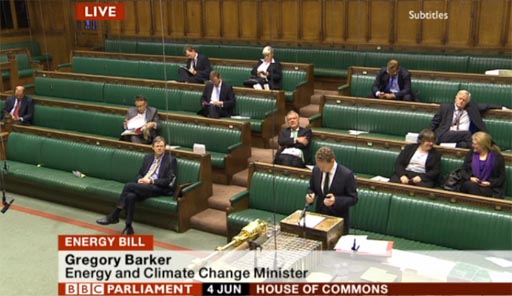 This comprised a central part of Greg Barker's speech to the Commons, delivered shortly after the Yeo amendment was defeated by 290 votes to 267 (spool to about halfway down). The concept was announced under the joint headings of "electricity demand reduction" (EDR) and "route to market", where new amendments were introduced which – "for the very first time in our energy history" said Energy Minister Barker - "would allow energy saving projects to compete for new investment on an equal footing with power stations". "It has long been recognised that in many cases it is cheaper, as well as greener, to save electricity rather than generate it", Barker says, then asserting that successive governments had "failed to grab the opportunity to get units of saved power, or 'negawatts' as they are sometimes called, to compete with traditional megawatts". Thanks to this reforming Energy Bill, he then said, "the era of negawatts has finally arrived". This is to be wrapped up in a "new financial incentive", aimed at "delivering a step change in the efficient use of electricity", which would be achieved by including it in a proposed "capacity market". Quite how this is going to work is not at all clear. The government amendment refers to "demand reduction payments", but leaves the detail to follow in a Statutory Instrument. One has to say that the legacy media is not at all helpful on this, and there is only limited reference in the specialist media. This truly is "under the radar" stuff and the story is being largely missed. Barker tells us that, through this, we will not be building expensive new energy plants unnecessarily where cheaper alternatives for energy efficiency are available. Delivering EDR, we are told, will allow three key objectives to be achieved. The first two are "targeting reductions at more expensive peak times" and "securing value for money because it will set megawatts against potentially cheaper negawatts". The third is "bringing permanent demand reduction projects into line with shorter-term demand-side response measures to enable more effective, joined-up delivery of energy efficiency across the board". If you fully understand that, you are a better man than I, Gungadin, but it can't be only us scratching our heads. The government is planning to test the concepts, via large pilot, or pilots, "to better understand, among other things, the complexity of the issue and the scale of the potential". One learns to be wary of such things, and more so as we discover that the whole idea has been rushed in at the very last moment, without even the opposition being able to see the detail. What seems to have happened, says opposition spokesman Dr Alan Whitehead, is that, when the Energy Bill was first published, no-one had given any thought to "how to go about supporting or rewarding the verifiable and permanent reduction in industry or in domestic supply". Some very furious paddling below the surface over the last few months resulted in the outline of how a scheme would work, which is reflected in the amendments. But even to this day, there is no clarity as to what is really proposed. But then, throughout the debate yesterday, there were never much more than about 20 MPs sitting in the chamber. One constantly hears of how short MPs are of work, so much so that they have been given extra holidays. But when there is a really serious debate, the vast majority are suddenly too busy to attend. Thus, we are really none the wiser about the "negawatts" which the government has in mind for us - and MPs less so. According to Energy Secretary Ed Davey, we will get to see something next July, but until then we will have to put up with the mystery. One thing is probably for certain, though. While the language of energy policy is being rewritten, this - as Booker explains in today's Mail is going to cost us a bag of money. COMMENT THREAD Richard North 05/06/2013 |
EU referendum: sucking the vitality from the debate
Tuesday 4 June 2013
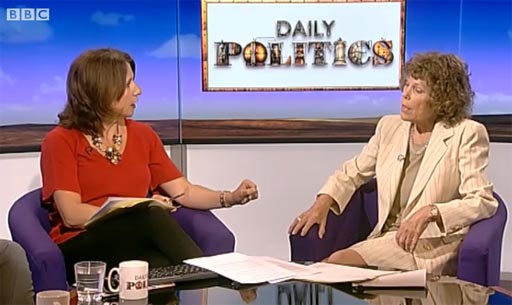 This follows campaign leader John Mills getting stuck in earlier in the day, telling us in somewhat more moderate language that Labour would be "unwise" to rule out a commitment to a public vote. A referendum promise, he says, would be "popular" with voters, a claim backed up by a poll which has 40 percent of Labour voters refusing to support the party at the next election unless it pledges a referendum. Publicly, only 15 Labour MPs support the campaign, but Mills claims there is wider "tacit" backing within the party. Nevertheless, Mr Miliband seems to be taking the view that it is better to stay out of the fray and leave UKIP and the Conservative Party to battle it out. The intervention of Mills, however, isn't particularly helpful as he backs David Cameron's plan for a renegotiation followed by a referendum before then end of 2017, saying it is "not an unreasonable stance at all". With Kate Hoey supporting that stance, we end up with another europlastic group that is ducking the "out" question, by opting for the renegotiation fantasy. This adds to the air of unreality projected recently by Lord Kalms, life president of failing retailer Dixons and one-time bigwig in Business for Sterling. Now a supporter of the Business for Britain, also opting for a national drive to renegotiate the terms of Britain's membership of the EU, this man was allowed recently to write in the Telegraph Media Group Ltd broadsheet that the European Union "is no longer fit for purpose". This same man also tells us that, "like Boris Johnson", he'd "like to see the EU taken back to a trading relationship that promotes rather than inhibits commerce with the rest of the world". This is the classic High Tory fantasy, for which the grandees have convinced themselves that what is now the EU started off as a benign trading organisation and somehow – at a time unspecified - went off the rails. Thus it is that Kalms wants business to "tell the country about why it's imperative that we get a better deal from the EU; for jobs, for growth, for Britain". How exactly this differs from the stance of Damian Green is hard to determine. A leading member of the "one nation" wing of the Conservative party, Green says there is a "hard-headed Conservative case" for Britain's membership of the EU, which needs to be heard. He believes that it is right in the current climate to promise hold a referendum, but goes on to say: "We must all learn lessons. For years pro-Europeans opposed the idea of a referendum. But the strategy of negotiating a new settlement, and then putting that to British people, is clearly the right one for current times". Green hopes and expects that "the outcome of this process will be to renegotiate, reform, and revalidate Britain's place in Europe", happily asserting that, "For those of us sympathetic to the European argument this is an opportunity to make our case, and the prime minister's case, that a properly reformed EU will be hugely to Britain's advantage". Slowly, gradually, the forces of appeasement are coalescing, subverting the "out" campaign not with outright opposition but with the substitution of a woolly, ill-formed "renegotiation" which sucks the vitality from the debate. Europlastics all, whether they claim to be "eurosceptics" or "pro-Europeans", there is not a fag paper between them. COMMENT THREAD Richard North 04/06/2013 |
Wednesday, 5 June 2013


 Posts
Posts

