
Zoonotic TB: the bigger picture
Wednesday 5 June 2013
 Fronted by Mary Creagh, Labour MP for Wakefield and shadow secretary of state of the environment, she opened with the question: "is culling badgers the most effective way to stop the spread of bovine tuberculosis?" This is the classic straw man ply, setting up a false premise in order to knock it down. No one with any sense will actually argue that a cull will stop the spread of what I prefer to call zoonotic TB – the bacterial strain has long adapted to multiple hosts and can no longer be considered a bovine pathogen. To any sensible person, the cull is simply one tool in a complex "toolbox" of measures available to control the disease, which in the UK is largely out of control, spreading geographically and affecting increasing numbers of animals. Thus, it would have been far more appropriate to address the issue of whether, in the context of the disease having established itself in the wild fauna, zoonotic TB in domestic cattle had ever been successfully eliminated without first dealing with the wildlife reservoir. And it is here, as in many other things, we can benefit from taking a broader view of the situation, looking beyond our borders, and seeing what is happing elsewhere. And, if we do, we find that the UK is by no means alone in suffering from the upsurge in zoonotic TB. For instance, in the Bieszczady region in the southeast of Poland, not far from the Ukraine border, there has been a major outbreak in wild bison (below).  Significantly, the local veterinary authorities carried out investigations of other wild animals and, in mid-April discovered infection in wild boars – to which badgers are closely related. As recently as May, tuberculosis had been confirmed in three pigs that had died in the Bieszczady forest, in the same area where previously tuberculosis had been found in bison. This broader view, therefore, underlines the relationship between the disease in ruminants and other fauna, a relationship so well established in veterinary circles that, when Mexico domestic cattle were found to be infected with zoonotic TB, the authorities immediately undertook surveillance of wild ruminants in what was called the "wildlife-livestock interface". White-tailed deer, North American elk and red deer were “harvested” via controlled hunting. The relevance of the "wildlife-livestock interface" is further emphasised by official Italian veterinary advice, which lists the different "risk factors" in production systems, including as a major factor in the spread of TB, "poor surveillance systems and control of bovine tuberculosis in wildlife". Thus, in a major outbreak of zoonotic TB in cattle in Sovona in 2007 – a region which was a long history of TB outbreaks, much emphasis was placed on controlling the wild boar population, which were implicated in the spread of the disease. Wildlife management was thought essential before there could be a return to what was termed "normal care". In Spain, it has long been recognised that high densities of wildlife, mainly Eurasian wild boar and red deer have been able to maintain M. bovis in circulation, even in the absence of domestic livestock, this forming what is technically known as a self-sustaining “maintenance” reservoir. In 2008, a ground-breaking study of Spain's Doñana National Park proved unequivocally the link between infection in the domestic cattle, using genotyping to demonstrate the epidemiological relationship. European wild boar, red deer and the fallow deer were examined for the presence of zoonotic TB. The infection was confirmed in 52 percent of wild boar, 27 percent of red deer and 18 percent of fallow deer. The results obtained confirmed that wildlife species were infected with the M. bovis strains which are more prevalent in cattle, with the official report concluding that introduction of domestic animals into wildlife areas when there no guarantee of freedom of disease and without appropriate diagnostic techniques and control measures represented a risk to cattle health. Researchers suggested that identifying and culling animals with advanced bovine TB could reduce the number of super-shedders and the availability of contagious carrion. This builds on the work from the Office International des Epizooties (OIE), which reports that 22 percent of countries with TB infection have detected bovine tuberculosis in wildlife (deer, elk, wild boar, feral goat, buffalo, possum, ferret, mink, hedgehog, lion, cheetah, kudu, baboon, and seal) in the last 10 years. Where wild species become "maintenance host" for M. bovis, they can be responsible for continuing outbreaks even when infection is eliminated from domestic cattle. The best-known examples of this dynamic are cited by the OIE as the European badger (Meles meles) in the United Kingdom and the Republic of Ireland, the possum (Trichosurus vulpecula) in New Zealand, the white-tailed deer (Odocoileus virginianus) in Michigan, which has served as the presumptive source of infection for cattle herds and carnivores, and the African buffalo (Syncerus caffer) in Africa, which has spread the infection to predators. Thus, when a very recent TB outbreak was observed in Bavarian cattle, investigation of deer and roe deer in the Upper Allgäu were carried out and infection of the dame type was found, with a prevalence of 18.2 percent. As a result, 1,614 red deer have been shot by the deer hunting community. Similarly, recent outbreak in Swiss cattle, in the Cantons of Fribourg, Vaud and Valais – the first cases for 50 years – deer have been examined for potential infection. A reminder of the zoonotic character of the disease, incidentally, comes from the latest outbreak in Germany where, on a farm in the district of Rotenburg, a farmer has succumbed to the disease. In this country, the owner of a flock of alpacas which was found to be infected, is currently being treated for a serious case of the infection, and may need an operation to remove one of her lungs. There has also been a recent outbreak of zoonotic TB in Belgium, which has been free from the disease since 2003 – the disease having been discovered in a slaughterhouse in Holland. Investigations are currently being carried out, but it is significant that the affected cattle are from a beef herd which does not have contact with other cattle. From the UK's perspective, some of the more significant outbreaks have been in France, where the increase is regarded as "worrying" by the authorities. There, we note, in some prefectures, badgers have been associated with the spread of disease and the Ministry of Agriculture is seeking destruction of badger setts when they are classified as harmful. In France, currently, a policy of whole-herd slaughter is practised, but there is also no reticence about culling wildlife. In February 2012, M. bovis infection was detected in wild boar in a game park in Marne department, previously a bovine tuberculosis-free area. In order to prevent spillover, all the game present in the park was slaughtered, including 280 wild boars, where the prevalence of infection was determined at 7.3 percent.  At the end of May this year, after three cases of bovine tuberculosis were diagnosed in less than a year in herds Semide, Contreuve and Sugny, resulting in the slaughter of about 200 cattle, two badgers carrying bovine tuberculosis were found, close to the areas where the cattle infection had occurred. 
The local hunts were involved (pictured above) by the prefecture in the Ardennes, through the formal system of "lieutenants de louveterie" and in the first days of this month, systematic trapping and analysis of badgers was conducted, with 60 badgers taken. Four have been found to be infected.
Control measures are ongoing, and one notes that while the media here lauds a former pop-star guitarist, who believes M. bovis to be a virus rather than a bacterium, Pascal Mailhos, prefect of Burgundy and Côte-d'Or, recently awarded medals to officials actually dealing with TB in the front line, including Jean-Luc Loizon, the local Lieutenant louveterie. This is an interesting reflection of relative national priorities.  But, as he went into bat for the government's plans, no one was more conscious of this "bigger picture" than Secretary of State for the Environment, Owen Paterson. One of the most eurosceptic ministers in the Cabinet, he regularly outflanks his own officials at EU council meetings by being able to speak with his French and German counterparts, whose languages he speaks fluently. And thus, while Mary Creagh flounders around as the perpetual "little Englander", Paterson is in touch with the European and global scene, using data from all over the world to strengthen the case for dealing with the wildlife reservoir over here. Fortunately, the "bigger picture" prevailed and the motion was defeated by a handsome majority. Owen Paterson lives to fight another day. COMMENT THREAD Richard North 05/06/2013 |
EU referendum: an insufficient margin
Wednesday 5 June 2013
 This, the broadcaster claims, would result in an extremely narrow victory for those wanting to leave, although that is an extremely shallow approach to the issue. It fails to take any account of real referendum dynamics or previous poll experience. In addition to the Sky finding, though, we also have a YouGov poll, its results today published byDWN. This has 1,915 British respondents surveyed from 28-29 May, giving 43 percent wanting to leave the EU, as opposed to 35 percent who would stay in.
An earlier YouGov poll, carried out for the Sun, published on 16 May again had 43 percent in favour of leaving, with 37 wanting to stay in. A poll on 12-13 May had a very similar result, producing a majority of 44 percent, against 34 percent wanting to leave.
DWN also brings in the Germans, of whom 30 percent would vote to get out of the EU, whereas 49 percent want to stay in – almost an exact reverse of the UK position. Nevertheless, the German figure represents an increase of five percent in the people wanting to get out. By comparison, in France, 43 percent would stay in, and 34 percent would leave. In the Scandinavian countries (Denmark, Sweden, Finland) there is also a majority in favour of staying in. As always, though, the UK is on its own, as always. And when we looked at the issue on 19 May, we see no great movement. Then, we had an ICM poll giving 46 percent wanting to leave, against 30 percent staying in. And ComRes had 46 percent wanting to leave, against 25 percent staying in. The cumulative experience of polls in the UK, therefore, is not encouraging. The Sky poll, if it was at all representative, would be a disaster. But the best recent result YouGov can offer is in May 2012, which gave us 51 percent in favour of leaving, and 28 percent wanting to stay in. That gave us a margin of 23 points, as opposed to an eight percent margin from YouGov just now, shrinking two point in a matter of weeks. As we have discussed many times, and most recently here, the current margin is nowhere sufficient to give us any certainty of success in a referendum, once the status quo effect kicks in. And the two percent margin reported by Sky would virtually ensure a victory for the "inners". What is puzzling about the current findings, I wrote last month, is the stability of anti-EU sentiment. In broad terms, it has hardly moved in years and seems largely resistant to the ebb and flow of the debate on the EU. If anything, overall support for leaving the EU is shrinking – certainly, if we are to accept the Sky result. By the time the renegotiation meme has confused the picture, the chances of a successful "out" vote are extremely remote. Our opposition cannot be unaware of the progression of the poll figures, and one wonders whether their growing enthusiasm for a referendum reflects the narrow margins produced. It is very easy for the europlastic tendency to support a referendum if the indications are that an "out" campaign will not succeed. For genuine "outers", the prospect of a referendum offers nothing to be optimistic about. Given that there is supposedly strong public sentiment against the EU, we are not getting close to winning the argument. The failure of the legacy media to present the "out" position fairly and honestly must be in part responsible, but the "outers" themselves have failed to present a good enough case for leaving. Arguably, we need to up our game. COMMENT THREAD Richard North 05/06/2013 |
Energy: the era of negawatts
Wednesday 5 June 2013
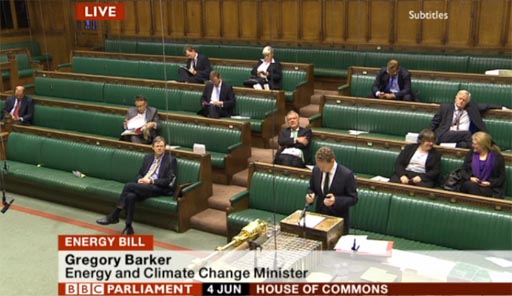 This comprised a central part of Greg Barker's speech to the Commons, delivered shortly after the Yeo amendment was defeated by 290 votes to 267 (spool to about halfway down). The concept was announced under the joint headings of "electricity demand reduction" (EDR) and "route to market", where new amendments were introduced which – "for the very first time in our energy history" said Energy Minister Barker - "would allow energy saving projects to compete for new investment on an equal footing with power stations". "It has long been recognised that in many cases it is cheaper, as well as greener, to save electricity rather than generate it", Barker says, then asserting that successive governments had "failed to grab the opportunity to get units of saved power, or 'negawatts' as they are sometimes called, to compete with traditional megawatts". Thanks to this reforming Energy Bill, he then said, "the era of negawatts has finally arrived". This is to be wrapped up in a "new financial incentive", aimed at "delivering a step change in the efficient use of electricity", which would be achieved by including it in a proposed "capacity market". Quite how this is going to work is not at all clear. The government amendment refers to "demand reduction payments", but leaves the detail to follow in a Statutory Instrument. One has to say that the legacy media is not at all helpful on this, and there is only limited reference in the specialist media. This truly is "under the radar" stuff and the story is being largely missed. Barker tells us that, through this, we will not be building expensive new energy plants unnecessarily where cheaper alternatives for energy efficiency are available. Delivering EDR, we are told, will allow three key objectives to be achieved. The first two are "targeting reductions at more expensive peak times" and "securing value for money because it will set megawatts against potentially cheaper negawatts". The third is "bringing permanent demand reduction projects into line with shorter-term demand-side response measures to enable more effective, joined-up delivery of energy efficiency across the board". If you fully understand that, you are a better man than I, Gungadin, but it can't be only us scratching our heads. The government is planning to test the concepts, via large pilot, or pilots, "to better understand, among other things, the complexity of the issue and the scale of the potential". One learns to be wary of such things, and more so as we discover that the whole idea has been rushed in at the very last moment, without even the opposition being able to see the detail. What seems to have happened, says opposition spokesman Dr Alan Whitehead, is that, when the Energy Bill was first published, no-one had given any thought to "how to go about supporting or rewarding the verifiable and permanent reduction in industry or in domestic supply". Some very furious paddling below the surface over the last few months resulted in the outline of how a scheme would work, which is reflected in the amendments. But even to this day, there is no clarity as to what is really proposed. But then, throughout the debate yesterday, there were never much more than about 20 MPs sitting in the chamber. One constantly hears of how short MPs are of work, so much so that they have been given extra holidays. But when there is a really serious debate, the vast majority are suddenly too busy to attend. Thus, we are really none the wiser about the "negawatts" which the government has in mind for us - and MPs less so. According to Energy Secretary Ed Davey, we will get to see something in writing next July, but until then we will have to put up with the mystery. One thing is probably for certain, though. While the language of energy policy is being rewritten, this - as Booker explains in today's Mail is going to cost us a bag of money. COMMENT THREAD Richard North 05/06/2013 |
Wednesday, 5 June 2013


 Posts
Posts

