
Justice: the scandal of secret courts
Wednesday 24 April 2013
 In fighting for her father, Wanda found herself convicted and sentenced to jail in her absence, and without even the benefit of legal representation – only for the fact of the imprisonment to be kept secret on the order of Judge Martin Cardinal. He would not even allow Wanda to be named. Whatever the rights and wrongs of the case, this is wrong. There is never in what passes for a free society for an individual to be convicted in absentia and then jailed. It is even worse when this is done secretly. Furthermore, this is by no means the only case. Booker, who adds a commentary to this news report, has been trying to place on the record another egregious case where a son is trying to protect his father from the depredations of the social services. Again, judges are imposing gagging orders, using powers they do not appear to have. Thus, the Mail does right to publicise this case, adding to the continuing toll of cases going through the families courts, where unnecessary and unhealthy secrecy is being imposed – for no better reason, it seems, to protect officials from deserved criticism. But while one applauds the Mail, there is also a sense of the fatuity of media campaigns. There was a time when even Booker and this lowly author, writing of some outrage, would receive a ministerial call the day following publication, and things would get done. These days, officials and politicians appear immune to all but the most strident and intensive campaigns – where virtually the whole press corps joins in and goes into hysteria mode until the issue is sorted. And clearly, this can only happen on a very limited number of occasions. As for judges, the arrogance of office is now such that these appointed officials seem to have lost sight of the reason they are appointed – to serve the interest of justice. They are placing themselves above the law, and we are all at risk. Thus, it seems to me, that somehow we need to redress the balance. Further, it is self-evident that we cannot rely on the establishment to respond. Ministers have been approached many times, and have yet to act. It is unlikely that they will act. Having given this a great deal of thought, it seems we are back in Harrogate Agenda territory, for the second time in two consecutive posts. When it comes to our six demands, readers will recall demand four, which states this: 4. no legislation or treaty shall take effect without the direct consent of the majority of the people, by positive vote if so demanded, and that no legislation or treaty shall continue to have effect when that consent is withdrawn by the majority of the people.This, in itself it not a great deal of use to us, but I have been mulling over an amendment, and have come up with this new text:. 4.no legislation or treaty shall take effect without the direct consent of the majority of the people, by positive vote if so demanded, and that no legislation, treaty or decision shall continue to have effect when that consent is withdrawn by the majority of the people.The key difference here is the addition of the word "decision", creating a situation where any official decision can be challenged by way of a referendum – a sort of people's judicial review. In the Maddox case, this power could perhaps have been used in several different ways, but the one that would appeal most (to me) is the power to challenge decision to appoint Martin Cardinal as a judge. In effect, the power gives people to right to fire officials when they go off the rails. In my view, any judge who can go about jailing someone without a hearing, and who sees nothing wrong with keeping his action secret, deserves to be fired. For many reasons, there are many other public officials who deserve to be fired. And the very fact that the people, their paymasters, are able to fire them, would be a powerful tool to keep them in check. All of a sudden, an appearance in the Daily Mail would mean something again. At the very least, it would remind them who their masters were. COMMENT THREAD Richard North 24/04/2013 |
Eurocrash: the Greek destination
Wednesday 24 April 2013
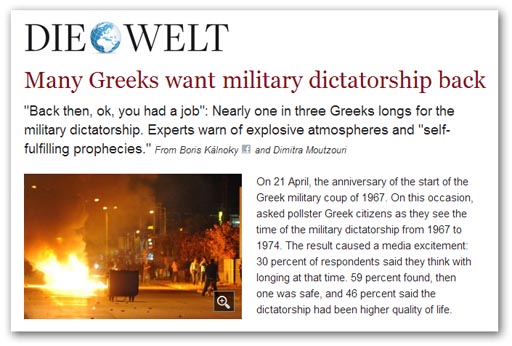 The occasion was the anniversary of the Greek military coup, which started on 21 April 1967 – a mere 46 years ago and thus within the living memory of many. Thirty percent of respondents wanted the Colonels back, 59 percent thought the streets were safer with them, and 46 percent said the dictatorship had provided a higher quality of life. This, of course, was a regime characterised by random arrests, torture and arbitrary justice, yet a significant number of people are prepared to accept that in return for stability, personal safety and prosperity. It goes without saying that. a military dictatorship would be incompatible with EU membership. But, if this survey is presented as a choice between democracy and dictatorship, the retort from one respondent, an unemployed 45-year-old, makes the appropriate point. "We have no democracy anyway", he says. A choice, therefore, between a dysfunction government and one that works – neither of them democracies – is entirely rational, especially as the current crop of politicians are regarded as crooks, as indeed many are. What is sad is that there seems no aspiration to replace the current system with anything which approaches a true democracy. One can only suppose that the word has been so debased, and the concept so tarnished, that few people have any faith in the idea. But what we are actually seeing is the effects of a lack of democracy. For too long, people have tolerated corrupt and incompetent politicians, within the framework of a system that denies people power, and thus bears only a passing resemblance to a democracy. That, in turn, has led to a widescale retreat from politics, where the political class of "professional" politicians have taken over the running of the government, and the people have allowed themselves to be excluded from decision-making. The trouble is, as we have observed before, if you don't take an interest in politics, it will take an interest in you. That, really, is what the Harrogate Agenda is all about. For too long, we have allowed the political classes to define what they mean by democracy, and have accepted what they tell us at its face value. But democracy is actually about people power. One hoped that the Greeks might understand this and start to re-assert their own power. Whether they do or not, though, there is a lesson for us. If we follow on the same path trodden by the Greeks, we now have a very clear view of the eventual destination. And it ain't pretty. COMMENT THREAD Richard North 24/04/2013 |
EU politics: German defence minister gives game away
Wednesday 24 April 2013

An exclusive interview of German defence minister Thomas de Maizière, for the Guardian highlights an apparent inconsistency, as the minister suggests that a UK outside the European Union would "jeopardise military standing".
Ostensibly, this is an absurd assertion, as the UK would continue to participate in joint military ventures through its membership of NATO, the activities of which are increasingly duplicating EU military initiatives. Unwittingly, though, de Maizière is revealing a mindset now prevalent amongst European defence ministers, who are sharing the view offered by this article, effectively conceding that the days of NATO are numbered. With the EU Foreign Affairs council just concluded in Luxembourg, with defence ministers present, one can see the writing on the wall, as ministers grapple with plans to reactivate the battlegroup concept – effectively moribund since 2007 – prior to a major defence council in December, when we expect to see significant developments in the EU's Common Security and Defence Policy. On the other hand, with NATO operations in Afghanistan winding down, the glue that binds the North Atlantic Alliance is melting away. The United States is looking east, with North Korea currently dictating defence priorities, drawing further away from NATO and reducing its European presence. Behind the scenes, what we are also seeing is a gradual insitutional merger between the EU and NATO. So deep is the "strategic partnership" that the European components of NATO are becoming completely integrated with the EU military structures, to the point where they are inseparable. In the fullness of time – and now not very far distant – we will witness a restructuring of NATO, comprising EU elements, the non-EU European elements and the North American elements (US and Canada). But the heart of the NATO will become its 21 EU members, who will be the driving force. It is in that context that de Maizière's comments must be seen. He asserts that, "If Great Britain leaves the EU, it would be a great disappointment to us. It would weaken Nato, it would weaken the British influence within Nato. I think from a military point of view the disadvantages for Great Britain would be bigger than the advantages". De Maizière is effectively saying that full participation in NATO (as it is about to become) will be dependent on membership of the EU, the latter having engineered a reverse takeover. NATO, at a European level, becomes "EUNATO". Increasingly, we can also see the United States channelling its initiatives via the European Union, quite deliberately in an attempt to keep Britain within the EU, with the United Nations also dealing with the EU as the partner of record. All this will be (and is being) designed to convey precisely the impression de Maizière has given theGuardian. This is more that the usual FUD, and represents a structured attempt to undermine UK independence. When it gets to the stage that even military co-operation with the United States is channelled through the EUNATO complex, Britain will no longer have the option of bilateral relations with the US. The UK will be locked in to the EU, whether it likes it or not. However, what de Maizière omits to tell us is that there is provision for actors to take part in EU institutions without being members of the EU. This is typified by Norway being a participant in European Defence Agency initiatives. Thus, the UK outside the EU could still elect to take part in EU defence ventures, on an ad hoc basis, losing nothing by being outside the fold.
But then, you do not expect the "colleagues" to tell the whole story. It would spoil their game and reduce the impact of their message.
COMMENT THREAD Richard North 24/04/2013 |
Wednesday, 24 April 2013


 Posts
Posts

